jump to navigation

The Ash Wednesday Supper May 12, 2012

Posted by Beachcombing in : Medieval, Modern

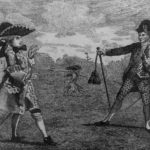
Giordano Bruno (pictured badly) was a sixteenth-century philosopher with a thing about infinity. Giordano also had an infinite capacity to create irritation. Indeed, his travels around Europe have a fascinating pattern of greeting, slighting and sprinting. Typically, GB is obliged to leave his last home in a hurry because of offence caused to the church or/and secular authorities. Giordano then turns up in his new home, is greeted as a major European thinker. Then six months later the pattern reasserts itself and Giordano is running for his life once more.

Among GB’s very many unfortunate habits were those of throwing out images of saints and that of telling anyone who cared to listen that God had created endless inhabited worlds, making Giordano a kind of patron secular saint of the UFO community. This pattern, in any case, finally went up the chimney when 17 February, 1600, Bruno was burnt as a heretic in a Roman piazza. His ashes were then scattered in the Tiber and Giordano Bruno became his ideas: all that survived of him.

Now on the subject of ashes… In 1584 Bruno had one of those legendary dinners – the Ash Wednesday Supper – that, on previous occasions, Beach has referred to as Immortal Meals. Moments when the Olympians of the human race meet over bread and wine. We know about this meal because GB wrote a pseudo-Platonic dialogue based around it that he published in the same year under the title Cena de le Ceneri. It was by any standards, perhaps particularly though by the standards of a razor-sharp Italian bon vivant,  a catastrophic repast.

First GB had been invited to the house of the poet Fulke Greville, an over serious Elizabethan sonnet writer who served both Elizabeth I and James I and who was a great friend of Philip Sydney. GB had been called in to debate philosophy with some Aristotelians down from Oxford for the evening. Bruno, it goes without saying, was a Platonist.

GB probably saw this as an opportunity to educate the ‘mad barbarians’ as he called the English. But the evening turned into a sorry comedy of errors. Bruno misunderstood the time of the meal and this caused confusion with his hosts who came to pick him up but found him out. Then, when they finally met up, he and his hosts crossed the Thames on a boat and ended up lost on the wrong side of the river (don’t do this in London). We cannot be certain how much of this account is ‘allegorical’ (those damn Platonists) and even basic details may have been invented: it is argued that the meal took place, for example, in a house other than Greville’s.

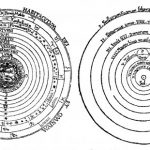
However, we can probably trust the account in terms of its intellectual content. The Oxford scholars made a terrible impression on the Italian. Bruno tried to defend the Copernican system, but he did so against men who, according to his account, barely knew how to argue (sounds like an Oxonian) and who were still trapped in medieval scholasticism.

This was all compounded by the fact that GB (an unquestionably brilliant scholar) had not troubled to learn English and by the fact that the English Professors did not know Italian. The argument (for such it quickly became) raged then in Latin. This must have been a sixteenth-century equivalent of empiricist American professors of fifty years ago, say, being confronted over table by Foucault in a furious conversation in poor Spanish.

Naturally, Bruno came off best and is praised by his host: but then Bruno wrote the account and Bruno always comes out best in those circumstances. A year later, England had chewed him up and spat him out. Then sixteen years later a fire was lit under Giordano’s toes. We’ll end with a detail that has always haunted Beachcombing: before GB was burnt his mouth was taped shut so that he could not spout dangerous sentences to the gathering crowds, something that the professors at that long ago meal would doubtless have approved of.

Beach is always looking out for remarkable meals: drbeachcombing AT yahoo DOT com

Flying to the Moon on Geese December 5, 2011

Posted by Beachcombing in : Modern

Beach has heard rumours over the years of Domingo Gonsales’ strange voyage to the moon in the early seventeenth century [1620s], carried thither by a flock of enormous geese. But it was only this morning that he finally settled down to read DG’s adventures: perhaps inspired by the equally fantastic Zambian moon programme. For those who don’t have time to read through the whole thing, here is an eighteenth-century summary that gives some sense of just how unusual Domingo’s trip was.

An Account of the island of St. Hellena; the Place where he resided some Years in, and where he planned this Wonderful Voyage; his entering on Board one of the Homeward-bound East-India Ships for Spain; their running on the Rocks near the Pike of Teneriff to avoid an English Squadron of Ships, that were in Pursuit of the Spanish Fleet ; Gonsales had just Time to fix his Machine, which carried him in Safety to the Pike of Teneriff, having rested his Ganzas on the Mountain, whence was pursued by the Savages when giving the Signal to his Birds, they arose in the Air with him for their Journey to the Moon : The wonderful Apparitions and Devils he met with in his Progress ; their Temptations to him, which he avoided, and their supplying him with choice Provisions ; his leaving this Hellish Crew, and proceeding on his Voyage to the Moon; his safe Arrival there; the Manners, Customs, and Language of the Emperors, Kings, Princes and People: His short Stay there, to the great Grief of the Lunars; the inestimable Presents in Jewels the Author received at his Departure ;his repairing to our Earthly Globe again, and was set down in China by his Birds; his being taken for a Magician by the Country People, and preserved from their Fury by a Chinese Mandarin; his going aboard an India Ship bound to Europe, his safe Arrival in his own Country, where he made his Discoveries to the King of Spain, who held several Cabinet Councils to deliberate on a proper Use to be made of these Discoveries. With a Description of the Pike of Teneriff, as travelled up by some English Merchants.

There is, it seems, a rather sterile debate about whether this is ‘proto science-fiction’ or utopian literature. What is striking is that there are many spirited references to contemporary astronomy and particularly to Copernicus. This despite the fact that the author was Francis Godwin (obit 1633), then Bishop of Hereford! However, don’t despair Anglicans, once on the moon DG discovers the Lunars, a Christian race hiding out among the woods.

Any other early examples of proto-science fiction from 1500-1800? drbeachcombing AT yahoo DOT com

***

11/12/12: TF writes in: ‘Not quite in the same league, but there are fly powered model airplanes in
the Smithsonian Air&Space collection.  And in 1887, the US patent office issued patent 363,037, ‘Means and Apparatus for Propelling and Guiding Balloons’, where the means were ‘one or more eagles, vultures, condors, &c” restrained in a harness. The applicant states at the end “I do not claim a device for holding birds that are to carry and hold suspended a car or other aerial vehicle. Birds have not the power to do this for any reasonable length of time.’ Which I find an amusing bit of lucidity in an otherwise fanciful document.’  Thanks TF!!!

Boethius’s Astronomy: Did it Exist? October 4, 2011

Posted by Beachcombing in : Medieval

Beach has always had a thing about Boethius (obit 525). Boethius penned the great Consolation of Philosophy, a strangely affecting study of human priorities, while waiting for his execution. Boethius hovers between Neo-Platonism and Christianity: he is, in some senses, the missing link between the two religions. Then Boethius also  wrote books that do not survive: always a strong recommendation, and among these is his Astronomy.

The proof that the Astronomy once existed are four fold.

First, in a letter, Cassiodorus – the most difficult Latin writer ever born? – claims that thanks to Boethius the west can read (i.e. has seen translated from the Greek): inter alia Euclid’s Geomoetry and Ptolemy’s Astronomy.

Second, there are several medieval catalogues that refer to works on astronomy associated with Boethius.

Third, there are some very doubtful references to Boethius’s Astronomy in two letters of the early medieval writer Gerbert.

Fourth, Boethius in his Arithmetic states that he intended to write an Astronomy.

Boethius’ Astronomy is one of these works that might have made a difference. It would, in fact, have given us (and the Middle Ages) a straightforward guide to classical thinking on the heavens without having to surrender the field to Firmicus and other dunces. But, as the careful reader will have noted, the ‘proofs’ above are about as weighty as dead leaves. Indeed, as the great Jim Tester noted (123) the Astronomy‘s existence is ‘an unanswerable question, with the balance in favour of the Noes rather than the Ayes’.

After all, Cassiodorus, in the reference cited before, seems to have been speaking generally of the communication of knowledge from Greek to Latin, something that Boethius did in all his works and that characterised his opus. Medieval catalogues err (constantly) particularly about authors. Gerbert is, as Beachcombing noted, ‘doubtful’. And Boethius promised many things that he did not achieve: he was an ambitious man whose life was cut horribly short. He was likely hacked to death with a sword on his master’s orders after a prolonged imprisonment.

What seems at first a case then of a burning library book might in the end be nothing more than an entry in an invisible library: a ghost summoned up by greedy medievalists and star-mad monks.  Still in the last fifty years unexpected plums have been fished out of monastic libraries. Perhaps, in the near future, a scholar will be leafing through a manuscript from Verona when… We can but hope.

Any other now-you-see-it, now-you-don’t books? drbeachcombing AT yahoo DOT com

Updated BH News Stories (with thanks to readers)

Joy Riding on the Moon October 3, 2011

Posted by Beachcombing in : Contemporary

***This post is dedicated to Larry who pretty much wrote the whole thing himself***

Autumn flu continues, but Larry K came to the rescue this morning saving Beachcombing from having to think too hard or even, if truth be told, from dragging himself out of bed. Beach can do no better than quote from Larry’s email:

In August I met a semi-retired geologist who told me about a major geology meeting he attended in Washington, D.C. in 1989. One of the speakers was Harrison Schmitt, the first and so far only professional geologist to ever walk on the Moon courtesy of the Apollo 17 mission in December of 1972. This geologist relayed to me that Schmitt said on one of the Apollo missions which carried the rover (so this had to be only Apollo 15, 16, or 17), the astronauts decided to test the lunar 'hot rod' with some unscheduled (and definitely unauthorized) stunts. They drove the rover up a nearby hill (all three final Apollo missions took place in the lunar highlands), then sped down the hill at top speed just to see how fast it could go. When they reached the bottom the astronauts apparently hit a rock and went flying into the (virtually non-existent) air. They flew 30 feet in altitude and 300 feet down range, thanks to the much-reduced gravity of the world they were exploring. The lower gravity also kept them from crashing when they and the rover finally touched down. For obvious reasons the astronauts in question did not report their actions to Mission Control and apparently (again) only a few selected folks knew about this event - until now.

Larry underlined that he trusts his source:

'The person who told me this seemed honest and if he wanted to pull one over on me, well he got me, end of story. He also told me he wasn't joking about the story, plus he is a semi-retired geologist. In all seriousness, I do not doubt that he heard this story where and who he said it came from. Apparently it was also told to a whole room of geologists in 1989. I wondered why such a story had not been widely dispersed by now? While I do not claim to know every little detail of space history, I do like to think I know more than just the usual stories and I certainly do love these kind. And the ones I have heard leave little doubt that some of those guys would have tried such a thing.'

Memories of NASA and a ham sandwich...

There is then the question of which of the three rovers carrying missions this could possibly have been.  Larry has done all the spade work here too.

Apollo 15 [1971] - The rover was first carried on this mission and it was undoubtedly exciting to be able to get around the lunar surface as much as it allowed. Seeing just how fast they could go would be part of this excitement. They had plenty of good hills/mountains about them, all fresh (undriven upon). Plus these are the guys who took first day covers with them illegally and got in big trouble after that, never allowed to fly in space via NASA again. With such a heinous criminal activity already part of the mission, stunt driving would not be  far behind.

Apollo 16 [1972] - Duke and Young, the first two Good Ol’ Boys to land on the Moon. Add a vehicle with four wheels, plenty of sloping terrain, and nobody else besides Mattingly in orbit for 240,000 miles around and you get a Dukes of Hazard situation well in hand. I bet they even put a Confederate Battle Flag on the rear of the rover.

Apollo 17 [1972]- The last manned mission to the Moon in the series. Note that Harrison the story teller was on that flight. They also had a broken wheel bumper which they fixed with a laminated map. I cannot say that I recall how they broke it, but I bet a wheel slamming violently upward after, say, a forceful impact with the regolith after, say, a levitated incident with the rover might do it.

Beach has corresponded with Larry before and trusts him and trusts Larry’s judgement. But he is suspicious about some of the details. As Larry writes ‘the rover had a video camera aboard and the astronauts carried cameras strapped to their chest as well’. If the astronauts had done as described would they have really got away with it? Perhaps what we are hearing here is an exaggerated tale about a wheelie on the moon? In any case it is a very enjoyable story: Beach is hoping it is as advertised.  Anyone able to fill in any gaps here? drbeachcombing AT yahoo DOT com

Thanks again Larry, easiest post that B has ever 'written'! Now back to the vegetable broth and the comic books.

***

3 Oct 2011: Invisible sends in this modern piece of publicity - have rumours of joy riding on the moon got out there prior to this post... Thanks Invisible!

4 Oct 2011: Some very amusing emails on this – the general drift of which is that the astronauts they chose were crazy and capable of anything. However, sticking to the more factual communications… Ricardo writes in: ‘Your post reminded me a description of one of the joy rides of the astronauts aboard the rover so I don't think it's a "secret" thing but maybe a nice way of telling the story. I'm looking out for the documentary where I saw it but meanwhile went to wiki and, for Apollo 16, ‘The astronauts also conducted performance tests with the lunar rover, Young at one time getting up to a top speed of 11 miles per hour (18 kilometers per hour), which still stands as the record speed for any wheeled vehicle on the Moon.’ The ride has been described has a cross country test somewhere else so... I also doubt they would manage to hide it from everyone... albeit the 3rd mission of skylab left 3 dummies in place, waiting for the 4th and last mission... who found an "occupied" station on arrival. The trivia on space missions is truly interesting :)’ Nancy from over at Universe Today is also skeptical: ‘I've not heard this story before, and I have doubts about it. The astronauts were fairly well monitored during their spacewalks, and in constant communication with mission control, so if they did something like this, it would be pretty surprising – not only because they did something not in the original missions plan (and I have heard the astronauts say there was so much to do during their spacewalks on the Moon and not all that much time to do it in – especially Apollo 15 and 16), but also because no one has leaked anything like this before. If you can verify this story, it would likely be a pretty substantial coup!  (and I'd like to hear about it!)’ Also Invisible has another shot at this, and it’s a good one: One more thing about the moon joy-ride... There are, of course, NASA sites showing the surface of the moon. For example, this one: http://www.nasa.gov/mission_pages/LRO/news/apollo-sites.html Surely, if this story was true, there would be tracks where no tracks ought to be? Unless, in its usual conspiratorial way, the Government is supressing the Truth.... (I will let wiser, more scientific eyes take a look because I have no idea what I am looking at!)’ Thanks to Nancy, Ricardo and Invisible!

5 Oct 2011: Moonman wrote a couple of emails (spliced together here) in just before I put the last lot of posts up: 'Actually, there is a good way to PROVE this story's truth.  We can now SEE the tracks of the rover.  I think 3D models have also been generated with stereo imagery of these Apollo sites, I will look it up.  Since they likely did not "cover their tracks" Indian style, the whole story should be obviously read in the images. The idea of the video capturing the event is unlikely since I think they had to reposition the video camera antenna to get a link to Earth during broadcasting and this occurred during stops.  Also, the camera they were carrying were still camera and unlikely to be used in transit. Also, find the astronauts with the dustiest uniforms after the rover driving and before lunar liftoff.  They took a lot of pictures throughout each mission and Sherlock Holmes (or even Dr. Watson) would find it elementary to observe since lunar dust sticks like the dickens to everything... especially astronauts. In fact there is a story of one astronaut falling but who had trouble getting up... I will see if I can find the video... I also remember the picture of their landing site and it showed one of the landing legs on the edge of a deep small crater, suitable of tipping it over!  This was a good example of how many landing  legs you need and landing precision.  I will see if I can find that image link somewhere too. The LRO images that were most recently taken of the Apollo 17 site which really show the rover tracks well are not publicly available in their entirety for a few months. This is the best they are offering: tracks 1 and tracks 2. Maybe some of the prior LRO images have good enough Sun angles to resolve the rover tracks.  Will have to check (as I am sure others already are). Also, they did have a special camera to film movie sequences on the rover, but those were on briefly (Apollo 15 rover movie film covered 5 minutes of travel in the rover).  So, don't count on the stunt being covered.  Anyway, the Apollo 15 rover had a "speed test" which was covered in video/film and was legit. Of course, audio coverage was continuous so I wonder how such an event could have been unnoticed by mission control. I reread your article and now realize they AND the rover fly through the "air".  I had been thinking the astronauts flew after the rover hit the rock.  Thus my proposed dust assessment on the suits would likely not be useful. I found the astronaut falling video clip... Here it seems like he just fell on his side and likely to his knees first...  They had trouble picking up the dropped camera because they could not bend in the spacesuit. They need a shovel like tool to pick it up. It demonstrates the hazard of falling on the lunar surface in a suit. From Apollo 15 and the film.  JBC (through Larry) 'Not saying it didn't happen. But Apollo EVA times and progress were tightly controlled and monitored in real time with continuous downlink. On Apollo 16 John Young did an authorized off-road test of the LRV which was filmed by Charlie Duke. Al Shepard's golf swings were on live TV. Closest thing I recall hearing about an off-the-record activity during a surface EVA was when Conrad and Bean were vigorously digging through their sample bag on Apollo 12 looking for the camera timer while they claimed to be resting. (Hence their extremely dirty suits.) Plus who measured their height and distance? Maybe new LRO images can find LRV tracks with a 100-meter gap?  That would confirm and identify the time, place and driver. This sounds like one of those stories so good that if it isn't true, it should be.' Thanks Moonman and JBC (and Larry)

6 Oct 2011: Moonman has been rethinking some of his earlier conclusions. He wonders whether audio really was continuous. And then the question of the tracks. 'If the astronauts drove up the hill and then drove "precisely" down the same track at breakneck speed then perhaps the jump could be missed. ... Of course, they hit a rock so that likely was not on the path uphill. You should see where they landed though if they went splat.' Then Ricardo 'Both the off-road test and astronaut falling are on this you tube link. I'm still trying to find the documentary I saw. I think (but memory is tricky, as you know) it has a better description of this joy ride and I think it's easy that this off road has transformed itself in that wild story. Of course we can all do as those lines in the end of John Ford ‘Who shot Liberty Valence’... ‘when legend becomes fact, print the fact, not the legend’ Thanks yet again Moonman and Ricardo!

10 Oct 2011: Ricardo writes 'Hope this will be of help to the fire. Apollo 15 journal with audio and video and transcripts of the audio and comments from the astronauts obtained in interviews.  Apollo 16 and Apollo 17. There was no Apollo 18 but someone did a film about it, considered by some the Blairwitch of space...'  Then finally Larry posted the Lunar Rover article on David S. F. Portree's Facebook page version of his Beyond Apollo space history blog.  This is David's response  'There are all kinds of reasons to believe that this never happened, or that it is a gross exaggeration. Perhaps Schmitt told a story and the numbers became inflated over time, or maybe it was told as a "could have happened" story that was m...isinterpreted as a "did happen." I believe that this story hasn't been told widely because most people would realize that it's not possible. It would not be surprising to hear that the LRV left the ground and flew 20 feet or 30 feet. In fact, that certainly did happen on multiple occasions. But 300? At an altitude of 20 feet? Schmitt would not have made it back to Earth to tell the tale. Regarding fenders: the LRVs had to fold up to fit onto the LM. The fenders included extensions that unfolded during deployment. They appear to have been poorly designed. Apollo 16 lost one before its last EVA. Apollo 17 lost one ahead of its first EVA. Because the 16 astronauts had been showered with dust, they advised that a repair effort be made for 17, hence the map fender. The Apollo 16 "grand prix" was not a joyride, it was part of the planned roster of surface activities. Young drove alone while Duke captured it on film. The purpose was to study LRV dynamics. Young was cautious during the drive, even hesitating to "turn sharp" when Duke asked him to The LRV could not return TV unless parked. The dish antenna was for TV. It had to be pointed at Earth manually by the astronauts.’ To which Larry replies:  'David, you present to me a detailed series of cold, sober facts. What I was really hoping for was the image of the Lunar Rover flying against the blackness, the powdery regolith spraying from its wheels in all directions, while the two astronauts gave a hearty YEEEHAAA! to the sound of rapidly-played banjo music and a folksy narrator proclaiming "Well, it looks like those Apollo boys are in a heap of trouble with Boss NASA this time!" Then the LR hits the regolith with a bounce but nary a dent and turns 180 degrees to a spectacular halt, with a final spray of lunar surface arcing across the landscape.’ Thanks Ricardo, Larry and David. It was good while it lasted...

Meteor Destroys Pub September 25, 2011

Posted by Beachcombing in : Modern

Several months ago Beachcombing became interested in incidents of meteors intervening in history or, at the very least, scaring the eeby jeebies out of humankind. He was particularly interested in the way that the perception of meteors changed in the late eighteenth and early nineteenth century. This text comes from the key period when scientists were rapidly altering their patterns of belief and coming to accept that a rock could fall from the sky. It is also unusual because it is an example of a meteor doing serious damage to a property, though it didn’t – the grail of meteor bizarrists – actually hit a family member.

Note the way that the meteor is a Biblical ‘ball of fire’ and yet the stone is described and analysed in a scientific fashion. If this had happened fifty years before Beachcombing’s guess is that the morals of Mr John Hubbard or better still his wife would have been called into question by the local press.

‘Whoring Publican’s Wife Judged by Fire from the Heavens…’

You get the idea.

(Wonderful 272) On 4 July 1803, a ball of fire struck the White Bull public house, kept by John Hubbard, at East Norton [UK]. The chimney was thrown down by it , the roof in part torn off, the window shattered to atoms, and the dairy, pantry etc converted into a heap of rubbish. It appeared like a luminous ball of  considerable magnitude ; and on coming into contact with: the house, exploded with a great noise and a very oppressive sulphurous smell. Some fragments of this ball were found near the spot, and have been subject to chemical analysis by a gentleman in that neighbourhood, who has found them to consist of nearly one half silicious clay, 35 parts of oxidated iron, 12 of magnesia, and a small portion of nickel, with some sulphur. The surface of these stones is of a dark colour, and varnished as if in a state of fusion, and bearing numerous globules of a whitish metal, combining sulphur and nickel. From some indentures on the surface, it appears probable, that the ball was soft when it descended, and it was obviously in a state of fusion, as the grass is burnt up where the fragments fell. Its motion while in the air was very rapid, and apparently parallel to the horizon. This ball appears to agree in most respects with those which have fallen in Portugal, Alsace, Yorkshire, Sienna, Bencres, Bohemia, France,etc; and which have for some time engaged the attention of philosophers in all countries. [Note that a slightly different version of this can be found on East Norton history site.]

Any other obscure meteor falls? drbeachcombing AT yahoo DOT com

***

26 Sept 2011: Invisible immediately trumps the original post with this impressive list. Can anyone add to it? ‘Where to start? I have a couple dozen meteor fall/strike stories in my files, having been fascinated by the subject since being shown a rough stone in an Ohio cemetery, claimed to be the meteor that killed the man buried beneath.  Here is an alarming site about the damage that can be caused by things falling from the sky, with some historic examples. The 1880s newspapers are particularly full of meteor reports as well as spoofs. Starting even earlier (from the 1870s onward) several men were claimed to have been killed by meteors: David Misenthaler (several variants on his last name like Melsenthaler and many different locations given), also Leonidas Grover and Roman Cruz, a Mexican sheep-herder, Julius Rabb/Robb and “M. Garcia” and family. The New York Times archives are especially rich in meteor tales, some told as spoofs and some more plausible. A gentleman in London is hit by a meteor.  A Cleveland , Ohio man’s smoke disturbed by an aerolite (Perhaps Prof. Morley was included to add verisimilitude to a spoof, but he was the very real chemistry professor Edward Morley of the Michelson-Morley experiments on the speed of light and Adelbert College eventually became Case Western University.)  And this amusing article about Meteoric Lotteries.  Then there is this 1890s account of a ship being struck. When I read the name of the schooner, I thought this must be a hoax to drum up business for Barnum’s Museum. It may still be, but the schooner was reported to have been built in 1890 with Mr. Barnum as principal owner; the ship bore a figurehead of the great showman. Barnum died in 1891. And there really was a Captain Blake. I can’t find any record (in an admittedly quick search) that any meteors were ever on display at his museums, nor a follow-up article about the “bushel-sized” fragments. The New York Times 11-20-1894 TOPMAST WAS TRUCK BY A METEOR A Connecticut Skipper’s Story of an Incident in Squad Inlet. Bridgeport , Conn. , Nov. 19 Capt. Blake of the schooner P.T. Barnum, hailing from this port, has returned from a trip to Philadelphia with a story about the vessel being struck by a meteor. The schooner was plowing along under good sail and wind in Squad Inlet, when suddenly the decks of the vessel were illuminated as bright as day, and the crew were thrown to the deck, stunned. The topmast had been struck by a meteor and flames were thrown in every direction. Harry Neilson, one of the crew, was aloft taking in sail at the time. He says he heard the hissing sound preceding the contact with the ropes. The rigging where the meteor struck was instantly set afire and though Neilson made all haste to reach the deck, before he could do so he was badly burned about the legs. The sailor had a narrow escape. If he had been a little lower in the rigging he would have been hit. When the meteor struck, it broke and fell to the deck in pieces as large as bushel baskets. The crew were panic-stricken for a time, but order was secured, and the flames put out. The only damage done was to the rigging, and the vessel continued on her voyage. Capt. Blake says that in all his seafaring experience he never heard of such a thing before. This meteor-fire tragedy was reported in several papers: The Ogden Standard-Examiner 12-23-1928 Ogden , Utah Woman, Babe Killed by Meteor Blaze Greendale , N.Y. , Dec. 22 (UP) Residents of Greendale reported today that a meteor fell from the sky last night and set fire to a farm house, burning a woman and year-old baby to death and injuring six others painfully. Scientists say such a thing happens once in 500 years. J.R. Hicks, storekeeper, related today that he stood in front of his store and saw a ball of fire shooting from the sky. It landed on the roof of William Peator’s house, he said. Mrs. William Peator, 43, and Raymond Ford, Jr., her on-year-old nephew, were killed. Others in the house, Minnie and Doris Peator, 5-year-old twins; Ruth Peator, 16 and Mrs. Raymond Ford, 28, were painfully burned. Two tales of animals reported killed by “meteors.” Bakersfield Californian December 11, 1915 Three Dogs Killed By Meteor in Alaska Dawson, Y.T. Dec. 14 Three dogs which were drawing Andrew Johnson, a telegraph lineman, were killed by a giant metear [sic] which fell on the Yukon telegraph line, south of Atlin, according to word reaching here yesterday. Johnson, who was traveling 50 feet behind the animals, was stunned for several hours as a result of the impact. The meteorite made a hole almost 50 feet in diameter. The [sic] earth all about appeared subjected to intense heat. Sterling, IL Standard July 29, 1887 Was the Horse Killed by a Meteor? From the Galveston Daily News: Last night about 9:30 o’clock as Mr. Cain, who lives about four miles east of here, was going home in his wagon, and about 600 yards from his house, something like a meteor struck one of his horses. It struck the horse on the right side of the ribs, making a hole the size of a hen’s egg, and breaking some ribs loose from the spine, going forward up the spine till nearly the head. Mr. Cain says at the report he fell or dropped in the wagon bed and the horses ran home. The horse was taken out of the wagon before he died. Parties cried for more [illegible] thinking someone had tried to waylaid [sic] Cain and shot the horse, but upon close inspection of the ground no sign of any one being secreted could be found. The horse was dissected, and no lead or anything that would go to show the horse was shot could be found. Two parties say they saw the meteor, and say it made quite a display of colors, and they heard the explosion. A French scientist suggests meteors can be deadly in a number of ways: Florence Morning News, 12-15-1929 Florence , South Carolina Meteors Cause Plane Crashes is French Idea Paris, Dec. 14 (AP) Meteors may be to blame for mysterious airplane accidents, strange explosions, forest fires and even bad weather, a noted French authority, General Frederic Chapel, retired, has affirmed in a special interview with The Associated Press. He is the author of several works on meteors and astronomy and evolved his theory from investigation of many queer occurrences. Red-hot meteors, or “falling stars,” he thinks probably set up electrical disturbances as they sizzle through space. To illustrate their power he has calculated that a little two-ounce meteor, the size of a hazel nut, would travel thirty miles a second when approaching earth and have the force of a 500-ton train. Meteors, says the general, are so numerous that they often form “bombardments.” Most of them go into space or hit other planets but on earth enough arrive to cause accidents such as that at Budapest recently when a Hungarian girl was killed by a meteor on her way to a wedding. [have not tracked down this reference.] In such fashion, the general reasons, airplanes may have been struck down or ships destroyed. He suggests also that meteors might explain many other phenomena such as the recent explosion at Toul of an army magazine when fifty tons of powder blew up without any apparent cause. [nor this.] Note the late date for this lethal shower: Lowell [MA] Sun 8-16-1951 p. 19 12 Killed by Meteor “Shower” Tehran, Iran, Aug .16 (UP) A “downpour” of meteorites killed 12 persons, injury 19 and flattened 62 buildings near the south Iranian city of Shiraz last Monday, Terhan [sic] newspapers reported today. About 300 cows, sheep and donkeys also were reported to have been killed in the meteoric shower. And lastly, (meteors no respecter of persons) La Nona Ora by Cattelan‘ Thanks Invisible!

28 Oct 2011: Now it is the legendary Ed Murphy’s turn. ‘Re: your item on meteorites striking buildings, one such just happened here recently.  It was in Lorton, Virginia, a few miles from Washington DC and my home in Arlington. A small meteorite plunged through the roof of an office building and landed in the suite of some doctors (fortunately harming no one).  The docs donated the rock to the Smithsonian Institution.  But then the owner of the office building claimed that the object belonged to him, not the MDs, since they were only renters, and he claimed that as property owner he had the mineral rights.  This left the Smithsonian in the embarrassing middle, and the last I heard, all 3 parties were still trying to work things out.   Also, here’s a link on the Meteorite that killed a dog.’ Thanks Ed!


Converting Martians May 31, 2011

Posted by Beachcombing in : Contemporary, Medieval, Modern

***This post is dedicated to Ypres Soup***

When scientists speculate today about whether intelligent life exists on other worlds the  questions that come up reflect typical modern preconceptions: Will they like us? Will they dress like us? Will they eat us? Etc etc. And these questions have changed little since the late nineteenth century when Wells described the Martian death ray. However, previous to the mid nineteenth-century speculations about alien life – and there was from 1100-1800 a surprising amount – led to quite different concerns: particularly over the denomination of aliens. After all, Christianity is all about saving souls and as soon as you establish that there are other beings in other worlds – be they Darth Vader or Yoda – then this begs the question of whether they are worth saving. There is a parallel here over some of the early sixteenth-century inquiries about the ‘humanity’ of native American Calibans and the Christian responsibility of settlers towards them.

Thinking of Renaissance theology and aliens there is a passage in William Vorilong (obit 1464): ‘Now doubt arrives. By what means are we able to have knowledge of [another world]. I answer by angelic revelation or by divine means. If it be inquired whether men exist on that world, and whether they have sinned as Adam sinned, I answer no, for they would not exist in sin and did not spring from Adam. But it is shown that they would exist from the virtue of God, transported into that world as Enoch and Elias in this earthly paradise. As to the question whether Christ by dying on this earth could redeem the inhabitants of another world, I answer that he is able to do this even if the worlds were infinite, but it would not be fitting for Him, to go into another world that he must die again.’

Let’s hope Vorilong was right. Beachcombing has a sudden vision of Christ having to lug his cross up to a hill on Alpha Centaurai. ‘Just another two hundred thousand habitable worlds to go…’ he mutters despondently through his crown of off-world thorns.

But as astronomy became a well established discipline and astronomers were able to stare for hours at tiny details on planets in this solar system then it was no longer enough to write off, say, Venetians as a species of angel. Interestingly when the great New York moon hoax of 1835 broke one earnest preacher in the metropolis told his congregation that soon they would be having to prepare Bibles for the Lunarians. Now that would have been a book worth reading!

Nor has this concern for the spiritual welfare of aliens entirely died out. Ypres Soup sends in a 2009 article from the Daily Telegraph describing the Vatican’s concern for our brothers and sisters elsewhere in the Galaxy. Beachcombing has got to go off and bore a class now on Roman walls (of all things), but he has time to squeeze in some choice quotes. ‘[the Vatican astronomer] asked if he would baptise an alien, he replied ‘Only if they asked’… And Beach’s favourite  ‘Any entity – no matter how many tentacles it has has a soul’

Tell that to the mouse under Beachcombing’s desk: is this even good theology?

Beachcombing would be fascinated to hear of any other collisions of belief – Christian and otherwise – and speculation over alien life. drbeachcombing AT yahoo DOT com

***

31 May 2011: Invisible writes in with this reference from Wikipedia to Ray Bradbury’s The Fire Balloons. ‘A missionary expedition of Episcopal priests from the United States anticipates sins unknown to them on Mars. Instead, they meet ethereal creatures glowing as blue flames in crystal spheres, who have left behind the material world, and thus have escaped sin. This story appeared only in The Silver Locusts, the British edition of The Martian Chronicles. One of the priests, instead of putting up a crucifix, creates a glass sphere with a glowing gas inside so the creatures will feel that they are created in ‘God’s’ image.’ Thanks Invisible!!!

William Herschel and Trees on the Moon May 23, 2011

Posted by Beachcombing in : Modern

Born in Hanover,  but living in Britain for most of his adult life, William Herschel (obit 1822) was a celebrated astronomer in the century after Newton. WH has crossed Beachcombing’s radar not just because of his great achievements – discovery of Uranus etc – but because of some of his more curious speculations. For centuries, scholars, thinkers and theologians had wondered aloud whether there were not other worlds and even other inhabitants on other worlds: Beachcombing has looked at some of this waffle in previous posts. But Herschel claimed – and he was perhaps the first to do so? – to have spied life through a telescope: Herschel it should be noted was not just a brilliant astronomer but also a brilliant telescope builder.

This evening I tried a new ten foot reflector on the Moon with a power of 240. The moment I saw the Moon I was struck with the appearance of something that I had never observed before, which I ascribed to the power and distinctness of my instrument, but which may perhaps be an optical fallacy. But in the first place I will argue and describe the phenomena, as if those appearances I saw had been founded upon reality. I believed to perceive some thing which I immediately took to be growing substances, I will not call them trees as from their size they can hardly come under that denomination, or if I do, it must be understood in that extended signification so as to take in any size how great soever. The Moon was gibbous, being 12 days old, also in and near the meridian; and the air very fine. My attention was chiefly directed to Mare humorum, and this I now believe to be a forest, the word being also taken in its proper extended significance as consisting of such large growing substances.

WH sketches a brief figure in his notebook here and describes it as a ‘wood which goes up to Mount Gassendus. The different Colours of the plain ground, of the rocks and of the shadown cast by high places are easily to be distinguished on the Moon. It has hitherto been supposed that those seas as they are called consisted of a different kind of soil, which reflected light less copiously than the hills and mountains.’

One can sense, as in much of his work, Herschel’s excitement here. This was, after all, the man whose enthusiasm was such that his sister Caroline claimed he only ever slept when there was cloudcover or overbright moonlight. Herschel rounds off by modestly noting that his findings need to be confirmed and then reflects on these trees’ likely size. ‘Our tallest trees would vanish at that distance. It is not impossible but that the vegetable creation (and indeed the animal too) may be of a much larger size on the Moon than it is here, tho perhaps not very likely. And I suppose that the borders of the forest, to be visible, would require trees at least 4, 5 or 6 times the height of ours. But the thought of forests, or lawn or pastures still remains exceedingly probable with me, as that will much better account for the different colours, than different colour’d soils can do’.

Interestingly, the cautious Herschel never published these findings, though he did later scribble in his notebooks about the existence of pyramids and even cities on the moon. Again to the best of Beachcombing’s knowledge Herschel is one of the first modern astronomers to have claimed – however privately – to have seen life through a lens: drbeachcombing AT yahoo DOT com A rather less melodramatic version of previous Beachcombing posts on vegetation on Mars, Lowell’s canals, the New York bat men and Fort’s claims for synchronized swimming on the moon. Herschel’s public utterances were limited to ideas about what life might be like on other planets in our solar system – and the sun! – an interesting if quite different thing.

Total Eclipse February 12, 2011

Posted by Beachcombing in : Ancient, Contemporary, Modern

A reader – Moonman to friends – has written in to remind Beachcombing of the old ‘cover thy face’ trick whereby ‘the civilised’ with knowledge of an eclipse, show their power over the elements by ‘ordering’ the sun to disappear in the presence of the unenlightened. Beachcombing knows this trick from Hergé’s Prisoners of the Sun where Tintin saves his own life and, rara avis, those of his friends, by using his knowledge of total eclipse of the sun against the Incas of Peru. Hergé incidentally always regretted this plot device because he came to feel, perhaps reasonably, that the sun-obsessed Incas would have known all about such games.

Moonman points Beachcombing in the direction too of Mark Twain in the Connecticut Yankee at King Arthur’s Court playing a similar trick. Did Hergé steal from MT? And if so who did Twain steal from because this cannot have been MT’s idea? (It just isn’t in character) Then far more importantly, to the sound of bugles, the key question: has this trick ever been carried out in the real world?

One example that always made Beachcombing wonder is Herodotus’ reference to Thales of Miletus predicting an eclipse in 585 BC. In the Histories this is associated with the Persians and Lydians ceasing to fight in a battle, shocked by the vanishing sun.

The romantic in Beachcombing sometimes wondered if Thales could be credited with predicting the eclipse during the battle, perhaps even – forgive Beachcombing… – with engineering the battle to take place as the sun had its holiday. However, Herodotus tells us that Thales made the prediction that the eclipse would take place within a year, lacking Hank’s and Tintin’s exactitude.

But if Thales’ prediction and the battle are just two unconnected events, tied together by the Father of Lies then Beachcombing does have an example of a clever European getting one up on the natives. Beachcombing has had reason before to mention Robert Felkin for that author’s remarkable descriptions of African Caesarean sections: in fact, Beachcombing will never again be able to look at banana wine in the same way…

Well, in a study by Peter Dunn we learn that in the late nineteenth-century [Felkin] travelled up the Nile to Khartoum, where he met General Gordon, and then on through what was then wild and unmapped country to the Great Lakes. There he met Emin Pasha, the Governor of the Equatorial Province, and was presented to King M’tesa, whose personal physician he became in 1879. When a Muslim anti-missionary movement threatened the lives of his fellow Christians, Felkin warned the King that, should any harm come to them, a great disaster would befall his people. As a sign he foretold that the sun would be darkened; in due course the anticipated eclipse occurred and Felkin was established as a great ‘medicine man’.’

But was it true?

Beachcombing should add that Felkin was a member of the Hermetic Order of the Golden Dawn. How he must have loved telling this story back in the temple! Beachcombing returns then to his point about Mark Twain above: this is almost certainly a nineteenth-century motif and it would be interesting to know the Ur version before crediting Felkin – as a high mage with all that profession’s propensity to fantasy – with working eclipses in darkest Africa.

There is one other example that also sounds too good to be true but that Moonman put Beachcombing on to and that must be cited and that can certainly be enjoyed. In 1806 an Indian prophet based in Ohio/Indiana, Tenskwatawa announced, in answer to a challenge from the local white leader, William Henry Harrison, that the Great Spirit would show a sign. ‘At around noon on the appointed day, June 16th 1806, a total solar eclipse crossed the region. A long eclipse with a band of totality stretching from near the southern tip of Lake Michigan to just north of Cincinnati it encompassed most of the lands inhabited by Tenskwatawa’s followers. In Greenville, where Tenskwatawa and Tecumseh waited for the event, close to a thousand had gathered to see the Prophet’s sign. The Prophet waved his arms towards the eclipse at the appropriate time, and the people were truly impressed.’

Beachcombing has had the pleasure of Tecumseh’s and Tenkwatawa’s company in the past and knows the way that legends are drawn like metal filings to these remarkable men: there is something almost unbearably sad about the capable nineteenth-century Indian leaders, fighting their hopeless fight for autonomy against the Federal and State governments. Beachcombing doesn’t believe, dearly as he would like to or, at the very least, first he’d like to have a proper look at the sources in question or hear from any better connected readers. Then, of course, if this is true, there is the fascinating question of where Tenkwatawa got his information from! The mind boggles…

Beachcombing will come to similar stories about moon eclipses on another day, but do please keep any moon or sun eclipse stories rolling in! Drbeachcombing AT yahoo DOT com

***

13 Feb 2010: MP writes in with the evidence for the UR text: ‘In today’s offering about eclipses you missed a very well known fictional account that predates Twain’s by four years, that is H. Rider Haggard’s use of an eclipse to save the protagonists in his novel King Solomon’s Mines.’ Beachcombing knew that it wasn’t that old faker Twain.’

27 Feb: Moonman has written a couple of thoughtful emails that Beachcombing has run together here. Ideally Beachcombing would have written new posts, but, hey, that time will come.  ’I see that someone commented about Haggard’s prior use of the eclipse [see above]. I recollect that  Haggard had stated in his first edition that the eclipse was a solar eclipse during a full Moon.  Needless to say, such an event is impossible (the Sun is blocked by the Moon thus the Moon must be completely un-illuminated by the Sun… i.e. a new Moon).  After biting criticisms from his reviewers, he changed his book in the later editions to an eclipse of the Moon by the Earth’s shadow (lunar eclipse)… somewhat less dramatic than the  solar eclipse.  I found another mention of impressing ignorant barbarians with eclipse legerdemain.  I found it mentioned by R. R. Newton in ‘Two Uses of Ancient Astronomy’, Philosophical Transactions of the Royal Society of London. Series A, Mathematical and Physical Sciences, Vol. 276, No. 1257, The Place of Astronomy in the Ancient World (May 2, 1974), pp. 99-116.  He says…’The ‘eclipse’ described by Anna Comnena (ca. 1120, chap. vol. 2) is the earliest example I have found in which a person uses the ability to predict an eclipse in order to confound an uneducated opponent.’ I had not heard of before but the reference lists information…. ca. 1120 Syntagma rerum ab Imperalore Alexio Comnena gestarum, there is an edition by L. Scnopen, in 2 volumes, in Corpus scriptorum historiae Byzantinae, 1839, (ed. B. G. Niebuhr), Bonn; Weber’s.  All this is Greek to me, so I googled her name+eclipse, and lo!, I come up with a nice Nature article (Nature 143, 280-280 (18 February 1939) ‘Bluffing by Eclipse Prediction’, C. J. Westland, ‘The communication by Prof. W. A. Osborne has the effect of opening up the question whether the eclipse of the sun mentioned by Anna Comnena may be included in historical eclipses. It is interesting to be able to state that her record seems to be quite sound. There was a total eclipse visible at Constantinople on February 16, 1086.’  Ah, so then it was Prof. Osborne I should look up…..Nature 142, 837-838 (5 November 1938) ‘Bluffing by Eclipse Prediction’, W. A. Osbourne, Abstract: ‘Less familiar is the very effective use of a solar eclipse by the Byzantine Emperor, Alexius I. Comnenus, who figures so prominently in the history of the First Crusade. To quote the words of his biographer, his daughter Anna Comnena: ‘In the course of the discussion a certain Nicolas, one of the Emperor’s secretaries, came up to him and whispered in his ear, ‘You may expect an eclipse of the sun to take place to-day’, and on the Emperor’s expressing a doubt, he swore with an oath that he was not lying.’ But back to Anna’s book, I finally found something called the Alexiad on Google books, pg 221 which has a confusing event of intrigue/political justification/bluff with Scyth barbarians.  In this text the eclipse date is given as Aug 1 1087.  The translator does not provide a reason for this, unless he/she is simply aware that one occurred on that date.  One did occur on that date, but it was far south in Egypt and Africa and only an annular eclipse in which the apparent size of the Moon is smaller than that of the Sun, which is not what Anna describes.  So, we need a date from here biography if it exists. The one speculated to be correct is a total solar eclipse over that region in Feb 1086. [Note also that] The prairie-bird (1844) Author: Murray, Charles Augustus, Sir, 1806-1895 Pages 343-345 cover the use of an solar eclipse by some Indian princess. The book was written in 1844. We may thank Osbourne in his 1938 Nature article for the find.’ Thanks Moonman and MP!!!

Dragons and Hairy Stars in Early Ireland September 30, 2010

Posted by Beachcombing in : Medieval

Beachcombing knows that there is a fashion for exaggerating the achievements of the medieval Irish. So let Beachcombing be emphatic. The early Irish did not have a table of elements. They did not talk of words like ‘relativity’ or ‘displacement’. They did not make clones or drop atom bombs. However, recent research has suggested that in astronomy they excelled.

Anyone who has ever read a medieval Irish text will not be surprised to learn this. Early medieval Irish writers radiate the kind of curiosity that one needs to invent or discover. And, from the seventh century, when we have enough writing to make balanced judgements about Irish culture, we have evidence of this energy. For example, Cummian’s Paschal Letter: a dazzling mix of mathematics, calendar studies and insults. Or Concerning the Miracles of the Holy Bible, a work of Biblical exegesis that mentions in passing that Irish monks measured waves to understand the tides better.

However, until very recently the evidence for astronomical studies in Ireland was almost non-existent. Indeed, as recently as 1996 one expert could claim that the Irish knew far less than their neighbours on the Continent about the workings of the heavens.

That this idea has now been turned round is thanks largely to the work of two Irish scholars: Daniel McCarthy and Aidan Breen. In a number of seminal studies McCarthy and Breen have shown that not only did the Irish observe the heavens, but that they did so systematically in a way that cannot be paralleled anywhere else in the Europe of their day.

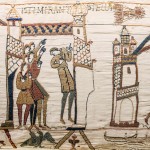
So why did we have to wait so long to learn about the Irish achievement in astronomy? One important reason is that the Irish did not use the same words to describe the phenomena that they saw. Take the ‘dragons’ that are said to have appeared in Irish skies in 735 ( in fact, a very strong Aurora Borealis). Or the ‘red tower of flame’ reported in 1054  (a supernova). Or, charmingly, ‘the hairy star’ (Haley’s Comet) in 1066.

McCarthy and Breen decoded these entries and others like them using contemporary reports from around the world and complicated scientific formulae. So we have, for example, the Super Nova of 1054 – an eruption in the Crab Nebula (MI). Evidence from China for that same year talks of a ‘reddish-white’ star ‘with pointed rays that shone from all sides’. And McCarthy and Breen rolled out the hardware to show that these ‘pointed rays’ would also have been visible in Ireland. In terms that neither Beachcombing nor the medieval Irish would have understood: ‘If f(ρ) = 105.36 [1.06+cos2ρ]+ 10 (6.15 – ρ/40) + 6.2 x 10⁷ x (ρ) –2 then mth = 8.88 + k (sec z sun – sec Z ) – 2.5 x log [f(ρ) x (1-10 –0.4kxsec z)]’

‘But so what!’, the reader might say. This hardly adds up to evidence for scientific knowledge. After all, you do not have to be a genius to stop and point in amazement at something unexpected in the sky and call it a ‘dragon’ or a ‘burning tower’.

Beachcombing concedes the point. But these entries were only, in fact, the tip of the iceberg, a select few recorded for posterity. The Irish took the trouble to put them into their chronicles – the annals of Ireland – because they were thought to be omens of the end of the world. The super nova (‘tower of flame’), for example, was treated with special awe because it appeared on the day of St George: the slayer of the dragon of the antichrist in Irish tradition.

Yet, even if these entries were not written into Irish annals for scientific reasons, they do, anyway, betray scientific attitudes and scientific knowledge. First, look at the details given. For example, in the year 672 ‘a thin and tremulous cloud in the shape of a rainbow appeared at the fourth vigil of the night on the sixth feria preceding Easter, from east to west through a clear sky.’ Precision in timing and observation were obviously valued.

Then, second, many of the events described were actually not so dramatic: for example, low magnitude lunar and solar eclipses in 688 and 691. Breen and McCarthy believe that the lunar eclipses suppose people sitting up and watching the skies deliberately; otherwise it is unlikely that they would have been noticed at all.

We only know about the Irish achievement in astronomy because, by great good fortune, a few observations did get sucked into these annals and so survived.

But what else did the Irish study or discover that never got written down in one of those few, great, bound manuscripts that have reached the modern age? Drbeachcombing AT yahoo DOT com

Life on Mars and other stories September 14, 2010

Posted by Beachcombing in : Modern

Beachcombing has always had a bit of a thing about Percival Lowell (1855-1916) word-smith, Orientalist (author of Noto, 1891) and Ivy League rebel. And of all Lowell’s accomplishments none stand as high in Beachcombing’s estimation as Lowell’s  theories on Mars set out in three books – all happily now available in pdf form: Mars (1895), Mars and Its Canals (1906), and, perhaps best of all, Mars as the Abode of Life (1908).

The titles give some idea of the lush undergrowth into which we are about to stray…

Lowell came to astronomy fairly late in life and only began to dedicate himself to its study from 1893 when he was in his forties. But he did so with energy, iniative and wealth – he was, after all, one of the Boston Lowell’s, a colonial age family who had been present, with gold in their pockets, at every turn of American history.

With this wealth Percy built an observatory at Flagstaff in 1894 and watched the heavens from an elevated spot with no city lights to pollute viewings. Lowell famously wrote that telescopes should see and not be seen: in other words results, based on careful siting, not impressive-looking hardware were what mattered.

His great love was Mars and he studied this planet – particularly in periods of opposition – with passion and was particularly interested in ‘non-natural’ traces there. Indeed, his books are littered with references to ‘oases’, ‘nodes’ and, of course, that old Martian favourite canals.

Canals…

Lowell, who had an extremely sharp, well-disciplined mind is, in fact, a case study in how reasoning can go horribly wrong and those damn canals were at the bottom of it.

Giovanni Schiaparelli had introduced canals to the study of Mars in 1877 when, during the opposition, Schiaparelli had seen long lines on the surface of the planet.

Schiaparelli used the neutral canali in Italian that would be best translated into English as ‘channels’. But the word was translated into English as ‘canal’, a word that suggests, nay, demands intelligent agency: red-navvies working under a Martian heaven.

Lowell was well aware of the mistranslation, but he nevertheless deduced, to his own satisfaction, that the canals had been built. They had been built, he decided, by a dying civilisation on Mars that wanted to drain water from the icy poles towards the equator in harvest season. What astronomers were seeing, argued Lowell, were not lines in the deserts but blooming vegetation around those lines as water filled the channels: for a map see the image above.

It’s Beachcombing’s sad duty to report that what astronomers were actually ‘seeing’ was an optical illusion. The canals were small points on Mars that linked together when viewed from a distance. But, though this suggestion was already around in the early 1900s, Lowell was able to brush these counter-theories aside. He could argue that other scientists lacked his clear view from Flagstaff.

Lowell managed to get away with a great deal in his twenty years of astronomy precisely because he could wave ‘remote and elevated’ Flagstaff in his foes’ faces. Lowell saw, it was argued, better than astronomers in other observatories and, at least, at the beginning few dared contradict him when his sightings were ‘off’.

From the canals Lowell built a whole series of secondary theories including the position of Martian settlements and even speculation about how long it would take a Martian to build the channels in question. Lowell would then – in his talks and his writings – leave science behind and end with a dirge about how Martian life was dying as water was leaving the red planet and how this fate awaited the earth too. There was something very fin d’siècle about Lowell’s Mars.

Read Lowell’s books on Mars today and you will be treated to exquisite prose and exquisite reasoning put to the wrong ends.

Lowell’s consolation are his ‘children’. His books on Mars fertilised two disciplines: science fiction (War of the Worlds anyone…) and popular astronomy.

And reading his works in 2010 there is still an echo of that excitement that once filled the observatory in Flagstaff and that so animated his readers. Beachcombing remembers one passage in Lowell’s first Mars book where the astronomer sees a flash of light from the surface of Mars and deduces that the sun has glinted off a Martian glacier. Suddenly other worlds come alive and Mars exists as a landscape rather than a dot in the sky.

Beachcombing is always on the look out for eccentric nineteenth-century astronomical theories: drbeachcombing AT yahoo DOT com

Page 1 of 212