jump to navigation

Shape-Shifting in a Nineteenth-Century Court-Room May 18, 2012

Posted by Beachcombing in : Modern

Beachcombing has visited the Isle of Man on several occasions in this blog (he has only been once physically): there was the mermaid sighting from an early submarine, the drunk Manx buggan, and the early medieval kingdom of Mannau. But he is confident that this story will trump them all. Our author has been describing the execution of a witch on Man in less happy times. What follows is remarkable proof of the survival of superstition and, more importantly, high comedy.

Suspected witches are now [mid 1840s] differently treated in the Island, as appears by the following case, of recent occurrence. A farmer named John Quine, residing at Ballaharry, in the parish of Marown, having lost in succession a heifer, a cow, and a horse, stupidly attributed the death of these animals to the influence of witchcraft, though it was plain to other people that his loss, in each instance, was only the effect of a natural cause. On the 19th December, 1843, he obtained from one of the deemsters a trespass warrant, under authority of which a jury was sworn and a great number of persons summoned as witnesses, and examined on the premises. The examination was conducted chiefly in Manks; and such questions as the following were put: ‘Did you ever witch Quine’s cattle?’ ‘Do you bear any malice against Quine?’ ‘Did you hear any body talking about Quine before his cattle died, and seemingly grudge him what he possessed?’ The jury was ultimately adjourned, and on the following day similar questions were proposed; but one of the jurymen interfered and refused to allow any interrogatories irrelevant to matters of trespass, and the proceedings were further adjourned till Thursday, the third day of January, in the present year 1844, when those who were summoned and did not attend on the previous day, were brought up in the custody of constables, amongst whom was Quine’s sister-in-law, a midwife in his immediate neighbourhood.

At this point Beachcombing needs to intervene to note how (1) midwifes were often suspected of witchcraft: if you ever find yourself in the 1500s do stay away from that particularly career path. Also (2) witches were, it was claimed, able to transform themselves into a hare.

After being sworn in the common form, the question put to [the midwife] was, ‘Did you ever come in any shape or form to do Quine or his goods an injury?’ The poor woman confessed that she had once passed through Quine’s fields without leave, on being called, in great haste to attend a neighbour’s wife in labour; and being frightened into the belief that she was consequently liable for the expenses of the court, before a verdict was pronounced by the jury, she agreed to pay the costs, amounting to nearly five pounds. While the advocate, employed in this case, was busily employed in taking minutes of the evidence, some wag managed to let loose, unperceived, in the room, a wild rabbit. On the appearance of this unexpected visitor, all in an instant became terrified, and a scene of confusion ensued, that may be better conceived [?] than it is possible to describe. The jury, in particular, with staring eyes, hair on end, and mouths distorted, shouted ‘the witch! the witch!’ This uproar continued for several minutes, till one of the party, more courageous and daring than the rest, seized the supposed witch, and while depriving the harmless creature of existence, triumphantly exclaimed ‘You shall not trouble poor Quine again’.

Please let this be true! The circumstantial details surely speak in its favour and our author is a meticulous early Victorian writer. Beach wagers no one will come up with a witch story as good as this one: drbeachcombing AT yahoo DOT com

Nashville Debutante Fights Imperial Japan May 15, 2012

Posted by Beachcombing in : Contemporary

***With thanks to Larry***

A wish-i’d-been-there moment from 1941. Cornelia Fort was a twenty-three-year-old pilot and instructor flying a Cadet out of Honolulu in that year. Incredibly though CF had only been flying for a matter of months she was already deemed good enough to work as an instructor, putting a young Hawaiian through his paces. And that’s what she was doing at dawn on 7 December with the American Pacific fleet (thankfully minus Enterprise and Lexington) spread out below her.

In one of CF’s surviving letters she writes that she was happiest in her life behind the controls of a plane in the peaceful early morning sky. Well, of course, 7 December was to be anything but peaceful… Pearl Harbor has many memorable moments, not least the radar crew dismissing a splodge of red on their radars as birds and rushing off for breakfast. But for Beach this marvelously spirited flapper gliding into the Japanese attack beats them all.

Cornelia spotted a silver airplane surfing in from sea straight towards her. She, at first, registered irritation and then her instincts fired.  She took the controls from her trainee and climbed as fast as the throttle would allow her. She was only just in time. The Japanese plane – its imperial insignia clearly visible – swept under her and rattled the civilian craft. If anyone doubts that she was in terrible danger consider this: as she landed another instructor and trainee were torn apart on a Japanese strafing run.

Cornelia Ryan was only at Honolulu through a technicality. The youngest of four children from a wealthy Nashville family, Cornelia’s father had, many years before, called her three brothers into his study and had required them to give their oath on the Bible that they would never fly. The old patriarch did not believe for a moment that Cornelia, a girl, would take to the air, though that what is she did in 1940, the year of his death. When one of her brothers objected she pointed out that she had never been asked to swear to anything: even if she had watched from the hall as the oaths were given. Cornelia had a point.

As to flying she was a natural. This skill would take her to Hawaii and then into the wartime air-force (she is pictured above, the highest of the four with a raw, natural beauty) where women ferried military planes from one part of the country to another. Her talent would finally take her to her death in 1943 when she was caught up in a mid-air collision while in Texas. CR was to be the first woman to die on active service in the US armed forces.

Today an airfield is named after her, she appears fleetingly in Tora! Tora! and there is a book Daughter of the Air. For a short, though charming documentary, hop over to Youtube and for a longer article visit the Airspace Magazine.

Beach is always on the look out for Wish I’d Been There Moments: drbeachcombing AT yahoo DOT com


***

23 May 2012: Nathaniel writes in A quibble with your “Nashville Debutant Fights Imperial Japan” post’s statement about a radar crew mistaking the incoming Japanese planes for a flock of birds. Per Wikipedia: “As the first wave approached Oahu, a U.S. Army SCR-270 radar at Opana Point near the island’s northern tip (a post not yet operational, having been in training mode for months) detected it and called in a warning. Radar had been in use in a training mode by the U.S Army Hawaiian Department for some time, but was not fully operational.[62] Although the operators, Privates George Elliot Jr. and Joseph Lockard,[63] reported a target, a newly assigned officer at the thinly manned Intercept Center, Lieutenant Kermit A. Tyler, presumed it was the scheduled arrival of six [U.S.] B-17 bombers. The direction from which the aircraft were coming was close (only a few degrees separated the two inbound courses),[64] while the operators had never seen a formation as large on radar;[65] they neglected to tell Tyler of its size,[66] while Tyler, for security reasons, could not tell them the B-17s were due[66] (even though it was widely known).[66]” Lt. Tyler was cleared of wrongdoing because he was newly assigned and had not been trained. Somewhat more complicated than your post implies, and one of the many misfortunes of war.” thanks Nathaniel

Cato’s Sword February 9, 2012

Posted by Beachcombing in : Ancient

Beachcombing usually plans about two days ahead with his posts. But every so often something emerges from out of the depths of the subconscious and will just not leave him in peace. This morning it was the death of Cato the Younger that tapped like a woodpecker on his inner skull. It had already been a tough night: the Beachcombing’s aupair had taken the car out and had left the radar, leaving to fears of death and coffins back to the US. Beachcombing also made the mistake of watching a 90s noir film to detox from a day of homework marking. He got to bed about 3.00 am and then Cato appeared with his oh-too-serious face and his sharp sword. This morning Beachcombing went and dug up Plutarch 71 (?) where the terrible deed is described.

For those who don’t know the tale, the news of Caesar’s victory has come through to Cato. And the grand Republican decides, quite sensibly, that he will be better off dead than alive on the charity of that slimy old world-destroyer JC.

Then the sword was sent in, carried by a little child, and Cato took it, drew it from its sheath, and examined it. And when he saw that its point was keen and its edge still sharp, he said: ‘Now I am my own master.’ Then he laid down the sword and resumed his book, and he is said to have read it through twice [Plato’s Phaedro]. Afterwards he fell into so deep a sleep that those outside the chamber heard him. But about midnight he called two of his freedmen, Cleanthes the physician, and Butas, who was his chief agent in public matters. Butas he sent down to the sea, to find out whether all had set sail successfully, and bring him word; while to the physician he gave his hand to bandage, since it was inflamed by the blow that he had given the slave. This made everybody more cheerful, since they thought he had a mind to live. In a little while Butas came with tidings that all had set sail except Crassus, who was detained by some business or other, and he too was on the point of embarking; Butas reported also that a heavy storm and a high wind prevailed at sea. On hearing this, Cato groaned with pity for those in peril on the sea, and sent Butas down again, to find out whether anyone had been driven back by the storm and wanted any necessaries, and to report to him. And now the birds were already beginning to sing, when he fell asleep again for a little while. And when Butas came and told him that the harbours were very quiet, he ordered him to close the door, throwing himself down upon his couch as if he were going to rest there for what still remained of the night. But when Butas had gone out, Cato drew his sword from its sheath and stabbed himself below the breast. His thrust, however, was somewhat feeble, owing to the inflammation in his hand, arid so he did not at once dispatch himself, but in his death struggle fell from the couch and made a loud noise by overturning a geometrical abacus that stood near. His servants heard the noise and cried out, and his son at once ran in, together with his friends. They saw that he was smeared with blood, and that most of his bowels were protruding, but that he still had his eyes open and was alive; and they were terribly shocked. But the physician went to him and tried to replace his bowels, which remained uninjured, and to sew up the wound. Accordingly, when Cato recovered and became aware of this, he pushed the physician away, tore his bowels with his hands, rent the wound still more, and so died.

There is a literature from the end of the empire in the fifth and sixth century about the ‘last of the Romans’: which unlikely provincial fop with a gladium deserves the title of final preserver of a bronze eagle. But Beachcombing likes to think that it was the last Roman Republicans, like Cato, in the first century AD and BC who deserve the laurels, before the Empire rose Darth-Vader-like under Caesar and Augustus and chewed the Mediterranean in its terrible maw. And to those who argue that Rome would never have survived without strong men? They are almost certainly right, but that was because Rome, by then, was not worth saving.

In any case, spare a thought for Cato tearing at his own innards.

A final note and a curiosity: Cato dies reading the Phaidon, Plato’s description of the suicide of Socrates. There is a tradition that Cleombratus of Ambracia threw himself from a high wall ‘screaming farewell sun after having read a book of Plato’, presumably the Phaidon with its promise of the immortality of the soul. It is an obvious book to read before ‘self-murder’: any other examples of it cropping up in the hands of a suicide, ancient or modern? drbeachcombing AT yahoo DOT com Beachcombing feels a related post coming on about the things historical suicides did before putting the knife in or swallowing the hemlock. Personally, Beach would watch an episode of Fawlty Towers, but, as often noted in this place, there’s no accounting for taste .

Plotinus Meets a God January 8, 2012

Posted by Beachcombing in : Ancient

A WIBT (Wish I’d been there) moment from later antiquity, brought to mind, in part by stories at the end of 2011 about Socrate’s daemon. The subject is Plotinus, a follower of Plato and the thinker who offered the ancient Mediterranean a ‘sensible’ alternative to Christianity: neo-platonism.

Plotinus, as all Platonists, had mixed feelings about magic. On the one hand, Plotinus saw magic as a distraction from the goal of unity or identification with the ‘One’; a particularly dear aphorism of Plotinus is that ‘I will not go to the gods, but they must come to me’.

But Plotinus also seems to have had a ‘gift’ for magic. He was either extraordinarily percipient (Beachcombing’s explanation) or (for those psychically minded) a clairvoyant for he managed such tricks as identifying a household thief and predicting the future of a child; he also was alleged to be able to turn black magic on those that attacked him with spells.

But most interestingly Plotinus once got involved in what Beachcombing can only describe as a séance. It is a particularly haunting scene because it shows foolish mortals getting in way over their heads.

An Egyptian priest who came to Rome and wanted to give a display of his wisdom asked Plotinus to come and see a visible manifestation of his own companion spirit [i.e. his daemon]. Plotinus readily agreed, and the evocation took place in the temple of Isis; the Egyptian said it was the only pure spot he could find in Rome. When the spirit was summoned to appear a god came and not a being of the spirit order, and the Egyptian said ‘Blessed are you who have a god for a spirit and not a companion of the subordinate order!’ It was not, however, possible to ask any questions of the god or even to see him there any longer, for the friend who witnessed the manifestation strangled the chickens he was holding as a protection, either because of jealousy or because he was afraid.

When Beachcombing thinks of conjuring up gods he imagines Edwardian gentlemen playing at the occult in underground basements in east-end pubs: the poor sops! But here is a ‘real’ encounter from the heart of the pagan Mediterranean in the third century A.D. The Egyptian priest summons Plotinus’ daemon and to his amazement finds that he is not dealing with a household ‘brownie’. Unfortunately before the god can properly reveal himself ‘the friend who witnessed the manifestation’ strangled the chickens he was holding ‘as a protection’. That begs a number of questions…

Beachcombing remembers that the Temple of Isis in Rome was outside the pomerium in the campus Martius. Presumably an almighty gust of wind blew through the doors unhinging for a second the tense players in the ritual. Perhaps even Plotinus blanched momentarily! Oh to have been there…

Any other ancient rituals to conjure up spirits? Drbeachcombing AT yahoo DOT com

Electrocuting African Tribal Hosts January 3, 2012

Posted by Beachcombing in : Modern

One of the great challenges of any nineteenth-century explorers was to make friends with the ‘primitives’ in such out of the way places as an equatorial rain forest, the upper peaks of the Andes and through much of Darkest Africa. And, of course, to do so they brought gifts along with them: a sensible enough precaution. And what gifts! Here is a list from one African-bound American at the end of the nineteenth-century. The following were  an addendum to his goods as things that, though useless in themselves, he could give to the natives to add to his prestige and power over them.

I bought more than 5000 pounds of beads of different sizes and colors, several hundred pieces of cotton goods, some pieces of silk and coats, waistcoats, shirts, 2000 red caps, a few umbrellas, files, knives, bells, fire-steels, flints, looking-glasses, forks, spoons, some stove-pipe hats for the kings near the sea-shore, straw hats, etc., etc. Then, to impress the wild people with what I could do, I bought several large Geneva musical boxes, one powerful electrical battery, several magnets, and six ship clocks, etc, etc.

Two items stand out for Beachcombing on this list. The stove pipe hats – see illustration – and the ‘powerful electric battery’. WtH! Let us imagine for a moment that you have just accidentally trod on the sore toe of a powerful up-river chieftain. How is a ‘powerful electric battery’ going to save your life? Well, read this passage and remember that our hero has already intimidated his hosts with gunfire and – the darkness! – Swiss music boxes.

After a few moments I took the [music] box back into my hut,   and brought out a powerful electric battery. Then I ordered   the forty-three elders and the king to come and   stand in a line. They came, but were evidently awed.   The people dared not say a word. Every thing being  ready, I told them to hold the ninety feet of conducting  wire. ‘Hold hard!’ I cried.  The people looked at the old men with wonder, and could not understand how they dared to hold that charmed string of the Oguizi [a white]. The Ishogos, my guides, were themselves bewildered, for they had not seen this thing in their village. My Commi men did not utter a word, but their faces were as long as if they never had seen anything. ‘Hold on!’ I repeated, ‘do not let the string go out of your hands’. I then gave a powerful continuous shock. The arms of the elders twisted backward against their will, and their bodies bent over; but they still held the wire, which, indeed, now they had not the power to drop. Their mouths were wide open; their bodies trembled from the continuous electric shock; they looked at me and cried ‘Oh! oh! oh! Yo! yo! yo!’ I had really given a too powerful shock. The people fled. In an instant all was over. I stopped the current of electricity. The wire fell from the elders’ hands, and they looked at me in perfect bewilderment. The people came back. The elders explained their electric sensation, and then a wild hurra and a shout went up. ‘There is not another great oguizi like the one in our village,’   was the general exclamation ; and they came and danced around me, and sang mbuiti songs, bending their bodies low, and looking at me in the face as if I had been one of their idols.

He then proceeds to terrify the villagers with a deftly used magnet…

 Any other ‘superiority’ gifts? Drbeachcombing AT yahoo DOT com

***

5 Jan 2012: Sword&Beast writes in ‘I´ve just read your post on gifts from explorers and it reminded me a passage from the history of Brazil. Bartolomeu Bueno da Silva was an explorer from the 17th century then village of São Paulo, one of many who went deep inland to fetch for natives, gold or diamonds. The 1987 movie The Mission gives a good impression of these slave-hunting expeditions called ‘bandeiras‘. In 1682, Bartolomeu Bueno da Silva run into a tribe where the women were richly adorned with gold. As they refused to tell were the gold came from, the explorer threw the strong Brazilian run called “cachaça” (which today is used for milder uses such as “caipirinha”) into a pound and set it on fire, saying that he would burn all rivers and water sources if he was not taken to the gold sites. Although not as threatening as Swiss music boxes, it worked and the explorer passed into history known as Anhanguera, which means ‘old devil’ in the local amerindian language.’Thanks S&B!

Gunfire in Notre Dame November 9, 2011

Posted by Beachcombing in : Contemporary

A wibt (wish I’d been there) moment in a snatch of about five minutes as Mrs B is still far away from home and Beachcombing has to undertake full babysitting duties for his two terrifying daughters.

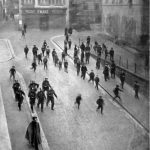
26 August 1944, after four long years of Nazi occupation, Paris is liberated by Allied troops and marching into the capital comes General De Gaulle, the leader and hero of the Free French. De Gaulle being De Gaulle he ordered his column, after laying flowers at the tomb of the Unknown Soldier, to go straight to the church of Notre Dame, for if Paris is the centre of France then Notre Dame is the heart of the capital, a church that had also been a childhood haunt of the General. What should have been though the most sacred moment of that most sacred day risked becoming a bloodbath for as the general arrived gunfire broke out all around. This is a description from Helen Kirkpatrick who happened to be on the scene.

The general’s car arrived on the dot of 4.15. As they stepped from the car, we stood at salute and at that very moment a revolver shot rang out. It seemed to come from behind one of Notre Dame’s Gargoyles. Within a split second a machine gun opened up from behind the Hotel de Ville. It sprayed the pavement at my feet. The generals entered the church with people pressing from behind to find shelter. Follow the link for archive film of this moment.

De Gaulle and his attendants within the cathedral began to march down the central aisle, but now gun fire opened up in the church itself.

Suddenly an automatic opened up from behind us – it came from behind the pipes of Notre Dame’s organ. Other shots rang out and I saw a man ducking behind a pillar above. Beside me FFI [Forces Françaises de l'Intérieur] men and the police were shooting. For one flashing instant it seemed that a great massacre was about to take place as the cathedral reverberated with the sound of guns. There was a sudden blaze and a machine gun sprayed the center aisle, flecking the tiles and chipping the pillars to my left. Time seemed to have no meaning. Spontaneously, a crowd of widows and bereaved burst forth into the Te Deum as the generals stood bareheaded before the altar. (260)

HK didn’t focus on De Gaulle, but BBC correspondent Bob Reid, who gives us the most vivid record of the attack, couldn’t keep his eyes off the self pronounced man of destiny. What follows comes from Reid’s live broadcast, all given with his gentle, unflappable 'Yorkshire'.

Immediately in front of me are lined up the men and women of the French Resistance Movement; they’re a variegated set of boys and girls – some of the men are dressed in dungarees, overalls, some look rather smart, the bank-clerk type, some are in very shabby suits but they’ve all got their red, white, and blue armlets with the blue Cross of Lorraine, and they’re all armed, they’ve got their rifles slung over their shoulders and their bandoliers strapped round their waist. And now here comes General de Gaulle. The general’s now turned to face the square, and this huge crowd of Parisians [machine gun fire]. He’s being presented to people [more machine gun fire]. He’s being received [shouts and shots]. He’s being received even while the general is marching [more fire]—even while the general is marching into the cathedral . [break in recording] Well, that was one of the most dramatic scenes I’ve ever seen. Just as General de Gaulle was about to enter the Cathedral of Notre Dame, firing started all over the place. I’m afraid we couldn’t get you the noise of that firing because I was overwhelmed by a rush of people who were trying to seek shelter, and my cable parted from my microphone. But I fell just near General de Gaulle and I managed to pick myself up. General de Gaulle was trying to control the crowds rushing into the cathedral. He walked straight ahead in what appeared to me to be a hail of fire from somewhere inside the cathedral – somewhere from the galleries up near the vaulted roof. But he went straight ahead without hesitation, his shoulders flung back, and walked right down the central aisle, even while the bullets were pouring around him. It was the most extraordinary example of courage that I’ve ever seen. But what was to follow was horrible, because it happened inside Notre Dame Cathedral. While the congregation were trying to take shelter lying flat on the ground under the chairs and behind the pillars, the firing continued at intervals; the police, the military and the Resistance Movement – all these people, they came in and were trying to pick off the snipers. Some of the snipers had actually got on to the roof of the cathedral. There was an awful din going on the whole time. Just by me one man was hit in the neck, but I will say this for this Parisian crowd, there was no real panic inside the cathedral at all; they simply took reasonable precautions. Round every pillar you’d see people sheltering, women with little children cuddled in their arms. I saw one child being carried to safety in the arms of a young priest who sheltered the youngster to his breast and carried it to the shelter of one of the pillars. It was – as I say – it was a most extraordinary scene, as the snipers were spotted around the gallery by the police and by the soldiers, and there was a smell of cordite right throughout the cathedral. But Paris had come to celebrate the solemn Te Deum and it did; even while the firing was going on the people rose to their feet and stood there and sang the Te Deum with General de Gaulle at the head of them. And then, when it was all over, the general marched right down the aisle; heaven knows how they missed him, for they were firing the whole time; there were blinding flashes inside the cathedral, there were pieces of stone ricocheting around the place.

Napoleon has a nice phrase about ‘two o’clock in the morning courage’ or ‘instantaneous courage’. There are few better examples than De Gaulle continuing his slow walk towards the altar of Notre Dame in the midst of what Reid elsewhere called ‘a queer, crazy scene of modern war amid the medieval setting of a 13th-century church’, cordite and incense mixing in the air.

Yet De Gaulle, who never suffered from false modesty, is strangely reticent in his autobiography about what happened in the cathedral focusing, instead, on the music: ‘Le Magnificat s'élève. En fut il jamais chanté de plus ardent?’ [‘The Magnificat rose up, was it ever sung with such passion?’]!

As to the attack no one was apprehended and though the gunshots were routinely written off as snipers trying to kill De Gaulle there is room for doubt. The General himself wondered if it hadn’t been an attempt to sow panic and justify a continuing state of emergency in Paris. De Gaulle, however, was a sucker for conspiracy theories.

Beachcombing can’t help but wonder what would have happened if a bullet had found its way into the head of the leader of the Free French: the Cuban Missile Crisis, Britain’s late entrance to the EEC, Algeria, 1968… All had crucial input from De Gaulle.

Any other explanations for the attack or any alternative witness accounts gratefully received: drbeachcombing AT yahoo DOT com

***

30 Nov 2011: KMH writes in, 'The perception of great leaders being immune to the effects of gunfire in war (and possibly fully aware of it) isn't limited to de Gaulle. I remember the same was evident  with Douglas MacArthur and George Patton in WWI who went on to participate in WWII. And perhaps the same applied to Montgomery, but I am hazy here. Throughout history the same notion has applied whether with bullets or bows and arrows. So you see there is a distinct difference between us, the commoners, and great military leaders.' Thanks KMH!


A Look Up Caterina Sforza’s Skirt October 28, 2011

Posted by Beachcombing in : Medieval

Caterina Sforza was one of those extraordinary individuals who managed to pack five or six lifetimes into her forty odd years. Wife, alchemist, mother, warrior, seductress, torturer, hunter, general, rape victim and, don’t forget, the model for one of the three graces in Botticelli’s Primavera: she also had a lot of hot Milanese blood swilling around inside her.

On a day when Beach should really be getting ready for the first post holiday lessons he thought he would celebrate his favourite Caterina episode up high on the Ravaldino, the fortress that frowns over Forlì, her husband, Girolamo’s stronghold.

14 April 1488 Girolamo was killed in a conspiracy in that town and his body was cut to pieces. Caterina and her immediate family was taken prisoner by the rebels and she particularly was lucky to escape an immediate lynching.

Given what she would later do to those who were guilty of her husband’s murder there is no question that this was a mistake on their part. The conspirators then compounded their initial error by giving Caterina a finger’s breadth of freedom. The Ravaldino was still in the hands of men loyal to the dead Girolamo and so the conspirators, after some useless parlying, allowed Caterina to go into the castle to negotiate its surrender. They must have reasoned that they had Caterina’s children, mother and half sisters and that no self-respecting woman would risk defiance in those circumstances. But this was Caterina Sforza and the bad Milanese blood was bubbling over the top of the pan…

Caterina immediately took control of the defence of the fortress and went up on to the battlements to insult the men who had been foolish enough to let her go.

When they pointed out that they could kill her children she lifted her skirt exposing her genitals and roared back at them: ‘I have what it takes to make others’.

It is a fabulous story. However, is it true? The tale appears in Machiavelli  and is endlessly repeated from then on, but is the father of political science (and hence the step-father of lies) to be trusted? Common wisdom would say not: Wikipedia writes this off rather airily as ‘a famous legend (without historical veracity)’. And we all know that what Wikipedia says…

However, the early sources are surprisingly good. A letter sent one day after Caterina entered the fortress gives this account:

Madonna [Caterina] does not want to come out. The people can easily say, ‘we will kill your children’. She replies that there’s no way, that they poisoned them anyway, and that she is carrying one in her body and she is capable of having more. By no means does she want to hear a thing about coming out and bombards the whole surrounding area without stopping.

Then two days later another letter – translation taken from Hairston here and above – confirms this behaviour.

The people menacingly demanded of Madonna Caterina to have the castle turned over into their hands. Her Highness replied that if they, while maintaining hold of her children, would have her accompanied into the fortress by four or six of their men, they would see the work she would do with the castellan. After having done so, she stayed in the fortress and told the men who had accompanied her to leave without her, and that they could do with her children whatever they wished, that for her the one in Milan, who’s the oldest, and the one she has in her body are enough. Then the castellan told those men to make the people understand that if in the future the aforesaid children were mistreated, or if they were killed or harmed in any other way, that they would level the town with bombards.

Here we see a woman of great spirit playing the poor cards dealt to her with style: the claim that she was pregnant seems to have been a lie! As to the skirt lifting this doesn’t appear in contemporary accounts, sadly. But there is a reference to an obscene hand gesture that the livid Caterina makes at her husband’s murderers from the castle walls: the dreaded four figs, to be found in Dante and the medieval Italian equivalent of Darth Vader’s choking trick.

The Orsi family, for the record, were virtually wiped out in the next weeks: if memory serves Beachcombing correctly parts of one of the conspirators were eaten by Caterina’s loyalists.

Nice place renaissance Italy.

Any other memorable wish-I’d-been-there moments from history: drbeachcombing AT yahoo DOT com

***

28 Oct 2011: Ricardo writes in. ‘Reading Herodotus on Ethiopia and Egypt, probably you know the story. Quoting from memory, the Egyptian king had left a garrison of a few thousand to guard the borders with Ethiopia. Well, he ‘forgot’ them there so after some years they got upset, packed up and decided to cross to the other side. And so the word reached the King who decided to run over and get them back. He rounded them up and made an appeal (ah, some nice Hollywood speech?) about their homeland and the women who soon they would be leaving behind. One from the army them come forward, holding his testicles in hand and saying: ‘where these go, my sons and daughters go’ and so they left. Herodotus gives this a reason for an increase in culture in Ethiopia about this time!’ Thanks Ricardo!

Recent Strange History News Stories with Thanks to Readers

Arguments at Tehran October 19, 2011

Posted by Beachcombing in : Contemporary

***Apoloiges for being so behind with comments: exams here – tomorrow free day***


WIBT (Wish I’d been there)  moments from the Big Three Conference at Tehran in 1943 are so numerous that a casual reader would be spoilt for choice: Marshal Voroshilov dropping the Sword of Stalingrad at the worst possible moment in the ceremonials; German intelligence’s attempts to kill Churchill, Roosevelt and Stalin; agreement on the United Nations; not to mention Stalin’s fear of flying. However, if Beachcombing would have been present at only one scene it would have been a dinner – one filed away in his immortal meals series – held on 29 November where Churchill, Roosevelt and Stalin all sat down with a few other luminaries including Eden, Hopkins, Harrhim, Molotov and Elliot Roosevelt the President’s son. The most vivid account of the meal comes from Churchill’s pen, not least because this was his one proper stand up argument with Uncle Joe.

Stalin… indulged in a great deal of ‘teasing’ of me, which I did not at all resent until the Marshal entered in a genial manner upon a serious and even a deadly aspect of the punishment to be inflicted upon the Germans. The German General Staff, he said, must be liquidated. The whole force of Hitler’s mighty armies depended upon about fifty thousand officers and technicians. If these were rounded up and shot at the end of the war German military strength would be extirpated. On this I thought it right to say, ‘The British Parliament and public will never tolerate mass executions. Even if in war passion they allowed them to begin they would turn violently against those responsible after the first butchery had taken place. The Soviets must be under no delusion on this point.’

As Beachcombing has noted before in this place Churchill was a knight of the shires from the mid nineteenth century who had accidentally strayed into the mid twentieth. It would have been well worth seeing him lecturing a totalitarian regime on ‘the British parliament and public’.

Stalin, however, perhaps only in mischief, pursued the subject ‘Fifty thousand’, he said, ‘must be shot’. I was deeply angered, ‘I would rather’, I said, ‘be taken out into the garden here and now and be shot than sully my own and my country’s honour by such infamy.’

The meal, if Beach recalls correctly, was held in the Soviet Embassy. When Churchill offered then to have himself shot in the garden, one suspects that Stalin and Molotov were on the edge of gratefully accepting. But before they could do so Roosevelt offered an uncharacteristically gauche compromise: in his defence the President’s health had not been good in the preceding days.

[Roosevelt] had a compromise to propose. Not fifty thousand should be shot, but only forty-nine thousand. By this he hoped, no doubt, to reduce the whole matter to ridicule. Eden also made signs and gestures intended to reassure me that it was all a joke. But now Elliot Roosevelt rose in his place at the end of the table and made a speech, saying how cordially he agreed with Marshal Stalin’s plan and how sure he was that the United States Army would support it. At this intrusion I got up and left the table, walking off into the next room, which was in semi-darkness.

Churchill was always sensitive to American cozying up to the USSR, particularly when the US ignored Britain, as she systematically did at Tehran. However, help was at hand…

I had not been there a minute before hands were clapped upon my shoulders from behind, and there was Stalin, with Molotov at his side, both grinning broadly, and eagerly declaring that they were only playing, and that nothing of a very serious character had entered into their heads. Stalin has a very captivating manner when he chooses to use it, and I never saw him do so to such an extent as at this moment. Although I was not then, and am not now, fully convinced that all was chaff and there was no serious intent lurking behind, I consented to return, and the rest of the evening passed pleasantly.

Rather movingly after dinner in a private place (charm 554) Churchill told his confidantes, thinking no doubt of a newly reinvigorated Soviet Union, that there ‘might be a more bloody war’. However, he would not be there to see it. ‘I want to sleep for billion of years’. Then ‘stupendous issues are unfolding before our eyes, and we are only specks of dust, that have settled in the night on the map of the world’.

Churchill, at base, was a decent old cove, ready – one of the proofs of gentlemanly conduct – to defend his enemies while they were bleeding on the ground. Nor was this an isolated incident. When, indeed, in 1944 Morgenthau presented his plans for the pastoralization of Germany Churchill noted that ‘it was unnatural, unChristian and unnecessary’, quoting Burke’s glorious words ‘you cannot indict a nation!’

But before Beachcombing gets sentimental about the man who dragged the Empire through Gallipoli in the First World War and back into the Gold Standard in the 1920s it is worth remembering that it was Tehran where the US and the UK condemned millions of central Europeans to fifty years in the Gulag.

Beach is always on the look out for striking historical meals: drbeachcombing AT yahoo DOT com


The Wold Cottage Meteorite October 15, 2011

Posted by Beachcombing in : Modern

Beachcombing has, over the months, given some publicity to meteorite history, the intrusion of bolides into human affairs, and today he thought he would do tribute to a rock that came hurtling from the sky in 1795. Though not in itself a particularly remarkable example of the shooting star the Wold Cottage Meteorite changed scientific history. Before it came crashing into a Yorkshire field, nine yards from a labourer, no intelligent person believed in ‘stones falling from the sky’. After it had come crashing down and the evidence had been properly examined it became unfashionable not to believe in the same.

We might start with a simple account of events, not from a witness but as described by the owner of the land on which the meteorite fell: Edward Topham.

The very singular phenomenon which took place near my house in Yorkshire on Sunday, Dec. 13,  1795 has excited general curiosity. Being in London at the time, it was impossible for me to know more of it than from some vague accounts in provincial and London papers; and to be certain, from private letters that such an event had happened, on my return here I found that, for a space of nearly three weeks, 30 or 40 person on each day had come to see the STONE which had fallen; and I found likewise a number of letters from all parts of the kingdom, requesting to me to give an account of the circumstance.

Topham, goes on to record that the stone weighed 56 pounds and that it had plunged nineteen inches into the soil and then through six odd inches of solid chalk rock. ‘When taken up it was warm, and smoked’.

It is thanks to Topham that the discovery was taken so seriously for though he put the stone on public display in a penny-a-time coffee shop, he also went to great pains to document the fall talking to and swearing many witnesses.

At Bridlington, and at different villages, sounds were heard in the air, which the inhabitants took to be the noise of guns at sea; but at two adjoining villages, the noise was so distinct of something singular passing through the air toward my habitation, that five or six people came up, to see if anything extraordinary had happened to my house or grounds.

These are generalities, but there were also the affidavits again organised by the careful Topham. Take, for example, that of  John Shipley who was almost struck by this messenger from the outer reaches of the Solar System, ‘the clouds opened as he it fell, and he thought HEAVEN and EARTH were coming together’!

‘John Shipley, husbandman, deposes, that he was within eight or nine yards of the stone when it fell, saw it distinctly seven or eight yards from the ground, and then strike into the earth, which flew up all about him, and which alarmed him very much. In falling, sparks of fire seemed to fly from it. On recovering from his confusion, he went up to the place in company with George Sawdon, carpenter, and James Watson, groom to Capt. Topham, and helped to dig the stone from the rock of lime-stone where it was stuck.’

Topham, who was, by any standards, a remarkable man, a magistrate, a newspaper editor and later a dog racer and trainer just happened to be the right man in the right place (or at least the right property) at the right time. Science dithered and dallied before the strength of the evidence that he had amassed and then surrendered another bit of their obscurantism. There were would be no more mocking those stones that fell from the heavens…

Beach is always on the look out for meteorite stories: drbeachcombing AT yahoo DOT com

***

28 Oct 2011: Several of you (Invisible, EdM, Southern Man, SY)  have sent in this great report from the Telegraph describing a recent meteorite attack on a French home. Thanks to all!

30 Oct 2011: KMH (who also noted the report above) has kindly boiled down the Wikipedia article on historic ‘interventions’ of meteorites: ‘There is a Chinese record describing the death of 10,000 people in 1490 from ‘falling stones’. The Wabar craters in Arabia may be just a few hundred years old. There is the Tunguska blast in 1908.  ‘The only reported fatality from meteorite impacts is an Egyptian dog that was killed in 1911 by the Nakhla meteorite, although this report is disputed. The meteorites that struck this area were identified in the 1980s as Martian in origin. The first known modern case of a human hit by a space rock occurred on November 30, 1954, in Sylacauga, Alabama. There a 4 kg (8.8 lb) stone chondrite crashed through a roof and hit Ann Hodges in her living room after it bounced off her radio. She was badly bruised. Several persons have since claimed to have been struck by ‘meteorites’ but no verifiable meteorites have resulted.’ Thanks KMH

Hearts, Genies and Gnosticism at Nag Hammadi October 14, 2011

Posted by Beachcombing in : Ancient, Contemporary

Howard Carter whispering ‘wonderful things’, Leslie Alcock finding Dark Age timber at Cadbury (‘that was Camelot’), Bedouin shepherds investigating a complex of caves at the Dead Sea… All wonderful, of course. But for Beachcombing none of these quite match the thrill of the discovery at Nag Hammadi in 1945.

In that year, possibly in December, a group of Egyptian farmers led by one Mohammed Ali Samman were out digging for fertiliser near the Egyptian town of Nag Hammadi when they hit the mother-lode: a mummy and a one metre long red earthenware jar. The farmers, after some argument, decided to break open the jar, for one had pointed out that there might be gold inside. And, overcoming their fear of genies, the earthenware container was smashed and  Ali and his friends took out twelve  leather books. Disappointed at not discovering coins or nuggets Ali gathered up the books to take them home: his companions refused them, neither he nor they realising that what they had stumbled upon was in every sense more valuable than gold.

The books were not treated as they should have been. It seems that Ali initially tore the volumes up to share them out only throwing them back together when the rest of the party expressed their disinterest. He then took them home where his mother used pages from these sixteen hundred year old books to light her stove: [expletives deleted]. And there they would have remained had it not been for, of all things, a blood feud.

Ali and his brothers were intent on revenging themselves on a man, Ahmed Ismail, who had allegedly killed their father. In fact, this being rural Egypt in another age, he and his brothers hacked Ismail to bits with sharpened mattocks – Ismail had foolishly fallen asleep by the side of the road – and ate his still warm heart.

In the subsequent police investigation Ali feared detection  - he was eventually arrested for the crime – and gave the books to the village priest so they would not be discovered by the police, thus saving them from his mother’s kindle pile. The priest showed them to his brother-in-law who stayed at his house once a week to teach English and history. And from there they slowly made their way to Cairo, one - the so-called Jung Codex - getting lost in Switzerland on the way.

These twelve volumes were the most substantial Gnostic collection the world had ever seen and make a mockery of papyrologists pouring over itty-bitty fragments from the Egyptian sand dunes. Beachcombing has one English translation, which runs to 550 pages - on the table before him and the names, many unknown to theologians prior to the discovery, are redolent enough: The Thunder - Perfect Mind, The Gospel of the Egyptians, The Concept of Out Great Power… Reading even a few pages is like taking a walk in a very strange but beautiful city around twilight.

Ali, who sounds like the nicest sort of scoundrel, was never able to bring archaeologists back to the exact spot of the discovery. Or rather he brought them to three separate spots claiming that each was the site of the discovery! We cannot even be sure of the details of his account, details that were remembered decades after and that had important variants depending on when he told the story. Was there really a mummy, for example? Its inclusion sounds like something out of genie mythology.

Beachcombing would certainly have given six months of his life to have been there that day when the spade went ‘clink’. He would also, it goes without saying, have given six months of his life, not to have been there when Ali’s mother was making her cous-cous by lighting the Gospel according to the Crucifix or other such treasures from the burning libraries of the past.

We at strangehistory.net are putting together a list of extraordinary archaeological discoveries and the events around them. Any offers? Drbeachcombing AT yahoo DOT com

Page 1 of 512345