jump to navigation

The Last Invasion of Britain? May 5, 2012

Posted by Beachcombing in : Modern

***Dedicated to Kithra***

It is sometimes said that the last invasion of Britain took place 22 April 1778 at Whitehaven in Cumbria. On that date, John Paul Jones, a Scot and an American patriot led his ship, the USS Ranger, against the small Lakeland Port (another post, another day) in an unlikely annex to the War of Independence. However, this was not the last invasion on British soil, for the simple reason that Jones himself launched a later attack on St Mary’s Isle on the Solway Firth in Scotland (pictured). So obscure is this raid that even its date is not clear: it was probably carried out 24 or 25 of the same month. However, Jones’ logic in attacking was straightforward enough. Dunbar Douglas 4th  earl of Selkirk had his home on the isle and Jones wanted prisoners, particularly important unionists. It should also be mentioned that Jones’ father had worked for the Earl’s family: there may have been a bit of Freudianism in this descent. The true last invasion of Britain began, in any case, as an attempt at kidnapping and ended as something rather different. Here are Jones’ own words.

On my return on board the Ranger [after Whitehaven], the wind being favorable, I set sail for the coast of Scotland. It was my intention to take the earl of Selkirk prisoner, and detain his lordship as hostage, in conformity to the project already mentioned. It was with this view about noon of the same day I landed on that nobleman’s estate, with two officers and a few men. In the course, of my progress, I fell in with some of the inhabitants, who, taking me for an Englishman, observed that lord Selkirk was then in London, but that her ladyship and several ladies were at the castle.

Note that this ‘invasion’ was so fearsome that the locals did not even realise that they were being attacked! We then have evidence of that strange ‘keep-the-gloves-on’ chivalry that generally characterised the American forces, though not sadly always British forces, in that war.

On this [news], I determined to return: but such moderate conduct was not comfortable to the wishes of my people, who were disposed to pillage, burn, and destroy every thing, in imitation of the conduct of the English towards the Americans. Although I was not disposed to copy such horrid proceedings, more especially when a lady was in question, it was yet necessary to recur to such means as should satisfy their cupidity, and at the same time, provide for Lady Selkirk’s safety. It immediately appeared to me, to be the most proper mode to give orders to the two officers to repair to the castle with the men, who were to remain on the outside under arms, while they themselves entered alone. They were then instructed to enter, and demand the family plate, in a polite manner, accepting whatever was offered them, and then to return, without making any further inquiries, or attempting to search for more.

It should be mentioned that Jones had serious problems with his crew who were a mutinous bunch. After this pleasant interlude in Scotland, indeed, Jones reports that he ‘ran no small risk of being either killed or thrown into the sea’ by his sailors and officers.

I was punctually obeyed; the plate was delivered; lady Selkirk herself observed to the officers, that she was exceedingly sensible of my moderation; she even intimated a wish to repair to the shore although a mile distance from her residence, in order to invite me to dinner; but the officers would not allow her ladyship to take so much trouble.

Next we see the strangely quixotic character of Jones himself. A savage man at times, who had flogged, earlier in his life, a sailor to death and who would later be accused of rape, he could also act like the perfect Scottish gentleman: he despised, for example, slavery.

At the time I had been obliged to permit my people to take Lady Selkirk’s plate, I determined to redeem it out of my own funds the moment it should be sold and restore it to the family. Accordingly, on my arrival at Brest, I instantly dispatched a most pathetic letter to her ladyship, in which I detailed the motives of my expedition, and the cruel necessary I was under in consequence of the English in America, to inflict the punishment of retaliation. This was sent open to the post-master general, that it might be shewn to the king of England and his ministers… During the course of the war, I found it impossible to restore the plate belonging to the Selkirk family; I, however, purchased it at a great price, and at length found means to send it by land from l’Orient to Calais, by means of M. de Calonne, who transmitted to me a very flattering letter on the occasion; in short I at length received a very flattering letter from the earl of Selkirk, acknowledging the receipt of it.

Those damn Yankees, blast their eyes for their horrid inhumanity!

Any other unlikely acts of chivalry in war? Drbeachcombing AT yahoo DOT com

***

5 May 2012: Very quick is Southern Man this morning who writes: ‘I know this story and would like to share with you a passage from an anti-Jones publication. This describes how one of the officers at the castle was polite and the other rude. It also gives more details of the plate’s return. ‘Several years elapsed without [lady Selkirk] hearing from jones, and all hope of the realizement of his promise had vanished; but, in the spring of the year 1783, to the great and agreeable surprise of her ladyship, the whole of the plate was returned, carriage, paid, precisely in the same condition in which it had been taken away, the tea-leaves remaining in the tea-pot as they were left after the breakfast on the morning of their visit to the castle.’ I love the detail of the tea-leaves. Seriously though I think the elapse of years speaks strongly in favour of Jones the gentleman rather than Jones the flogger or (supposed) rapist.’ Thanks SM!


Singing Enemy Songs: Lili Marleen April 13, 2012

Posted by Beachcombing in : Contemporary

One of the most moving moments in cinema is the extraordinary ending of Kubrick’s Paths of Glory. A young German girl is pulled in front of a crowd of French soldiers and forced to sing. The poilu mock her but as she nervously begins  the mood changes. The soldiers join in and drown her anxious, uncertain German, humming along. What begins as a musical lynching ends as a moment of unlikely understanding between enemies.

It works in a film, but has music ever really united foes in this way? Sure, there are stories of Silent Night/Stille Nacht being sung on both sides of the trenches at Christmas in the First World War. But these are difficult to document. However, there is one striking example from the Second World War, Lili Marleen, that can be documented by record sales alone.

Lili Marleen had the unlikely trajectory of so many surprise successes. It was written as a soldier’s poem in 1915, published in 1937 (in a very different Germany) and then set to music and recorded in August 1939 just before the Reich knocked rather loudly on the door of the Polish corridor.  The song was a complete failure and would have been entirely forgotten had it not been played by chance in 1941 by Germany’s military Radio Belgrade. There it was particularly picked up by Rommel’s Afrika Corps, listening and dreaming of home on the other side of the Med: Rommel himself is said to have loved the song, though Beach has found no good source for this.

A problem. The song was not very ‘Nazi’. In fact, its popularity infuriated Goebbels who briefly banned it – it did not help that its singer, Lale Andersen, had many Jewish friends. The song describes, after all, not the inevitably tedious march of the master race, but a suffering soldier with a heavy pack recalling a girl back home. And all this sung to a nostalgic, jerky, but catchy Blue Danube type tune! The arms of the swastika were wilting by the time you got to the end of the second verse.

However, it was these qualities that meant that it was able to cross the enemy lines with both the Dominion and British troops in the Eighth Army in Egypt and Libya singing along as they piled up sand bags or carried munitions back and forth.  By then Radio Belgrade, often listened to by the Allies, was using the song as their signature.

The war in the desert was a bloody and unpleasant affair: but it involved a degree of chivalry not found on any other front as combatants (all in a foreign land) found themselves also fighting the dunes and the sun. (Memories of the weather wars). In this unusual situation Lili Marleen became a motif of solidarity between the troops, friends and enemies alike. One British security agent, for example, remembers that whenever he was to debrief a German soldier he would always break the ice by asking what the latest alternative verses to Lili Marleen were: countless parodies and subversive versions were composed.

There was initially resistance to Allied soldiers singing the music: remember that some English-speakers had tried to get Beethoven banned for the duration of the World Wars, so a contemporary German number was bound to be controversial. However, in the end, Lili Marleen’s popularity was such that an English version became a commercial ‘sure thing’. A catastrophic rendering was given by Vera Lynn who is just too strait-laced and, well, English to do it justice. The best version in English is perhaps Marlene Dietrich’s sultry and very enjoyable purring. And from 1941 the song was translated into various languages among the combatant nations. Today it belongs to all of them.

Any other soldiers-brought-together-by-music stories? drbeachcombing AT yahoo DOT com

***

First on the subject of LM Howard M writes ‘I thought you might enjoy — if enjoy is the right word — this version (attached) of 07 Lilli Marleen recorded by Goebbel’s own propaganda swing band, Charlie and His Orchestra. It’s a bit atypical for Karl Schwendler’s outfit, since this is performed straight and sentimental. Nonetheless, the Reich seemed to feel that a German song popular with Allied soldiers had some propaganda value, or they wouldn’t have recorded it. Note that it’s not the usual English translation, and was probably written by Schwendler himself.  I don’t know if you’re familiar with the music of Charlie and His Orchestra; their best-known recordings are parodies of popular American and British dance numbers, characterized as much by exceptional musicianship as by lyrics full of antisemitism, racism, and frequent boasts of Aryan supremacy. The history of jazz and jazz musicians under the Third Reich is fascinating in and of itself (Jews! Drug addicts! Negermusik!), but I’m a little too steeped in jazz history to know if it qualifies as “strange” for your purposes.’ Katie J writes in ‘After the Battle of Fredericksburg in December 1862, the Union regimental bands started playing at twilight. They played pro-Union songs, naturally. After a while, Confederate band started playing their songs. Finally, the Confederates started to play, ‘Home, Sweet Home’ and Union bands joined in. It’s recorded that soldiers of both sides joined in. I’m pretty sure that ‘Home, Sweet Home’ was a neutral song, but Fredericksburg was a horrific battle and oddly enough, there are a few well-documented acts of kindness and mercy between the opposing armies. Perhaps the combatants felt the need to reassure themselves of their common humanity.’ On the Civil War there is, as Tacitus points out, that beautiful story about Dixie. Abe Lincoln was said to be rather fond of Dixie Invisible writes in with an example of the Battle of the Bands also from the CW:  See Battle of the Bands and the Battle of the Bands at Stone River. ‘As’ Invisible continues ‘for soldiers being brought together by music, (but not on opposing sides) you can do worse than think of all the regimental pipers who stood their ground in the face of charging cavalry, rallied the wavering when badly wounded, and piped their men over the top or onto the beaches. Here’s the obituary of one, The Mad Piper, Bill Millin JEC writes ‘When I think of incidents of one side singing the enemy’s songs, I’m reminded of a scene from the book Das Boot and the movie of the same name in which the crew of u-boat U-96 lustily sing ‘Its A Long Way To Tipperary’. The book was written in 1973 by former Kriegsmarine propaganda officer Lothar-Günther Buchheim and, while fictionalized, closely follows his mission on the real U-96 in 1941. In the scene, the politically reckless captain clearly enjoys ordering his over-formal First Officer, a committed Nazi, to replace a Berlin propaganda broadcast being played over the p.a. system with the old English music hall song. The crew’s enthusiastic singing tells the reader/viewer that they heartily approve of the little tweak of the young Nazi’s inflated ego. Because the book and film are so well documented as having been heavily autobiographical, I feel safe in submitting this as a real-life incident.’ As a sidenote, the captain of the actual U-96, Korvettenkapitän (Lieutenant Commander) Heinrich Lehmann-Willenbrock, was awarded the Knight’s Cross with Oak Leaves (Ritterkreuz des Eisernes Kreuzes mit Eichenlaub) for conspicuous and multiple incidents of gallantry, and, although wounded in action, survived the war to serve as a consultant on the masterful 1981 Wolfgang Petersen film based on Buxhheim’s book.’ KMH writes: Music itself does have a particular quality of rising  above national distinctions. Is it possible to imagine a world where German music was appreciated only by the Germans, Russian music only appreciated by the Russians, etc.? Music, as the world’s foremost international language,  seems to have done its share in promoting a global reluctance to indulge in genocidal thoughts and activities. The exception seems to be the Muslims, who have their own music, but non-Muslims aren’t aware of or familiar with it. Problem nations aren’t musical nations. The same goes for problem ideologies. This may be one reason why they inevitably fail to achieve their objectives.’ And to round off perfectly Grand Old Partisan, Michael Zak sent in this video of that famous Cold War Warrior Edward Rowny playing LM on his harmonica. Thanks to MZ, KMH, Invisible,Tacitus, Katie J. and Howard!

30/04/2012: Mike Zak also writes in: ‘Yankee Doodle was originally a British mockery of the American colonials’ Thanks Mike!

The Irish Invade Canada April 12, 2012

Posted by Beachcombing in : Modern

Beachcombing used to run a series of tags on weird wars and he thought that he would resurrect these with references to one of strangest invasions in world history. 11 June 1866 between 600 and 800 Irish Fenians based in the United States declared war on the British Empire with its population running to hundreds of millions. Now if they had declared war and nothing more then this would have been another sterile act of nationalism by a group who could ‘talk the talk’ but was not always ready to ‘walk the walk’. But, after the declaration, Erin’s warriors then proceeded to cross the Niagara River and started, incredibly, a successful-ish invasion of Canada.

The Fenians were usually well infiltrated by British security forces. But in the US this infiltration was clearly lacking and an army was gathered and organized without the authorities in Canada learning anything. Once it had started there were two reasons that Britain and its North American dominion had to fear the attack.

First, many of those involved were the victims or the children of victims of the potato famine of the late 1840s. There are still arguments about Britain’s culpability in that pitiful episode, but what is certain is that the Irish diaspora blamed London for the halving of the Irish population c. 1840.

Second, many of the ‘Irish’ soldiers (how many spoke Gaelic Beach wonders?) had fought on the Union side in the Civil War. These were not then some Irish drunks with broken bottles singing Danny Boy and looking to beat up a peeler. This was a trenchocracy of hardened soldiers about to strike a blow against the hated Brits Canadians.

In that rather naïve fashion of political passionates the Fenians reckoned that the oppressed of Canada would flock to the standard: French-speakers, Roman Catholics, the poor… As it was the Canadians  pulled a militia together and marched out to meet the Fenians at the battle of Ridgeway fought on 2 June.

Ridgeway is a peculiar battle not only because it involved Irish combatants an ocean away from Ireland. It also saw extraordinarily, Beach is tempted to write unbelievably, low casualties. About 700 men fought on both sides and yet four or five or perhaps six Fenians were killed and about twelve Canadians: a civilian woman was also accidentally shot by the ‘imperial’ forces.

The Fenians defeated the Canadians: though quite how with the rather unserious biffing that went on is a nice question. They took a number of Canadian prisoners and, how they must have whupped with joy, one British private in chains. But they then heard news that the ‘regulars’ were marching on them and sensibly let their prisoners go and skeddadled back to the US side of the border, leaving Washington and London to shout hysterically at each other.

Not that it did much good: in the next five years Fenian invasions of Canada became something of a hobby among Irish Americans. In Canada, meanwhile, habeas corpus was suspended and a medal was minted that pretty much says it all.

Any other freelance invasions? Drbeachcombing AT yahoo COM

***

17 April 2012: The great Mike Dash  writes in: There are “men who would be king” stories, and then there is the saga of William Walker, the American journalist who led several private armies – the “filibusters” – into central America in the 1850s. A great believer in white supremacy and Manifest Destiny, Walker kicked off with a 45-man invasion of Baja California and managed to hold it briefly as the Republic of Lower California before being ejected by the Mexicans. Seeking a softer target, he raised a second tiny force and invaded Nicaragua in 1854. Opportunely arriving in the middle of a civil war (perhaps not such an unlikely coincidence in the Americas of that period) with a mere 60 men, he recruited a few more locally and took sides, backing the Democrats against the Legitimists and fairly rapidly succeeding in installing himself as the power behind a Democratic government. From there he was but a short stab in the back from setting himself up as President of Nicaragua. Walker controlled the country for about a year, thanks in part to the financial backing of good old Cornelius Vanderbilt, and made plans to extend his rule to neighbouring countries. He also tried to recruit more men from the Southern US states by proposing to reintroduce the institution of slavery, outlawed in Nicaragua in 1824. His career ended messily; expelled by a coalition of Guatamalan, Honduran and Salvadorian troops, Walker made an attempted comeback in 1860 only to fall into the hands of a Royal Navy squadron based on the Mosquito Coast. The British handed him over to the Hondurans, who shot him in September 1860. I am sure there must be quite a few other examples – the founders of quite a few Chinese dynasties started out as minor league peasant rebels, for instance – but Walker is probably the most spectacular relatively recent one; and despicable as his intentions were, his military successes, however short-lived, do faintly echo those of Stout Cortez. I thought enough of Walker’s story to pitch the idea as a book a few years back, but oddly enough American publishers weren’t interested in a study of maverick right-wing American Exceptionalists wreaking havoc in less technologically advanced nations on behalf of the nineteenth century equivalent of Big Oil. Thanks Mike!

Owen’s Untimely Death January 31, 2012

Posted by Beachcombing in : Contemporary


There are occasional micro moments in history that are so extraordinary painful to read about that they strangely dwarf greater tragedies such as the liquidation of a ghetto, the dropping of an atom bomb or the sinking of a cruise-liner. One of these micro tragedies that has been bobbing in and out of Beachcombing’s consciousness in the last 24 hours is the appalling death of Wilfred Owen in the First World War. Not ‘appalling’ because Owen suffered particularly – he seems to have died mercifully in a hail of machine gun bullets – but ‘appalling’ because of its timing.

For those who might not know him Wilfred Owen was the greatest English-speaking poet to come out of the First World War.  He was only twenty three when he went up to the front and he was twenty five when the war ended and yet he attained a maturity in his works that was denied to many older contemporaries. He also  showed signs of ‘stretch’ that others like Sassoon and perhaps even Graves did not have. After the war he was destined to write other works with other themes and to have wrought his world in rhyme. He should have been one of the greatest English-speaking poets of the Edwardian age and perhaps of the century.

Owen first served in 1916 and eventually was returned to Britain suffering from shell shock after several traumatic experiences. (He was lucky to have survived these). He went back out, however, to the front and was ‘in at the kill’ in those dramatic last two weeks before the Armistice when British and Dominion troops rolled up the German lines completing the work that the Italians had begun at Vittorio Veneto.

On 11 November 1918, the German finally signed the armistice and Owen’s parents, devout Anglicans, listened to the bells in Shrewsbury ringing out to pronounce the end of the war. Susan, his mother will have  likely give thanks, in prayer, for the miracle that her four children had made it through their Gomorrah alive: something given to very few families, especially those with three boys – all the pent up anxiety of five years rushing out of her. Then zingggggg. The doorbell rang and the Owen family learnt, in their moment of relief, that their Wilfred had been killed.

Owen had actually died a week before on the Manchesters’ legendary attack on the Sambre-Oise canal, and Britain’s angels of death took time to inform families. Just a couple of days before this attack  he had written to his mother: ‘I hope you are as warm as I am, soothed in your room as I am here. I am certain you could not be visited by a band of friends half so fine as surround us here. There is no danger down here, or if any, it will be well over before you read these lines…’ Owen, of course, knew that the war was almost over.

There is something, at times, almost sadistic about the peculiar rhythms of life that make one want to reach out and give the divinity a good slapping: ‘As flies to wanton boys are we to the gods they kill us for their sport.’

Any other deaths in the moment of victory: drbeachcombing AT yahoo DOT com

***

3 Feb 2012: Several names came up for death at the moment of victory including (again and again) Nelson. M. Zach, the grand old partisan gave Horatio Nelson, Yonatan Netanyahu and Abraham Lincoln. SY gave Wolfe at Quebec in 1759. Thanks SY and MZ!

De Gaulle and Ike at Gettysburg January 26, 2012

Posted by Beachcombing in : Contemporary, Modern

***Dedicated to Michael Zak, a grand old partisan***

One of Beachcombing’s many files in the rusty filing cabinet in the downstairs bathroom is a surprisingly bulky: ‘battlefields after the fact’. Here there are a series of great men and women visiting the places of carnage past and reflecting on ‘the father of all things’.

There are many precious references in said file including Roosevelt’s trip to the killing plains of northern Africa in late November 1943: at one point Roosevelt and Eisenhower have a picnic in an olive grove with a large picket of military policemen standing in a circle, their backs to the commander in chief and his entourage.

Of course, the American battles in Tunisia were a recent memory when Roosevelt flew in. But the British generals who were taken in the same year on a friendly visit to Yorktown – of all places! – by their opposite numbers in the US forces was an unlikely attempt to put the Atlantic alliance on a firm footing.

However, Beachcombing’s favourite twentieth-century instance – any others: drbeachcombing AT yahoo DOT com – is De Gaulle’s and Eisenhower’s visit to Gettysburg in 1960.

De Gaulle was in the United States to discuss Cold War strategy: just four short years after the painful events of Suez when Eisenhower had cobbled the Anglo-French initiative in the Mediterranean. Yet despite this recent disagreement between the US and France De Gaulle and Eisenhower got on well and their adventures at the site of the Civil War’s most decisive battle saw them playing like two mud larks in a foot of Thames water.

General de Gaulle had told me before the trip that he would ask Eisenhower to make time to visit the Gettysburg battleground. A scholar of military history, de Gaulle said he greatly admired Gen. Robert E. Lee, ‘by far the most brilliant generally in your Civil War’…. On the farm at Gettysburg, President Eisenhower proudly gave de Gaulle the grand tour of the stables and the barn. De Gaulle’s eyes gleamed when he saw some beautiful Arabian horses but began to glaze over as Eisenhower presented his Angus cows and bull. Growing impatient, de Gaulle finally managed to suggest tactfully that they get to the nearby battleground before the hot day had tired them out.

Eisenhower agreed at once and asked de Gaulle what particular site he would like to visit, since there would be not time for an extensive tour. Ike was impressed when de Gaulle talked learnedly of Cemetery Ridge, Culp’s Hill, Round Top and the tide of battle. ‘I had to concentrate to keep pace with my French friend’, Ike told me later, ‘He knows his battle of Gettysburg like a West Pointer.’

The two leaders scrambled over the field and eventually came to two, rusting artillery pieces.

Two of the guns in the battle are still in place at Gettysburg, a monument to the bravery of both sides. There is a 3-foot-high stone wall in front of the cannons to discourage trespassers. I watched in amazement as the two 70-year-old generals clambered over the wall, frisky as youngsters, curious as tourists. Charles de Gaulle was fascinated by the guns. He ran his hands over them, bent down to squint, to find their field of fire. He shook his head and said to Eisenhower, ‘Those gallant, crazy Southerners. How could they have charged into that wall of fire?’ Sweat was pouring down de Gaulle’s forehead. The French president was wearing his traditional heavy, worsted, double-breasted navy-blue suit. President Eisenhower, less formal than the stiff Frenchman, wore a more appropriate beige raw-silk summer suit, his bald head protected from the sun by a fedora. Ike’s cheeks were scarlet from the heat, but, like De Gaulle, he was enjoying himself. His aides kept whispering urgently that they were falling behind schedule. They were due to continue their conference at Camp David, and a helicopter was waiting to whisk them away. Finally, reluctantly, the two old soldiers allowed their aides to lead them away from the battleground.

Beachcombing has a special place in his heart for de Gaulle and Eisenhower and the picture of them enjoying themselves with the irresponsibility of ten year olds in the middle of weighty presidencies is one that he treasures.

Poor Ike also took the insufferable Montgomery over the same plots of land.

Beach has to confess on, the other hand, to a certain indifference to Lee’s tactics at Gettysburg. But for the record and for the Google spiders these were Lee’s two mistakes as seen by de Gaulle and recounted later to the author of this piece, David Schoenbrun, by Ike himself.

‘Well, first… Lee allowed Gen. J.E.B. Stuart to continue his cavalry raids against the capital at Washington. De Gaulle acknowledged that these raids did keep Washington dithering in fright and that this was hurting President Abraham Lincoln’s chances to be nominated for re-election. So the raids were useful. But they could not be decisive in winning the war. To win the war Lee had to win a major victory on Federal soil and hold Union ground. Stuart would have been far more useful in battle at Gettysburg. Without Stuart’s mobile cavalry, Lee was fighting blind. He did not have enough intelligence on Union strength and positions and was thus unable to turn the Union flank. De Gaulle felt that this cast Lee the victory… De Gaulle felt that General Pickett should never have been given permission to charge the strong center of the Union line. That was the second error. The South – with less manpower, less weapons, less money than the North – could not afford a bloody, if gallant, assault that drained its strength. Superior Federal power would always triumph in a man-to-man assault. The South had to be a wily fox, not a charging bull.’

The conversation ended, according to Eisenhower, with a more general reflection of how wars are won and lost.

‘Oh, I had a few observations of my own to make. When de Gaulle told me how surprised he was at some of Lee’s blunders, I told him about the blunders of the Union Commander, George Meade. Meade could have ended that war then and there if he had pursued the rebel army as it retreated southward from Gettysburg. Lee could not get his men across the storm-swollen Potomac. If Meade has pursued him, he could have destroyed the Army of North Virginia, ending the Civil War. De Gaulle agreed, then paused. ‘Victory’ he said sardonically, ‘often goes to the army that makes the least mistakes not the most brilliant plans.’’   

***

The Count remembers Patton and battlefields and reincarnation. Patton’s curious views on his past lives deserve several posts of their own. As often with reincarnation believers he seems to have been a series of famous people. ‘You want to know if other modern commanders have made a point of visiting the sites of historical battles – well, surely the ultimate example must be General Patton? According to the movie Patton, he not only loved to visit such places, but believed that in a long succession of previous incarnations, in all of which he seems to have been a soldier, he actually fought in those battles, some of them over 2000 years ago! Of course, that’s just a movie, but since I understood it to be an exceptionally accurate biopic with no really major distortions of the facts, I was inspired by your latest post to do a quick google, and apparently Patton really did have these beliefs, and according to some sources, seemed to have an uncanny familiarity with ancient battlefields he had never visited before. Also, he wrote poetry, some of which is quoted in the film, explicitly describing his previous lives in a totally non-metaphorical way. Perhaps you might like to look into this. I’m no military historian, but it does appear to be true. Indeed, the first site that comes up if you google ‘Patton + reincarnation’ makes a very sincere and surprisingly good case for Patton and Hannibal being the same person.’ Thanks Count!

Ecdicius and the Eighteen January 25, 2012

Posted by Beachcombing in : Ancient


Beachcombing’s recent description of the Roman end times – the grinding to dust of Roman civilisation in the fifth century – got him musing on one of his favourite decline and fall scenes. The following is a letter from Sidonius Apollinaris (obit 489) to his brother-in-law Ecdicius.  He is remembering the moment some months or years before when Ecdicius had saved the city of Auvergne, the defence of which was Sidonius’ responsibility: Sidonius was then bishop.  This surely is a candidate for one of the most bizarre victories in warfare: a tiny force of cavalry against, allegedly, thousands of barbarians.

Nothing so kindled [the locals] universal regard for you as this, that you first made Romans of them and never allowed them to relapse again. And how should the vision of you ever fade from any patriot’s memory as we saw you in your glory upon that famous day, when a crowd of both sexes and every rank and age lined our half-ruined walls to watch you cross the space between us and the enemy? At midday, and right across the middle of the plain, you brought your little company of eighteen safe through some thousands of the Goths, a feat which posterity will surely deem incredible. At the sight of you, nay, at the very rumour of your name, those seasoned troops were smitten with stupefaction; their captains were so amazed that they never stopped to note how great their own numbers were and yours how small. They drew off their whole force to the brow of a steep hill; they had been besiegers before, but when you appeared they dared not even deploy for action. You cut down some of their bravest, whom gallantry alone had led to defend the rear. You never lost a man in that sharp engagement, and found yourself sole master of an absolutely exposed plain with no more soldiers to back you than you often have guests at your own table.

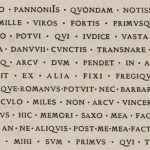
illud in te affectum principaliter universitatis accendit, quod quos olim Latinos fieri exegeras barbaros deinceps esse vetuisti. non enim potest umquam civicis pectoribus elabi, quem te quantumque nuper omnis aetas ordo sexus e semirutis murorum aggeribus conspicabantur, cum interiectis aequoribus in adversum perambulatis et vix duodeviginti equitum sodalitate comitatus aliquot milia Gothorum non minus die quam campo medio, quod difficile sit posteritas creditura, transisti. ad nominis tui rumorem personaeque conspectum exercitum exercitatissimum stupor obruit ita, ut prae admiratione nescirent duces partis inimicae, quam se multi quamque te pauci comitarentur. subducta est tota protinus acies in supercilium collis abrupti, quae cum prius applicata esset oppugnationi, te viso non est explicata congressui. interea tu caesis quibusque optimis, quos novissimos agmini non ignavia sed audacia fecerat, nullis tuorum certamine ex tanto desideratis solus planitie quam patentissima potiebare, cum tibi non daret tot pugna socios, quot solet mensa convivas.

This is a precious memory from the post-Roman fifth century, the only eyewitness account we have of a Roman force defying the barbarian invaders successfully. And Ecdicius did it with the style that makes Hollywood movies unbelievable.

If there were more sources from that dark century – the most obscure in our era – we might better judge the deeds of similar Roman heroes in Britain and Spain who fought the barbarian waves: like Cu Chulainn on the strand, uselessly but with nifty footwork. Certainly this was the way that legends were made: in the excited imaginations of populations who had despaired at salvation. Read now in many ways the most moving part of Sidonius’ letter, his description of how Ecdicius was greeted in the city he had just saved.

Imagination may better conceive than words describe the procession that streamed out to you as you made your leisurely way towards the city, the greetings, the shouts of applause, the tears of heartfelt joy. One saw you receiving in the press a veritable ovation on this glad return; the courts of your spacious house were crammed with people. Some kissed away the dust of battle from your person, some took from the horses the bridles slimed with foam and blood, some inverted and ranged the sweat-drenched saddles; others undid the flexible cheek-pieces of the helmet you longed to remove, others set about unlacing your greaves. One saw folk counting the notches in swords blunted by much slaughter, or measuring with trembling fingers the holes made in cuirasses by cut or thrust.

hinc iam per otium in urbem reduci quid tibi obviam processerit officiorum plausuum, fletuum gaudiorum magis temptant vota conicere quam verba reserare. siquidem cernere erat refertis capacissimae domus atriis illam ipsam felicissimam stipati reditus tui ovationem, dum alii osculis pulverem tuum rapiunt, alii sanguine ac spumis pinguia frena suscipiunt, alii sellarum equestrium madefacta sudoribus fulcra resupinant, alii de concavo tibi cassidis exituro flexilium lamminarum vincla diffibulant, alii explicandis ocrearum nexibus implicantur, alii hebetatorum caede gladiorum latera dentata pernumerant, alii caesim atque punctim foraminatos circulos loricarum digitis livescentibus metiuntur.

It is tempting to ask whether in Britain the Arthurian legend was not born in scenes like this as one Roman leader or another – an Ambrosius or a Constantine – drove the Saxons back from the hills and returned victorious to Cadbury or another green castrum.

An aside. The account of Ecdicius is also given at third or fourth hand in Gregory of Tours who says that Ecdicius charged with just ten men (rather than 18): like Falstaff’s growing band of ruffians, we have Ecdicius’ shrinking band of partisans.

If we had only Gregory to rely on we would dismiss the account out of hand or rationalise it away. As it is we have the baroque Latin of Sidonius who watched events from the walls of the city and Ecdicius’s success, while remaining inexplicable, is confirmed as fact.

Beach is always on the look out for impossible victories in weird wars: drbeachcombing AT yahoo DOT com

***

28/1/2012: Tacitus from over at Detritus sends some good Sidonius stuff in from his own site.  Then RG, an old friend of the blog, writes  – vis-à-vis ‘certainly this was the way that legends were made: in the excited imaginations of populations who had despaired at salvation’ – There’s an interesting brief exposition of this theory about heroic myth in MK Joseph’s experimental/SF novel The Hole in the Zero. In one segment, the character Paradine becomes a mythic hero, and finds himself described in a book: ‘Lord Paradine is, in fact, a typical example of the kind of heroic superman almost invariably invented in cultures undergoing a final period of steep decline, as compensation for the experience of cultural overthrow. They are then normally taken over and elaborated in the romance cycles of the succeeding culture’. Thanks Tacitus and RG!!

Highland Gladiators December 24, 2011

Posted by Beachcombing in : Medieval

If Beachcombing had another ten years to add to his natural lifespan he would study duels: there is enough bizarre material there for at least a decade of honest work. As it is the years pass and there is little time. So he will offer up here, in passing, just one of those many collected and crudely thrown together, a face off between the warriors of two Scottish clans in 1396. The first mention of the battle at Perth is in the rhymed chronicle of Andrew Wyntoun (obit c. 1423) who may even have seen the duel with his own eyes. The account here is based, instead, on the possibly derivative John Fordun.

In the year of our Lord 1396 a great part of the north of Scotland, beyond the Alps [Moray?], was disturbed by two wretched Caterans [clan warriors] and their follower – namely, Scheabeg and his kinsmen, who are known as the Clankay, and Cristi Jonson with his kin, who are called the Clanquhele. These could not be reconciled by any agreement or treaty, and by no skill of the king or governor could they be reduced to obedience. At length the noble and industrious Sir David of Lindesay of Crawford, and Sir Thomas, Earl of Moray, applied themselves with such diligence and effect that they brought the parties to this mutual agreement that on a certain day they would appear before the King at Perth, and each party choosing thirty of their kindred, they would fight each other, armed only with swords and bows and arrows, and without doublets, or other armour save pole-axes; by this means terminating their contention and restoring peace to the country.

Imagine sixty clansmen dressed in their kilts, bare-breasted with swords arrows and pole axes. What is more they were to fight to the death before ‘the king and governors and an innumerable assemblage upon the North Inch of Perth! And to the death or almost they fought: ‘they fight one with the other, and as if they were butchers preparing oxen for the market as unconcernedly they slaughter each other in turn. Yet among so many there was not so much as one found who was as if mad or fearful, or, sheltering himself behind the back of his fellow, attempted to escape from such slaughter’. No wonder that of ‘the sixty combatants all were slain save one of the Clankay and eleven of the opposite party’. Interestingly there is a scrabble to claim descent from the victors, the Clanquhele, almost certainly the Clan Chattan. The Clankay though has not been identified and no one is queuing up for the honour to be related to the defeated Scots.

And what about the one that got away? The sole surviving member of the mysterious Clankay. There is the detail – in Fordun and elsewhere – that one man was so terrified before the battle began that he dived in the Tay and swam away and  ‘he was pursued by thousands, but could nowhere be found’.

Any other collective duels? Drbeachcombing AT yahoo DOT com

Eating Flags December 22, 2011

Posted by Beachcombing in : Contemporary, Modern

In Beachcombing compendious filing cabinets there is a surprisingly thin folder on flags. ‘Surprising’ as flags, as highly charged symbols, encourage moving and peculiar behaviour. One of the most notable films of the last years is, after all, the Flags of Our Fathers (2006) telling the story of that photograph and Old Glory on Iwo Jima. A recent bit of flag japes was the Canadian raid on Greenland rock in 2005 that ended with the Danish flag being torn down and mailed to the Danish ambassador in Ottawa: the Canadians are always so respectful. There was that embarrassing go-to when Bill Clinton misunderstood the Romanian flag given to him as a gift (with the Communist centre cut out) as a poncho! Memorable too was Chris Patton weeping over the Union Jack as Hong Kong was handed over to the Chinese in 1997.  The most vivid description of the military coup in Chile in 1973 known to Beach is, meanwhile, the description of a pilot fighting for General Pinochet flying a strafing run at the Presidential palace and finding, to his horror, the Chilean flag in his cross-hairs. And always remember that burning a bit of fabric that happens to have red, white and blue can get you fined up to 7,500 euros in France; while burning the Turkish flag (in Turkey) will get you landed in prison for three years – Kurds beware!

The best flag stories though involves the standards of losing armies: echos of the lost eagles of the Romans. Major Robert Anderson’s shot up flag from Fort Sumter in 1861 became one of the most potent proofs of northern determination in the first days of the Civil War. It is pictured above. The same flag was raised there at the fort again in 1865 by the then General Robert Anderson and the image was borrowed after Pearl Harbour.

”"

But at least Anderson was, in the end, on the winning side. Imagine you have fought under Lee for four years and then in 1865 comes the news that the army is to surrender and that the flag is to be given to the enemy. What do you do in that situation? That ‘bit of fabric’ (as Beach called it above), often riddled with bullets, had held men in line and prevented routs, in desperate moments it was all that stood between defeat and victory, the greatest sacrifices had been made to keep it flying:

Our color bearer knocked down a Yankee with his flag staff, and was shot to death at once. One of the color guard took the flag, and he also was killed; another, Roswell S. Lindsay of F Company, bayoneted a Yankee, and was immediately riddled with balls, three going through him. Four color bearers were killed with the colors in their hands, the fifth man flung the riddled flag to the breeze, and went through the terrible battle unhurt.’

Are you really going to abandon the Virginia battle flag (the flag you had sworn never to fail) or will you hand it over to a colonel from New York or Rhode Island and allow it to become a souvenir in the mansion of a northern governor?

Of course, men in situations like this would do anything rather than let the flag fall into the hands of their foes.  George Barbee of the Forty Fourth North Carolina hurled his flag into the river Appomattox, others burnt theirs. Andrew Payne cut out the centre of his Confederate flag and sewed it into the lining of his coat to get it home: as the poncho stories above suggested there is a post to be written on flags with their hearts’ cut out of them. There are stories too of Confederate flags being ripped up and divided by veterans determined to share the symbol among themselves rather than give it to the enemy.

The most beautiful story though of a flag in a defeated battalion is that of the Italian units of Napoleon’s Imperial army. When the news came in 1814 that these men were to be absorbed into the (hated) Austrian army they took their flags and burnt them, slopping the ashes into soup that all the men would then consume: the flag and the army became one.

Any other good flag stories: drbeachcombing AT yahoo DOT com

***

30 Dec 2011:  Jay writes in about one of the most famous flags of all ‘Your post on surrendering flags makes me wonder about the fate of Hitler’s Blood Flag. This was the most ‘sacred’ symbol of Nazism, being the swastika-blazoned banner that was carried during the failed Beer Hall Putsch in November 1923. It was called the ‘Blood Flag’ because it was stained with the gore of fallen Nazis. Hitler used this flag to consecrate other flags, including the battle standards of the SS. The rather spooky ceremony can be seen in “Triumph of the Will” of him touching it to the banners one by one. Anyway, as far as I know, the flag was not found at the end of the war. I imagine it decorates some bunker in Argentina or secret Neo-Nazi Fortress of Doom in Antarctica.’ Thanks Jay!

Dunkirk and Golden Bridges December 13, 2011

Posted by Beachcombing in : Contemporary

Dunkirk is one of those moments in recent history that you have to look at sideways to have even a modest chance of understanding and still then there is something that defies analysis. How was it that the British Expeditionary Force, demoralized, bloodied and on the run, with the greatest army of the twentieth century snapping at its heels was allowed to slip away to Britain? (For the sake of present arguments we will forget the hundred thousand Britons, a third of those who had gone to France, who didn’t make it home.)

How indeed? Churchill called it a ‘miracle’, which is one way of ending the debate. Others were just left scratching their head. Lieutenant General Henry Pownall (who given his exalted position in the BEF should have known) was still worrying over the question in Burma four years later: ‘I shall not ever forget my feelings during the black fortnight in May, 1940, when the capture or annihilation of the entire BEF seemed almost inevitable. I do not yet know how that came to be avoided.’

There are numerous factors: the desperation and the skill of the Allied troops defending the perimeter; the unbelievable calm on the Channel; the long history of the Royal navy getting British troops out of jams (‘five years to build a ship, five hundred years for a tradition’)… But among these there is only one that matters and that is Hitler.

On 24 May Hitler ordered a ‘halt order’ to his armour crashing into France. For three days German armour remained immobile, recuperating before pushing on to finish the job. The BEF escaped because of Hitler’s decision. The question, of course, is why Hitler called a halt to his army at just the point the sword had been swung back to finish off the Allies?

Here there are different theories but they might be summed up as follows:

(i) ‘That idiot Goering’: Goering convinced Hitler, 21 May, that his Luftwaffe could finish off the BEF, trapped in the pocket. He was wrong as it happened, but Hitler believed him.

(ii) ‘That idiot Hitler’: Hitler just couldn’t believe his luck. Something was going to go wrong. The British and the French were about to violently counter attack. Best consolidate.

(iii) ‘Stabbed in the Arras’: A notable British counter attack 21 May had unnerved the Germans and particularly Hitler: an exaggerated report from Rommel helping.  The Allies seemed stronger than the Germans had believed.

(iv) ‘Golden Bridge’: Our real war is with France not with Britain. Whip the British and then let them get away. It will be easier for the British to negotiate their way out of the war and to have cordial relations with us afterwards if their army has not been annihilated.

The conventional answer is point (i) and (ii) and probably in the end the larger part of the truth is there: of course, all four of these could be reduced to ‘That idiot Hitler’. (iii) has become more popular in British histories over the last years for obvious reasons: again though it is just an aspect of (ii). Most intriguing though is the question of (iv). Is it possible that, on some level, Hitler wanted the British to escape destruction?

Perhaps the pertinent words here are ‘on some level’. The human mind is complex and even something as simple as Beachcombing waking up at 4.00 am this morning has about fifty different causes, most impossible to separate from each other. How much more then were Hitler’s motives likely to be mixed and complicated as he decided the destiny of a continent? Perhaps even Hitler himself would have had problems sorting them out: though a predatory weasel like AH would not, in any case, have wasted much time on these kind of reflections.

Certainly, there are clues that Hitler might have, in part, wanted the British to get away. Some of these clues come too late to be taken entirely seriously: Hitler, for example, in 1945 talked of how Churchill had not appreciated the ‘sporting chance’ he had given the British.  But this could so easily be Hitler rearranging the past to better write his obituary: that was, at that date, fast approaching…

Other comments from his secretary and a Luftwaffe general suggest though that at the time Hitler said similar things. Were these perhaps comments that came after the BEF had escaped and so were a similar rationalization? Was this Hitler, the expert manipulator, saying different things to different peoples as he so often did?

Most contemporary historians have no time for these kinds of arguments, but as John Lukacs argues in his excellent Five Days in London (the seed for much of what is written here) there might just be something to the Golden Bridge. If so it is the most striking example of Hitler completely misunderstanding the British.

Any other explanations for the 'miracle' of Dunkirk? drbeachcombing AT yahoo DOT com

16 Dec 2011: Louis writes ‘There is, as far as I can see, a good explanation for this Inhis book: The Blitzkrieg legend: the 1940 campaign in the West  von Karl-Heinz Frieser,John T. Greenwood, Mister Frieser gives his analysis of what happened during 23 and 24 May. Von Runstedt gave a halt order on the 23rd, (probably because he either very anxious about his flanks, or jealous of von Manstein and his Sichelschnitt plan and wanted it to fail), and was sidelined by the GeneralHQ (OKH), and deprived of the Panzer Army group. When Hitler came to von Rundsteds HQ, he was appalled, because he did not know of this decision to deprive von Rundstedt of the Panzer army group. And Hitler then made a political decision. He confirmed the halt order of von Rundstedt, and chastised the GeneralHQ (OKH) for not informing him (of the change in command of the Panzers), and not waiting for his input on this. HE, Hitler, was the master of Germany and he did not want an independent army that could take decisions like that without his knowledge and OK. The way it is stated in the book, and with all the rest of the “Options” more or less unlikely (both militarily and political) this looks to me the only viable option. Below is the paragraph from the German Wiki about the Battle of Dunkirk, which more or less says the same thing, about this being a political decision, and not a military one. Die Gründe für den Haltebefehl vom 24. Mai werden noch heute kontrovers diskutiert. In der Regel wird der Haltebefehl Hitlers auf dessen eigene Autoritätsdurchsetzung zurückgeführt. Da er während des bisherigen Westfeldzuges als militärischer „Führer“ völlig außen vor gelassen wurde, nutzte er den Haltebefehl dazu aus, seine eigene Autorität zu festigen. Andere Gründe, beispielsweise die eingeschlossenen britischen Truppen könnten als Unterpfand für eventuelle Friedensverhandlungen mit den Briten dienen, werden allerdings als Erklärungsversuche häufig zurückgewiesen. But whatever the reason, it did save a lot of British, and also lots of French, troops from going into captivity’. KMH writes, meanwhile, 'I am in favor of the last idea because I don't believe Hitler wanted  war with his equals or superiors. According to his master race theory, he was completely justified in conquering and enslaving the inferior races such as the Poles, Slavs, etc., mostly in the East. Engaging Britain, if necessary,  should have only come after all other objectives had been achieved, not at the beginning. The suspicious flight of Hess to Britain supposedly to discuss ending the hostilities may support this argument. However, the vainglorious visions of Hitler ended in a two-front war he originally vowed never again to be caught up in. For what it is worth, even the witches in England were devoutly praying for calm weather to rescue the BEF in addition to the customary believers. Philosophically, without these initial disasters such as Dunkirk and Pearl Harbor, the later true successes such as decoding the enigma machine, and new inventions such as the proximity fuse may not have come as quickly.' Several readers wrote in to say that the golden bridge is a way to dampen British and French heroism at Dunkirk. Thanks Louis, KMH and others!

Gunfire in Notre Dame November 9, 2011

Posted by Beachcombing in : Contemporary