Welsh Pre-Marital Sex, c. 1850 May 11, 2012
Posted by Beachcombing in : ModernA German tourist in Wales in the 1850s. Our hero befriends, Sarah the girl of the house where he is staying and on whom, Beach suspects, he had something of a crush. However, Sarah, who is the only member of the house who can speak English, is walking out with Owen, the elder son of a nearby farm. One evening the German walks back to his room through the gloaming and meets Sarah who seems a little standoffish.
I wished Sarah good night, and went upstairs. But I had scarce reached my room, when I heard the kitchen door and then the house door gently opened. Growing curious, I went to the window, and saw, by the light of the moon, Sarah crossing the yard and proceeding towards a stall, from whose half open door a male figure speedily emerged, which could be no other than Owen. ‘By Jove!’ I thought ‘she did not stay up on my account alone.’ I hoped to be witness of a Welsh pastoral in storm and rain; but I had deceived myself; the Phillis [!] of our farm had arranged matters more comfortably. She walked back across the yard, and her faithful shepherd behind her, and then into the kitchen. How my astonishment increased, however, when, instead of sighs, oaths, and kisses, I only heard a sound imitating that Owen was pulling off his boots and Sarah her shoes. And I was right: they came up-stairs in their stocking feet, passed my door, and entered Sarah’s little chamber. ‘No,’ I said to myself ‘that is a little too much, that is beyond decency.’ The girl was scarce eighteen years of age, with childish eyes, retiring behaviour, modesty in language and conduct. Celts! Celts! I might have thought to myself at once that they would not belie their nature. But what does it concern me? Perhaps we are living in a Paradise, where the Serpent has not yet spoken!
It is a fascinating scene. Here we see a rare intimate glimpse of pre-marital ‘heavy petting’ in the nineteenth century. It has long been known by social historians – as it was known by social commentators before them – that sex took place before marriage in the nineteenth century in the working classes. However, for the most part evidence had to be amassed from bulges in wedding dresses or obtuse calculations from census returns cross-referenced with birth certificates. Pregnancy, in fact, was often the cue for courting to end and engagement and marriage.
In just the same way as it is said that today a quarter of all Italians are conceived in cars (how did anyone come up with this statistic?), a third of all lower class children in the nineteenth century (Beach made this statistic up) were the result of hurried love-making in barns and under hedge-rows.
Sarah – who went on to marry Owen – seems to have been enjoying here a custom where the courting couple spend an night together in bed as a form of marriage commitment: with the knowledge of parents. ‘Of course’, nothing untoward happened in the bed room, because then Sarah’s honour would have been besmirched. Or that, at least, was the theory that our German friend subscribed to… Any other examples of formalised loving before marriage in Christian countries prior to the twentieth century? drbeachcombing AT yahoo DOT com
***
14/May 2012. Akauma writes in: ‘Well… here I am with more stories than I have time to write re: premarital intimacy (if you will). Half of my family has been in the states from, let’s see… the wheel had been invented… but Moses was still a pup… actually, some of my paternal relatives really did come ‘over on the Mayflower’ though most wound up in Rhode Island since they weren’t exactly ‘Puritan material’… …having followed in my father’s footsteps and taken an interest in family history (read that genealogy), I have to say that although marriage due to pregnancy was hardly the norm, it was quite common and although families tried to ‘fudge’ records (including Bible records!) rather often in such cases, it’s usually not all that hard to find actual birth &/or marriage dates. One such alteration was a family Bible entry which read 21 March ALN… I scratched my head a long time over this one but finally discovered the marriage record from the town of Alna, Maine in the year 1815. What is really odd about this one is that their 1st child was born on 15 Nov 1815 and, really, who would even suspect what with so many babies conceived within the 1st days of marriage? But they knew that the not quite 9 month pregnancy was really full term, I suppose… My maternal family is German and there are several early babies on this side of the pond in the 19th century, but the case that interests me most occurred in Germany in the mid-18th century and was certainly over a year (if memory serves) between birth & marriage and simply too hard to hide and so was recorded as it happened sans whitewash. I’ve been told that primogeniture & a law disallowing marriage for those who did not own property caused quite a number of ‘late’ marriages. If this is the reason it certainly explains the large German/American population! I could go on but will end with an observation; it seems that in America at least the late 19th century brought about some highly imaginative forms of marriage &/or ‘utopian communities’. In at least one neighborhood in Rhode Island where my family lived (small cough here) marriage seemed to be looked upon as optional and procreation with a number of ones neighbors appears to have been a hobby that some engaged in rather often. Oh… one more! from the same general area which is my ‘fave’ example of a creative sense of morality. Seems a gentleman married a widow who had children by her 1st marriage, at least one of whom was a girl. The gentleman & his formerly widowed wife proceeded to have a number of children as time went by and as time went by earlier mentioned daughter of the widow grew to young womanhood and before one can say ‘bigamous cad’ the gentleman, if we can call him that, had set up a second household across town replete with a common-law-stepdaughter-wife & children. Least you think I am simply intrigued by titillating tales, I find this example particularly interesting because the children/step-grand children’s births were all duly recorded with both parents named and, this being the case, everyone in town must have known, including earlier mentioned formerly widowed wife, who as it would happen, was still mothering children by said “gentleman” who (the children, not the gent) would then have been the gent’s common-law-stepdaughter-wife’s half brothers & sisters and technically I imagine her step-grandchildren to boot.’ Wade has a link to a fascinating article on Courtship, Sex and the Single Colonist. Then Chris: ‘Well, there’s the whole tradition of “bundling“, which Lawrence Stone argues can be traced to the 17th century at least in England. But contra Philip Larkin, sexual intercourse wasn’t actually invented in 1963, so I’m sure there are other examples if you can find them.’ And in case you are wondering about bundling but don’t have time to click Kate writes in to explain: ‘Bundling was an old Yankee and Pennsylvania custom. A courting couple would spend the night together in bed, wrapped in blankets and sometimes separated by a board running the length of the bed. Traditionally, they were to spend the time talking, presumably about future plans, but this didn’t always happen. It occurred only during the winter months and was done with the full knowledge and approval of both sets of parents. It sounded like a sort of pre-marriage try-out. My understanding is that if a pregnancy resulted, no great shame was attached to the circumstances and the couple married.’ Thanks Akauma, Wade, Chris and Kate!
18 May 2012: John G. writes ‘Should one ever wish to go on mastermind can you think of a better specialist subject “and your subject tonight is Welsh Pre-Marital Sex”. More seriously in a time and place where your “pension plan” was your family it seems remarkable common sense to make sure that any binding union was going to be fruitful, making sure that the Bride and Groom could reproduce together would be to the advantage not only to the happy couple but also to their parents. On the subject of reproduction, I was told years ago of an interesting custom in Malta, if a bride had not conceived within a year of marriage the local priest would go to the family home to “pray” with the girl that she might be fertile, to ensure that the “prayer” session was not interrupted by the husband the priest would hang his umbrella over the front door handle as a form of “do not disturb” notice.’ Thanks John!!
23 May 2012: SY sends this in from a late eighteenth century English work. ‘And here amongst the usages and customs, I must not omit to inform you, that what you have, perhaps, often heard without believing, respecting the mode of courtship amongst the Welch peasants, is true. The lower order of people do actually carry on their love affairs in bed, and what would extremely astonish more polished lovers, they are carried on honourably, it being, at least, as usual for the Pastoras of the mountains to go from the bed of courtship to the bed of marriage, as unpolluted and maidenly as the Chloes of fashion; and yet, you are not to conclude that this proceeds from their being less susceptible of the belle passion than their betters: or that the cold air, which they breathe, has ‘froze the genial current of their souls’. By no means; if they cannot boast the voluptuous languors of an Italian sky, they glow with the bracing spirit of a more invigorating atmosphere. I really took some pains to investigate this curious custom, and after bing assured, by many, of its veracity, had an opportunity of attesting its existence with my own eyes. The servant-maid of the family I visited in Caernarvonshire happened to be the object of a young peasant, who walked eleven long miles every Sunday morning to favour his suit, and regularly returned the same night through all weathers, to be ready for Monday’s employment in the fields, being simply a day labourer. He arrived in time for the morning service, which he constantly attended, after which he escorted his Dulcinea home to the house of her master, by whose permission they as constantly passed the succeeding hour in bed, according to the custom of the country. These tender sabbatical preliminaries continued without any interruption near two years, when the treaty of alliance was solemnized: and so far from any breach of articles happening in the intermediate time, it is most likely that it was considered by both parties as a matter of course, without exciting any other idea. On speaking to my friend on the subject, he observed that, though it certainly appeared a dangerous mode of making love, he had seen so few living abuses of it, during six and thirty years residence… in that county, where it, nevertheless, had always, more or less, prevailed, he must conclude it was as innocent as any other. One proof of its being thought so by the parties, is the perfect ease and freedom with which it is done; no awkwardness or confusion appearing on either side; the most well-behaved and decent young women going into it without a blush, and they are by no means deficient in modesty. What is pure in idea is always so in conduct, since bad actions are the common consequences of ill thoughts; and though the better sort of people treat this ceremony as a barbarism, it is very much to be doubted whether more faux pas have been committed by the Cambrian boors in these free access to the bed-chambers of their mistresses, than by more fashionable Strephons and their nymphs in groves and shady bowers. The power of habit is, perhaps, stronger than the power of passion, or even of the charms which inspire it; and it is sufficient, almost, to say a thing is the custom of a country to clear it from any reproach that would attach to an innovation. Were it the practice of a few only, and to be gratified by stealth, there would, from the strange construction of human nature, be more cause for suspicion; but being ancient, general, and carried on without difficulty, it is probably as little dangerous as a tete-a-tete in a drawing room, or in any other full-dress place, where young people meet to say soft things to each other. A moon-light walk in Papa’s garden, where Miss steals out to meet her lover against the consent of her parents, and, of course, extremely agreeable to the young people, has ten times the peril’ Thanks SY
Aggressive Ghost in Fourteenth-Century Germany May 8, 2012
Posted by Beachcombing in : Medieval, ModernBeach is taking a long trip today on a plane with his three-year-old daughter: a first visit to the patria with Little Miss B who is thrilled because she is going to see otters AND eat fish and chips. In this time of holiday and reduced writing he has lined up several reserve posts taken from his reading the last weeks: sorry if emails are not answered quickly. The first of said reserve posts is a very peculiar poltergeist case from the writing of Johannes Aventinus (obit 1534). This is an eighteenth-century English translation for Beach has not had the time to track the Latin down. ***Scroll down for a serious change to the chronology of this piece***
In Germany, not far from the Town Bing [Bingen] where the River Navas mixes itself with the Rhine, there is a Village, commonly call’d Cament (quasi Caput Montium) a Name given it by the Romans, when they possessed that Country, because there begin the Mountains which run along with the Rhine towards the North. There, in these our Days [no date given], a revolted and roving Spirit has done many strange things, playing prestigiating Tricks, and infesting the inhabitants. First, this cursed Spirit, seen by no Man, began to throw Stones at Persons, and to knock at Doors.
So far it is life in a modern inner city neighborhood. But then things start to get a little strange. This poltergeist (?) becomes human.
Soon after, this pestilent and wicked Genius taking a Human Shape, gave Answers, discover’d Thefts, accused many of Crimes, and set a Mark of Infamy on them, stirr’d up Discords and ill-will among Persons:
Then comes the victim.
By degrees, he set fire to, and burnt down Barns and Cottages, but was more troublesome to one Man than the rest, always keeping with him wherever he went, and burnt his House and, to stir up the whole Neighbourhood to destroy this innocent Man, the wicked Impostor openly declared, that for this Man’s Crimes the Place lay under a Curse, and would be unfortunate so that the Man was forced to lie without doors, all Persons denying him entrance into their Houses, they looking on him as one followed by evil Spirits.
The ‘victim’ next took an ordeal: though it is not clear why.
He, to satisfy his Neighbours, carry’d a burning-hot Iron in his Hand, with which, not being hurt, he prov’d his Innocence: nevertheless the wicked Spirit burned his Stacks of Corn in the Fields, and as he was daily more and more troublesome, the Country People were forced to acquaint the Archbishop of Mentz [Mainz], with it, who sent Priests to expiate and lustrate the Fields and Villages; which they did with solemn Prayers and consecrated Water and Salt. The wicked and disturbed Spirit at first strove against them, and wounded some with Stones: but being overpowered by divine Exorcisms, and adjured by efficacious Prayers, he at length ceased, nor did he anywhere appear. When the Priests were gone, this pestilent Spirit returned again, and said, ‘while those bald-pated Priefts mutter’d I know not what, I lay hid under the Amiculum [vestment!] of one of them (whom he named) who, by my persuasion, lay the last Night with his Host’s Daughter’. And having said this, the wicked Ghost went off with a mighty roaring Noise [a laugh?], and left the Country quiet.
For all Beach knows this may be a Fortean classic,but he has never read about it before and found it gripping and unusual. The sequence of events are not clear. The spirit causes problems, then seems to become one of the villagers (or at least is physically present), then picks on the ‘victim’ who presumably takes the ordeal because he has been accused of witchcraft? Any other key of interpretation: drbeachcombing AT yahoo DOT com
***
8 May 2011: Invisible puts this polt in a wider context: What a wonderful poltergeist story! Quite new to me! The “stages” of this particular poltergeist reminded me of the escalating violence of the Bell Witch case, which, in spite of the name, is a famous American poltergeist story. The Bell Witch ordeal began with knockings and scratchings, progressed to human-like noises, then to speech. The entity also threw stones. Like the German manifestation, it focused its worst violence on one man: the father of the Bell family, John Bell, whom, it is claimed, the “witch” murdered, although other persons in the family were scratched and slapped. It also (like Gef, the Talking Mongoose of the Isle of Man) knew gossip and scandalous tittle-tattle from neighboring communities. General Andrew Jackson was said to have been a witness to some of its antics. The one thing missing from the Bell Witch case, which is found in the German story and many other poltergeist tales, is the setting of fires. There seems to be a sub-species of incendiary poltergeists–I’ve got a number of cases in my files like this more recent one. The stone-throwing feature is also reminiscent of this “stone-throwing devil” case: It is curious that the narrator of the German story does not suggest the identity of any perpetrators, other than the targeted man who cleared himself by ordeal. The detail of the German creature taking human shape is very unusual, although in the Bell Witch case, events started with a sighting of a “strange animal” and the entity eventually called itself “Kate”. One wonders if eventually it would have manifested itself as a human figure. Poltergeists usually “wear out” before they can become visible apparitions and mostly confine themselves to making noises and hurling objects about. It is also very common for the clergy to be called in to deal with or exorcise the poltergeist. Inevitably this makes things worse, just as in the German story. Strange to think that poltergeists (or is it the folklore of poltergeists?) follow the same patterns today as they did in 16th-century Germany. Sceptics maintain that poltergeist activity is all faked by mischievous adolescents. The late Dr. William G. Roll, who studied poltergeist phenomena extensively, proposed that people plagued by poltergeists have a unique pattern of brain activity. No matter what the reason for such occurrences, it is striking that poltergeist stories from many different countries and time periods relate similar incidents and follow similar arcs.’ Thanks Invisible!
14 May 2012: Invisible now writes in: ‘The day after your post on the German stone-throwing poltergeist my copy of Poltergeists: A History of Violent Ghostly Phenomena by P G Maxwell-Stuart arrived. [just apported right onto the seance room table!] On page 17-18 is the same German polt account attributed to the Fulda Annals, under the year 858 [Citation: Annales Fuldenses, ed. G. Pertz, Hannover: Hahn 1891 51-53.] It contains all the same details: a house near Bingen, the knockings, stones thrown, the fires, the man accused by his neighbors and undergoing the red-hot iron ordeal, the priests arriving to sort things out, the evil spirit claiming that a particular priest had slept with the daughter of the town proctor. The only detail lacking is the spirit taking human form. Happy to send a scan or transcription if you like. I think you would like this book (can’t recall if you already recommended it). Excellent primary sources although he inexplicably omits Caesarius of Heisterbach and his Dialogue on Miracles and Foissart’s Chronicle, with the wonderful story of “Orton“, a familiar spirit, who, like Gef, the Talking Mongoose, reports the news from all over.’ Something doesn’t add up here. Either Beach’s source misunderstood the origins (most likely) or Invisible’s source has got it wrong. Likely the first. More, we hope, to follow.’ Thanks Invisible! PS same day. It is in the Annals. Here is the Latin: Villa quaedam haud procul ab urbe Pinguia sita est, Caput-montium vocata, eo quod ibi montes per alveum Rheni fluminis tendentes initium habeant, quam vulgus corrupte Capmunti nominare solet; nbi malignns spiritus evidens nequitiae suae ostendit indicium. Nam primum quidem lapides iaciendo et parietes domorum quasi malleo pulsando hominibus loci illius infestus efficitur; deinde vero manifeste loqui et furtim sublata quibusdam prodere, post haec discordias inter habitatores eiusdem loci seminare; denique omnium animos contra unum hominem concitavit, quasi peccatis illius exigentibus ceteri talia paterentur: et ut maius odium adversus eum excitaret, in quamcumque domum idem homo intravit, statim malignus spiritus illam exussit. Igitur ex necessitate coactus cum uxore et filiis foris mansit in agris, omnibus propinquis suis sub tectum suum illum suscipere timentibus. Sed nec ibi tutus fuisse permissus est; nam cum universas fruges suas congregasset et in acervos collegisset, spiritus nequam ex inproviso veniens cunctas incendit. Ut autem animos vicinorum illum interficere cupientium placare potuisset, idem ipse ferro fervente de omnibus, quae ei obiciebantur, criminibus se ostendit immunem. Missi sunt itaque ab urbe Mogontiaca presbyteri atque diacones cum reliquiis et crucibus, qui malignum spiritum ab eo loco expellerent. Sed illis in quadam domo, ubi maxime saeviebat, letanias agentibus et aquam benedictam spargentibus antiquus hostis nonnullos ex eadem villa illuc convenientes iactando lapides cruentavit; tamen modicum temporis a sua infestatione quievit. Postquam vero inde discesserunt, qui missi fuerant, idem hostis multis audientibus lugubres edidit sermones; nam presbyterum quendam nominatim exprimens se sub cappa illius stetisse professus est ea hora, quando aqua benedicta aspergebatur in domo. Quibus se prae timore signantibus idem hostis de eodem presbytero: ‘Meus’, inquit, ‘proprius est servus; a quo enim quis superatur, huius et servus est; quia nuper me suadente cum filia procuratoris istius villae concubuit’. Quod factum nullus mortalium antea sciebat exceptis his, qui hoc crimen perpetraverant. Patet ergo, quia iuxta veritatis sententiam nihil opertum est, quod non reveletur. His et huiusmodi malis apostata spiritus in loco supra dicto per tria annorum curricula infestus non ante cessavit, donec universa pene aedificia ibidem succendendo consumeret.
The Babel of History May 2, 2012
Posted by Beachcombing in : Ancient, Contemporary, Medieval, Modern
***Dedicated to Mike Dash***
The past according to a much worn-line is ‘a foreign country, they do things differently there’. Of course, if this were all then history would be a doddle. It would be enough to fill the Cutty Sark with sabres and give the natives music sheets for their acres. But, unfortunately for those who like the easy life, the past is many different countries and, almost as bad, the present is also a vast thalassocracy stretching to the horizon. The success of any historical venture will depend on the proximity of the historian’s land to the one he or she wishes to travel to: and that proximity depends to a large extent on language.
For a start, one language is rarely enough to study the past. There are the tongues that were spoken by the people(s) you want to study multiplied by the languages spoken by the nations that study them today. To deal with the Anglo-Saxons, for example, you would need Anglo-Saxon and Latin and perhaps some rudimentary knowledge of the Celtic languages or Norse. But you would also need English, German, French and (preferably) Spanish and Italian for secondary sources. That is bad enough, but let’s say you had an attitude problem and decided to study Anglo-Saxon missions in Scandinavia: then you would have to add Swedish, Danish and Norwegian. Or perhaps you decide to do your doctorate on Anglo-Saxons in the Varangian Guard in eleventh-century Constantinople: Greek, ancient and modern would matter and quite possibly Turkish and a couple of Slavic languages. If you are really serious about the Varangians you could do a lot worse than marry a Bulgarian.
Some areas of the past are neglected not then because they are inherently difficult in source terms, but because there are impossible language combinations. In some senses, this is becoming less common (for secondary sources) as English becomes the language of choice in academic journals. But, in other ways, it is getting worse as ‘minority’ or despised languages start to assert themselves. Take another example: the ancient Mediterranean was ultimately split into a Latin speaking western half and a Greek speaking eastern half. In the good old days scholars needed Greek, Latin and the colonial languages, French and English to study the Roman province of Africa. Today the Mediterranean is split between the Romance and Slavic speaking north: with Albania and Greece tagged on and the Arabic speaking ‘southern shore’. In the twenty-first century it will be a handicap for a Roman historian determined to study that same province not to know at least some Arabic for archaeological reports. Greek and Latin and a smattering of modern European languages will no longer be enough.
Of course, these kinds of examples are not just restricted to the classical world. There is no definitive book on the Voyage of the Damned, the final phase of the war between Japan and Russia in 1904/1905 for the simple reason that no scholar of stature has both Japanese and Russian. Ditto pogroms in the Second World War: who has Hungarian, Romanian, German, Polish and the Baltic languages? The Nazis and their friends killed many of those who could have replied ‘yes’ to that question. More modestly, the present author’s most productive medieval research took place a decade ago with material involving three different Indo-European language families. There was, in scholarly terms, lots of low-hanging unpicked fruit simply because no one who had troubled to look at it, had had this combination of languages before.
Then if this all sounds easy what about this email sent in by Mike Dash on the languages needed to master the story of the Mongols?
Someone – it might have been JJ Saunders – commented that to do a thorough history of the Mongols would require a historian who spoke, at minimum, Chinese, Japanese, Persian, Turkish, Arabic, Armenian, Syriac, Latin and Russian (just for the original source materials), plus of course ideally Mongol itself (for the Secret History.) Then to read what historians have written, which has not been translated, you’d need at least German and French as well as English, and ideally Czech and Hungarian. Hence in a discipline in which it is rare for a seminal work to stand unchallenged for more than 20-40 years (the longer period, I think, for the medieval stuff) there is always W. Barthold’s Turkestan Down to the Mongol Invasion, originally a PhD thesis defended at St Petersburg in 1900. It remains the standard work because no one since has mastered all the languages required to supplant it. It would be interesting to know if any still-standard work on any other place or time antedates it.
Beach wonders if anyone could come up with a more challenging selection than Mike’s. It makes messing about with Old English and Greek look positively tame: drbeachcombing AT yahoo DOT com
***
Singing Enemy Songs: Lili Marleen April 13, 2012
Posted by Beachcombing in : ContemporaryOne of the most moving moments in cinema is the extraordinary ending of Kubrick’s Paths of Glory. A young German girl is pulled in front of a crowd of French soldiers and forced to sing. The poilu mock her but as she nervously begins the mood changes. The soldiers join in and drown her anxious, uncertain German, humming along. What begins as a musical lynching ends as a moment of unlikely understanding between enemies.
It works in a film, but has music ever really united foes in this way? Sure, there are stories of Silent Night/Stille Nacht being sung on both sides of the trenches at Christmas in the First World War. But these are difficult to document. However, there is one striking example from the Second World War, Lili Marleen, that can be documented by record sales alone.
Lili Marleen had the unlikely trajectory of so many surprise successes. It was written as a soldier’s poem in 1915, published in 1937 (in a very different Germany) and then set to music and recorded in August 1939 just before the Reich knocked rather loudly on the door of the Polish corridor. The song was a complete failure and would have been entirely forgotten had it not been played by chance in 1941 by Germany’s military Radio Belgrade. There it was particularly picked up by Rommel’s Afrika Corps, listening and dreaming of home on the other side of the Med: Rommel himself is said to have loved the song, though Beach has found no good source for this.
A problem. The song was not very ‘Nazi’. In fact, its popularity infuriated Goebbels who briefly banned it – it did not help that its singer, Lale Andersen, had many Jewish friends. The song describes, after all, not the inevitably tedious march of the master race, but a suffering soldier with a heavy pack recalling a girl back home. And all this sung to a nostalgic, jerky, but catchy Blue Danube type tune! The arms of the swastika were wilting by the time you got to the end of the second verse.
However, it was these qualities that meant that it was able to cross the enemy lines with both the Dominion and British troops in the Eighth Army in Egypt and Libya singing along as they piled up sand bags or carried munitions back and forth. By then Radio Belgrade, often listened to by the Allies, was using the song as their signature.
The war in the desert was a bloody and unpleasant affair: but it involved a degree of chivalry not found on any other front as combatants (all in a foreign land) found themselves also fighting the dunes and the sun. (Memories of the weather wars). In this unusual situation Lili Marleen became a motif of solidarity between the troops, friends and enemies alike. One British security agent, for example, remembers that whenever he was to debrief a German soldier he would always break the ice by asking what the latest alternative verses to Lili Marleen were: countless parodies and subversive versions were composed.
There was initially resistance to Allied soldiers singing the music: remember that some English-speakers had tried to get Beethoven banned for the duration of the World Wars, so a contemporary German number was bound to be controversial. However, in the end, Lili Marleen’s popularity was such that an English version became a commercial ‘sure thing’. A catastrophic rendering was given by Vera Lynn who is just too strait-laced and, well, English to do it justice. The best version in English is perhaps Marlene Dietrich’s sultry and very enjoyable purring. And from 1941 the song was translated into various languages among the combatant nations. Today it belongs to all of them.
Any other soldiers-brought-together-by-music stories? drbeachcombing AT yahoo DOT com
***
First on the subject of LM Howard M writes ‘I thought you might enjoy — if enjoy is the right word — this version (attached) of 07 Lilli Marleen recorded by Goebbel’s own propaganda swing band, Charlie and His Orchestra. It’s a bit atypical for Karl Schwendler’s outfit, since this is performed straight and sentimental. Nonetheless, the Reich seemed to feel that a German song popular with Allied soldiers had some propaganda value, or they wouldn’t have recorded it. Note that it’s not the usual English translation, and was probably written by Schwendler himself. I don’t know if you’re familiar with the music of Charlie and His Orchestra; their best-known recordings are parodies of popular American and British dance numbers, characterized as much by exceptional musicianship as by lyrics full of antisemitism, racism, and frequent boasts of Aryan supremacy. The history of jazz and jazz musicians under the Third Reich is fascinating in and of itself (Jews! Drug addicts! Negermusik!), but I’m a little too steeped in jazz history to know if it qualifies as “strange” for your purposes.’ Katie J writes in ‘After the Battle of Fredericksburg in December 1862, the Union regimental bands started playing at twilight. They played pro-Union songs, naturally. After a while, Confederate band started playing their songs. Finally, the Confederates started to play, ‘Home, Sweet Home’ and Union bands joined in. It’s recorded that soldiers of both sides joined in. I’m pretty sure that ‘Home, Sweet Home’ was a neutral song, but Fredericksburg was a horrific battle and oddly enough, there are a few well-documented acts of kindness and mercy between the opposing armies. Perhaps the combatants felt the need to reassure themselves of their common humanity.’ On the Civil War there is, as Tacitus points out, that beautiful story about Dixie. Abe Lincoln was said to be rather fond of Dixie Invisible writes in with an example of the Battle of the Bands also from the CW: See Battle of the Bands and the Battle of the Bands at Stone River. ‘As’ Invisible continues ‘for soldiers being brought together by music, (but not on opposing sides) you can do worse than think of all the regimental pipers who stood their ground in the face of charging cavalry, rallied the wavering when badly wounded, and piped their men over the top or onto the beaches. Here’s the obituary of one, The Mad Piper, Bill Millin JEC writes ‘When I think of incidents of one side singing the enemy’s songs, I’m reminded of a scene from the book Das Boot and the movie of the same name in which the crew of u-boat U-96 lustily sing ‘Its A Long Way To Tipperary’. The book was written in 1973 by former Kriegsmarine propaganda officer Lothar-Günther Buchheim and, while fictionalized, closely follows his mission on the real U-96 in 1941. In the scene, the politically reckless captain clearly enjoys ordering his over-formal First Officer, a committed Nazi, to replace a Berlin propaganda broadcast being played over the p.a. system with the old English music hall song. The crew’s enthusiastic singing tells the reader/viewer that they heartily approve of the little tweak of the young Nazi’s inflated ego. Because the book and film are so well documented as having been heavily autobiographical, I feel safe in submitting this as a real-life incident.’ As a sidenote, the captain of the actual U-96, Korvettenkapitän (Lieutenant Commander) Heinrich Lehmann-Willenbrock, was awarded the Knight’s Cross with Oak Leaves (Ritterkreuz des Eisernes Kreuzes mit Eichenlaub) for conspicuous and multiple incidents of gallantry, and, although wounded in action, survived the war to serve as a consultant on the masterful 1981 Wolfgang Petersen film based on Buxhheim’s book.’ KMH writes: Music itself does have a particular quality of rising above national distinctions. Is it possible to imagine a world where German music was appreciated only by the Germans, Russian music only appreciated by the Russians, etc.? Music, as the world’s foremost international language, seems to have done its share in promoting a global reluctance to indulge in genocidal thoughts and activities. The exception seems to be the Muslims, who have their own music, but non-Muslims aren’t aware of or familiar with it. Problem nations aren’t musical nations. The same goes for problem ideologies. This may be one reason why they inevitably fail to achieve their objectives.’ And to round off perfectly Grand Old Partisan, Michael Zak sent in this video of that famous Cold War Warrior Edward Rowny playing LM on his harmonica. Thanks to MZ, KMH, Invisible,Tacitus, Katie J. and Howard!
30/04/2012: Mike Zak also writes in: ‘Yankee Doodle was originally a British mockery of the American colonials’ Thanks Mike!
A Witch’s Secret Letter April 11, 2012
Posted by Beachcombing in : Medieval, ModernThis is perhaps the most extraordinary ‘witch’ source of them all. In 1628 Johannes Junius, aged fifty five, burgomaster of Bamberg was taken in by the local authorities as a witch. After days of interrogation he writes a secret letter to his daughter explaining his decision to confess to witchcraft. Here is the voice of the victim that is almost never heard in the witch trials.
Many hundred thousand times good night, my daughter Veronica so dear to my heart. Innocent I came to jail, innocent I was tortured, innocent I must die. For whoever comes to the house [where witches are examined] either must become a witch or be tortured for so long that he claims something pulled from his imagination, and, God have mercy, figures out something to say. I want to tell you how thing have gone for me…
Johannes describes being arraigned before witnesses who had named him after being tortured, a process that depressingly he would repeat.
Rather they said, I should confess voluntarily or the executioner would certainly force me to do so. I answered: ‘I have never renounced God, and did not plan to do so, and God should mercifully prevent me from doing so. I would rather endure what I had to’. And then came – God in highest heaven have mercy – the executioner, and put the thumbscrews on me, both hands bound together, so that the blood ran out at the nails and everywhere, so that for four weeks I could not use my hands, as you can see from my writing. So I put myself in the care of God in his five sacred wounds and said, because this concerns God’s honour and name, which I have never denied, therefore I will commend my innocence and all the tortures and harm to his five wounds and he will lessen my pain, so that I can endure such pain. Thereafter they first stripped me, bound my hands behind me, and drew me up in the torture. Then I thought heaven and earth were at an end; eight times did they draw me up and let me fall again, so that I suffered horrible agony.
Dear child, six witnesses have testified at the same time against me: the chancellor, his son, Neudecker, Zaner, Hoffmaisters Ursel and Hopffens Else, all falsely, through cercion as they all have told me and begged me [to forgive them] for God’s sake before their sentences were executed… they knew nothing but good and nice things about me. They were forced to say it, just as I myself would experience…
After much torture.
When the executioner took me back to jail, he said to me: ‘Sir, I beg you, for God’s sake confess something, whether it be true or not. Invent something, for you cannot bear the torture which you shall suffer; and even if you bear it all, you still shall not escape, not even if you were a count, but one torture will follow another until you say you are a witch. Not before that they will let you go, as you may see by their trials, for one is just like another’
Others gave similar sentiments.
So I made a plea, saying that I was in very bad shape, they should give me a day to think about it and send me a priest. They refused me a priest, but gave me the time to think. Now dearest daughter, can you imagine in what kind of danger I was and still am! I was supposed to renounce God for the first time, though I have never done so before. I worried myself sick day and night, and finally I hit upon a plan. I would not worry about it, as I had not been allowed to see a priest who could advise me whether I should think something up and say it. I would surely be better to say it with my mouth and with words, even though I had not really done it; and afterwards I would confess it to the priest, and let those answer for it who compel me to do it.
Now follows my statement which is pure lies, which I had to say under questioning accompanied by even greater tortures, and for which I must die. After that, I said that I was walking in a depressed state in my field near the Friedrichsbrunnen, and sat down there, and a wild girl came to me and said: ‘Sir, what are you doing, why are you so sad?’ I answered that I did not know, so she came closer. As soon as that happened, she became a billy goat and said to me: ‘See, now you see with whom you are dealing.’ It grabbed me by the throat and said ‘You must be mine or I will kill you!’ Then I said ‘God save me from that!’ So he disappeared and came back quickly, bringing two women and three men with him. I was to deny God, and I have confessed that I did so; I was to deny God and the heavenly host, and I have confessed that I did so; I have confessed that he then baptised me and the two women were the sponsors; and he gave me a ducat, but that it turned out to be a shard.
All this presumably came from the torturers’ witch book. It is instructive to see how useless ‘folklore’ evidence taken from investigated witnesses can be. There follows a heartbreaking passage in which he is forced, in turn, to name individuals: a pity he could not have named the torturer and all the rabble found there. Instead: ‘This rascal knows someone in the market place, spends time with him every day, and refuses to name him.’ Then they named Dietmeyer, and I was forced to name him too.’
And so evil begets evil. The letter ends, after advising his daughter to abscond, ‘Good night, for your father Johannes Junius will never see you again’.
Johannes Junius was executed with a sword (as became his rank) and then burnt. The source interestingly turned up in the judicial file. This means that it fell into the judges’ hands either during or after JJ was executed. His daughter may never have read it. We have no idea whether she survived those years or not: her mother had been tried and killed as a witch before her father.
Beach is struck by one strange thing reading this account and its background. This translation is taken from Apps and Gow. But they did not take a transcript from the original but from previously abridged German versions. In fact, there does not seem to be a complete German edition, all are abridged to one degree or another, which is simply extraordinary given its importance. Can this be true? drbeachcombing AT yahoo DOT com PS Looking at this Beach has found one pdf that has a photograph of the four sides of the letter.
Frau Feie and Jousting April 10, 2012
Posted by Beachcombing in : MedievalAnother book from the burning libraries file, this time from thirteenth-century Saxony. The book is, as the burning library tag suggests, lost but we learn something of its subject matter from a surviving town chronicle. In 1281-1282 Magdeburg decided to hold a jousting tournament with an unusual prize: a woman.
Now it must be remembered that women held an important role in chivalric life generally and in tournaments in particular. Women stood on the stands and cheered their men on: and knights very often jousted or fought in honour of a particular woman. Indeed, it is easy to see the whole institution of the tournament as being testosterone overflowing from the ‘grail’ of courtly love.
But, still, giving a woman as a prize seems a little over the top even for thirteenth-century Saxons: more usually women gave the prizes. In their defence the local notables had stumbled upon a delectable creature by the name of Frau Feie.
Frau Feie, it is reported, was both beautiful and loose in her morals: a combination that has always set men a-slavering. Excitement in Saxony reached fever-pitch. And many a knight must have dreamt of swimming towards Frau Feie’s opening thighs: or, to stay in the spirit of the times, of giving her a thornless rose with twenty petals.
But, regrettably, it was not to be.
Our chronicler does not record how this happened, but at Magdeburg ‘an old merchant from Goslar’ – a man ‘in trade’ no less… – won the competition: presumably by chance or through the lack of blood in his veins. And this despicable creature, instead, of allowing the cream of Saxony to live their fantasies vicariously through him decided to reform Feie. He provided her with a dowry, a generous one, and then married her off so that she would abandon her ‘wild ways’.
And the burning library? The Magdeburg chronicle records that ‘a whole book in German was made about [this tournament]’ and the end of Feie. It doubtless described how the desiccated old Gosling [sic] won the contest: and, Beach likes to think, how Feie returned to her vices unpunished once she’d offloaded what ever joke of a husband had been thrown at her. But we will now never know as the book, along with Feie, has vanished from this earth.
It is a shame for more than one reason as some heretical medievalists suggest that the tournament never took place, that it was a later parody of the way knighthood was going: cloth merchants displacing men with long swords. Personally, Beach cannot bear to think, though, of the thirteenth century without Frau Feie and his money is on the Magdeburg tournament as fact.
Any other lost books in German or any other language? Drbeachcombing AT yahoo DOT com
Suicide and Historical Loopholes April 7, 2012
Posted by Beachcombing in : Actualite, Ancient, Contemporary, Modern***Dedicated to David: ‘between the bridge and the river…’***
Suicide has proved abhorrent to most spiritual traditions. Certainly, the great monotheistic religions and most of the far Eastern religions have condemned ‘self-murder’: cue lots of pulpit bashing and descriptions of hell or unpleasant reincarnations. This begs the question though of what you can do if you live in 500 BC or 500 AD or 1500 AD and you want to end your life at all costs. Beach was musing on this last night (as you do) and he wondered, human ingenuity being what it is, how individuals have got around these strictures through time. He would be very interested in any other categories or vivid examples: drbeachcombing AT yahoo DOT com At the same time he should say that he writes this well aware of the horrible gravity of these matters and their capacity to blight families and communities; none of what follows is meant to be flippant either to G-K-Chesteron-Flag-of-the-World types or, indeed, to euthanasia ‘enthusiasts’.
i) This doesn’t count. Beach has come across several examples where individuals convince themselves that certain forms of suicide are not really suicide. For instance, if I eat rat poison then clearly I am ending my life and must suffer the eternal consequences. But if I stop putting food and drink in my mouth and I die then I have not ‘done’ anything: at best we can talk of a sin of omission. Curiously the examples of non-suicide by starvation, that he has found, come from nineteenth- and twentieth-century Germany. Not sure what to make of that or its historical background. Naturally many modern just-turn-off-the-machine debates involve similar arguments. It is one thing to fill someone’s veins with poison: another to stop pumping oxygen into the lungs or to take the food tube out of someone who has spent three decades immobile in hospital. An orthodox Catholic would claim, of course, that the difference, in the end, is not a categorical one: though even Beach’s beloved uber-Catholic wife would give up here if we talk about an elderly patient refusing, say, to take medicine.
ii) It wasn’t me. One extreme version of ‘this doesn’t count’ is tricking someone else into killing you. Take ‘a soldier’s death’: remembering countless examples from the eastern front in WW2. The man who does not want to go on living leaps out of the trench and walks towards the enemy firing to be killed moments later. There are some instances of death by cop in the modern United States, one problem with having an armed constabulary: a ‘perp’ pulls a weapon and police officers fire to defend themselves not knowing that they are really being coerced. Then there are even some extraordinary instances from history where a suicide kills an innocent (murder can be forgiven in most religions) so that they can be executed. This became a veritable plague in Denmark in the Early Modern Period. (Thanks to Andy the Mad Monk for this reference and Jason Z for some comments. ) Interestingly the early Christian martyrs had debates on a related question. Was it right to go and give yourself up to the Roman authorities? Or should you sit at home and wait for them to come to you? Christian attitudes to suicide arguably formed in this period in a strong rejection of the first.
iii) Can you help me? The reader will have noted that a lot of this suicide-avoiding-stuff involves loopholes. We’ll have to hope that, if there is an Almighty, He is more interested in the letter than the spirit of the law. Along similar lines one slightly more moral version of the ‘it wasn’t me’ technique is actually negotiating with someone to kill you so the sin is not on your head. A famous historical case of this was Masada where the defenders slaughtered each other by taking lots before the Romans could break through into the inner sanctum: that peculiar reluctance found in some period of not wanting to give your enemy the pleasure of massacring you. Beach, getting fictional, also has a scene from the Three Colours White in mind where much is made of this idea and the ‘murderer’ succeeds – the scene is extraordinarily moving - in giving the suicide a renewed will to live. It is interesting that in many cases couple suicides involve the partners ‘helping’ each other, almost as if there is a desire (unconscious or otherwise) to avoid putting your own hand on yourself.
iv) I ended my life but to save others. This is the category for those who suspect that, contrary to what was said above, the Almighty (always granting His existence) is more interested in the spirit than the letter of the law. There are, after all, cases where an act of suicide should actually help the world: depending naturally on our appallingly limited human viewpoints of what ‘help’ means. This might include the suicide of a Woolwich cadet described in an A.E.Housman poem who ends his life because he is worried he is going to damage himself and others: he was presumably homosexual at a time, late 19 cent, when this was unacceptable. This argument is passionately used as a justification for suicide bombing by some Islamists. An uneasy Biblical ‘precedent’ is Samson who brings down the temple on the heads of himself but also the Philistines: the same Samson praised by the normally grumpy Paul in his letters. Altruistic suicide might very reasonably be used to describe the death of Bruno Fanciullacci the Italian resistance fighter in the last war who hurled himself from an upper storey window to avoid torture and indiscretions at the hands of the Gestapo, arguably saving tens of lives. Thinking about this Beach once had a fascinating discussion with a member of Opus Dei who argued that, by this definition, Christ himself had committed suicide. Discuss.
John Lukacs: The Legacy of the Second World War April 5, 2012
Posted by Beachcombing in : ContemporaryJohn Lukacs’s The Legacy of the Second World War is, like most books by that brilliant and maverick historian, a bit of a mess. The chapter headings say it all. Chapter One, ‘Seventy Years Later’ and Chapter Two ‘the Place of the Second World War’ can pass muster. However, then everything is thrown off kilter. Chapter Three is about the carving up of the post-war world. Chapter Four is about Hitler’s personality. Chapter Five is about a meeting between two nuclear physicists (yes that meeting). Chapter Six, ‘Rainbow Five’ is about the American choice to finish in Europe before knocking out Japan. Then Chapter Seven discusses the origins of the cold war.
Usually run-around structures are not promising in a book: the ability to create a greater unity reflects on an author’s ability to be cogent, to the point and interesting from page to page. But in the case of JL the messier the structure the more interesting things seem to get.
The chapter, for example, on Hitler would justify the purchase of the book in itself. Again the arguments covered don’t always hold together: these are really three or four mini chapters strung one after another. But each section represents stimulating and sometimes taunting essays by a scholar who has refused to be cowed by contemporary ‘wisdom’ on the war.
So, there are thoughts on Hitler’s extraordinary state craft; Hitler as a Judaephobe rather than an anti-semite (JL as a Hungarian Jew was himself lucky to survive the Second World War); Hitler’s bizarre hesitation at Dunkirk; Hitler’s understanding that Germany was losing the war; Hitler’s indirect negotiations with the Allies…
JL at one point speculates whether Hitler will not become, in our future historical imagination, a second Diocletian: a ruthless defender of civilisation just before the barbarians cross the frozen Rhine. It would be absurd if this happened. But there is something eerily convincing about JL’s sense of where the world will drift in the next century. We are, as he often reminds his readers, at the end of an age. We’ll have to see how Beachcombing’s grandchildren have Hitler introduced to them in their text books… That is if there are still text-books to pass out.
Reading the book the historian that Beachcombing is sometimes reminded of is, of all people, the young David Irving; something that will make JL froth at the mouth should he ever read this. But JL, now in his eighties, has the younger David Irving’s talent as a gifted outsider. Yet there is none of DI’s grand-standing (Hitler’s Diary) or perverse/obscene political positions (re the Holocaust) or unfortunate heroes (let’s leave it at that). There is wisdom and a bubbling but always sensible moral impatience with the world. This might not be an ideal primer on WW2, but The Legacy is certainly the best advanced commentary Beach has read.
Beach is always on the look out for good books on WW2: drbeachcombing AT yahoo DOT com
And so it begins… Images from 1914 March 21, 2012
Posted by Beachcombing in : Contemporary
[students in Berlin, off to enlist]
Beachcombing has recently become interested in crowd photography: large groups of people, preferably in rather strange or extreme situations. And as part of this ‘project’ he started collecting photographs from perhaps the dizziest month in western history: August 1914. The war is just beginning and young and not so young men are racing to enlist, most of them with smiles on their faces. They are – and this is something that comes through these pictures – not only supported by their nearest and dearest, but their nearest and dearest seem to be almost as happy as our imperial warriors.
[Just joined up in Exeter]
The sheer enthusiasm unsettled many of the leaders who were responsible for the world war that was to come. Lloyd George noted, while walking through ecstatic crowds, towards the House of Commons: ‘These people are very anxious to send our soldiers to face death‘… and so they were. Revenge didn’t come into it: at least not then. There was something about transcendence and the nation state: that Beachcombing can just get glimpses of in these jubilant faces.
There may have been other wars where men were so happy to go off and kill and die for their country: but none jump to Beachcombing’s mind. The contrast with the Second World War is particularly striking. Then, the populations of even the most ‘enthusiastic’ nations gritted their teeth.
[Goodbye at the Gare d'Est in Paris]
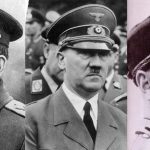
The First World War may or may not have been worth fighting. But these images don’t give justified causes. In fact, the silly hats and the moustaches, so similar from nation to nation: give a tweedle-dee, tweedle-dum feel to the whole enterprise, as if Europe was about to war over Swift’s boiled eggs rather than Serbia and Belgium’s territorial integrity. Look, for example, at the essential similarity of these scenes in London (Buckingham Palace) and Berlin (with the Kaiser speaking to his people). Then just to underline what these moments did to people, look who crops up in this shot from Munich in the third image…. Back story here.
Or what about Trafalgar Square against Unter den Linden?
It is an incredibly puerile thought given how many millions were going to die: but, well, couldn’t they just have settled it all with a massive boater throwing competition?
Beachcombing was set off on this hunt by the following image of French Heavy Cavalry leaving Paris: that’s right Captain, charge the two machine gun nests and then straight to Berlin!
Heavy cavalry! WtH!! But from there he branched out into other shots of women saying goodbye to the boys.
[German troops x 1]
[German troops x 2]
[French troops: a real frisson here]
[New Zealand troops]
And as a variation on theme, the sons wearing their fathers’ helmets as they go to leave their civilian clothes at home.
Then just to round off with another kind of photo and another kind of hysteria, here is Kier Hardie, the grand old man of British labour, addressing a pacifist meeting in London. The hats are the same…
Any other August 1914 pictures before the guns come out: drbeachcombing AT yahoo DOT com
Swallowing or Choking on (Operation) Mincemeat February 23, 2012
Posted by Beachcombing in : Contemporary***Dedicated to Glyndwr Michael***
Operation Mincemeat is often celebrated as the single greatest act of trickery of the Second World War. In 1943 a Welsh suicide victim was dressed up in the uniform of a British royal marine, put on dry ice in a submarine, thrown into the sea off the coast of Spain with some ‘vital’ (ahem!) documents chained to his wrist; documents that were allowed, with the connivance of Franco’s regime, to fall into the hands of the Germans.
The Germans fell for the planted documents ‘hook, line and sinker’ (as one contemporary put it) and were led to believe that the coming Allied invasion of Sicily was a feint and that the Allies’ actual target was Sardinia and Greece. The story is well-known and has been the subject of several books and even a film (the Man Who Never Was, 1956, which includes, rather improbably, the IRA!) And much attention is justly paid in these accounts to the skill of the British team in putting everything from concert tickets to love letters into the pocket of their plant, constructing the ideal character to bait their false documents.
What Beachcombing was not conscious of until he read Denis Smyth’s recent Deathly Deception: the Real Story of Operation Mincemeat was how close the whole thing came to failure. As a lover of accident, insane coincidences and human stupidity Beachcombing notes five moments when the scheme almost blew up (once literally) in the face of the British.
1) The potentially explosive reverse came when a pompous official at Gibraltar – a particular British ‘type’ – refused to stop anti-submarine sweeps in just the area where the British submarine was going to surface with the body! After months of careful work in London it would have been a painful irony if this extraordinary plan had been blown out of the water by the British themselves.
2) The Spanish son and father doctor team who examined the body and looked at the documents – nepotism in Southern Spain, who would have guessed it? – somehow managed to misread the various pieces of information that had been stuffed into the pocket of ‘Major William Martin’. The fact was that the British had planned the rate of decay of body and the date of leaving London (hinted at in various documents on the body) to perfection: what they hadn’t banked on was the Spanish officials deciding that there was a discrepancy between the rate of decay and the dates that they had muddled by misreading the corpse documents!
Beachcombing is reminded here of various other British attempts to get one over on the Germans and the Japanese in the war, where tricks became just too sophisticated for a practical, matter-of-fact opposition. In the end, British intelligence decided that only the Machiavellian Italians could handle their rather precious and high-pitched sophistication: and, of course, the Italians didn’t matter…
3) Another problem with the autopsy was the photograph. As the British intelligence crew had not been able to photograph the victim for his identity card – he was very clearly dead – they had found a doppelganger. The Spanish doctors understood almost immediately that the photograph and the man looked different. Most worryingly the photograph had more hair around the temples. Surely the easiest thing would have been to have not provided a photograph and to have allowed the Spanish to assume that the identity card had gone missing from an open pocket? As it was the son and father team managed to explain away, to their own satisfaction, these inconsistencies, but once more the British were almost caught out by being – another British vice – too clever by half.
4) Here is Beachcombing’s personal favourite. When the representative of HM’s government, one Haselden, went to pick up the body a Spanish official, in an eighteenth-century act of chivalry, offered the precious briefcase to the British vice-consul with a why-don’t-you-just-take-it shrug. This was before the Spanish had been able to photograph the briefcase’s contents! The British vice-consul’s blood must have run cold for he was one of the few individuals in the know. He managed to bluster away that he would get in trouble if he took the case without it going through the proper channels. If Haselden had not been so quick thinking on his feet or if he had not been in the know then Operation Mincemeat would have ended there…
5) The Germans knew of the secret documents but they had to navigate their way through the not always friendly departments of the Spanish government. Franco’s officials ranged from men who had fought on the eastern front in the Blue Brigade, (ardent Nazis) to quietly pro-British officers. The Germans put up a fight to get the briefcase. But a little more Spanish inertia or slightly less enthusiasm on the part of the Germans would easily have seen the briefcase returned to the British unphotographed. Or, at least, the time sensitive material would not have been shared with the Germans but would have remained on the desk of some mid-ranking Naval Officer in Andalusia.
In other words, the British operation that, in the end, took in the entire German command (including that professional liar Goebbels!) was a close run thing. A British plane in the wrong place, another vice-consul, another autopsy team and Mincemeat would be a footnote, and probably a much mocked footnote in the history of the last war. But then who dares, sometimes, wins. Other close run things from intelligence operations: drbeachcombing AT yahoo DOT com?
***
1 March 2011: Chris F. writes in with a US intelligence wheeze: Not quite as dramatic as the body shipped around on ice, but another well-known example: In the runup to the Battle of Midway, which many will agree was the most decisive battle in the Pacific War, a codebreaker’s clever idea may have made all the difference. Saying (falsely) that U.S. forces on Midway had a problem with their water supply, he watched for a spike in the use of the word water and was soon rewarded with unwitting confirmation that Midway was indeed the Japanese objective. A couple of days more and it probably would have been too late. The following is from an internet source I remember only as ‘Ultra’, sorry….: ‘Admiral Nimitz had one priceless asset: cryptanalysts had broken the JN 25 code. Since the early spring of 1942, the US had been decoding messages stating that there would soon be an operation at objective “AF.” Commander Joseph J Rochefort and his team at Station Hypo were able to confirm Midway as the target of the impending Japanese strike by having the base at Midway send a false message stating that its water distillation plant had been damaged and that the base needed fresh water. The Japanese saw this and soon started to send messages stating that ‘AF was short on water’. Hypo was also able to determine the date of the attack as either 4 or 5 June, and to provide Nimitz with a complete IJN order of battle. Japan’s efforts to introduce a new codebook had been delayed, giving HYPO several crucial days; while it was blacked out shortly before the attack began, the important breaks had already been made. As a result, the Americans entered the battle with a very good picture of where, when, and in what strength the Japanese would appear. Nimitz was aware, for example, that the vast Japanese numerical superiority had been divided into no less than four task forces. This dispersal resulted in few fast ships being available to escort the Carrier Striking Force, limiting the anti-aircraft guns protecting the carriers. Nimitz thus calculated that his three carrier decks, plus Midway Island, to Yamamoto’s four, gave the U.S. rough parity, especially since American carrier air groups were larger than Japanese ones. The Japanese, by contrast, remained almost totally unaware of their opponent’s true strength and dispositions even after the battle began.’ Thanks Chris!