The Problem with Sea Apes May 24, 2012
Posted by Beachcombing in : Actualite, Contemporary, Modern***Dedicated to Andy the Mad Monk and Invisible***
Beach has, since the early days of this site, shown a persistent interest in mermaids. It would be outrageous then to pass by the important new documentary coming out (or has it already aired?) on Animal Planet. The following is borrowed from Wikipedia (courtesy of the inestimable Invisible).
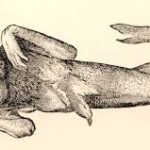
Mermaids: The Body Found is a two hour Animal Planet… The fictional film tells the story of a scientific team’s investigative efforts to uncover the source behind mysterious underwater recordings and an unidentified marine body. Two former National Oceanic Atmospheric Administration (NOAA) scientists tell their story on camera for the first time. After investigating mass strandings of whales, the team claimed to have recorded mysterious underwater noises coming from an unknown source. This sound resembled a sound previously recorded in 1997, called the ‘bloop’. They also claimed to have recovered 30% of the remains of an unknown creature from inside a great white shark which was said to possess attributes of the human body. They alleged that the marine creature had hands, not fins, and the hip structure of an upright animal. These findings, along with many others led the team to determine that this unknown animal was very closely related to humans, possibly a mermaid.
So a mockumentary has been created to entertain and to offer the latest theory on mermaids. And what is this theory? This time Beach borrows from part of a Fox News report (courtesy of Andy). Note how there is absolutely no mention here of the fictional content unless the word ‘compelling’ (as in ‘the punters don’t do simple facts’) is supposed to cover that!
In the two-hour CGI Special Mermaids: The Body Found, Animal Planet dives deep into the idea that mermaids may have been real, and, even better – related to humans! ‘It’s a very radical theory on human evolution, but we have approached an age-old myth and really chased its origins,’ Animal Planet honcho Charlie Foley told FOX411’s Pop Tarts column. ‘It has been compiled in a way that is very compelling, making us think that mermaids might not just be mythical creatures.’ The show unravels mysterious underwater sound recordings and presents a bone-chilling argument for the Aquatic Ape Theory, which suggests that during the transition from apes to hominid, some humans went through an aquatic stage. This stage is argued to have resulted in ‘aquatic ape-like’ creatures. ‘There are striking differences between us and other primates, yet [there are] many features we share with marine mammals, like the webbing between our fingers, which other primates don’t have, a layer of subcutaneous fat, and a loss of body hair,’ Foley explained. ‘We also have an instinctive ability to swim, and control over breath. Humans can hold breath up to 20 minutes, longer than any other terrestrial animal.’ Mermaids: The Body Found ponders the concept that coastal flooding millions of years ago turned some of our ancestors inland, while another group branched off into the deep water out of necessity and for food.
Beach has already highlighted sea apes. In fact, he dug up, to the best of his knowledge, the earliest reference to the concept that dates back to the eighteenth century. And this is where the problems begin… Readers might want to flag up problem concerning biology, which Beachcombing is, sadly, not qualified to do: drbeachcombing AT yahoo DOT com However, Beachcombing would like to stick his oar into the epistemology of sea-bourne monkeys.
If you want to explain the unicorn then it makes sense to look for a now extinct creature. After all, people no longer see unicorns (with very few exceptions) and those sightings there are usually involve travelers far from home confronted by unusual but known animals. If there was a unicorn-like animal ten thousand years ago then it is possible that this animal got trapped in an early phase of human myth and that it was passed down to us from there.
However, the problem with explaining mermaids in this way is that sightings continue into the present. There are dozens of sightings, for example, from the Hebrides (Scotland) in the nineteenth and twentieth centuries. Beach can only see three ways forward in relation to the sea-ape theory.
(i) There is a small population of sea apes that survived (or survives) on and off the British coast and yet no body or photograph has ever turned up.
(ii) The mermaids that are seen cannot be explained as physical entities. Here you can give a psychological, a theosophist or a ‘pagan’ explanation, but sea apes are out.
(iii) By some bizarre mechanism presently beyond our understanding the sea ape, which has not lived on the Scottish coast for a thousand or ten thousand years, entered ‘collective memory’ and has reappeared in the imagination of locals: go to (ii) above but with sea apes ‘in’.
Beach just might be able to conceive, against all his better judgement, that in the wild backwoods of New Zealand or in the expanses of the Rocky Mountains there are giant flightless birds or unknown hominids. But if anyone finds a sea ape community on the coast of Scotland, he’ll eat a tonne of boiled sweets. He has never seen (pace Jungians) any proof for ancestral memory. And so he would plump for number (ii), as he would for fairies.
In fact, forget sea apes, mermaids seem to be sea fairies. And in many ways the sea ape theory is to mermaids what the late nineteenth century pygmy theory was to the fey.
People sometimes see things that are not physically present: whether they are truly external or not Beach will happily leave to the philosophers. What is absolutely terrifying about this is that if our perception can play these kinds of tricks on us (or ‘pull back the veils of creation’ if you prefer) can our senses be trusted under any circumstances? On just that subject, looking forward to the documentary…
***
25 May 2012: Wade writes in ‘Your sea ape post instantly reminded me of the aquatic ape theory, first proposed by a German pathologist, Max Westenhofer, in 1942, then proposed again British marine biologist, Alister Hardy, in 1960. It has since been championed by Elaine Morgan, a Welsh writer (per Wikipedia). I saw a special on this years ago. It is a fascinating idea. My impression is that most anthropologists have either actively hated or completely ignored the theory as pseudo-science. Here are two links: Elaine Morgan’s and an anthropologist’s view that examines the controversial theory and yields the sceptical response. Thanks Wade!
Irish Merman Off Connemara April 21, 2012
Posted by Beachcombing in : Contemporary***Beach dedicates this to Mike Dash who sent in the clipping***
The Nottingham Evening Post, Aug 26 1937 ran with a merman story that was new (at least to this mermaid enthusiast). Note curious claims for his dimensions or is this just a misunderstanding on the part of the journalist in the English Midlands.
The ‘monster’ season has opened in Ireland – if the tale of two Connemara fishermen is to be believed. A bigger [?] and better ‘monster’ than than of Loch Ness, it is claimed, has been discovered at Ballinakill Bay, near Renvyle, Connemara. He is described as a ‘merman’. It is nearly nine months, according to the highest local authority, since he first made an appearance. On that occasion, after creating a mild sensation, he retired to winter quarters. A few days ago he woke and discovered it was summer. He also discovered that he was hungry, and cast an eye about for something to devour. At this point two Connemara fishermen, Thomas O’Toole and Michael Ward appeared on the scene in their curragh (a canvas covered canoe). The ‘merman’ according to them bobbed up beside the curragh.
Fishermen believed, it must be remembered, that mermaids were unlucky. And these two were also understandably terrified at this manifestation of the deep and they put their oars into the water with some rapidity.
The fishermen at once made efforts to set up a new world’s record for the flying half mile with curragh. The ‘merman’ started in pursuit. After a time, the story goes [?], the fishermen asked themselves whey they should run away from a mere ‘merman’. Up came the ‘merman’. The fisherman took stock of him. He had according to their version, strawlike, shaggy hair and beard, with very red lips and bushy eyebrows. His skin was fair in front and by way of variety, blue on the back. He swam head and shoulders above the water.
It would be interesting to see if any creature recognised by marine biologist comes close to this curiosity: ‘very red lips’? The best Beach could do was a seal whose spent too long near a nuclear power plant: drbeachcombing AT yahoo DOT com. Note the next scene with its fish-feeding recalls a nineteenth-century record from the south coast of the UK previously examined in this place.
When Ward threw him a mackerel [the merman] seized it eagerly, and dived under the water to consume it. In a few moments, according to the fishermen, he reappeared, smacking his lips and coming alongside the curragh with the evident intention of coming aboard. O’Toole decided that familiarity had gone too far, and gently chided the ‘merman’ with an oar. The ‘monster’ whinnied in pain and dived into the depths. The fishermen made tracks for the shore which they reached in safety, to tell their tale of adventure in the countryside.
Why was it a merman rather than a mermaid? An absence of breasts? The beard?
Newspaper Archives as Controls or Filters April 18, 2012
Posted by Beachcombing in : Contemporary, ModernBeachcombing spent more time than was strictly necessary last summer looking at nineteenth- and twentieth-century newspaper archives. It is an extraordinary world. You constantly find yourself caught up on headlines (‘Sea-monster seen in the Channel’, ‘Germans eat the French’) that cannot easily be ignored and then you take one last look over the page and are struck by yet another title and so it goes on. In the end, after thirty minutes, you are still on p. 2, 4 May 1901, the Torrington Herald with nothing but curiosities to show for your troubles. So much virgin territory, so many jigsaw pieces that fit nowhere…
Beachcombing was so struck by the experience that he still uses the newspaper archives to try and verify material found elsewhere. Take, for example, the rolling head story from yesterday, or the Benbecula mermaid story from c. 1830 or, for that matter, the Robert Stephen Hawker’s mermaid fake from 1825. All three stories describe events that were explosive in their communities. All these stories rely on non-newspaper accounts. And, most confusingly, all these stories are absent from contemporary newspapers.
Beachcombing feels that this should be significant. One of the most fascinating questions about newspapers, particularly for ‘bizarre’ stories is how receptive these publications are to tales from their heartlands. Given some of the junk that they publish it seems almost impossible that mermaid sightings or the decapitated head of the devil could escape their notice especially given that it involved (allegedly) an important part of the community.
So what are we seeing in these three instances? There seem to be two possibilities. First, the anecdote is false and the newspaper can act as a control: Beachcombing certainly has his suspicions about the two mermaid stories and Invisible this morning has sent an email (just put up) that calls the Owens’ account into question.
The second possibility is that newspapers just were not interested. In the case of the Benbecula mermaid perhaps the newspapers in question were too far away. In the case of the Cornish mermaid perhaps, say, the editor had illusions of grandeur and wanted to avoid Fortean tat.
Beach can’t help thinking that it would be useful to gather together twenty nineteenth-century anecdotes that involve community reactions and to search for them through the newsprint. Whether we are dealing with false stories or just the ability of peculiar happenings to escape the notice of the print barons would be something of great interest. History, after all, is what happens when no one is looking. The problem, of course, would be to divide the false anecdotes from the overlooked ones. That would be – Beach suspects – impossible and so an interesting exercise would become an ambiguous one.
Any thoughts on this search for anecdotes through newsprint? drbeachcombing AT yahoo DOT com
***
22 April 2012: Invisibile writes in: Invisibile writes in: ‘You mention using the newspaper archives to try and verify stories such as the mermaid tales. I should think that the reverse would obtain: that anything found in a 19th century newspaper should be regarded with the utmost suspicion. It was the golden age of hoax stories, the best of which are difficult to distinguish from true forteana even today. I’ve been wrestling for some time with the veracity question and still haven’t got the hang of it. I’ve enjoyed obvious hoaxes, but have also verified stories that seemed patently impossible. It’s the more reasonable, plausible hoaxes that drive me mad. To state the obvious, some caveats in using 19th century newspapers: Distrust and verify. Damnably, hoax stories often contain names of real people and places. Context can be everything. One doesn’t cite an apparently serious account of an early flying machine if the author was known to have previously written only tall tales. Local knowledge can be invaluable. When a newspaper article mentions secret treasure caves in a place called “Mt. Nebo” in the northeastern corner of Ohio, it’s useful to know that a) Mt Nebo is in the southeastern part of the state and b) the caves, as situated by the article, do not exist and cannot exist due to the local geology. Recurring lurid stories about neighboring communities may reflect rivalry, rather than reality. Genealogy sites are useful, if tedious, for verifying the reality of persons mentioned in a story. However, they are not infallible. It is astonishing how far tales traveled–even the smallest of small town newspapers have articles about killer meteor showers in Persia or the habits of ostriches in South Africa. The degree of exaggeration is a natural tip-off. I think it is safe to say that the 200-foot-long Hideous Ice Worm was a journalistic invention. But what about the Two-Headed Baby of Morrow County? Or the Girl Buried Alive For Three Weeks? (Both actual events, although the burial was a publicity stunt for a “fakir.”) Sometimes, maddingly, stories will have no endings. I’ve been collecting stories about panics and local sensations (“Ghostly Woman in White Seen Again!” “Women Fear the Gum-Shoe Man!”) Some run over a series of weeks or even months. Others run for a few days and then stop. Nothing is ever heard on the subject again. Are these just hoaxes that had run their course? Newspapers weren’t shy about exposing supernatural hoaxers, as you might have gathered from the file of “joke” ghost stories I sent you a while back—they were very severe on sheeted young men jumping out of the bushes, scaring the womenfolk. So why did these stories have no official end? Or did they merely trail off in real life with no satisfactory ending? That said, I’m very grateful I can search and retrieve 18th- and 19th-century newspapers without going through microfilm motion-sickness. And sometimes you just want to enjoy a good yarn. To use a much later example, in response to your suggestion about studying historical anecdotes in the light of newspaper reports, I was struck by the irregular media coverage of a tragic local story. The story went that a number of teenagers had been hit by lightning at a mysterious stone structure known as Frankenstein’s Castle or Witches’ Tower. Naturally the marks of the burns were still visible on the stones and the ghosts of the victims were to be seen at the tower on stormy nights. It was an excellent ghost story, but I assumed it was the sort of folkloric tale that is told about any strange castle-like structure—except that I kept hearing it from librarians and public officials who had remembered it for 30 years and who swore that it was true. So I went in search of documentation. There was absolutely no news coverage in the Dayton/Kettering papers, even though the tower stands on the edge of downtown. I spoke with some older local firefighters and police officers who said they remembered the case, knew it had happened in the 1960s, but nobody had any specifics. Eventually I wrote about it as a local legend. It wasn’t until several years ago that Curt Dalton, a local historical researcher, found a small article about the tragedy in a Van Wert paper—a community over 90 miles north of Dayton. Armed with the names in that article, Curt located this article http://www.daytonhistorybooks.com/frankenstein.html in a Xenia paper—a community about 30 miles from the death site and about 10 miles from the dead girl’s Bellbrook home. It is a mystery to me why this sensational story never made it into the local papers. Thanks Invisibile!
A Dutch Mermaid March 24, 2012
Posted by Beachcombing in : Medieval, ModernBeachcombing recently stumbled on this semi-mermaid story: if that is what it is.
At that time there was a great tempest at sea, with exceeding high tides, the which did drowne many villages in Friseland and Holland; by which tempest there came a seawoman swimming in the Zuyderzee betwixt the towns of Campen and Edam, the which passing by the Purmerie, entered into the straight of a broken dyke in the Purmermer, where she remained a long time, and could not find the hole by which she entered, for that the breach had been stopped after that the tempest had ceased. Some country women and their servants who did dayly pass the Pourmery to milk their kine in the next pastures, did often see this woman swimming on the water, whereof at first they were much afraid ; but in the end, being accustomed to see it very often, they viewed it neerer, and at last they resolved to take it if they could. Having discovered it, they rowed towards it, and drew it out of the water by force, carrying it into the town of Edam. When she had been well washed and cleansed from the sea-moss which was grown about her, she was like unto another woman. She was appareled, and began to accustome herself to ordinary meats like unto any other, yet she sought still means to escape and to get into the water, but she was straightly guarded. They came from farre to see her. Those of Haarlem made great sute to them of Edam to have this woman, by reason of the strangenesse thereof. In the end they obtained her, where she did learn to spin, and lived many years (some say fifteen), and for the reverance which she bore unto the signe of the crosse whereunto she had been accustomed, she was buried in the church-yarde. Many persons worthy of credit have justified in their writings that they had scene her in the said towne of Haarlem.
The story is associated with the early fifteenth century: though naturally documentation only comes later. There was though well into the nineteenth century a statue of a mermaid in Edam with the following coy legend. Dit beeld hier opgericht tot een gedachtenis/ Wat in het Purmer-meyr voorheen gevangen is. / Anno 1403. [This statue was erected in memory/ Of what had been caught in Lake Purmer./ In the year 1403.] Other stories describe how this mermaid lacked words: she never learnt to speak but that she did learn to bow before the cross.
Eighteenth- and nineteenth-century authors had a fabulous time with this mermaid, particularly the Dutch historians who couldn’t quite let the legend go. One scholar wrote that ‘this supposed mermaid was an idiot, who probably was deaf and dumb, and had fallen into the sea from some ship that had been wrecked upon the coast. [this scholar] conjectures also that she might have the singular property of floating long on the water, which practice might render pleasing to her. In support of this opinion, he quotes instances from several writers, of persons endued with this natural levity; and from one Leegwater, a Dutch writer, gives an account of a man who could remain three quarters of an hour under water, and while there, not only peeled pears and eat them, but also played on the hautboy.’
Beach remains sceptical particularly given the extraordinary mermaid tradition in the Netherlands, more interesting than anything that England has to offer. He wonders idly if this is not to be framed in a rivalry between Edam and Haarlem: though such legends do not usually end in gifts. Any ideas? drbeachcombing AT yahoo DOT com
***
28/Mar 2012: Trevor writes: In 1403 there a major dyke breach from the Zuiderzee leading to extensive flooding, 50 years after William V had awarded Edam civil privileges and the right to build a harbour, which led to a rapid increase in wealth but afaik no great problems with Haarlem. The first known reference to the mermaid is 200 years later on a gable stone on the old Purmer Gate in Edam, 60 years after Charles V had ordered the connection with the Zuiderzee to be dammed to prevent flooding, putting an end to Edam’s maritime ambitions. So I figure her function is wistful, rather like pub signs of Queen Vic in post-imperial Britain. The Muiden mermaid also deals with shifting sands. Before Muiden was fortified and before the munitions factory it was presumably a small collection of filthy fishers’ hovels with a toll house, and the rhyme she speaks to the fishermen after they’ve let her go is Muden sal Muden bliven, Muden sal nyet becliven = more or less There’s always be a Muiden, Muiden will not endure. How poetic, the contradiction, say van Gouw & ter Lennep None of this answers the question as to how a woman with the tail of a fish coped with clogs.’ Thanks Trevor!
Mermaid Killing in Exeter February 24, 2012
Posted by Beachcombing in : ModernBeach recently stumbled upon yet another nineteenth-century British mermaid article. ‘…the most extraordinary, the most minute (I had nearly said the most recent), and certainly the most domestic of all stories of Mermaids, as well as that in which the veracity of the narrator is the most completely pledged for the accuracy of the detail, is one which relates to a marine animal seen by Mr Toupin of Exmouth, in Devonshire, on the 11th of August 1812.
Now, in fact, Beachcombing has already reviewed Mr Toupin’s curious experience. But he has no explanation and, far more seriously, no good sources for what follows:
The River Ex and its vicinity is indeed remarkable, not only for the appearance of more than one Mermaid [!?], but for that of more remarkable Mermaids. It is not a century since a Mermaid was said to have been seen in the river just mentioned, close to the walls of the city of Exeter.
Now a century should bring us to the period 1730-1750 as the quoted publication was 1823: out author is usually reliable with chronology. However, what about this story that seems more folktale than eye-witness account?
Unlike the Batavian or Moluccan stranger, but like very other Mermaid on record, its humanity extended to the waist; and, so far like our present eastern curiosity, it bore, from the waist downward a resemblance to a salmon. It had, however, two legs placed below the waist, and absolute novelties in the history of Mermaids.
The author is, of course, right. Who has ever heard of a mermaid with tail and legs together? If Beach read this in a modern newspaper report he would assume that here was someone in a fancy dress outfit who had drunk too much perry. In any case, the legs in question did not help the Exeter mermaid, poor thing.
With these legs it left the shore of the river Ex, and ran before its pursuers, screaming with terror, till it was knocked down and killed!
The author tells us nothing more: did the good folks of Exeter eat the mermaid in question?
As one local blogger notes there is a Mermaid Yard in Exeter (relatively) near the river (and the walls??). It is very likely named after a local pub. Was this then a story after the fact to explain a local placename, onomastics, in short, gone mad? Any local knowledge: drbeachcombing AT yahoo DOT com
An Aberystwyth Mermaid February 13, 2012
Posted by Beachcombing in : Modern***Dedicated to Andy the Mad Monk, who sent in news of the Zimbabwe mermaids, just over the hill from Aber***
Mermaids are the most despised of all the creatures of the British imagination. Folklorists have only had the decency to write two half decent books on them over the last century. The result is that there are lots of accounts out there that have never been gathered in. This one seemed, at least to Beachcombing, particularly endearing. It appeared in a Welsh newspaper (in Welsh) in the 1820s.
In the month of July, 1826, a farmer from the parish of Llanuwchaiarn, about three miles from Aberystwyth, whose house is within 300 feet of the seashore, descended, the rock, when the sun was shining beautifully upon the sea, and he saw a woman (as he thought) washing herself in the sea within a stone’s throw of him. At first, he modestly turned back ; but after a, moment’s reflection thought that a woman would not go so far out into the sea, as it was flooded at the time, and he was certain that the water was six feet deep in the spot where he saw her standing. After considering the matter, he threw himself down on his face and crept on to the edge of the precipice from which place he had a good view of her for more than half-an-hour, After scrutinizing her himself, he crept back to call his family to see this wonderful sight. After telling them what he had seen, he directed them from the door where to go and to creep near the rock as he had done. Some of them went when they were only half dressed, for it was early in the morning, and they had only just got up from bed. Arriving at the spot, they looked at her for about ten minutes, as the farmer was calling his wife and the younger child. When the wife came on, she did not throw herself down as the others had done, but walked on within sight of the creature; but as soon as the mermaid saw her, she dived into the water, and swam away till she was about the same distance from them as she was when she was first seen. The whole family, husband, wife, children, menservants and maid-servants, altogether twelve in number, ran along the shore for more than half-a-mile, and during most of that time, they saw her in the sea., and sometimes her head and shoulders were upwards out of the water. There was a large stone, more than a yard in height, in the sea, on which she stood when she was first seen. She was standing out of the water from her waist up, and the whole family declared that she was exactly the same as a young woman of about 18 years of age, both in shape and stature. Her hair was short, and of a dark colour; her face rather handsome, her neck and arms were like those of any ordinary woman, her breast blameless and her skin whiter than that of any person they had ever seen before. Her face was towards the shore. She bent herself down frequently, as if taking up water, and then holding her hand before her face for about half-a-minute. When she was thus bending herself, there was to be seen some black thing as if there was a tail turning up behind her. She often made some noise like sneezing, which caused the rock to echo. The farmer who had first seen her, and had had the opportunity of looking at her for some time, said that he had never seen but very few women so handsome in appearance as this mermaid. All the family, the youngest of whom is now eleven years old, are now alive, and we obtained this account, word for word, as it is given here, from them themselves within the last month.
Beach is always on the look out for mermaid accounts: drbeachcombing AT yahoo DOT com
Thanks to Wade for correcting a ridiculous error here.
Oh and the updated Bizarre History News Feed with thanks, as always, to contributors.
-
BH News Stories
- A) American Football, History and the Military
- B) Do you want to own a guillotine?
- C) Stonehenge and Meteorites
- D) Andrew Lang, Deserves a Biographer
- E) Mystery of the Escaped Slaves
- F) Neanderthals See Red
- G) And Wings in Ancient Rome
- H) Bawdy Roman Coins
- I) Darwin and the Bassoon
- J) Last Stand in Guam – Lest We Forget
- K) Another Mother Goddess – she’s beautiful
- L) A Sweetner that Kills
- M) Morbid Collector
- N) History of Pregnany Tests
- O) Home Guard Monkey Attrocity
- P) Origins of Amerindians
- Q) Truth About Glen Miller’s Death?
- R) Renting Hitler’s Lair
- S) Curious Roman Helmet
- T) Death Camp Archaeology
- U) Physics Meets History
- V) Meet Your Ancestors
- W) What Happens to Old Space Units in Russia
- X) Being Rude to Hitler POW-Style
- Y) Neanderthals Build with Mammoth Bones!
- Z) Astronomical Visions
Mermaids, Ahoy! January 14, 2012
Posted by Beachcombing in : ModernBeachcombing still hyperventilating from the terrifying task of talking in front of 200 plus ‘new’ students yesterday. Only syllabus writing is worse. Anyway, back to the far more serious task of charting the perversions of the human imagination. Beachcombing had been going to spend the Christmas holidays writing serious academic ‘stuff’ about Marco Polo. But, somewhere about 10 Dec he got distracted and lingered rather too long in nineteenth-century Cornwall. He came across many beautiful passages but this letter was among his favourites. The experience related dates to between 1850 and 1860.
‘Some fourteen years ago I found myself, with about fifty [Cornish] emigrants; in the Gulf of St Lawrence, on board the old tub Resolution, Captain Davies, commander. We were shrouded in a fog so thick that you might cut it like a cheese, almost all the way from the Banks to Anticosti. One morning, soon after sunrise, when near that island, the fog as thick as night overhead, at times would rise and fall on the shore like the tantalising stage curtain. All at once there was a clear opening right through the dense clouds which rested on the water, that gave us a glimpse of the shore, with the rocks covered with what to us appeared very strange creatures. In a minute, the hue and cry from stern to stern, among all the cousin Johnnys, was ‘What are they, you? What are they, you?’ Somebody gave the word ‘mermaids’. Old men, women, and children, that hadn’t been out of their bunks for weeks, tore on deck to see the mermaids, when, alas the curtain dropped, or rather closed, and the fair were lost to sight, but to memory dear; for, all the way to Quebec, those not lucky enough to see the sight bothered the others out of their lives to know how they looked, and if we saw the comb and glass in their hands.
And here the conspiracy theory truly began…
The captain might as well save his breath as tell them that the creatures they saw on the rocks were seals, walruses, and sea-calves. ‘Not yet, Captain dear, you won’t come that over me at all ; no, not by a long chalk! No, not at all, I can tell’e! I know there are mermaids in the sea ; have heard many say so who have seen them too! But as for sea-calves, I ain’t such a calf nor donkey neither as to believe it. There may be a few of what we call soils (seals) for all I know; perhaps so, but the rest were mermaidens.’ No doubt, centuries hence, this story of the mermaidens will be handed down with many additions, in the log-huts of the Western States.’
Quite.
Mistaken identity is always fun: drbeachcombing AT yahoo DOT com
Swearing to Mermaids December 3, 2011
Posted by Beachcombing in : Modern
A further Scottish Mermaid sighting, dating to October 1809. This one is particularly interesting because there seems to have been a concerted effort to get the local ‘yokels’ – whose testimony is usually reckoned at less than naught – to swear to what they saw.
Neil McIntosh in Sandy Island, Canna, states that he has heard from different individuals in the island of Canna, that they have seen the fish called Mermaids; that these animals had the upper parts resembling the human figure, and the lower extremities resembling a fish. In particular, about six years ago, Niel Stewart and Neil McIsaac, both alive in Canna, when walking upon the sea beach on the north end of the island, on a Sunday, saw, stretched on a rock at a small distance, an animal of this description, having the appearance of a woman in the upper parts, and of a fish below; that on seeing them it sprung into the water, after which they had a more distinct view of its upper part, which strongly resembled a female of the human species. That Lachlan McArthur, of the same island, informed McIntosh, that some years ago, sailing from Uist to Skye in a stormy day, he saw rising from the water, near the stern of the boat in which he was, a. figure, resembling a human in its upper parts, which terrified him extremely. Neil McIntosh further states, that he himself, about five years ago, was steering a boat from Canna to Skye in a stormy day; that when about one-fourth of the passage from Canna, he saw something near him of a white colour, and of the human figure, spring almost out of the water, which he took for the animal above described; but as it instantly disappeared again, he had no opportunity of examining it minutely; that he felt considerable alarm at the sight of it, as a general opinion or prejudice exists amongst the inhabitants of the Western Isles, that it is extremely unlucky to meet with or look upon such animals at sea, or to point them out to the rest of the crew, unless they observe it themselves.
Fairly modest stuff, but in many ways the most interesting part of the letter is the legalistic coda. Oaths and attestations are breaking out in folklore.
Signed, Neil McIntosh; Robert Brown, factor for Clanrannald witness; Donald McNeil, of Canna, witness; Wm Campbell, W. S. Edinburgh, witness; James Gillespie, architect, Edinburgh, witness. Portree, 2nd October, 1809.
That what is above written is a true copy of the original.
Attested, Malcolm Wright, N. P.
Beachcombing should say that since writing this up he has come across a second copy of the same with some variants. Not sure what that is about.
Strangehistory is always interested in mermaid stories! drbeachcombing AT yahoo DOT com
Eggs, Mermaids and Fairies October 26, 2011
Posted by Beachcombing in : Contemporary, Modern***This post is dedicated to Invisible who first worried over the connection***
Like, to use an Old Testament image, a dog returning to its vomit, Beach is sidling back to a problem from several months ago. The following reference appears in Waldron's Description of the Isle of Man and what confuses Beachcombing is the final reference to eggs
Some people who lived near the coast, having observed [the mermaids’] behaviour, spread large nets, made of small but very strong cords, upon the ground, and watched at a convenient distance for their approach. The night they had laid this snare, but one happened to come, who was no sooner set down, than those who held the strings of the net, drew them with a sudden jerk and enclosed their prize beyond all possibility of escaping. On opening their net, and examining their captive, the largeness of her breasts, and the beauty of her complexion, it was found to be a female; nothing… could be more lovely, more exactly formed, in all parts above the waist, resembling a complete young woman, but below that, all fish, with fins, and a huge spreading tail. She was carried to a house, and used very tenderly, nothing but liberty being denied. But though they set before her the best provision the place afforded, she could not be prevailed on to eat or drink, neither could they get a word from her, though they knew these creatures were not without the gift of speech, having heard them talk to each other, when sitting regaling themselves on the seaside. […?] They kept her in this manner three days, but perceiving she began to look very ill notwithstanding, and fearing, some calamity would befall the island if they should keep her till she died, they agreed to let her return to the element she liked best and the third night set open their door; which, as soon as she beheld she raised herself from the place where she was then lying, and glided with incredible swiftness, on her tail, to the seaside. They followed at a distance, and saw her plunge into the water, where she was met by a great number of her own species, one of whom asked what she had observed among the people on earth; nothing very wonderful answered she, but that they are so very ignorant, as to throw away the water they boil their eggs in. This question, and her reply, they told me, was distinctly heard by those who stood on the shore to watch what passed.
Why does the mermaid show such an interest in the water that eggs are boiled in? One possibility is that the story-teller was making clear the difference between the mermaid and the human world: humans are interested in the eggs, mermaids in the water. But there is an interesting parallel here with changeling belief as attested from Britain and Ireland in the nineteenth and twentieth centuries. When a parent suspected that a child was a changeling there were a number of strategies the parent could adopt. Take the following text from mid-nineteenth-century Ireland where a mother must decide what to do about her changeling child.
Some wanted her to put [the child] out on a hot shovel; others to make egg-broth before it, that is, to boil egg-shells, and offer it the water they were boiled in for its dinner, which would make it speak at once; others to keep its head under water for twenty and five minutes, when, if it was a right child, it would be drowned; if it was not, why it would be alive in the face of the country.
Offering a child egg-shell soup would seem a fairly mild strategy in relation to the others, even an act of random madness. But the point of the offering of egg-shells is to trick the non-talking changeling into an indiscretion. Typically the changeling, who pretends not to speak, is excited into uttering something by his foster parents’ bizarre behaviour. The classic text from the Gaelic world is ‘The Brewery of Egg Shells’ in a famous nineteenth-century Irish folklore collection:
30-31 The child was lying for a wonder quite easy and quiet in the cradle, every now and then cocking his eye, that would twinkle as keen as a star in a frosty night, over at the great fire, and the big pot upon it; and he looked on with great attention at Mrs. Sullivan breaking the eggs, and putting down the egg-shells to boil. At last he asked, with the voice of a very old man, ‘What are you doing, mammy?’ Mrs. Sullivan’s heart, as she said herself, was up in her mouth ready to choke her, at hearing the child speak. But she contrived to put the poker in the fire, and to answer, without making any wonder at the words, ‘I’m brewing, a vick (my son)’. ‘And what are you brewing, mammy?’ said the little imp, whose supernatural gift of speech now proved beyond question that he was a fairy substitute. ‘I wish the poker was red,’ thought Mrs. Sullivan; but it was a large one, and took a longtime heating: so she determined to keep him in talk until the poker was in a proper state to thrust down his throat, and therefore repeated the question. ‘Is it what I’m brewing, a vick’, said she, ‘you want to know?’ ‘Yes, mammy: what are you brewing?’ returned the fairy. ‘Egg-shells, a vick.’ said Mrs. Sullivan. ‘Oh!’, shrieked the imp, starting up in the cradle, and clapping his hands together, ‘I’m fifteen hundred years in the world, and I never saw a brewery of egg-shells before!’ The poker was by this time quite red, and Mrs. Sullivan seizing it, ran furiously towards the cradle; but somehow or other her foot slipped, and she fell flat on the floor, and the poker flew out of her hand to the other end of the house. However, she got up, without much loss of time, and went to the cradle intending to pitch the wicked thing that was in it into the pot of boiling water, when there she saw her own child in a sweet sleep, one of his soft round arms rested upon the pillow – his features were as placid as if their repose had never been disturbed, save the rosy mouth which moved with a gentle and regular breathing.
The significance of the eggs has been debated by others before Beachcombing. Are they a memory of a time when the changeling was boiled – see the end of this tale? Are they a psychological symbol of individuation? Or are they just a chance motif thrown up by the European folklore tradition – such tales stretch all the way through northern Europe? What does matter is that the reference to eggs may offer an insight into Waldron’s mermaid text.
[The mermaid] was carried to a house, and used very tenderly, nothing but liberty being denied. But though they set before her the best provision the place afforded, she could not be prevailed on to eat or drink, neither could they get a word from her, though they knew these creatures were not without the gift of speech, having heard them talk to each other, when sitting regaling themselves on the seaside. […?]
The mermaid is allowed to go back to the sea.
They followed at a distance, and saw her plunge into the water, where she was met by a great number of her own species, one of whom asked what she had observed among the people on earth; nothing very wonderful answered she, but that they are so very ignorant, as to throw away the water they boil their eggs in. This question, and her reply, they told me, was distinctly heard by those who stood on the shore to watch what passed.
There are parallels here with the changeling tradition: the locals cannot get the mermaid to speak and yet it is finally the eggs boiled in water that cause her to utter words that are ‘distinctly heard’. The fact that the mermaid is surprised that the boiled water was thrown away may be Waldron’s misunderstanding of the Manx tale or a variant. Perhaps a mermaid and a fairy are of the same genus, after all?
And yet… And yet… There are other references that break this neat explanation. For example, in one late nineteenth-century text from the Scottish Highlands we read:
A mermaid was caught by a man of Skye and kept by him for a year, during which time she gave him ‘much curious information’. When they parted, he asked her ‘what virtue or evil there was in egg water’ – water in which eggs had been boiled. To this she returned the tantalising answer, if I tell you that, you have a tale to tell, and disappeared.
Or what about this from the Orkneys in the seventeenth century as paraphrased by Diane Purkiss (90) in her excellent Troublesome Things. A fairy explains to a girl, one Elspeth that to become wise she should ‘Take an egg and roast it. And take the sweat of it three Sundays. And with unwashed hands wash her eyes wherby [sic] she should see and know any thing she desired.’
What the hell is going on here? drbeachcombing AT yahoo DOT com
***
27 Oct 2011: James writes about witches and the sea and notes that Reginald Scot's catalogue in Discoverie of Witchcraft (1584) states that witches could 'saile in an egge shell, a cockle or muscle shell, through and under the tempestuous seas. '(Bk.I ch.14 p.6) This is how the witches travel in Jonson’s Masque of Queenes: -- 'we all must home i' the egg shell sail'. So there you are. Invisible also has been doing her research: ‘I dipped into A Dictionary of Superstitions (Opie and Tatem), to see what it says about eggs and found some interesting points about eggs being unlucky for seafarers: “EGG” taboo word 1875 Notes & Queries 5th series II, p. 204 [Flamborough, Yorks.] The fishermen…had a great fear if…eggs were spoken of. 1923 P S Jeffrey, Whitby Lore, p. 138 [Staithes, York., 1885] An egg is deemed so unlucky that the fishermen will not even use the word, but call the produce of the fowl a “roundabout.” EGGS on board ship 1885 Folklore, p. 55 [Rosehearty, Aberdeen ] Eggs are [supposed to cause contrary winds], and there are fishermen that would not allow a single one on board. 1853 Notes & Queries 1st series VII p. 152 [ Somerset ] Always poke a hole through your egg-shell before you throw it away. If you don’t, the fairies will put to sea to wreck the ships. [same thing said of witches] 1887 ‘Speranza’ Wilde Superstitions of Ireland II p. 102. People ought to remember that egg-shells are favourite retreats of the fairies, therefore the judicious eater should always break the shell after use, to prevent the fairy sprite from taking up his lodgment therein. Thinking practically, given the food value of chickens on a long sea voyage, I find it interesting that eggs are considered so unlucky by mariners (of course many things were unlucky onboard ship including pigs, whistling, red hair—and mermaids.). If even mentioning eggs onboard was unlucky, it must have been doubly unlucky to overhear a mermaid discussing them. Further, I find that this statement in Superstitions of the Highlands and Islands of Scotland , Collected Entirely from Oral Sources, Rev. John Gregorson Campbell, 1900. p. 230: It is unlucky to use for washing your hands or face water in which eggs have been boiled or washed. It is a common saying when mischance befalls a person through his own stupidity, "I believe egg water was put on me." I also remembered a fairy tale read in childhood called “The Sea Maiden” in which the life of the sea maiden was contained in an egg. An old soothsayer tells the hero how to kill the mermaid, who has kidnapped his princess: “On an island in the middle of the loch is a white deer whose slender legs are swifter than a cry. If you catch her, from her mouth will come a black crow, a hoodie, that is strong of wing. If you catch it, from its mouth will come a trout that can swim faster than a racing salmon. If you catch it, out of its mouth will come an egg. In the egg is the life of the sea maiden. Crush it and she dies.” [This is a Scottish tale found in Popular Tales of the West Highlands by John Francis Campbell and Celtic Fairy Tales by Joseph Jacobs. Both of these are available online.] If a mermaid’s life was contained in an egg, then what is special about the water it is boiled in? And yet, aren't the mermaids in the tales speaking of ordinary hens' eggs? Still more food, as it were, for thought. Cracking under the strain of trying to find an answer’ Thanks Invisible and James!
27 Oct 2011: Diane Purkiss author of the brilliant Troublesome Things (At the Bottom of the Garden in the US) writes in: ‘I liked your webpage on eggs and mermaids and changelings. It’s a recurring motif in folktales about changelings, and nobody has really explained it, but it’s interesting to note how little folklore there is on eggs in general. Chickens very rarely get bewitched – it does happen, but not often in comparison with dairy animals and pigs – so I wonder if the egg has some kind of power derived from being an enclosed but living thing? But I don’t REALLY know, and people often do rituals without really understanding how they came into being – why a rabbit’s foot, why unlucky thirteen? – though the latter is also VERY recent.’ Thanks Prof Purkiss!
More Caithness Mermaids October 23, 2011
Posted by Beachcombing in : ModernMermaid posts. It has been a while… This one should be read together with another nineteenth-century Caithness sighting. It cannot be a coincidence that two letters were sent at the same time relating to the same village. Presumably the publicity given to Miss Mackay in late May for her sighting, encouraged or emboldened William Munro, a school teacher, to recall his own close encounter, when a Dr Torrence, his correspondent, required it.
Thurso, 9th June, 1809.
Dear Sir, Your queries respecting the Mermaid are before me: from the general scepticism which prevails among the learned and intelligent about the existence of such a phenomenon, had not your character and real desire for investigation been too well known to me for supposing that you wished to have a fertile imagination indulged by a subject of merriment, I would have been disposed to have concluded that in this instance you aimed at being ranked among the laughing philosophers at my expense. Sensible, however, that this is not the case, and taking it for granted that you are sincere, I shall endeavour to answer your queries, though there is little probability that any testimony which I can give respecting the mermaid will operate towards convincing those who have not hitherto been convinced by the repeated testimonies adduced in support of the existence of such an appearance.
About twelve years ago [1797?], when I was Parochial schoolmaster at Reay, in the course of my walking on the shore of Sandside Bay, being a fine warm day in summer I was induced to extend my walk towards Sandside Bay, when my attention was arrested by the appearance of a figure resembling an unclothed female, sitting upon a rock extended into the sea., and apparently in the action of combing its hair, which flowed around its shoulders, and of a light brown colour. The resemblance which the figure bore to its prototype in all its visible parts was so striking that had not the rock on which it was sitting been dangerous for bathing I would have been constrained to have regarded it as really an human form, and to an eye unaccustomed to the situation it must have undoubtedly appeared as such.
The head was covered with hair of the colour above mentioned and shaded on the crown, the forehead round, the face plump, the cheeks ruddy, the eyes blue, the mouth and lips of a. natural form resembling those of a, man, the teeth I could not discover as the mouth was shut: the breasts and abdomen, the arms and fingers of the size of a full grown body of the human species, the fingers, from the action in which the hands were employed, did not appear to be webbed, but as to this I am not positive. It remained on the rock three or four minutes after I observed it, and was exercised during that period in combing its hair which was long and thick, and of which it appeared proud, and then dropped into the sea, which was level with the abdomen, from whence it did not appear to me. I had a distinct view of its features, being at no great distance on an eminence above the rock on which it was sitting and the sun brightly shining. Immediately before its getting into its natural element it seemed to have observed me, as the eyes were turned towards the eminence on which I stood.
It may be necessary to remark that previous to the period I beheld this object I had heard it frequently reported by several persons, and some of them persons whose veracity I never heard disputed, that they had seen such a phenomenon as I have described, though then like many others I was not disposed to credit their testimony on this subject. I can say of a truth that it was only by seeing the phenomenon I was perfectly convinced of its existence. If the above narrative can in any degree be .subservient towards establishing the existence of a phenomenon hitherto almost incredible to naturalists or to remove the scepticism of others, who are ready to dispute everything which they cannot fully comprehend, you are welcome to it from, Dear Sir, your most obliged and most humble servant, W[illia]m Munro.
Why does this source ring less true than that of Miss Mackay? Beach suspects it is the anthropomorphic detail about hair-combing or perhaps it is just his long-standing ire against school teachers. WM was much mocked in contemporary newspapers: hopefully relatively little of it reached him up in the far north.
Any other mermaid sightings rare or otherwise? drbeachcombing AT yahoo DOT com