jump to navigation

A Romani Mystery in Eleventh-Century England March 9, 2012

Posted by Beachcombing in : Medieval

***Dedicated to Stephen D***

Our knowledge of the ancient and medieval movements of peoples depends on extraordinarily inadequate contemporary sources and the  deadly (and often unsupported) prejudices of historians and archaeologists. But now, with the use of DNA sampling and other techniques, including isotope analysis, science is coming to the rescue: giving us surprising insights into long dead periods and blowing away our assumptions like so many cobwebs.

Beach particularly likes a paper from Biology Letters (2005) 280-282 by Töfp and Rus Hoelzel that makes a mockery of certain British chronologies. The authors were surprised (to say the least) to find a Romani mitochondrial haplotype in a cemetery in Norwich in East Anglia, a cemetery that was in use from the tenth to eleventh centuries ‘ca. 930-1050′. This means that – drum roll – somehow Gypsy (‘Romani’) DNA got into the English blood stream prior to 1000 AD: which is pretty extraordinary given that the Romani are generally thought to have got to the United Kingdom c. 1600 AD!

Beach noted in his post of yesterday that he does not read Russian. And he should note at this point that he does not read DNA either. The graphic above is, for example, supposed to mean something and sentences like the following leave him feeling not only inadequate but also vaguely nauseous:   ‘A fragment of 264 bp (including primers) of the mtDNA HVS-I was amplified using primers 16099 (50AACCGCTATGTATTTCGTAC30) and 16331 (50TTTGACTGTAATGTGCTATGTA30) (numbering according to Anderson et al. 1981).’

Quite.

But even a DNA dullard like Beachcombing knows that the Romani are special. As a sub-continental people who made it into the Mediterranean Basin and subsequently as far as Scotland and Scandinavia: the Romani brought an entirely alien strain of DNA deep into a region with its own distinctive genetics. The result is that Romani DNA is particularly easy to pick out: certainly, it easier than arguing about the DNA differences between ‘Celts’ and ‘Germans’ and similar such nonsense.

With this by way of apology how do the authors explain this embarrassing stray? Well, they kindly offer five explanations:

1) An independent mutation in the British population: ‘very unlikely’.

2) A Romani-style halotype which may be present but undetected in the European population: ‘the probability is very low’.

3) The halotype was common in Saxon times but has since been lost: the authors also think this is improbable.

4) A Viking serving in the Varangian Guard in the ninth or tenth century somehow fathered, with a Romani mother, a child who later came to Britain or who was born there.

5) ‘The independent arrival of Romani people in England, 500 years before the oldest known record’.

Beach has not the knowledge to pontificate on the arguments for (1-3): all he can note is that the authors do not seem to take them too seriously. If readers know better or if research has since changed things please let Beach know: drbeachcombing AT yahoo DOT com

The Varangian route seems to be rather tortuous. East Anglia had an iced sugar Norse sprinkling but was not part of the mad-dog cursed Viking heartlands: Orkney, Cork etc. Were there even Romani in the Byzantine empire in c. 950 say? Our best – though admittedly very uncertain sources – would say not.

The final possibility is surely the best one – if the authors can be trusted in their judgements over 1-3. It is attractive because it covers so many possibilities. It could involve a small group of Romani mercenaries being hired into an East Anglian fyrd: though how did they get there? Or it could, instead, be a Romani slave traded through Syria and up onto the Northern European trade routes: God help her!

Then a final thought. It would be interesting to know how exclusive this mitochrondrial haplotype was in India. If we are talking about a general Indian feature – the “gypsies” only in European terms – Indian contact with Anglo-Saxon England would be easier to explain than the specific movement of one nomadic tribal society, the Romani. Beach remembers earlier posts including the embassy to St Thomas.

In any case, fascinating stuff and thanks again to Stephen for taking the time to send this stoneless cherry in.

***

18 March 2012:  Karen writes in: Phoenicians were traders for tin, and travelled to many countries. Perhaps they also traded in slaves. Celts were known to hire themselves out as mercenary warriors at times. Even to distant lands. (Galatia was a settlement of Celts, and although these were probably not from Britain, certainly it shows that mercenaries could and did go far afield for opportunity.) Warriors are known to take slaves as booty. There is no reason to think that Celtic people had no slaves from other countries. There were soldiers in England from many areas of the Roman world. Higher ranking officers sometimes had slaves, or brought wives. Royalty, especially, was known to have slaves, and often a taste for exotic ones. Also English royals did marry royals from Europe. In those days, DNA tests did not exist, so it would be impossible for a king or prince or lord to tell if a baby was really his, especially if he were Spanish, Portuguese or a swarthy Eastern European himself. The era of the gravesite is a time marked by wars and pestilences, with rough knights hardly more than terrorists of the peasants in Europe. In such confusing times, who knows who was brought to England or by whom? This Romani DNA, while found in a gravesite from 950 or 1000, could have been passed down for many many generations in England, and indeed may still be in some small population of very “white” English persons.’ thanks Karen!!

Japanese Torpedo Boats in the Baltic March 8, 2012

Posted by Beachcombing in : Modern

In 1904 the Russian Tsar, Nicholas II, ordered his Baltic navy to travel around the world to take on the Japanese (who had already destroyed Nicholas’ Pacific fleet). It proved an extraordinary ‘voyage of the damned’ as almost forty Russian ships, including five capital ships sailed towards their doom at the hands of the able Japanese Admiral, Togo. But Beachcombing is not interested in their undoing (at least not today). Rather his curiosity is aroused by a curious episode that took place at the very beginning of the voyage when the Russian fleet believed that it was attacked by Japanese torpedo boats at Dogger Bank, between the Baltic and Britain, and managed, in the confusion, to kill four British fishermen.

Now to a casual reader the very idea of Japanese torpedo boats in the North Sea might seem strange; as, in fact, it is and was. The only way that Japanese torpedo boats would have found their way to the North Sea would be if they had had a nearby friendly port. Yet the Dutch and the Danes were not in the habit of opening their quays to hostile oriental powers wanting to take a swipe at the Russian Bear. Britain, it was true, was in alliance with Japan but it would be an act of diplomatic suicide – it would mean that Britain wanted war – to allow armed Japanese vessels from Dover to steam out towards a European neighbour.

But the Russian fleet and diplomatic service were convinced that Japanese torpedo boats were waiting for them in some God-forsaken islet. Sound absurd? Paranoia had been fed by reports of oriental gentlemen in Baltic ports and mysterious boats glimpsed at twilight: the useless rumours and banter modern intelligence services call ‘chatter’ was picking up. And, what is truly incredible is that the Russians acted upon this chatter.

At almost 9.00 pm 8 October a Russian ship, the Kamchatka radioed to the fleet leader that it was under attack. Now the Kamchatka created confusion everywhere it went: the admiral of the fleet, the capable Rozhestvensky called it ‘Lecherous Slut’. So perhaps a little hysteria in the dark was to be expected. What was extraordinary was the exactitude of its messages. ‘Attacked from all directions’, ‘Torpedo boats at a cable length’,  ‘steering in different directions to avoid torpedo attack’. Given that there were no torpedo boats in the area: it is difficult to understand what was going on in the minds of its crew.

Rozhestvensky had nothing but contempt for the Kamchatka, but he could hardly ignore such reports and everyone was put on the highest alert and after midnight he personally saw a series of small boats, unlit, bobbing towards his flag ship, the Suvorov. Rozhestvensky ordered the sea to be lit up with searchlights and to his shock a torpedo boat passed through a searchlight beam.

‘Fire!’

For several confused minutes the guns opened up, with interludes as there also seemed to be fishing boats in the area (!) and  Russian boats accidentally, in their enthusiasm, fired on each other. Rozhestvensky, relieved, brought his boats through and then headed as rapidly as possible for the Spanish coast, where he made port several days later.

In Vigo (Galicia) Rozhestvensky’s relief turned though to horror. On arriving he learnt that he had accidentally opened fire on the Hull Fishing Fleet, one of Britain’s largest, and killed three men (one other would die later). In so doing the Russian admiral had come close to setting off the First World War: though with Russia on the side of the Germans and the French embarrassed neutrals.

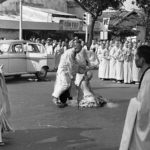
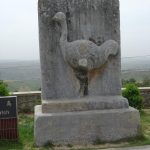
The statue commemorating one of the victims at the head of this post is a strange memory of this forgotten episode.

But what  circumstances set off the Russian torpedo-boat mania? The ‘attacks’ came in the dark and when Rozhestvensky saw his boat there were also fishing craft in the area. This was surely a case of seeing what you want to see: or better, in this case, seeing what you fear? Rozhestvensky himself, who would, in other circumstances, have been a good witness – he was well-disciplined and honest – stuck to his claim that a torpedo boat had been there. Indeed, he sent a telegram off to this effect.

The North Sea Incident was occasioned by the action of two torpedo boats which steamed at full speed under cover of the night, and showing no lights, toward the ship that was leading our detachment. It was only after our search lights had been turned on that it was remarked that a few small steam craft bearing resemblance to trawlers were present. The detachment made every effort to spare these craft and ceased firing as soon as the torpedo boats had disappeared from sight (105 Pleshakov).

As noted above, Rozhestvensky was scrupulously honest: there is no question of evasion in these words. He clearly believed what he wrote. There was also another strange bit of ‘proof’ , if that is, indeed, what it is. One of the British complaints against the Russian fleet was, having sunk and damaged vessels, a Russian torpedo boat hung around yet did not assist survivors. But the Russian fleet had no torpedo boats… So how to explain this confusion? drbeachcombing AT yahoo DOT com

Beachcombing has no Russian (blame his comprehensive school) but perhaps there are still Russian conspiracy heads out there claiming it was the Japanese?!

***

9 March 2011: First Ricardo writes in with this superlative site on the war of 1904-1905. Then Mike Dash with some background information. ‘Back in the 1980s I had cause to investigate some of these rumours for a study of the ways that the “moral influence” of the torpedo and the submarine affected naval strategy prior to the Great War. As a result I have a file which reveals the following: One can certainly say that the Russians were not simply misled by sightings of Hull fishing trawlers – they reported being tracked or attacked by both Japanese torpedo boats and Japanese submarines (which in 1905 were even less seaworthy than TBs) off the coast of Denmark, and again in the Mediterranean and off the coast of Sumatra. There were also reports of minelayers and even lights in the sky that were interpreted as Japanese balloons seen scouting at night – early UFO reports, if you will, which tie in well with a number of contemporary “airship scares” across the world. Prior to the disastrous Dogger Bank incident, in consequence, the Russians had already opened fire on French, German, Swedish and Norwegian merchantmen in the Baltic – the only difference in these cases was that they missed. The Russians put several men ashore at Vigo to give their side of the Dogger Bank story to the outraged British (it did not help that the incident had occurred on the 99th anniversary of Trafalgar). These men proceeded to Paris where an international court of enquiry was convened. Their leader, Captain Klado, stuck firmly to their story and argued that if no torpedo boats had in fact been present, lookouts on five different ships must have been simultaneously struck by identical hallucinations. To be fair to the Russians, there was one way in which Japanese torpedo boats might have operated in the North Sea without access to friendly ports: a class of warship known as the torpedo boat carrier, which carried very small TBs on deck. The British had one such ship called HMS Vulcan, which carried six small TBs and could winch them out and launch them as required. The French had a similar ship called the Foudre. The Japanese didn’t, but perhaps it didn’t seem impossible that they could have adapted a ship to carry out this task – by 1905 they had already proved themselves surpassingly competent at everything else. To be even more fair, the underwater threat from torpedoes was very much an unknown at this point. The Japanese were equally jumpy, and fired wildly at suspected Russian submarines off Port Arthur in May 1904. And I should close by pointing out that poor old Rozhestvensky’s men were not simply making these demons up from nothing. The scare was actually set in motion by a useless Tsarist agent by the name of Captain Hartling, who was sent to Copenhagen with 300,000 roubles and 540,000 French francs to spend on acquiring intelligence. Some of this money was disbursed on paying locals to report sightings of anything suspicious, and one is tempted to suspect Hartling and his hapless Danish coast-watchers felt a certain pressure to justify the disbursement of this remarkable budget. At any rate, the captain began to wire back alarmist reports of sightings and of Japanese plans to attack with submarines, torpedo boats and mines to Russia daily. These were forwarded to St Petersburg without being checked. What happened in the North Sea seems to have been men giving shape to imagined demons – but the imagination was Hartling’s, not their own.’ Then Tacitus from Detritus of Empire has this comment. ‘A partial analog to the Japanese torpedo boats in the north sea might be found about ten years later. In the panic stricken days of August 1914 rumors were rampant regards the tens of thousands of Russian soldiers who were landing in Scotland and boarding trains for London.  Supposedly they were going to shore up the collapsing Allied front in Belgium.  Lots of folks believed this, and even the Germans were a little concerned.  As to how the hopelessly inefficient Russian military managed to marshall these redoubtable legions through Murmansk or Archangel in such a short time, well, nobody cared. But perhaps the North Sea contains some interdimensional transit portal?’ Thanks Tacitus, Mike and Ricardo!!!

30/April/2012: Celeste Culpepper writes in: ‘Am I the only person (I can’t be. I’m not that old) to be reminded of the 1964 Tonkin Gulf incident? Those Russian reports sound suspiciously like those of the US Navy at the time and, yes, the USN vessels did fire on each other, too. In other words, given a sufficiently belligerent context all vessels seem armed enemies just as at night all cats are black. I can’t be too judgemental about the Russian officers involved.’ Thanks CC!


A Surprise at Apple Down Cemetery January 2, 2012

Posted by Beachcombing in : Medieval, Modern

***Dedicated to Stephen D***

There is a cute game that academics play where the more exciting the results of your research the more boring your abstract must be. Take the following tedious example from the 2011 American Journal of Physical Anthropology. Read through the miasma of low-key, lead on sentences and consider what an extraordinary discovery has allegedly been made here by Drs. Cole and Waldron.

This report describes a putative case of a treponemal infection observed on a skeleton of a young male adult from the Apple Down Anglo-Saxon cemetery dating to the sixth century AD, accompanied by grave goods indicative of a high status burial. The skeleton is well preserved and almost complete. The pathological evidence includes an extensive area of lytic destruction to the frontal bone of the skull, widespread profuse bilateral symmetrical periosteal reaction affecting scapulae, clavicles, arms, legs, hands, feet and ribs. There is also evidence of gummatous destruction on some of the long bones. Application of a differential diagnosis of all probable diseases exhibiting the individual symptoms leads to a clear conclusion that the person was infected with a treponemal pathogen. The skeleton shows none of the stigmata associated with the congenital form of treponemal disease. We propose that the evidence suggests a possible case of venereal syphilis rather than one of the endemic forms of treponemal disease. This diagnosis is based on the geographical pathogen range, the apparent low prevalence of the disease, significant social upheaval at the time, the high social status and early age of death of the individual.

Syphilis is one of the most controversial of diseases for the simple reason that scholars have long argued (sometimes viciously) over whether it is a New World disease brought back by one of the early European missions to the Americas or whether, alternatively, it is an Old World disease brought over to the Americas with tuberculosis and other darling conditions. The balance has swung backwards and forwards over the last generation, but present opinion is swinging back towards the first and traditional explanation: syphilis was the revenge of the afflicted native peoples of the Americas.

However, that was before Apple Down…

Little is said in the article itself. Indeed, as Stephen D, who sent this in, noted: ‘I particularly admire the way the authors heroically abstain from speculation’.

If the authors are correct in their argument that this is a case of venereal syphilis then there are only two possible conclusions. Either syphilis was present in Europe prior to Columbus or – and this way madness lies… – the subject of this study had had a brief and torrid love affair with a proto-Pochahontas.

Beachcombing is joking about the second, of course, but the first is exciting enough not to need laughs. Any other arguments for the European origin of syphilis? drbeachcombing AT yahoo DOT com

***

3 Jan 2012: Tony F writes in. Beach can confirm that Apple Down came after the publication of this article. ‘Also from the Am. J. of Phys. Anthropology this (er, last) year was a review article which says that all 54(?!) pre-Columbian syphilis cases are misdiagnosed, or temporally misplaced. Don’t know if that includes the Apple Down skeleton. Unfortunately, the article is behind a paywall, so I can’t read it. Harper, K. N., Zuckerman, M. K., Harper, M. L., Kingston, J. D. and Armelagos, G. J. (2011), The origin and antiquity of syphilis revisited: An Appraisal of Old World pre-Columbian evidence for treponemal infection. American Journal of Physical Anthropology, 146: 99–133. doi: 10.1002/ajpa.21613 Abstract: For nearly 500 years, scholars have argued about the origin and antiquity of syphilis. Did Columbus bring the disease from the New World to the Old World? Or did syphilis exist in the Old World before 1493? Here, we evaluate all 54 published reports of pre-Columbian, Old World treponemal disease using a standardized, systematic approach. The certainty of diagnosis and dating of each case is considered, and novel information pertinent to the dating of these cases, including radiocarbon dates, is presented. Among the reports, we did not find a single case of Old World treponemal disease that has both a certain diagnosis and a secure pre-Columbian date. We also demonstrate that many of the reports use nonspecific indicators to diagnose treponemal disease, do not provide adequate information about the methods used to date specimens, and do not include high-quality photographs of the lesions of interest. Thus, despite an increasing number of published reports of pre-Columbian treponemal infection, it appears that solid evidence supporting an Old World origin for the disease remains absent.’ Thanks Tony!

Turkish in Medieval Cambodia? December 6, 2011

Posted by Beachcombing in : Medieval

An incredibly busy day today – exams are drawing near – and so Beach is going to put up a cheat post with apologies, using an extract sent in by a reader. This appeared a couple of weeks ago and was pasted under a previous post on Amazons. However, Beachcombing is not interested, at least for present purposes, in the same thing as his correspondent: female fighting and fighters. His mouth though dropped open when the question of the queen’s language in the extract below came up. So much so that he has spent a lazy few minutes, in an otherwise frenetic day, looking into this question and has got nowhere.

On the second day after our arrival at the port of Kailukari the princess summoned the captain, officers and merchants to a banquet she had prepared for them, according to her custom…. When I greeted the princess she said to me in Turkish, ‘How are you? Are you well?’ She seated me near her…She asked me from which country I came. I said ‘From India’. She said: ‘The pepper country?’ I said yes. She asked about that country and events there and I answered her. She said ‘I must invade it and take possession of it. Its wealth and its soldiers please me.’ I said to her ‘do so….

Some basic background. This text appears in the fourteenth century Travels of Ibn Battutah. Ibn Battutah is a generally and demonstrably truthful correspondent, though there are some concerns about later additions to his original. Kailukari, the port where the queen dwells, is a bit of a mystery. But it is certainly to the east of India. Cambodia is one of the solutions given though there is no need to be so exact. It appears that this was a nation in contact with India and also a nation that was not of the faith  (i.e. Islam). Let’s keep it generic and just think of the south-east of Asia.

Now the mystery. The language of the place is not described but it transpires that the queen speaks to Ibn Battutah in Turkish and carries out a conversation in this language. If this was the Middle East and a monarch spoke in Turkish or if this was the far east and yet the woman had somehow learnt some words of Hindi, say, this might just about pass muster: though it would still be worthy of comment. But Turkish in south-east Asia  in the fourteenth century?!?

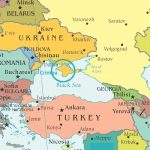
Beachcombing knows that Turkish is a Turkic language and that Turkic languages are also spoken in western China and in Siberia (see map) and other far flung regions. But before we even begin to ask whether Ibn Battutah could have mistaken a far eastern Turkic tongue for Turkish we have to accept that this does not get us appreciably closer to south-eastern Asia. Can anyone come up with a half decent, cogent solution to this crux? Drbeachcombing AT yahoo DOT com

***

11 Dec, 2012: ML writes in with a ‘long shot’. Of course, for a maniac problem like this there are no others! ‘I’ve just come back from a holiday in Myanmar and I was told there by our Burmese guide that the Burmese people are descended from Tibetan peoples. Tibet = Western China Burma = East of India. Maybe Burma rather than Cambodia.’ Thanks ML!!!

The Zambian Space Programme of 1962 December 4, 2011

Posted by Beachcombing in : Contemporary

***This post is dedicated to Ricardo and Invisible***

One of the problems of looking for the bizarre in history is that, after a while, you’ve read everything before: mermaid funerals in the Hebrides, tick; bats used in bombs against Japan, tick; Roman legionaries in China, tick… But then every so often something comes along that is fresh and that has completely escaped your notice and suddenly life feels worth living again. That, anyway, was the emotion that Beachcombing had when he read last week about Zambia’s attempt in the early 1960s to enter the space race. Beach writes ‘Zambia’ that would be wild enough, but actually this was Edward Makuka Nkoloso, a Zambian high school science teacher who became head of the National Academy of Science, Space Research and Philosophy, an organisation that naturally EMN founded.

His ten Zambian astronauts and a seventeen-year-old African girl are poised for the countdown.  [EMN] said: ‘I’ll have my first Zambian astronaut on the moon by 1965. My spacemen are ready, but we’re having a few difficulties…we are using my own firing system, derived from the catapult.’ Mr. Nkoloso continued: ‘To really get going we need about seven hundred million pounds. It sounds a lot of money, but imagine the prestige value it would earn for Zambia. But I’ve had trouble with my space-men and space-women. They won’t concentrate on space-flight; there’s too much love-making when they should be studying the moon. Matha Mwamba, the seventeen-year-old girl who had been chosen to be the first coloured woman on Mars, has also to feed her ten cats, who will be her companions on the long space flight… I’m getting [the astronauts] acclimatised to space-travel by placing them in my space-capsule every day. It’s a 40-gallon oil drum in which they sit, and I then roll them down a hill. This gives them the feeling of rushing through space. I also make them swing from the end of a long rope. When they reach the highest point, I cut the rope – this produces a feeling of free fall.’

Nkoloso was, in short, one of those wonderful eccentrics who usually only appear after three or four generations of middle class parliamentary democracy, preferably with what Beachcombing likes to think of, with apologies to Weber, as the Protestant Mad Ethic somewhere in the background. And yet here in Africa, in that wonderful glow of colonial freedom, before everything went to hell in the 1970s and the 1980s, was the kind of genius that would not have gone amiss riding through the English shires in the 1700s in a turquoise stage coach, raving about Atlantis and Romish spies.

Nkoloso revealed, for example, that he had been watching Mars from his ‘secret headquarters’ and had discovered that the planet was peopled by a strange race of primitive savages. He guaranteed, however, that he would not force their conversion, which was gracious of him. Perhaps memories of cack-handed Anglican missionaries in his part of Africa?

Enjoy this contemporary video that ends with the unnecessarily cruel words: ‘to most Zambians these people are just a bunch of crackpots and from what I’ve seen today I’m inclined to agree’.

What happened to Nkoloso? Beachcombing has been unable to find out. Edward, if you (or any of your astronauts) are still out there, Beach would love to hear from you: drbeachcombing AT yahoo DOT com. And if you are not he would gladly contribute to a plaque somewhere prominent on the other side of the equator.  

Africa, of course, has since entered the space race: Nigeria has several satellites in orbit. However, there are still, it seems, amateur African attempts. The most recent has appeared in Uganda and has recently been celebrated by the Daily Mail. ‘[Chris NSamba] firmly believes it will launch in the next ‘four to six years’. But given the condition of his project at the moment, he might be advised to buy a gigantic rubber band to help it on its way.’ Etc etc.

Beach cannot find his old file on amateur space launches though he has happy memories of a video of the disastrous launch of Starchaser 3 in 1998 on Dartmoor. Does anyone know where to find this? Invisible has also recently put him onto catastrophic attempts to combine rocket science and the postal service in Scotland in the 1930s: ‘Some letters singed from the blasts were salvaged –  to be posted in the normal way or coveted by collectors (which they are to this day). But little could be salvaged of Zucker’s life. Having been found ‘a threat to the income of the post office and the security of the country’, he was deported –  and immediately arrested by the Germans on suspicion of collaboration with Britain. He was forbidden to make further rocket experiments after release and became a furniture dealer. But before dying in 1985, he managed to dabble again in rocketry –  briefly and fatally, for three people who got in the way of his launcher‘.

Happy times…

***

11/12/2011: David B writes in with this ‘Reading your article on The Zambian Space Programme of 1962 I was reminded of the Idi Amin space program. What sticks in my mind are pictures of a space ship fashioned from garbage cans and the official comment when the projected launch date came and went that ‘The white man has stolen the magic‘.’ Beach would love to know more. Thanks David!!!

From Vienna to the Baltic in Roman Times November 28, 2011

Posted by Beachcombing in : Ancient

A couple of rarely examined sentences in Pliny’s Natural History (37,45) give the outline of a grand old Roman adventure in the times of the Emperor Nero (54 AD 68 AD).

There are about 600 miles from Carnuntum [Roman camp close to Vienna] in Pannonia to the shores of Germany from which amber is imported. The fact was recently established and a Roman knight still lives who was sent to get some amber by Julian, when Julian was given the job of taking care of the gladiator games put on by Emperor Nero. The knight wandered through the markets and the coasts  and found so much amber that the protective nets separating the wild beasts from the podium were hung with pieces of amber, and, what is more, the arms and the litters (?) and all the apparatus for every day (in as much as the gallant preparations changed every day) were decorated with amber.

DC M p. fere a Carnunto Pannoniae abesse litus id Germaniae, ex quo invehitur, percognitum nuper, vivitque eques R. ad id comparandum missus ab Iuliano curante gladiatorium munus Neronis principis. qui et commercia ea et litora peragravit, tanta copia invecta, ut retia coercendis feris podium protegentia sucinis nodarentur, harena vero et libitina totusque unius diei apparatus in variatione pompae singulorum dierum esset e sucino.

The journey described here might appear fairly undramatic: after all, to drive today from Vienna to the Baltic is the work of twenty four hours and you travel on good roads all the way. But in these times Carnuntum was the jumping off point between Mediterranean civilisation and the tribal north. The unnamed knight will have moved through territories where Romans were despised and territories ruled over by a melange of Celtic, Slavic and Germanic clans. It is extraordinary not only that he made it to the Baltic, but that he managed to get back with the amber that he somehow purchased there.

And what was this amber that the Romans esteemed so much? Well, we today know that amber is fossilised resin but the ancients did not know this and speculated that amber was everything from gummy liquid (close) to solidified lynx urine! For them amber was  the only real treasure, to be got from trading with the Baltic. It is interesting to speculate though whether the nameless knight was not sent north for other purposes besides precious ‘stones’. Nero’s gladiatorial games are mentioned: was the equestrian  supposed to bring back new and exotic beasts from the north of Europe to be killed in the sand of the coliseum? Danube bears, Polish wolves, German boars…

Beachcombing is always interested in earlier adventures off the beaten track: drbeachcombing AT yahoo DOT com

***

30 Nov 2011: Carter from Across Difficult Country writes in with a fascinating point that sheds some light on Greek and Roman confusion about the Baltic, ‘The writer Avram Davidson speculated amber convinced the ancient Greeks Hyperborea had a warm climate. Thanks Carter!

- Carter

American Indian Settlers in Iceland? November 20, 2011

Posted by Beachcombing in : Medieval, Modern

*** Dedicated to Wilson ***

Iceland, the tiny nation floating between Britain and Greenland, has been isolated for much of its history. This isolation has given the island two extraordinary resources: one is a spectacular landscape, untainted by industrialisation (see above); and the second is a closed DNA pool.

A closed DNA pool = an extraordinary resource? In days gone by such sentiments would have been the prerogative of Nazis. But since the early 2000s it has been understood that Iceland’s small and homogenous population, close to 300,000 with virtually no foreign influxes, makes the island a perfect setting for genetic investigation as there is little ‘background noise’. This relatively simple genetic situation can then be cross-referenced with detailed Icelandic medical records, a boon for those investigating heart disease, various neurological conditions and cancer.

For historians though there is a further prize lurking here. The extensive investigations into Iceland’s genetic pool have kicked up some surprising insights into Iceland’s early history: one of which – an apparent Amerindian migrant – definitely deserves a bizarre history post.

Iceland’s first settlers were Vikings from the homelands but Scandinavians also came from their rapidly evolving settlements abroad, particularly in Britain and Ireland. Not surprisingly ‘Insular’ genes also appeared then in Iceland, salting Scandinavian ones: probably indicative of a large slave influx from Jorvik and Dublin. All of this is borne out by the genetics.

However, a 2010 study (Ebenesersdottier et al) surprised everyone by showing one more exotic strand of dna, C1e, which appears to come from a female Amerindian donor. More than 80 modern Icelanders carry this DNA strand and it is estimated that c. 1700 about 4 Icelanders carried the same. Then ‘there is good reason to believe that the C1e lineage arrived in Iceland several hundreds of [sic] years before 1700’.

The proof of the antiquity of this DNA (prior to 1700) goes beyond Beachcombing’s weak grasp of science. Does it depend on something in genetics itself? Or does it – and this would be worrying – depend on calculations about when Icelanders ‘should have’ come across Native American populations? If the Amerindian in question could have arrived c. 1600 then everything that follows here would need to be written in different terms. One thinks, for example, of possible cases of Amerindian boats lost at sea.

The authors go on to write, perhaps unnecessarily sexing up what is, in any case, an exciting enough discovery:

[T]here is no direct evidence of contact between the Vikings and Native Americans – i.e. that they actually met.  Our findings raise the possibility that there was in fact contact between the Icelandic Vikings and the Native Americans which led to a Native American woman’ being brought back to Iceland.

This passage is a bit disingenuous in that the sagas, some of which read like historical accounts, describe contact between the Vikings and the native populations. Indeed, we have previously here looked at one famous meeting in Vinland. The implication is presumably that only L’Anse aux Meadows is ‘proof’ and yet it is L’Anse aux Meadows which demonstrates that the sagas were essentially correct.

But what the historian in Beachcombing finds really extraordinary is the following. If a native American woman was brought back to the Greenland settlements and, eventually, to Iceland, how did this escape contemporary Norse writers? Wouldn’t this have been one of the most remarkable events of the age?

Well, for us yes. But evidently for the Icelanders no. There is not even a vague allusion in Icelandic literature to this forgotten Inuit Eve: even though there were Icelandic ‘records’ (discuss) at this time. The real story here for Beachcombing is not the unsurprising minor contact between peoples at this date, but the remarkable blind spot in the medieval Norse mindset that could pass over a Native American woman being sold in the slave market at Reykjavík.

Any other examples of DNA opening up interesting contact between cultures? drbeachcombing AT yahoo DOT com

***

26 Nov 2011: Invisible writes in with a sensible objection: ‘My question arising from your post is: is Amerindian DNA the same as Inuit?  Since you’ve got Inuit settlements in Greenland from (approx) the year 1200 – just a hop, skip, and a kayak away from Iceland–I don’t see why Inuit DNA in the Icelandic population would be remarkable. But if the Amerindian DNA is something different: say, Sioux or Apache or Mayan, that would be startling. I don’t know enough about the gradations of DNA to know how finely the genetic/tribal boundaries can be drawn.’ Beachcombing luckily has a colleague at hand who has dabbled in DNA. He claims that the genetics of the Inuit and the Amerindian population should be similar as they are essentially the same people: Asian emigrants from the New World. The question he would have is whether lapplanders DNA is all that very different… Thanks Invisible.

28 Nov 2011: Stephen D writes in support of Invisible. ‘No, it can’t be an Inuit connection. The Icelandic American DNA is haplogroup C, Inuit is A or D. Interesting detail from the Ebenesersdottir paper though: it’s a new subgroup, C1e. C1a-d are already known, and Amerindian; but nobody can say whether C1e is Mayan, Algonquin or whatever (Sioux or Apache are, um, geographically implausible). A wild guess might be Beothuk (right part of world, idiosyncratic language so possibly ditto genetics, now extinct and so DNA not readily accessible).‘ Thanks Stephen!

31 Dec 2011: Stephen D writes in with still more and it is wonderful stuff: ‘I’ve dug down a bit further into the online data, and it seems that while it is true that the Icelandic mitochondrial DNA falls into a unique subclass, C1e, with at least 14 mutations separating it from C1a (eastern Siberian) or C1b-d (Amerindian), and with no known complete corresponding sequences anywhere, there are a number of partial mitochondrial sequences that may well turn out to be C1e. These are:  2 ancient Tainos sequences, Dominican Republic (good preColumbian seafarers, from Lesser Antilles to Bahamas: largely extinct: strong candidate in my opinion); 1 ancient Ciboney sequence, Cuba (mostly driven out of Antilles by Tainos: extinct: weaker candidate); 2 ancient American Midwest sequences, Oneota: wrong place?; 2 modern samples, Brazil: probably wrong place; 3 modern sequences, Chile, 1 modern sequence, Peru, 1 modern Canadian sample (Nuu-Chah-Nulth, Vancouver), 1 American sample (Apache): definitely wrong place; 2 modern sequences, origin unknown, no use to anybody; And then it gets interesting; 1 modern sequence, Canary Islands: probably descendant of Amerindian brought there post-Columbus; 1 modern sequence, Germany of all places: probably as above but Ebenesersdottir et al don’t completely rule out older C1e component in European populations; DNA does get around. You may have come across the Tuareg mitochondrial component in modern Hungary (presumably brought there in retinue of some Turkish pasha), and Thomas Jefferson’s Y chromosome DNA found in his lawful white and bastard coloured family, which despite the Jefferson’s Welsh ancestry turned out to come from Egypt or thereabouts (presumably via some merchant, official or soldier in Roman times).’ Thanks Stephen!


A Rhinoceros in Eighteenth-Century London November 5, 2011

Posted by Beachcombing in : Ancient, Medieval, Modern


 ***This post is dedicated to Don who sent the reference in***

Beach has a longstanding thing about elephants (see many previous posts and many posts to come) and has been wondering recently about opening up a second front on the rhinoceros: a distant reading of a text about Romans importing this beast for their games has been jumping up and down in his head. He has been spurred on by this late but fascinating reference to an eighteenth-century rhinoceros in London, one of the earliest to come to the British capital. Pity the beastie. Bizarrists might remember that 1739/1740 was the winter of the Great Frost.

‘This creature was first shewn in London in Jun 1739 at 2s and 6d for each spectator, being esteem’d a very great curiosity, there not having been a Rhinoceros in England since 1685. He was fed here with rice, hay and sugar. Of the first he eat 7 pounds to about 3 pounds of the sugar; they were mixed together, and he eat this quantity every day, divided into three meals, and about a truss of hay in a week, besides greens of different kinds, of which he seemed fonder than of his dry victuals; and drank large quantities of water. He bore to be handled in any part of his body; but was outrageous when struck or hungry, yet pacified in either case only giving him victuals. In his outrage he jumps about, and springs to an incredible height, driving his head against the walls of the place with great fury and quickness, notwithstanding his lumpish aspect… A very particular quality is observable in this creature, of listening to any noise or rumour in the street; for though he were eating, sleeping or under the greatest engagements nature imposes on him, he stops every thing suddenly and lifts up his head, with great attention till the noise is over.’

There follows a detailed and often amazed description of this strange beast. Beach hopes he will not seem too puerile if he concentrates on the passage relating to the rhinoceros’ pudenda. In part because it gives us a glimpse of how the locals interacted with him and, in part, because Beach is used to Victorian (non-)descriptions where such things would never appear in a popular magazine.

The penis of the Rhinoceros is of an extraordinary shape. There is first a theca or praeputium, arising from the inguinal part of the belly, nearly like that of a horse, which conceals (as that does) the body, and glands, when retracted… His keeper, who was a native of Bengal, would make him thus emit his penis when he pleased, while he lay on the ground, by rubbing his back and sides with straw; and, in its utmost state of erection, it never was extended to more than about eight or nine inches.

Imagine that being printed up in the Graphic or Science Gossip in the 1870s. there would have been questions in Parliament!

There is also an interesting history of the Rhinoceros from the earliest times. Some of this is erroneous, some  is missing and some was new (at least to Beachcombing): but it represents early eighteenth century English knowledge on the question.

He was not known to the Greeks till the time of Aristotle, nor to the Romans till 85 years before the Christian era, so that he seems to be scarcest of all the quadrupeds; Rhinoceros is his Greek name, from the horn on the nose, and he is with great probability supposed to be the unicorn of the ancients.

The author then goes on to theorise that the Rhinoceros is the unicorn of the Old Testament: a thesis that is almost certainly wrong (another post, another day) and offers a discussion of the one horn vs two horn rhinoceros.

Now that brought from Asia to the King of Portugal in 1513, and those brought from thence to England in 1685, in 1739, and in 1741, were single horned, and a great number of hors in the museums of the curious brought from the East Indies are also single. We may therefore venture to assert, that all those of Asia have but one horn n the nose; and this is confirmed by many gentleman who have seen those creatures in Persia. On the other hand we are sure the Romans  had always a great commerce with the Africans, and had many cargoes of wild beasts from that quarter of the world; it is therefore probable that they might more conveniently have obtained the several Rhinoceros’s which were shewn in that city from Africa than Asia, as the former is much nearer to Italy. And we do not want proof that the African Rhinoceros has 2 horns. Peter Kolbe, a Dutchman, in his voyage to the cape of Good-hope, says there is one in the summit of the nose like the other’s but having a smaller close behind it. There are also two horns in Sir Hans Sloan’s museum sticking to the same integuments, not more than an inch from each other; all of which makes it probable, at least, that the Asian Rhinoceros was the Unicorn of the ancients notwithstanding those exhibited at Rome had two horns; and probability, in questions of this nature, is all that can be reasonably expected by the most diligent enquirer.

Personally Beachcombing is all in favour of the rhinoceros as unicorn theory. However, the Africa one horn and Asia two horns is, of course, an oversimplification. Any other Rhinoceros stories? drbeachcombing AT yahoo DOT com

***

5 Nov 2011: First there is Mark L. ‘You might find this item to be of interest. The URL linked below points to an item on a site I maintain for the benefit of the academic community. It shows a Quadrans - or 1/4 of a As – the smallest denomination of Imperial coin ever used in the Roman Empire. You might think of it as equivalent to a Farthing, although it is difficult to assign it a relative value.  All Roman base-metal coins were token or fiduciary issues (yes, as far back as that – and earlier still) so its real purchasing power was a function partially of what was decreed for it and partially as the amount at which the market accepted it. You might recall the story about Vespasian, who when challenged about charging an admission price for the public “conveniences” (still called “Vespasianos” in some parts of Italy, I am told) held up a coin – presumably a quadrans, and as the smallest coin of the realm is most likely what the charge for use was – and said “Yet, this has no bad odor.” (or Latin to that effect). This piece with a main device of a rhinoceros was one issued by his son, Domitian – under whose reign a large number of small denomination types were issued. PS – Quadrantes almost never carried the portrait of the Emperor – perhaps due to their lowly status?’ Then up comes Invisible: ‘Here is a reference to the earlier rhino of 1684.  This is a quote from The Shows of London, Richard Altick p. 37 “the strange Beast called the Rynnoceros’. Evelyn, like most of the learned, identified the breed with the fabled unicorn, although the reality somewhat belied the myth, for ‘it more ressembled a huge enormous Swine, than any other Beast amongst us.’ Arriving aboard an East Indiaman in August 1684, the ‘rhinincerous’ (the spelling presented insuperable difficulties to contemporary pens) was valued at £2,000—an impressive indication of its worth as a commercial showpiece. The Rhinenceras was immediately put up for sale and was ‘bought for £2320 by Mr. Langly one of those that bought Mr. Sadlers well at Islington & in a day or two will be seen in Bartholomew faire.’ But Mr. Langley was unable to raise the money and lost his £500 deposit; whereupon the owners took back their Rhinonceros and put it up for resale, ‘but noe person bid a farthing soe lyes upon their hands.’ By the end of September the Rhynonceros was at the Belle Sauvage inn at the foot of Ludgate Hill, where the proprietor was said to take in 15 a day at a price of 12d. for a look and 2s. for a ride. The Rhynoceros continued to attract crowds until its premature death two years later (September 1686); ‘the severall proprietors having Ensured £1200 on her life the Ensurers are catched for much money.’” Here is an ad for said Rhino.  The inimitable Jan Bondeson on the famous Clara.  And a whole crash of early rhinos from this site‘. Thanks Mark and Invisible!

7 Nov 2011: Ricardo writes in ‘You know, certainly, that image was made by Durer from descriptions of the rhino King Manuel of Portugal brought to Europe (or gave orders to be brought) in 1515. The king allegedly walked the beast in the Lisbon streets and the next year sent it as a present to the Pope but it perished in a shipwreck near Italy. A half century would elapse before another rhino would set foot again in Europe. Just imagine the Portuguese King, XVI century, walking his newest pet through the streets of the capital…’ Thanks Ricardo, I found the image in the Gentleman’s Magazine and was completely unaware of its provenance!


Suger’s Sherbert Holder October 13, 2011

Posted by Beachcombing in : Medieval

In previous posts Beachcombing has celebrated objects that have long and interesting histories: take, for example, the Baltic buddhas, Cellini’s canon or the Dauphin’s heart. It was with some excitement then that he just recently stumbled upon a vase that made, in the Middle Ages, its way from Moorish Spain through the hands of several royals, to St Denis and finally into the Louvre’s collection where it remains to this day.

The cup, it is generally believed, dates back to the seventh or eighth century and early Moorish Spain. It was supposedly given to William IX of Aquitaine, by the Emir of Sargossa, though Beachcombing has found no evidence for this. Could it just be based on the fact that in 1120 William was campaigning against the heathen on the other side of the Pyrenees?

What is certain that Eleanor of Aquitaine took it north and gave it to the dreary, saintly,  goody-two-shoes Louis VII. Louis then, in turn, gave it to Suger of St Denis, a more interesting man altogether, who turned it into a mass cup. Goodness knows what the first Muslim owner used it for – a sherbet holder, incense diffuser… Certainly the blood of Christ didn’t figure. Louis (or perhaps Suger) had the following words carved on it.

Hoc vas sponsa dedit Anor Regi Ludvico,
Mitodolus avo, mibi Rex sanctsque Sugerus

This vase from Mitodolus was given to King Louis by his bride Eleanor and the King gave it to holy Suger.

Who on earth is Mitoldolus? And, perhaps more importantly, what did feisty Eleanor think about her bridal gift being given over to the Church in this way? It may have been gifted after the wars between the King of France and the Count of Champagne for which Eleanor was in large part responsible: perhaps it was even a joint peace offering.

In any case, it survived in St Denis’ collection until the unhappy events in France at the end of the eighteenth century. Indeed, one remarkable engraving shows it in the monastery’s treasure room in happier times. Then the French state looted Suger’s prize and put it in a museum for the newly enfranchised citizens to see.

Beach notes that  Elizabeth Chadwick has already written a post on this object and includes an Akashi reading! Beachcombing has previously recorded his suspicion (and guilty fascination) about these kind of psychic trails through history. But if ever there was an object that it would be nice to read, it would be Eleanor’s mantelpiece fodder.

Beachcombing is always on the look out for objects with a history: drbeachcombing AT yahoo DOT com


Tute’s Glass Ball September 27, 2011

Posted by Beachcombing in : Ancient

*** Dedicated to Andy the Mad Monk ***

Beach is in a meteor mood again and has been flicking back through his notes to some particularly interesting cases that Andy the Mad Monk sent him last year. Andy, in fact, provided a series of remarkable examples but Beach’s favourite is probably this curious case from ancient Egypt.

In the picture above we see Tutankhamen’s Pectoral that will have hung down over the doomed one’s pigeon chest and in the centre of this piece there is a beautiful yellow stone. This ‘stone’ is actually a piece of glass, which is curious as Ancient Egypt – at least by Tutankhamen’s time – did not have  glass-making technology.The matter is complicated and fraught – i.e. Beachcombing despite reading up doesn’t really understand – but it seems that glass-making knowledge in Egypt declined through the Bronze Age and had been lost by the boy pharaoh’s time.

So where did the stone come from? An Italian scientist Vincenzo de Michele noted, in a visit to Cairo museum, that this glass looked suspiciously like a naturally occurring substance found in the Great Sand Sea several hundred miles away. An optical measurement confirmed its provenance and Tutankhamen’s ‘stone’ is now officially catalogued as Great Sand Sea Glass (aka Libyan Desert Glass).

But if that answers one question it begs another. Where did the glass that litters several tens of kilometres in the deep desert come from? It seems that the only thing in nature able to create the necessary heat to melt sand into glass in this way would have been a huge fire ball, created by an unstable meteorite disintegrating as it came towards earth. Luckily you and I were not around twenty six million years ago to see this go down.

The Bedouin who brought Tute his special glass would have had no idea that a meteorite had created the polished treasure in his hands. But it is a pleasing thought that this hunk that hung around the neck of the one of the most powerful men in the ancient world had been created by a meteorite blast several million years before, many times more potent than an atom bomb. Got to beat your bog standard crown jewels!

Beachcombing should also note that – on the subject of atom bombs – there are some fringe Egyptologists  who claim that the scattered glass marked the remains of an antique nuclear war. Presumably the pyramids were missile silos…

Beach is always on the look out for meteorite stories: drbeachcombing AT yahoo DOT com

New news links with thanks to referrers..

***

28 Sept 2011: Some interesting responses to this one. First up is HC who has noted a mistake on the question of Egyptian glass production. Beach would love to learn more about this and the supposed loss of glass-making skills in the Near East: ‘Interesting article, but there is a factual error in it I should point out.  Contrary to the article,  the ancient Egyptians did manufacture glass in industrial quantities although they used it primarily for jewelry, as an artificial gem.  Egyptian glass was translucent, not transparent, and usually highly colored due to impurities.  There’s lots of sand there, and its likely it was first produced accidentally in the manufacture of ceramic glazes and during the smelting of metals, as the article describes, and then became a craft of its own.  The object in question may have also been acquired by trade.  For example, In Tut’s tomb an iron dagger was found, and although the Egyptians did not have the technology to work ferrous metal, they were familiar with it and had access to it from meteorites and from trade with the Hittites who did have crude iron-smelting capability.’ KMH pushes the minority opinion with force: ‘There may be more to the mystery of this glass than appears on the surface. The case for atomic weapons also rests on the finds of highly radioactive skeletons in the Indus valley and certain passages of the Mahabharata: check out world mysteries and multiman. However, the idea that once a culture discovers atomic weapons it will likely destroy itself is highly romantic. Undoubtedly there have been significant meteor falls in human history, but this particular area in the Sahara seems to lack an impact crater and other things characteristic of a meteor impact‘. Next up is Rick, one of our friends at the Anomalist: ‘I thought you might be interested in another theory for the creation of the Libyan Glass in Tutankhamen’s rich bauble.  Checkout what Electric Universe Theory proposes for this piece of glass: Libya’s Kebira Crater. Also see the information in another site that is related.  There you’ll find these statements concerning the dating of the “craters”: “The press release from Boston University listed the Kebira formation as “millions of years old”, corresponding to the dates fixed for other areas of the Gilf Kebir Plateau. But, is that the case? Could intense electromagnetic bombardment influence the apparent age accepted by the scientific community? The most common dating method is by measuring the isotopic ratios of particular elements. For example, uranium 235 decays into lead 207 with a half-life of 700 million years. That means, when the rock was first formed, it contained a fixed quantity of uranium 235 and every 700 million years thereafter it will exhibit half the amount of uranium 235 and an increasing amount of lead 207. Because a mineral sample’s age depends on that sample existing today exactly as when it was initially formed, if it has been affected by radioactivity, or heat, or a blast or electricity, any measurement of its age will be inaccurate. Therefore, if a multi-billion joule electric discharge, sufficient to excavate a crater 19 miles in diameter were to strike the earth, the gamma and x-ray pulses would drastically alter the decay rate, the isotopic ratios and, perhaps, form new elements within the rocks. For these and other reasons presented in these Pictures of the Day, it is not unreasonable to ask if Kebira and its surrounding craters may be the remains of electrical events, perhaps occurring in a more recent past than geologists have previously imagined.’ Then Ricardo with a general reflection on things with fiery tails: Comets are not meteors (although they can become such) but your meteor post reminded me of a delightful line in one of Jules Verne novels: ‘[...] La comète est le « Deus ex machina’; toutes les fois qu’on est embarrassé en cosmographie, on appelle une comète à son secours. C’est l’astre le plus complaisant que je connaisse, et, au moindre signe d’un savant, il se dérange pour tout arranger!’ (Clawbonny, Le Désert de Glace) I think it translates the spirit of the time regarding this natural phenomenon.’   Thanks to HC (and Larry who sent HC’s comment in), KMH, Ricardo and Rick!


Page 1 of 512345