A Romani Mystery in Eleventh-Century England March 9, 2012
Posted by Beachcombing in : Medieval***Dedicated to Stephen D***
Our knowledge of the ancient and medieval movements of peoples depends on extraordinarily inadequate contemporary sources and the deadly (and often unsupported) prejudices of historians and archaeologists. But now, with the use of DNA sampling and other techniques, including isotope analysis, science is coming to the rescue: giving us surprising insights into long dead periods and blowing away our assumptions like so many cobwebs.
Beach particularly likes a paper from Biology Letters (2005) 280-282 by Töfp and Rus Hoelzel that makes a mockery of certain British chronologies. The authors were surprised (to say the least) to find a Romani mitochondrial haplotype in a cemetery in Norwich in East Anglia, a cemetery that was in use from the tenth to eleventh centuries ‘ca. 930-1050′. This means that – drum roll – somehow Gypsy (‘Romani’) DNA got into the English blood stream prior to 1000 AD: which is pretty extraordinary given that the Romani are generally thought to have got to the United Kingdom c. 1600 AD!
Beach noted in his post of yesterday that he does not read Russian. And he should note at this point that he does not read DNA either. The graphic above is, for example, supposed to mean something and sentences like the following leave him feeling not only inadequate but also vaguely nauseous: ‘A fragment of 264 bp (including primers) of the mtDNA HVS-I was amplified using primers 16099 (50AACCGCTATGTATTTCGTAC30) and 16331 (50TTTGACTGTAATGTGCTATGTA30) (numbering according to Anderson et al. 1981).’
Quite.
But even a DNA dullard like Beachcombing knows that the Romani are special. As a sub-continental people who made it into the Mediterranean Basin and subsequently as far as Scotland and Scandinavia: the Romani brought an entirely alien strain of DNA deep into a region with its own distinctive genetics. The result is that Romani DNA is particularly easy to pick out: certainly, it easier than arguing about the DNA differences between ‘Celts’ and ‘Germans’ and similar such nonsense.
With this by way of apology how do the authors explain this embarrassing stray? Well, they kindly offer five explanations:
1) An independent mutation in the British population: ‘very unlikely’.
2) A Romani-style halotype which may be present but undetected in the European population: ‘the probability is very low’.
3) The halotype was common in Saxon times but has since been lost: the authors also think this is improbable.
4) A Viking serving in the Varangian Guard in the ninth or tenth century somehow fathered, with a Romani mother, a child who later came to Britain or who was born there.
5) ‘The independent arrival of Romani people in England, 500 years before the oldest known record’.
Beach has not the knowledge to pontificate on the arguments for (1-3): all he can note is that the authors do not seem to take them too seriously. If readers know better or if research has since changed things please let Beach know: drbeachcombing AT yahoo DOT com
The Varangian route seems to be rather tortuous. East Anglia had an iced sugar Norse sprinkling but was not part of the mad-dog cursed Viking heartlands: Orkney, Cork etc. Were there even Romani in the Byzantine empire in c. 950 say? Our best – though admittedly very uncertain sources – would say not.
The final possibility is surely the best one – if the authors can be trusted in their judgements over 1-3. It is attractive because it covers so many possibilities. It could involve a small group of Romani mercenaries being hired into an East Anglian fyrd: though how did they get there? Or it could, instead, be a Romani slave traded through Syria and up onto the Northern European trade routes: God help her!
Then a final thought. It would be interesting to know how exclusive this mitochrondrial haplotype was in India. If we are talking about a general Indian feature – the “gypsies” only in European terms – Indian contact with Anglo-Saxon England would be easier to explain than the specific movement of one nomadic tribal society, the Romani. Beach remembers earlier posts including the embassy to St Thomas.
In any case, fascinating stuff and thanks again to Stephen for taking the time to send this stoneless cherry in.
***
18 March 2012: Karen writes in: Phoenicians were traders for tin, and travelled to many countries. Perhaps they also traded in slaves. Celts were known to hire themselves out as mercenary warriors at times. Even to distant lands. (Galatia was a settlement of Celts, and although these were probably not from Britain, certainly it shows that mercenaries could and did go far afield for opportunity.) Warriors are known to take slaves as booty. There is no reason to think that Celtic people had no slaves from other countries. There were soldiers in England from many areas of the Roman world. Higher ranking officers sometimes had slaves, or brought wives. Royalty, especially, was known to have slaves, and often a taste for exotic ones. Also English royals did marry royals from Europe. In those days, DNA tests did not exist, so it would be impossible for a king or prince or lord to tell if a baby was really his, especially if he were Spanish, Portuguese or a swarthy Eastern European himself. The era of the gravesite is a time marked by wars and pestilences, with rough knights hardly more than terrorists of the peasants in Europe. In such confusing times, who knows who was brought to England or by whom? This Romani DNA, while found in a gravesite from 950 or 1000, could have been passed down for many many generations in England, and indeed may still be in some small population of very “white” English persons.’ thanks Karen!!
In Praise of the Hindoestanen February 29, 2012
Posted by Beachcombing in : Contemporary, ModernBeachcombing has run, over the months, a series of forgotten kingdom posts: lands and peoples that time forgot. Sometimes he has stretched this definition to its elastic limit by including forgotten communities: a personal favourite, for example, were the Confederates who fled from Lincoln’s peace and came to settle in Brazil. Another group that he has become increasingly fascinated by are the Hindoestanen of the modern Netherlands, a people that, by some estimates, number almost two hundred thousand. The Hindoestanen are, of course, of Indian descent, but what is interesting is how they arrived in Holland, for they did not come directly from India but by a (very) round-about route.
Essentially from 1873 to the time of the First World War the British allowed/encouraged Indian workers to travel from the Raj to Surinam in Southern America: Surinam being, of course, at this date, a Dutch colony, a younger sister of the more important Dutch possessions in the Pacific, possessions that the Japanese would chew up a generation later.
Surinam survived the Japanese onslaught and the Hindoestanen became an important part of that multi-ethnic state speaking a mix of Dutch, Hindi and other sub-continental languages. They had different religious backgrounds and the slogan of the Hindoestanen political party in Surinam was the pleasing: ‘Hindu, Moslem, Sikh, Christian; they are all brothers; India is the mother of them all!’ Par for the course in Delhi, of course, but a strange phrase to hear in downtown Paramaribo.
The Indians had come as indentured workers – about 30,000 of them of whom 20,000 decided not to return to India. But if they began as a poor community they quickly became one of the elites of the colony. Indeed, so invested were they in Dutch rule that the Hindoestanen often opposed decolonization when it finally became an issue in Surinam. Certainly, tens of thousands of Hindoestanen wisely got out with independence in 1975 and went to their step-mother, the Netherlands.
The Hindoestanen now established themselves in cold Holland, having gone anti-clockwise around the world, from northern India, to dank Surinam to the dykes of the Low Countries. As such they resemble some other communities moved around like checkers pieces by colonial governments, that had to then move again when the imperial draughts board was finally shut up in the mid-late twentieth century.
Another example are the Ugandan Indians who that idiot Idi Amin chased out of his country: honestly, who wouldn’t want an affluent, well-educated Indian middle class to tax?!
Interestingly India’s new found power in the world has not yet been welcomed by the European Hindoestanen, most of whom see themselves as Dutch rather than Indian. But with the shifting and peculiar identities of modern continental Europe, Mother India might yet come and appeal successfully to the great, great grandchildren of those the British loaded onto boats bound for Dutch Guyana.
Any other twice or thrice-moved peoples: drbeachcombing AT yahoo DOT com
***
29 Feb 2011: Southern Man writes in (and the emails below substantiate this in different ways): ‘Two groups that have moved endless times. First, the Jews who have been kicked around like a football from country to country: there was recent news, for example, of the evacuation of the last Yemeni Jews from their country now heading to the New World. Second, African slaves who were moved around through sales and then by daring escapes for freedom. Think of those slaves brought to the US and then their grandchildren brought back to Liberia in Africa.’ Andy the Mad Monk writes in: Jakub has a fascinating side light on this. Following your post on the Hindoestanen, here is another many times moved community that might be of interest: a slave settlement. Speaking of Paramaribo, there’s also a significant and quite ancient community of Jews in Surinam. Louis K, meanwhile, writes in about the Hindoestanen: ‘Being Dutch myself, I could not help notice that there are some trends within the Hindoestaanse Gemeenschap (Hindustan community) that seem to have escaped your attention. As the subject of ‘Identity’ (thanks to mr. Geert Wilders) is now ‘hot’ within Dutch society, for all different immigrant and non-immigrant cultures, a lot of Hindustan teenagers are turning to ‘Mother India’ to pronounce their ‘Indianischness’. Which is in turn roundly condemned by the older generation, who still remember that THEY came from Surinam. However, in The Netherlands, the Surinam Identity was, until recently, seen as a negative thing, and was splintered along ethnic lines (Indonesians, Hindustani, Ex-Slaves and Escaped Slaves, with a smattering of Chinese and Levantines) and the younger generation only knows The Netherlands. But I have read that they suffer from the same problem as US Afro-Americans that “return” to the motherland: Next to no knowledge about what is going on, and culture shock, because all they know about India is from the Bollywood movies that they see.’ Then pulling in the other direction there is Chames: I remember a recent meeting of the Hindustan community in Netherlands organised, in part, by the Indian Embassy there. One Hindustan speaker stood up and said words to the effect that ‘we are Dutch not Indian’ and was cheered ‘to the rafters’. Thanks SM, Andy, Jakub, Chames and Louis!
30 May 2012: Sword&Beast writes in ‘Your post on the hindustani of course got me interested. Living in Suriname itself for 4 months now, I have not much to add to your instructive post and the comments afterwards. Maybe just a picture from Suriname itself: the hindustani community represents, today, around 35% of the Surinamese population. Even though the community had reservations on the pace towards independence, and many indeed left in 1975, they had a major role in it. Its main party, the VHP, has more than 60 years, and its first president, Jagernath Lachmon (http://en.wikipedia.org/wiki/Jagernath_Lachmon), is revered as one of the founders of the nation. Besides being well organized and generally afluent, the community is proud of its heritage, with temples, festivities and excellent food. One recent example was the hosting, last week, of the Miss India Worldwide Pageant (http://miww2012.com/), with contestants with indian ascent from Sri Lanka to Scotland. By the way, the girl from neighbouring Guiana won it. ‘ Thanks S&B!!
Somehow Still Walking February 16, 2012
Posted by Beachcombing in : Contemporary***Dedicated to Tacitus over at Detritus of Empire***
Beachcombing used to live on a farm next to an SS veteran who had escaped from a Soviet prisoner of war camp with four ‘through and throughs’, a lot of random shrapnel and with one of his eye balls conspicuously absent: he was a bit of a ‘card’ and refused to wear a glass eye. Beach began to think of this gentleman while writing his post on survivors of massacres the other day, because he was intrigued by those injured in the most terrible way and yet living to (ultimately) walk away.
Most of the examples in the survival post were men and women who were not actually hit but who had the supreme good sense to lie still and not do anything while homicidal maniacs raged around. But one man mentioned there, Révérien Rurangwa, definitely fits into this category. RR was 15 at the time.
On 20 April, [RR's] family were slaughtered one by one inside the goat shed they had hidden in for a fortnight, but Révérien survived despite horrific wounds. ‘I just couldn’t seem to die,’ he says. ‘And when I asked them to kill me, they laughed and taunted me. They said, ‘Look at the cockroach crawling’. They said, ‘Hey, dead-on-legs, can’t you go any faster?’ They took bets on how long I would live.’
Regrettably Beach has never kept records of these somehow-still-walking cases, but several come to mind as he is typing. In a book he no longer owns he remembers a political prisoner in Berlin just before the Russians overwhelmed the city being taken out and shot by the Gestapo. The man in question was placed facing a wall when he turned to ask his shooters what they were doing. This act of turning meant that the bullet, instead, of passing through the nape, just clipped his neck, giving him a wound that, in the dark, looked superficially convincing. An hour later he came to and was able to walk away.
Other horrific wounds have been sustained in combat and yet somehow soldiers have survived. Beach recently came across an extraordinary example from the Second World War and from the US’s desperate Rapido River attack, a moment of conspicuous tactical stupidity on the part of Mark Clark’s Fifth Army (Jan 1944). One man made it to the German side of the river and had his chest blown open by shrapnel: a comrade stated that this was the only time he had ever seen a man’s heart beat. Yet somehow the injured man dragged himself back across the river, on a submerged Allied bridge no less, was brought to a hospital – where we are guessing hygiene was not an outstanding issue – and returned home to start his life again.
Another example that came to Beach was from the killing fields of Kohima Ridge where a group of gallant Ghurkas counter-attacking against the Japanese in 1944 were raked with machine gun fire. A British officer describes a Ghurka’s guts pouring out and the Ghurka packing them back in with handfuls of scooped Indian mud. The British officer rounds off his account (written decades after the war) with the words: ‘I still get a Christmas card from [the ‘mortally’ wounded Ghurka] each year’.
Ancient examples are more difficult to come by. Beach can think of several cases of appalling combat injuries in, say, Procopius. But in those times you survived only long enough to amaze your colleagues and get a visit from a curious physician or two.
Finally, DoE Tacitus put Beachcombing onto Rasputin’s famous death: though it seems there is serious controversy as to just how difficult it was to kill the Monster of Moscow. In short, they put not just arsenic but cobblers in his coffee: another post, another day…
Any other horrific injuries and inexplicable survivals? drbeachcombing AT yahoo DOT com
***
27 Mar 2012: Ricardo sends this in from Escaping the Bonds of Earth
The Fifties and the Sixties by Ben Evans “Aboard Voskhod 1, four years later, he would sit shoulder-to-shoulder with two men from very different backgrounds. Neither Konstantin Feoktistov nor Boris Yegorov possessed test-piloting credentials, but had established themselves as experts in the fields of physical science and medicine. Feoktistov, indeed, was lucky to be alive at all. Born on 7 February 1926 in the south-western Russian city of Voronezh, close to Ukraine, he was caught up in the Great Patriotic War shortly after the defeat at the Battle of Moscow. Amidst the retreating remnants of the Red Army, his mother gathered her belongings and, with the young Feoktistov, joined the steady stream of refugees fleeing eastwards. At a village where they stopped to rest, Feoktistov met a group of Red Army soldiers, one of whom remembered him trying to enlist a short time earlier and offered to make him a scout. In early July 1942, Feoktistov provided his first information to his superiors; information which earned him a commendation from his commanding officer. Then, walking the streets of Nazi-occupied Voronezh, he was stopped by a patrol, marched around the city and ordered to stop near a pit. Shortly afterwards, Feoktistov felt a sharp pain close to his chin, as a bullet grazed his throat, after which his legs caved in and he toppled face-first into the pit. The Nazis, thinking him dead, left. Feoktistov waited until nightfall, crawled out of the pit and returned home. In later life, a scar on his neck and the proudly-worn medal `For Victory Over Nazi Germany’ would be his mementoes of the day – and night – when `Kostya’s’ luck held out.” Thanks Ricardo!!
The Future of English December 29, 2011
Posted by Beachcombing in : ActualiteThere have been various ‘world’ languages, beginning with Greek, moving on to Latin, and from there changing rapidly from Portuguese, to Spanish, to French and more recently to English. Beachcombing spent a lazy moment yesterday browsing a nineteenth-century essay on the ‘inevitable’ triumph of English, the author arguing that not only would English become the world language, but that it would be permanently enthroned in that role, never mind, any geopolitical changes. How likely is this though and have the writer’s words – made in the balmy days of British imperium – been borne out in the century and a half since it was written? Will, what began life as the dialect of hicks around Birmingham really become and remain the global tongue?
The triumph of English in 1800-2000 was based on three factors. First, there was the coincidence that two successive world powers, imperial Britain and the ‘imperial’ US, spoke the same language, something without precedence in Western history. Second, English had drifted away from its Indo-European roots shedding (thank God!) declensions, verb stems and cases becoming a remarkably easy language: particularly if you don’t mind non-native speakers going ‘Estuary’ and speaking with seven rather than the requisite fourteen vowels. (The great misfortune of English is its obscene spelling system, that could so easily have been made phonetic in the eighteenth or early nineteenth century: a missed opportunity). Then, third, English has had the fortune to have been the world language at the moment of globalisation. English not Arabic is the language of Google and Twitter.
Will English survive as the top language given the geo-political changes that are likely to shake the world in the next years? Beachcombing, of course, has not the slightest idea and more sensible notions should be sent to drbeachcombing AT yahoo DOT com However, two almost random thoughts.
English very likely is crystallizing into a world tongue: as a native speaker Beach has noted with some alarm the way that ‘his’ language’s rules are being changed not through the grind of tongues in the Thames valley basin or on Manhattan Island but by the mistakes in foreign-learners’ classrooms. (What is the plural of deer, for example?) English is crystallizing though at a time when technology is also advancing rapidly. Indeed, Google Translate and Babel Fish are now able to give a tolerably close translation of most major world languages: they still have a way to go with Ancient Greek and Gaelic but, anyway… It may, in fact, be technology that means we don’t really need an international koine. What are the bets that in twenty years entrepreneurs from Kenya will arrive in Paris with a nifty simultaneous translating machine – such as those already used by the American army in Iraq and Afghanistan – and that the business meeting will advance in French and Swahili without any reference to l’anglais?
Second, if quantitative easing really does push the west down into the second league, economically speaking, in the next ten years, it will be ‘interesting’ to see whether the shift in power towards China and India takes place in a bloodless or a bloody way. If the former it is possible to imagine a world where India, and western Europe and the Americas come to an understanding against Chinese hegemony. If so then the succession of Britain, the US and India will provide three English-speaking world powers in succession. It is difficult to imagine humanity ever getting over that. A bloody shift of power though with economic and military might shifting to China after an exchange of nuclear weapons over Taiwan, say, might easily lead to Mandarin graffiti in London and New York by 2100.
Beachcombing wants to take this opportunity to wish a belated happy Christmas to his friends the Chinese hackers.
***
KMH writes in ‘My idea for English is that it will eventually assume the same status Latin had for written material, especially for religion, science, technology and academia. For speaking it will further fragment into more dialects although it may never mutate into the equivalent of the romance languages. Each dialect may incorporate elements of a native language with English, the most widely known second language. The long-term cultural future belongs to the Asiatic peoples and their languages, especially Mandarin. The ideographs would be good to leave behind since they aren’t as precisely interpretable as true words using an alphabet. Ultimately we will need a new language for the new kinds of situations and humans of the far distant future when we have exhausted the current ones. Zephaniah 3.9 actually predicts such a new language. Anyone interested in Esperanto?’ Adrian S meanwhile is taking an even longer view with futurese: From ‘Wé cildra biddaþ þé, éalá láréow, þæt þú tǽce ús sprecan rihte, forþám ungelǽrede wé sindon, and gewæmmodlíce we sprecaþ…’ to ‘We children beg you, teacher, that you should teach us to speak correctly, because we are ignorant and we speak corruptly…’ to ‘Wi txìldran beg yu, titxar, dat yu xùd titx as tu spik karektli, bikaz wi ar ìgnarant and wi spik karàptli…’ and finally ‘*ZA kiad w’-exùn ya tijuh, da ya-gAr’-eduketan zA da wa-tAgan lidla, kaz ‘ban iagnaran an wa-tAg kurrap…’ Or for a more lighthearted view (also via Adrian). Southern Man writes in ‘Your readers (and you) should go and look what Burgess did in the Clockwork Orange.’ Thanks KMH, Adrian and Southern Man
DNA Champion November 24, 2011
Posted by Beachcombing in : Ancient, Contemporary, Medieval, Modern
Our DNA is the damnedest stuff, it gets everywhere: not only forensically but also historically. Just the other day, Beach reviewed the evidence (2010) that one medieval Amerindian woman in Iceland passed on her DNA to eighty modern Icelanders. Then there are plenty of other dramatic examples of DNA spreading through history, especially now that we have labs to help out. A 2006 study claimed that about half of Ashkenazi Jews can be traced to one of four women, a thousand plus years ago. Staying among European Jewry, Schindler saved 1100 Jews whose blood is to be found in 7000 individuals today: an extraordinary expansion over little more than two generations. And then, of course, there is the great mother: Mitochondrial Eve. Every human being on the planet today ultimately came out of her womb about 200,000 years ago, probably in Africa.
Funny to think that Beachcombing writing this blog, and his friends, the Chinese, trying to hack into the same are united by a common experience on the prehistoric Savannah.
However, if you want the truly strange what about those who have managed to spread the most DNA in their own life time? Just to set the scene Beachcombing quotes from one of his favourite books on Wales. We are in the mid eighteenth century:
Not long ago, there died there an honest Welch [sic] farmer, who was an hundred and five years of age: by his first wife he had thirty children, ten by his second, and four by his third: his youngest son was eighty-one years younger than his eldest; and eight hundred persons descended from his body, attended his funeral.
Over the years Beachcombing has stumbled across a couple of examples of this mushrooming of genes. A modern champion is Hans Schaffer, who is only now in his early eighties. He and his wife, Josie, residents in the UK, had, in 2008, 11 children, 56 great grandchildren and 43 great grandchildren!
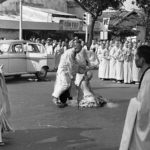
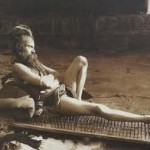
Beach unfairly calls Hans the champion rather than his spouse because usually it is only men who can pull off feats like this: typically by marrying several times or having many different wives and lovers simultaneously. Take, for example, the Indian Ziona Chang (pictured above in company) with, in 2011, 39 wives, 94 children and, to date, a mere 33 grandchildren. ZionA will rapidly overtake Hans in the next ten years. Beachcombing’s source doesn’t give Ziona’s age, but he looks in his late sixties with plenty of pep in him yet.
Historical champions are proving more difficult to track down: can anyone help? drbeachcombing AT yahoo DOT com Surely there was an Eastern Emperor with a large harem who peopled a small town or two? In recent times Beach finds himself wondering about Mussolini who used to organise daily bouts of sex with complete strangers. 365 multiplied by 15 or 20 years = genetic spread? Then Beachcombing also has a vague memory of an enormous Roman family. Is it Pliny that talks of this 100 plus clan? Was it based in Roman Fiesole? The internet has turned nothing up and Beach doesn’t feel like going to his Latin shelves.
***
25 Nov 2011: Rhys, Heather and Adrian all write in to suggest Genghis Khan signalling two different write ups: one from discovermagazine and the other from national geographic. Heather noted ‘though he wasn’t hot on mutual consent’!! Then Tim gives a more recent case: Was surprised in your blog about DNA Champion that you missed Yitta Schwartz, who had a New York Times article dedicated to her last year after she passed away. ‘WHEN Yitta Schwartz died last month at 93, she left behind 15 children, more than 200 grandchildren and so many great- and great-great-grandchildren that, by her family’s count, she could claim perhaps 2,000 living descendants.’ Thanks Rhy, Heather, Adrian and Tim!
Magic Translation and Flowers November 17, 2011
Posted by Beachcombing in : ModernBeachcombing previously in this place examined magical displays from medieval India and particularly levitation, which Beach still hasn’t got his head around. As a follow up of sorts he thought that today he would quote this description of parlour magic plus from the sub continent in the late nineteenth century. Some of the tricks sound like the kind of things the magicians’ circle whisper in each other’s ears to this very day. Others are rather more exotic and frightening.
The day following the visit to the temple of Kali we had an opportunity of witnessing the Mystifying feats of one of those jugglers whose mysterious powers transcend all deductions of science, and must be seen to be believed. Unlike the alleged spirit-mediums of our own country, they do not perform their feats in the dark upon their own premises, but in the full light of day in any situation and in the midst of any number of spectators, every one of whom is keenly watching for the slightest indication of fraud or trickery. We seated ourselves upon chairs arranged in a semi-circle under a huge tree in a courtyard.
Shortly after we were seated the magician appeared in company with a boy who carried his simple paraphernalia in a basket. He took his place about twelve feet in front of us and began to entertain us with some clever but common-place tricks, after which he requested each one of us to write something on a piece of paper and keep it concealed in our hands. Without changing his position he told each one in turn, word for word, what he had written.
I held a piece of paper in such a position that no one could possibly see it and wrote on it in Fijian, ‘Sa ndro na Singa; malua marusa’. When he looked at me he gave a quiet smile and said: ‘You did not write yours in English’. ‘In what language is it written?’said I. ‘Sahib’, he replied, ‘if you will look at the paper which you have crumpled in your hand you will read the English translation of what you have written, and also the name of the language in which you wrote it.’ I opened the paper, and could scarcely credit my own eyes when I read on it in English, ‘The day is vanishing; procrastination is destruction (Fijian).’ The Fijian words which I had written had disappeared completely, and the English translation appeared in the same spot, and written in my own handwriting. Scarcely willing to trust my eyes, I asked a white man who sat next to me to read what was on the paper, and he read the translation as given above. ‘Sahib’, said the performer to me again, ‘will you fold the paper for a moment and then unfold it again?’ After taking another look at the paper I crumpled it in my hand again and held it fast for a few seconds, and upon opening it once more I was amazed to read the two former sentences in Fijian, precisely as I had written them in the first place.
Not being quite satisfied with this, I retired within the house and wrote upon a piece of paper ‘Ika tonu taku ihi irunga i taku whenua’. No one could possibly have seen what I wrote, and I immediately folded the paper and held it fast in my hand as I returned to the courtyard, and, as soon as I had taken my seat, the Indian asked me to open the paper. I opened it forthwith, and instead of the words I had written, I read the correct English translation as follows: ‘My fire has been kept burning upon my land’ (Maori),which was the exact translation of what I had written. It is a common expression among the Maoris, meaning that their enemies have never succeeded in driving them or their ancestors off the premises which they hold. I showed the paper to some of the others, and they read the words as given above. Several others tried the same experiment by writing sentences in Russian, Persian, Turcoman and Yakut, and in every case the words were correctly translated into English.
Beachcombing’s easiest solution to this particular magical feat is that the narrator was a liar and that he was salting his book, which worryingly has the word ‘truthful’ and ‘strange’ in the title.
In any case, next the magician apparently kills his assistant then he comes up with a neat trick for a flower pot.
The necromancer then turned to our host again and said,’Sahib, will you let one of your servants bring a small flowerpot and a couple of handfuls of earth?’ When these were brought we made sure that the pot was empty by feeling inside of it with our hands, for by this time we had begun to doubt all evidence of our own eyesight. He filled the pot with the earth which the servant had brought and planted a small seed of some kind in the center of it. One of the company now requested permission to take a photograph of the pot as it stood, and the performer instantly granted the request. He next poured some water on the pot and covered it with the white cloth previously mentioned, after which he brought out what he called a tubri simmil, consisting of a sort of pipe flaring at one side and having a large bulb in the center. Squatting in front of the pot, he began to play on his small musical reed pipe (which these magicians all carry) in a low, droning tone, but soon started playing faster.
After a little we distinctly saw the center of the cloth begin to rise, while the player kept his eyes fastened upon it and played with might and main as though his lungs would split. Suddenly the frantic music ceased and he raised one side of the cloth. We all were more than astonished to see a plant about four inches high growing in the center of the pot. He calmly replaced the cloth and began playing as before; but instead of playing in an even tone he played faster and faster, until the music became a continuous long, screaming sound; he would suddenly lower his tone from time to time and begin again in the low, monotonous tone in which he first started to play. All at once he ceased his music, laid aside his pipe and sat with his arms folded gazing intently at the cloth, which continued rising in the center by almost imperceptible degrees until it was nearly a foot above the edge of the pot, when he again took up his flute and began to play the same wild music as before, whereupon the cloth began promptly to rise until it had attained a height of about thirty inches, when the cloth gave a strange tremor, as though someone were moving it, and then remained perfectly stationary. He ceased his music and sat staring at the cloth for a few minutes, then lifted it up, and we beheld a plant apparently about thirty inches high, covered with bright green leaves and beautiful red and yellow blossoms.
The man who had taken the first photograph asked the juggler for permission to take another picture of the plant. ‘You are not only welcome to take as many photographs as you like’, replied the Indian, ‘but you are welcome to pick the flowers off the plant and keep them’. I need not say that every one of us eagerly availed ourselves of this permission, and the plant was quickly stripped of its beautiful flowers. I secured two of them, which I kept for several years, but finally lost in the course of my travels.
I have since heard some people say that this must have hypnotized us and led us to Indian imagine that we saw objects which had no real existence. Without stopping to discuss this, it is sufficient to say that he could not have hypnotized the camera with which the first photograph was taken, before he covered the flower-pot with the cloth, and the second photograph after the cloth had been removed. The first photograph showed the pot containing nothing but a few handfuls of earth ; the second showed a plant over two-feet high covered with leaves and flowers, and with our own hands we picked the flowers and leaves.
Beachcombing has not the foggiest! Where’s the trick? Drbeachcombing AT yahoo DOT com
A-Z of Thuggery November 6, 2011
Posted by Beachcombing in : Medieval, ModernBeachcombing has been letting his dark side take charge this Saturday evening, while Mrs B. gets ready for mass, reviewing some of the fascinating Victorian literature on the thugs. The thugs, for the uninitiated, were, of course, the Indian sect whose members, in secret, and often without knowledge of their families, murdered travellers. They would pass through the country attaching themselves to parties of wayfarers and then they would kill at the most opportune moment, typically by strangling those they met on the road, disposing of their bodies so that they would never be found.
Beachcombing has used the word ‘sect’ because it is alleged that the thugs were religiously motivated and that their killings were sacrifices, though especially in modern times their motives have been questioned. Was this a bizarre form of piety or traditional criminal nastiness?
Either way – and the debate will rage on – here is a nineteenth-century vocabulary list that is as good an introduction as any to the ghastly yet strangely beguiling world of the thugs. A world where a clean, bloodless kill was a matter of pride and where there were precise words for the screams of a murder victim and the roomal or throttling handkerchief.
Aulae, or Bora, signified a Thug; Beetoo, or Kuj, everybody not a Thug; Bagh, Phool, a rendezvous; Boj’ha, the Thug who carried the bodies to the grave; Bhukote, or Bhurtote, the strangler; Beyl, site for murder; Bykureea, the scout of river Thugs; Beyl’ha, one who chose the place of murder; Bunij, literally merchandize technically a traveller; Bunij Ladhna, to load goods, i.e., to murder; Bhara and Ghurt’ha, dead bodies of victims; Bisul purna, to be awkwardly handled to have the roomal caught on the face or head, instead of being slipped round the neck the contrary of soosul purna: a Thug who was frequently guilty of bungling in this manner, was deposed from the honourable post of strangler; Chookadena, or Thibaedena, to get travellers to sit down and look up, by pointing out some star or object in the air, so that, the chin being raised, the handkerchief might be more easily passed round the throat; Chumoseea, or Shumsheea, the Thug whose duty it was to seize the victim’s hands; Chumeea, the Thug who held down the struggling victim; Chandoo, an expert Thug; Cheesa, a blessing from heaven, a rich traveller; Dhonkee, or Ronkee, a policeman or guard; Dul, weight; Duller, the head; Doonr, the shrieks of a victim; Jywaloo, left for dead, but afterwards recovering, which occasionally happened when there was not time to bury the bodies, or when it was judged imprudent to stab and slash them after being strangled; Kuboola, a tyro the opposite of Borka, an adept… Koojaoo, an informer, or one who extorted hush-money from Thugs; Khullee, a Thug who, from ignoble care-giving impecuniosity, concealed himself on his return home to avoid his creditors for the natives of Hindostan enjoy many of the blessings of an ancient and refined civilization; Khomusna, to rush in upon travellers when there was not sufficient time for the ordinary preparations; Kanthuna, or Kanth dalna, to stab when no opportunity was afforded for strangling a very exceptional case or to slash the suffocated victim, either to prevent revival, or the swelling of the body when buried, owing to the evolved gases finding no vent for escape. This gaseous inflation of the corpse was apt to cause the imposed earth to crack and open, when the horrid effluvia attracted jackals to the spot, who, by digging up the bodies, might discover the fact of a murder having been committed, and so lead to the detection of the murderers; Kathee kurna, to inveigle travellers, or to consult secretly as to the mode of doing away with them; Kharoo, a gang of Thugs; Kkuruk, the sound of the consecrated pick-axe in making a grave, supposed to be audible only to the initiated; Kurwa, a square, or oblong grave, for one corpse or for many; Gobba, a circular grave, with a small pillar of earth left in the middle it was believed to crack less than the ordinary grave, and was therefore preferred when the dead bodies were very numerous; Kuthowa, the Thug whose office it was to cut and stab the dead bodies; Lugha, the grave-digger; Lutfameea, a very small purse, used exclusively by Thugs and professional thieves; Maulee, or Phoola, the Thug entrusted with the duty of taking to the village the money sent by the absent gang for the maintenance of their wives and families; Nawureea, a novice on his first expedition sometimes they were compelled to kick the first murdered man five times on the back; Nissar, safe, as applied to any suitable place for lodging at, murdering, or dividing spoil opposed to tikkur, unsafe; Paoo, an accomplice of Thugs; Pehloo, or Sikka, or Roomal, the handkerchief. This was, rather, a turban unfolded, or the long narrow cloth, or sash, worn round the waist. It was doubled to the length of about thirty inches, with a knot formed at the doubled extremity, and about eighteen inches from that a slip knot. The distance between these two knots was regulated by preparing the fatal instrument on the knee, which was made to do temporary duty for a neck. The use of the two knots was to give a firm hold. When the victim was fairly prostrated, the strangler adroitly loosened the slip knot, and made another fold of the cloth round his throat. Then placing his foot upon the back of his victim’s neck, he drew the cloth tightly, as if to use the informant's own words he were ‘packing a bundle of straw’. Pehloo dena, to instal as a strangler, of which more hereafter; Phank, a. useless thing, a traveller without property; Pungoo, or Bungoo, a river Thug of Bengal, who murdered on board his kuntee or boat; Phur, same as Beyl, also a spot for dividing the plunder; Phurjhana, to clean the murder-spot after a nocturnal murder, some of the gang were generally left behind to remove any signs of the crime that might be visible by daylight; Phuruck dena, to wave a cloth as signal of danger; Pusur, the direction of an expedition; Euhna, a temporary grave; Soon, a Thug by birth, but not yet initiated; Saur, one who escaped from Thugs; Sotha, the inveigler; Tome, an article of extraordinary value; Tilha, a spy; Thap, a night encampment; Tuppul, a bye-path into which they often inveigled their unsuspecting travelling companions, as more convenient for their purposes. A rich traveller was called ‘a delicacy’; a poor one ‘a stick’; an old man ‘a barber’s drum’. Some of their signals, too, were quaint. The necessity of caution was inculcated by drawing the back of the hand along the chin, from the throat outwards; the open hand placed over the mouth and drawn gently downwards, implied the absence of danger. ‘Sweep the place’, signified to look out; ‘bring firewood’, take your places that is, the place assigned to each Thug preparatory to action; ‘take out the handkerchief with the Beetel’, get the roomal ready, as already described; ‘eat beetel’, or ‘hand the beetel’, despatch him this was called the Jhirnee, or signal to fall on; ‘look after the straw’, get the body ready for burial; ‘the straw is come out’, jackals have dug up the body. Another form of the Jhirnee was ‘Ae ho to ghyree chulo’, ‘if you are come, pray descend’. ‘When the scouts wished to report that all was safe, they called out as if to a comrade, ‘Bajeed Khan’, or ‘Deo’, or ‘Deoseyn’. If the scouts saw any danger at hand, or a traveller coming along, they would call out ‘Sheikh Jee’, or ‘Sheikh Mahommed’, if they were Mussulmauns; and ‘Luchmun Sing’, or ‘Lucbee Ram’, or ‘Gunga Ram’, if they were Hindoos. Sometimes the advanced guard of a gang, with victims in their power, would meet with a party of travellers, of whom they considered their friends in the rear were capable of disposing. In which case they sent some one back to tell Bajeed Khan, or Deoseyn, to make haste and overtake them. The others receiving this message understood that the coast was clear in front, and on meeting the travellers, lost no time in putting them to death. If a gang happened from any cause to get separated, they rallied with the cry, Bukh, Bukh, Bukh, ‘come, come, come’. When the leader judged that the time was at hand for selecting a beyl, or site for murder, he would say to the Thug on whom that duty devolved, ‘Jao, kutoree manj Jao’, ‘go and clean the brass cup’. When he desired every one to repair to his post, he gave the khokee, that is, he made a great noise of hawking up phlegm from his throat; if anything then occurred to cause the suspension of operations, he gave the thokee, or spit out the phlegm. Otherwise, he exclaimed aloud ‘Surbulund Khan’, or ‘Dulur Khan’, or ‘Surmnst Khan’, whereupon the stranglers made ready and only awaited the jhirnee. Then the fatal words were pronounced, Tombako kha lo, or pee lo, ‘eat’, or ‘drink’ (i.e., smoke) your tobacco’ or one of the other formulae was used and the next instant the roomal was round the throat of the ill-fated wretch.
All afternoon, Beachcombing has been imagining a short story where a group of Muslim thugs accidentally attaches themselves to a travelling party of Hindu thugs with tragicomic consequences. Let's hope sometime, somewhere, it happened.
Any other crime vocabularies? drbeachcombing AT yahoo DOT com
***
8 Nov 2011: Radko sends in Mark Twain's Following the Equator that has some typical Twainisms on the subject of the Thugs. We quote one paragraph. 'Here is the tally-sheet of a gang of sixty Thugs for a whole season--gang under two noted chiefs, 'Chotee and Sheik Nungoo from Gwalior': Left Poora, in Jhansee, and on arrival at Sarora murdered a traveler. On nearly reaching Bhopal, met 3 Brahmins, and murdered them. Cross the Nerbudda; at a village called Hutteea, murdered a Hindoo. Went through Aurungabad to Walagow; there met a Havildar of the barber caste and 5 sepoys (native soldiers); in the evening came to Jokur, and in the morning killed them near the place where the treasure-bearers were killed the year before. Between Jokur and Dholeea met a sepoy of the shepherd caste; killed him in the jungle. Passed through Dholeea and lodged in a village; two miles beyond, on the road to Indore, met a Byragee (beggar-holy mendicant); murdered him at the Thapa. In the morning, beyond the Thapa, fell in with 3 Marwarie travelers; murdered them. Near a village on the banks of the Taptee met 4 travelers and killed them. Between Choupra and Dhoreea met a Marwarie; murdered him. At Dhoreea met 3 Marwaries; took them two miles and murdered them. Two miles further on, overtaken by three treasure-bearers; took them two miles and murdered them in the jungle. Came on to Khurgore Bateesa in Indore, divided spoil, and dispersed. A total of 27 men murdered on one expedition.' Twain then rights. Chotee (to save his neck) was informer, and furnished these facts. Several things are noticeable about his resume. 1. Business brevity; 2, absence of emotion; 3, smallness of the parties encountered by the 60; 4, variety in character and quality of the game captured; 5, Hindoo and Mohammedan chiefs in business together for Bhowanee; 6, the sacred caste of the Brahmins not respected by either; 7, nor yet the character of that mendicant, that Byragee.' Well worth the read. thanks Radko!
Female Flyting in the Raj? August 17, 2011
Posted by Beachcombing in : Medieval, Modern
It has been a long day and Beach has not had time to look for this in all the normal works of reference. However, this story (or fiction?) rang no bells and as Beach has – disgrace upon disgrace – never had a Pakistani story before he thought he’d take a risk.
A curious custom, a Lahore paper remarks [in 1897], is observed in these Shraddh days by the woman folk of many families belonging to the higher castes in the city. At about three in the morning they – the ladies – congregate near a well in Vachowali Bazaar, and dividing themselves into two hostile parties, bombard each other with the ‘choicest’ and most telling abuse that their ingenuity can invent. Sometimes this party wins and sometimes that. A vast crowd of awe-struck males assemble even at that unearthly hour to witness this unique warefare [sic]. Five out of the total fifteen Kanagat days are set apart for this purposes. Now peace will be proclaimed till next year. The worthy conflict continues till about daybreak, when the exhausted dames, ranged on opposite sides, mingle again with the utmost cordiality and proceed together to the Ravi, singing suitable songs, for the usual matutinal ablutions.
Beachcombing has so many questions that he doesn’t know where to begin. (i) Did this really happen? (ii) Were the insults ingenious or just plain dirty? (iii) Is there still, pace the Taliban and their ilk, flyting today in the city? (iv) Was this a Muslim custom? drbeachcombing AT yahoo DOT com
Beachcombing’s source also has a legend that should be quoted as it may help searchers after the truth. Or it may, if this is all cobblers, be the explanation behind it.
There is a legend that once upon a time an Afghan invader was stealthily approaching Lahore to pounce upon it unawares. It so happened that he approached Aziraband a good two hours before sunrise…. They heard sounds as of elephants screaming, horses neighing, camels gurgling, bulls bellowing, bow strings twanging, wheels rumbling, drums booming, warriors roaring, and trumpets tooting. They thought that the capital had got scent of the invasion, and a vast army was coming out to meet them… So they mounted again and retraced their steps to Cabul with all possible speed. But think of the feeling of the Afghan leader when he came to hear afterwards that it was no opposing lashkar, only Lashore ladies engaged in their annual five days’ exercise fifty miles off that had frightened him.
Anglo-Saxons in Southern India? July 15, 2011
Posted by Beachcombing in : Medieval**Beachcombing dedicates the following to DGM, who has an excellent post on this subject**
For those like Beachcombing who lick their lips at descriptions of long and unlikely journeys in antiquity and the middle ages there are few more exciting sentences than this one-liner in some versions of the Anglo-Saxon Chronicle.
In the year 883, Alfred sent Sighelm and Athelstan to Rome, and likewise to the shrine of Saints Thomas and Bartholomew, in India, with the alms which he had vowed
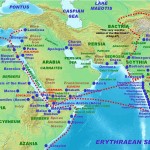
Just think about this and be amazed. In one of the darker generations of the dark ages King Alfred of Wessex, not satisfied with defeating several Viking armies and creating England sends out two of his men to distant India, half way across Eurasia. Sighelm and Athelstan will have passed from Rome across the Mediterranean to Egypt, where they will, like other European pilgrims in the ninth-century, have seen the pyramids ‘the grain barns of Joseph’. And from there they will have passed down the Red Sea – nodding to Yemen on their left – and to southern India where Thomas Christians, an early and forgotten sect of Christianity, would have marvelled at the pale-skinned English pilgrims from the far corners of the earth. They would presumably have made the journey on one of the spice vessels that ran the Indian Ocean in those years (see image above).
This voyage would have been extraordinary in the eighteenth century, almost unbelievable in the thirteenth century and stretches credibility to breaking point for the ninth century. And not surprisingly a number of objections have been put forward by academics to the seemingly impossible fact of little Englanders in India eight centuries before the Raj.
These academics try and get rid of our Anglo-Saxons in India with a fairly reasonable strategy. There is a textual problem here, they argue: something that is always possible with the ghastly confusion that is the Anglo-Saxon Chronicles. (We still lack a proper, complete edition). India is not India but – and in paleographic terms this is all too credible – Iudea. The city of Edessa had a collection of Thomas relics and we also know that Alfred sent messengers to Jerusalem, possibly the same party.
Beach, however, has faith that the chronicles are talking about India. After all, to any Anglo-Saxon St Thomas was India, the land Eusebius claimed the apostle had converted: if anything there is more the problem of what ‘India’ meant to western Europeans.
And the eighth and ninth century saw a boom of trade between east and west, most, if we are to believe Arabic sources, mediated by Jewish merchants through the Mediterranean: including, of course, spices from southern Indian ports.
We also know that in the late eighth century, an Indian Christian made his way to the Copt Christian community in Alexandria to find the Patriarch. So there were lines of contact open between the Christian heartlands in Europe and the outer reaches of the Christian world in southern India: albeit lines of contact like sagging telegraph wires caught up in the trees.
No, there is nothing intrinsically impossible about a trip to India in the ninth century, though Beachcombing wouldn’t have personally liked to have attempted it. If the spoil sport wants to have his fun at the expense of this text then he would be advised to note that the entry above does not claim that Sighelm and Athelstan ever made it back! Anglo-Saxon slaves in Outer Mongolia anyone?
There are some later, to Beachcombing, fairly generic sounding texts (Florence of Worcester etc) that claim that they did get home: Florence even claims that Sighelm became bishop of Sherbiton, imagine the contrast between ninth-century Dorset and the parched lands around Kerala! However, Sighelm is not a particularly rare name. This could all be later and all too medieval guess work.
Beachcombing is always on the look out for wrong-place travellers: drbeachcombing AT yahoo DOT com
***
16 July 2011: Virginia writes in to make the point that the Romans were regularly riding the monsoons to bring spice to and fro from southern India. Of course, the foundation of St Thomas Christians there may owe a great deal to that trade. The trade dried up with the collapse of Roman infrastructure at the end of the Empire. Viriginia references a recent book that sounds like fun S.E. Sideotham Berenike and the Ancient Maritime Spice Route. Thanks Virginia!
21 July 2011: Jonathan from A Corner of Tenth Century Europe writes in with some considerations that may just have swung Beach. ‘Your post about Anglo-Saxons in India is about a piece of evidence I’ve met myself. I should say that most of the current scholarship appears to be fairly happy with India not Judea, and we do have reason that there were Christians in Kerala so early, but all the same, I know where my money is and it’s no further east than Jerusalem. Doug Moncur who blogs at Thoughts of a Knowledge Geek has also done some sifting of Sighelm. He is fairly happy with India-not-Judea but as you’ll see thinks it likely that Judea must have been en route. This, to me, seems a bizarre decision for an alms-giver: ‘Well, here I am in the land of Jesus! Give all the money to the Holy Sepulchre, first shrine of Christendom? Eh, maybe I’ll go on a bit’. But who knows: perhaps the very extremity of the target was the point‘. Thanks Jonathan!!
First Unicorns? April 6, 2011
Posted by Beachcombing in : AncientBeachcombing is returning with some relief to familiar territory after the Shakespeare wars of the last couple of days. The subject: unicorns and the earliest human accounts of these mysterious creatures.
In the Indus Valley about 3000 BC a series of seals were created that portray an animal with one horn: they predate the mention of unicorns in the Bible by perhaps two thousand years (or more if as seems likely the Biblical unicorn is based on a mistranslation).
The unicorn is by far the most popular of the images found on these ‘documents’ from the dawn of civilization in the subcontinent. Of about 2000 seals at Mohenjodaro and Harappa that have been found, just under a thousand portray this mysterious creature.
The unicorn seals have certain features in common. First there is almost always what appears to be an incense burner in the corner of the image: though it is also possible that this ‘incense burner’ is meant to represent different crops found in the region – the seals would then relate to record-keeping relating to said crops.
The unicorns themselves are hardy creatures, looking more like bulls than the horsey unicorns of medieval and modern fantasy. They have a pizzle. They may have a saddle – though this is not clear. And they appear to have a contoured neck that may (or may not) represent a collar.
Beachcombing couldn’t be bothered to put ‘unicorns’ in inverted commas as he was going through this text. But many have argued that these creatures are nothing of the kind. They suggest that this is a simple bull seen in profile, so the second horn is to be imagined behind the visible close horn.Crucially there are some seals that seem to show the same animal with a turned head and two horns.
Other writers have contended that this is the mythic unicorn – perhaps glimpsed in Vedic texts. There are also scholars who believe that there really was a one horned beast in the woods of ancient India.
Beachcombing always enjoying the perversity of history wonders if this wasn’t bos primigenius drawn in profile, but that the frequency of the image and its apparent single horn led to the myth of the unicorn in early India and from there in the world. Humanity fooled by its own puppet show.
Certainly, whereas Beachcombing feels he understands the origins of werewolves, vampires, fairies and the like, he hasn’t the slightest idea where the unicorn comes from – though if a pistol was pointed at his head he would guess the rhinoceros.
Any other thoughts on the unicorn seals: drbeachcombing AT yahoo DOT com
***
30 April 2011: RuthWA writes in: ‘I’m familiar with farm animals and your picture really looks like a big bull to me–standing in profile. My husband went to an ag college for several years and I saw a lot of bulls that looked like that. Maybe the person who thought it was a Unicorn wasn’t overly familar with them?’ Thanks Ruth!
1 May 2011: ‘My vote [for the origins of unicorns] is for the elasmotherium for the really ancient accounts. The medieval accounts of a deer-like creature influenced by virgins seems paranormal, like the phoenix, for example. From Wikipedia; ‘One suggestion is that the unicorn is based on the extinct animal Elasmotherium, a huge Eurasian rhinoceros native to the steppes, south of the range of the woolly rhinoceros of Ice Age Europe. Elasmotherium looked little like a horse, but it had a large single horn in its forehead. It became extinct about the same time as the rest of the glacial age megafauna. However, according to the Nordisk familjebok (Nordic Familybook) and science writer Willy Ley the animal may have survived long enough to be remembered in the legends of the Evenk people of Russia as a huge black bull with a single horn in the forehead. In support of this claim, it has been noted that the 13th century traveller Marco Polo claimed to have seen a unicorn in Java, but his description makes it clear to the modern reader that he actually saw a Javan Rinoceros.’’ Thanks KMH and thanks Ruth!!