jump to navigation

The Ash Wednesday Supper May 12, 2012

Posted by Beachcombing in : Medieval, Modern

Giordano Bruno (pictured badly) was a sixteenth-century philosopher with a thing about infinity. Giordano also had an infinite capacity to create irritation. Indeed, his travels around Europe have a fascinating pattern of greeting, slighting and sprinting. Typically, GB is obliged to leave his last home in a hurry because of offence caused to the church or/and secular authorities. Giordano then turns up in his new home, is greeted as a major European thinker. Then six months later the pattern reasserts itself and Giordano is running for his life once more.

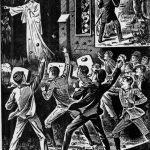
Among GB’s very many unfortunate habits were those of throwing out images of saints and that of telling anyone who cared to listen that God had created endless inhabited worlds, making Giordano a kind of patron secular saint of the UFO community. This pattern, in any case, finally went up the chimney when 17 February, 1600, Bruno was burnt as a heretic in a Roman piazza. His ashes were then scattered in the Tiber and Giordano Bruno became his ideas: all that survived of him.

Now on the subject of ashes… In 1584 Bruno had one of those legendary dinners – the Ash Wednesday Supper – that, on previous occasions, Beach has referred to as Immortal Meals. Moments when the Olympians of the human race meet over bread and wine. We know about this meal because GB wrote a pseudo-Platonic dialogue based around it that he published in the same year under the title Cena de le Ceneri. It was by any standards, perhaps particularly though by the standards of a razor-sharp Italian bon vivant,  a catastrophic repast.

First GB had been invited to the house of the poet Fulke Greville, an over serious Elizabethan sonnet writer who served both Elizabeth I and James I and who was a great friend of Philip Sydney. GB had been called in to debate philosophy with some Aristotelians down from Oxford for the evening. Bruno, it goes without saying, was a Platonist.

GB probably saw this as an opportunity to educate the ‘mad barbarians’ as he called the English. But the evening turned into a sorry comedy of errors. Bruno misunderstood the time of the meal and this caused confusion with his hosts who came to pick him up but found him out. Then, when they finally met up, he and his hosts crossed the Thames on a boat and ended up lost on the wrong side of the river (don’t do this in London). We cannot be certain how much of this account is ‘allegorical’ (those damn Platonists) and even basic details may have been invented: it is argued that the meal took place, for example, in a house other than Greville’s.

However, we can probably trust the account in terms of its intellectual content. The Oxford scholars made a terrible impression on the Italian. Bruno tried to defend the Copernican system, but he did so against men who, according to his account, barely knew how to argue (sounds like an Oxonian) and who were still trapped in medieval scholasticism.

This was all compounded by the fact that GB (an unquestionably brilliant scholar) had not troubled to learn English and by the fact that the English Professors did not know Italian. The argument (for such it quickly became) raged then in Latin. This must have been a sixteenth-century equivalent of empiricist American professors of fifty years ago, say, being confronted over table by Foucault in a furious conversation in poor Spanish.

Naturally, Bruno came off best and is praised by his host: but then Bruno wrote the account and Bruno always comes out best in those circumstances. A year later, England had chewed him up and spat him out. Then sixteen years later a fire was lit under Giordano’s toes. We’ll end with a detail that has always haunted Beachcombing: before GB was burnt his mouth was taped shut so that he could not spout dangerous sentences to the gathering crowds, something that the professors at that long ago meal would doubtless have approved of.

Beach is always looking out for remarkable meals: drbeachcombing AT yahoo DOT com

And so it begins… Images from 1914 March 21, 2012

Posted by Beachcombing in : Contemporary


[students in Berlin, off to enlist]

Beachcombing has recently become interested in crowd photography: large groups of people, preferably in rather strange or extreme situations. And as part of this ‘project’ he started collecting photographs from perhaps the dizziest month in western history: August 1914. The war is just beginning and young and not so young men are racing to enlist, most of them with smiles on their faces. They are – and this is something that comes through these pictures – not only supported by their nearest and dearest, but their nearest and dearest seem to be almost as happy as our imperial warriors.

[Just joined up in Exeter]

The sheer enthusiasm unsettled many of the leaders who were responsible for the world war that was to come. Lloyd George noted, while walking through ecstatic crowds, towards the House of Commons: ‘These people are very anxious to send our soldiers to face death‘… and so they were. Revenge didn’t come into it: at least not then. There was something about transcendence and the nation state: that Beachcombing can just get glimpses of in these jubilant faces.

There may have been other wars where men were so happy to go off and kill and die for their country: but none jump to Beachcombing’s mind. The contrast with the Second World War is particularly striking. Then, the populations of even the most ‘enthusiastic’ nations gritted their teeth.

[Goodbye at the Gare d'Est in Paris]

The First World War may or may not have been worth fighting. But these images don’t give justified causes. In fact, the silly hats and the moustaches, so similar from nation to nation: give a tweedle-dee, tweedle-dum feel to the whole enterprise, as if Europe was about to war over Swift’s boiled eggs rather than Serbia and Belgium’s territorial integrity. Look, for example, at the essential similarity of these scenes in London (Buckingham Palace) and Berlin (with the Kaiser speaking to his people). Then just to underline what these moments did to people, look who crops up in this shot from Munich in the third image…. Back story here.

Or what about Trafalgar Square against Unter den Linden?

It is an incredibly puerile thought given how many millions were going to die: but, well, couldn’t they just have settled it all with a massive boater throwing competition?

Beachcombing was set off on this hunt by the following image of French Heavy Cavalry leaving Paris: that’s right Captain, charge the two machine gun nests and then straight to Berlin!

Heavy cavalry! WtH!! But from there he branched out into other shots of women saying goodbye to the boys.

[German troops x 1]

[German troops x 2]

[French troops: a real frisson here]

[New Zealand troops]

And as a variation on theme, the sons wearing their fathers’ helmets as they go to leave their civilian clothes at home.

Then just to round off with another kind of photo and another kind of hysteria, here is Kier Hardie, the grand old man of British labour, addressing a pacifist meeting in London. The hats are the same…

Any other August 1914 pictures before the guns come out: drbeachcombing AT yahoo DOT com


Pulling Things Out of Rivers March 13, 2012

Posted by Beachcombing in : Ancient, Contemporary, Medieval, Modern

Rivers are useful guardians of the past: often thousands of years roll by (and millions of tonnes of water) before things that have been thrown in are fished out (sometimes literally) several hundred or thousands of years later. Here are Beachcombing’s favourite they-were-found-in-river things. Others would be welcome: drbeachcombing AT yahoo DOT com

1) Claudius’ Head in the Alde: In 1907 a school boy pulled this prize out of the river and brought it to a local antiquary. From then excitement slowly mounted and it has never entirely died down. What is of particular interest is the way that the head of the emperor Claudius seems to have been hacked off a statue and a blow to the back of the head suggests that murder was done on an inanimate object. It looks very much as if a Roman statue was ritually slaughtered and the head was then dedicated to a Celtic river God (i.e. thrown in a river): back in the days when the Alde was called the Itchen. And the suspects? Why not Boudicca’s revolt in 61 AD when Colchester with its Temple of Claudius was overrun by British ‘savages’ and Rome was, at least for a season, lain low in East Anglia?

2) Silver Plate in the Rhone: ‘In 1656 a fisherman on the banks of the Rhone, in the neighbourhood of Avignon, drew to shore in his net a round substance in the shape of a large plate, thickly encrusted with a coat of hardened mud. A silversmith who happened to be present brought it for a trifling sum. He took it home, and upon cleaning and polishing it, found it to consist of pure silver… Fearing that such a massive and valuable piece of plate might awaken suspicion , if offered for sale entire, he divided it into four equal parts, each of which he disposed of at different times and places.’ One of the pieces was sold at Lyons to Mr. Mey, a wealthy and well-educated merchant, who at once saw its value and who, after great effort, procured the other three sections. He had them nicely rejoined, and the treasure was finally placed in the cabinet of the King of France.’ This object is often called Scipio’s Shield. It actually dates to the fourth century AD.

3) A Steamboat in the Missouri River: In 1987 a nineteenth-century steamboat, the Arabia was discovered in a field just off the Missouri. Its excavation proved logistically difficult because river waters kept pouring in as the excavators dug down. In fact, in one episode an excavator was almost killed. The boat had disappeared into the mud of that river almost a hundred and fifty years before, sinking in ten minutes with no casualties save a mule! 700 items are now on display from this victim of ‘the hungriest of all rivers’ at a special Arabia museum: and the boat stands as one of the most impressive archaeological finds from frontier America.

4) A Tank and the Neva. This picture shows a BT-5 one of the most impressive Soviet tanks from WW2 being fished out of the river. A nice question is how it got there! Images of the tank and descriptions of the find suggest that there was no one in it when it went down into its watery grave – so bridges and vodka-sozzled drivers have to be ruled out. And it does not seem to have suffered any damage from the enemy: though Soviet tanks were famously resistant to even point blank blasts. Perhaps its owners, as they were surrounded by the Germans decided to get rid of it and the nearby river offered the quickest way to dispose of their hardware?

5) Hindu finds from the Thames: The Thames has been good for ‘Roman brooches, medieval pilgrim badges, 17th-century tin-glazed tiles, an 18th-century miniature portrait and an early-20th century handgun‘. But for Beachcombing at least some of the most curious finds have been the various Hindu statuettes dredged up in London’s river. So what does this represent: an underground Hindu cult in medieval London? Not a bit of it. The best estimates put these objects from the 1880s to 2000. For London’s modern Hindu community have evidently been using the Thames as a kind of surrogate Ganges, a place to throw their gods in an eerie echo of those rituals carried out in pre-Christian times on the banks of the same waterway. The British Museum at first thought that some of these statues were Roman… An understandable if entertaining mistake.

***

14/Mar/2012: First is Louis with some corrections for the tank story. ‘Actually BT tanks were notorious for their thin armor, which became very clear during the Winter War and the Nomohan incident and which prompted the Red Army to change to the T34 faster then previously scheduled. And, the tank was probably on its way to the Neva Bridgehead, on a pontoon, during a relief offensive for Leningrad, as can be read in this English language website:  Second is Tacitus from Detritus: Here is a link to one of my favorite river finds.  An early confederate submarine of which no reliable record has ever been produced.  Dredged up by accident in 1878.  Technically found in a bayou coming off of Lake Ponchartain, but clearly designed for use against an impending Union attack on New Orleans.  Even the thought of entering the treacherous muddy waters of the Mississippi in this glorified tin can alarms me! Then Jakub: ‘How about the opposite: pulling boats out of the ground? This happened a few years ago not far south from Warsaw, Poland. In a pond in an apple orchard a 500-year old ship was found and dug out: a 34m-long grain-punt. 500 years earlier Vistula, which is notorious for changing its course (and thus a most unsuitable container for long-lost artefacts), flowed through what is now the apple orchard on the border of a place called Czersk – once the capital of an entire province, dwindled into a tiny village once the river that gave it its prosperity decided to pack up and move a few miles eastward, leaving boats like this one in the middle of a sandy plain  (link in Polish). Next is Invisible: My personal favourite [creepy warning!]: I visited the Steamboat Arabia museum a couple of years ago. The amount of organic materials – leather, cloth, foodstuffs – that survived is simply astounding. Apparently the sites of several other wrecked steamboats buried by the shifting river are known and await excavation. The remarkable thing about the Arabia excavation and museum is that it was done entirely without public funds – the Hawley family (with friends and supporters) paid for the arduous, large-scale excavation, the conservation of the artifacts, and the museum out of their own pockets. The book The Treasures of the Steamboat Arabia by David Hawley gives a step-by-step account of the difficulties involved in getting the steamboat and its cargo out of the tons of mud that covered it and includes color photos of many artifacts. An extraordinary story.’ Thanks Louis, Tacitus, Invisibile and Jakub!!

16 March: Some great stuff from Jim W here. ‘Similar to the Arabia steamboat recovery was  the USS Cairo sunk in the Yazoo River during the Vicksburg Siege of the US Civil War.  Found by old-style geophysics (magnetic dip needle) nearly intact but broken in half during recovery.  Massively displayed in National Military Park as half original and half reconstructed.  Museum contains quantities of personal and military gear recovered in very good state of preservation. On the other side, the CSS Arkansas  is still buried under a mainline levee near Sunrise, LA.  She was badly damaged during the Vicksburg Siege and escaped downriver to her coup de gras at Baton Rouge. Steamer Desoto discovered under a bean field near Missouri River, IA, again by 1960s vintage geophysics (flux-gate magnetometer).  Excavated and on display with large quantity of personal and trade goods.  Carried supplies and equipment to Montana gold rush before snagged. Meandering, large-flow, high sediment rivers like the Mississippi/Missouri system do this kind of thing as a matter of course, generally leaving the wrecks hundreds of yards to miles from the present courses in old meanders. Reference the Mississippi Confederate submarine:  The Grand Gulf State Park Museum, Port Gibson, MS has (or had several years ago) a submersible home-built from an old boiler that was supposedly used for bootlegging from Louisiana to Mississippi back in the good/bad old days of Prohibition.’ Thanks Jim!!!!

28 March 2012:  Norman writes: Haven’t had any luck tracking an image of it down yet (still working on it), but I remember once seeing a crucifix in a museum in New Brunswick (Canada) that had been recovered from a river. It was made of bone (or maybe ivory, I misremember), and was of the type that missionaries would give out to the local Indians (in this case either Mi’kmaq or Maliseet). The cool thing about it was that the wrists and ankles of the figure, where they were attached to the cross, had been scraped so thin that they had nearly snapped off. Archaeologists conjectured that the natives had scraped thin shavings of the figurine into a broth which would then be fed to sick people – apparently a conflation of religion and magic, or perhaps a misunderstood interpretation of the old “this is my body…” routine that the indians took literally.’ thanks Norman!!


Witchcraft Murder in Modern London March 3, 2012

Posted by Beachcombing in : Actualite

Beachcombing has spent rather more time than is good for him over the last year looking at cases of, what are in legal terms, child abuse. Nineteenth-century Irish families who (to use an inadequate word) ‘punished’ children because they believed that they were fairies or ‘changelings’: the real child had, the families believed, been spirited away. Beach has been primarily interested in the folklore beliefs, but every so often the full horror of the situation seeps through and he recalls that these children were made of flesh and blood and often had to suffer horrendous treatment at the hands of those whom should have protected them.

Of course, as all this was happening one hundred and fifty years ago, the whole cast of stars, abused and abusers are long since in the ground and this does rather take the edge off things. But the indignation of contemporaries is easy to understand, something Beachcombing was able to measure yesterday in himself when this extraordinary news story broke.  The following quotation comes from the Guardian, which had the best coverage of this case:

When 15-year-old Kristy Bamu left his parents in Paris on 16 December 2010, he was looking forward to spending the Christmas holidays with his siblings, visiting their sister and her boyfriend in London. On Christmas Day he was found by paramedics in the bathroom of an east London high-rise flat. His body had been mutilated, teeth were missing and he was covered in deep cuts and bruising. In the last four days of his life he had suffered acts of unspeakable savagery [101 injuries were found on his body] doled out by a man he called ‘uncle’ and one of his own sisters. Why? Because Eric Bikubi, a powerfully built football coach, and Magalie Bamu were convinced the boy was a witch, possessed by spirits who wanted to bring evil into their home. On Thursday they were convicted of murder. They had earlier admitted actual bodily harm against Kristy’s sister Kelly and a younger sister, who cannot be named.

A BBC video report, meanwhile, carried an interview with the Crown Prosecution Service.

The parallel with changeling belief is there for all to see. The children were ‘possessed’ and were expected to confess their role as witches: much as changeling children were expected to confess their fairy nature.

The guilty party – found guilty by a jury of peers – argued ‘diminished responsibility’, a fact that also recalls the tragic circumstances of some changeling cases, including the most infamous, the Bridget Cleary burning of 1895. The defence though seems to have rested their claims on the shape of EB’s brain rather than his beliefs. The jury, in any case, rejected these pleas, though there were, neurologically-speaking, problems with an MRI scan: Bikubi may have suffered a damaging fall in childhood, something often found in the personal history of serial killers.

The belief system is more interesting for our purposes: kindoki is witchcraft in the Congo.

‘Bikubi’s awareness of kindoki… started early. He was born in the Democratic Republic of the Congo in 1983. His mother died during childbirth and he lived with his father, a gold trader. But as a child the shadow of kindoki hung over his life. During the trial, the court heard that from a young age he saw rats and other ‘abnormal visions’. Speaking to a forensic psychiatrist, Dr Tim Rogers, in Pentonville prison, four months after Kristy’s death, he explained he was isolated as a child as a result. ‘It seemed to be he was saying that he’d had the experience of seeing rats and other abnormal visions when they weren’t really there’, Rogers told jurors. ‘He was reporting that his family at the time feared that if he went around saying these things he would be labelled as being affected by witchcraft. Aged seven, to escape the chaos of war, Bikubi moved to Dagenham, east London, with several other young relatives and his uncle. The uncle, the only remaining father figure in his life, then died of Aids. But Bikubi appeared to have found a new family when he began an on-off relationship with Magalie Bamu [sister of Kristy] in 2004.’

If Beachcombing ever tracks down the elusive news story of the Irish child burnt as a fairy by an immigrant family in New York then it will be a particularly frightening parallel to the little hell created in this London tenement. The surviving family members must now spend the rest of their lives trying to forget that this ever happened: good luck to them…

Any other modern parallels with changeling belief? drbeachcombing AT yahoo DOT com

A Rhinoceros in Eighteenth-Century London November 5, 2011

Posted by Beachcombing in : Ancient, Medieval, Modern


 ***This post is dedicated to Don who sent the reference in***

Beach has a longstanding thing about elephants (see many previous posts and many posts to come) and has been wondering recently about opening up a second front on the rhinoceros: a distant reading of a text about Romans importing this beast for their games has been jumping up and down in his head. He has been spurred on by this late but fascinating reference to an eighteenth-century rhinoceros in London, one of the earliest to come to the British capital. Pity the beastie. Bizarrists might remember that 1739/1740 was the winter of the Great Frost.

‘This creature was first shewn in London in Jun 1739 at 2s and 6d for each spectator, being esteem’d a very great curiosity, there not having been a Rhinoceros in England since 1685. He was fed here with rice, hay and sugar. Of the first he eat 7 pounds to about 3 pounds of the sugar; they were mixed together, and he eat this quantity every day, divided into three meals, and about a truss of hay in a week, besides greens of different kinds, of which he seemed fonder than of his dry victuals; and drank large quantities of water. He bore to be handled in any part of his body; but was outrageous when struck or hungry, yet pacified in either case only giving him victuals. In his outrage he jumps about, and springs to an incredible height, driving his head against the walls of the place with great fury and quickness, notwithstanding his lumpish aspect… A very particular quality is observable in this creature, of listening to any noise or rumour in the street; for though he were eating, sleeping or under the greatest engagements nature imposes on him, he stops every thing suddenly and lifts up his head, with great attention till the noise is over.’

There follows a detailed and often amazed description of this strange beast. Beach hopes he will not seem too puerile if he concentrates on the passage relating to the rhinoceros’ pudenda. In part because it gives us a glimpse of how the locals interacted with him and, in part, because Beach is used to Victorian (non-)descriptions where such things would never appear in a popular magazine.

The penis of the Rhinoceros is of an extraordinary shape. There is first a theca or praeputium, arising from the inguinal part of the belly, nearly like that of a horse, which conceals (as that does) the body, and glands, when retracted… His keeper, who was a native of Bengal, would make him thus emit his penis when he pleased, while he lay on the ground, by rubbing his back and sides with straw; and, in its utmost state of erection, it never was extended to more than about eight or nine inches.

Imagine that being printed up in the Graphic or Science Gossip in the 1870s. there would have been questions in Parliament!

There is also an interesting history of the Rhinoceros from the earliest times. Some of this is erroneous, some  is missing and some was new (at least to Beachcombing): but it represents early eighteenth century English knowledge on the question.

He was not known to the Greeks till the time of Aristotle, nor to the Romans till 85 years before the Christian era, so that he seems to be scarcest of all the quadrupeds; Rhinoceros is his Greek name, from the horn on the nose, and he is with great probability supposed to be the unicorn of the ancients.

The author then goes on to theorise that the Rhinoceros is the unicorn of the Old Testament: a thesis that is almost certainly wrong (another post, another day) and offers a discussion of the one horn vs two horn rhinoceros.

Now that brought from Asia to the King of Portugal in 1513, and those brought from thence to England in 1685, in 1739, and in 1741, were single horned, and a great number of hors in the museums of the curious brought from the East Indies are also single. We may therefore venture to assert, that all those of Asia have but one horn n the nose; and this is confirmed by many gentleman who have seen those creatures in Persia. On the other hand we are sure the Romans  had always a great commerce with the Africans, and had many cargoes of wild beasts from that quarter of the world; it is therefore probable that they might more conveniently have obtained the several Rhinoceros’s which were shewn in that city from Africa than Asia, as the former is much nearer to Italy. And we do not want proof that the African Rhinoceros has 2 horns. Peter Kolbe, a Dutchman, in his voyage to the cape of Good-hope, says there is one in the summit of the nose like the other’s but having a smaller close behind it. There are also two horns in Sir Hans Sloan’s museum sticking to the same integuments, not more than an inch from each other; all of which makes it probable, at least, that the Asian Rhinoceros was the Unicorn of the ancients notwithstanding those exhibited at Rome had two horns; and probability, in questions of this nature, is all that can be reasonably expected by the most diligent enquirer.

Personally Beachcombing is all in favour of the rhinoceros as unicorn theory. However, the Africa one horn and Asia two horns is, of course, an oversimplification. Any other Rhinoceros stories? drbeachcombing AT yahoo DOT com

***

5 Nov 2011: First there is Mark L. ‘You might find this item to be of interest. The URL linked below points to an item on a site I maintain for the benefit of the academic community. It shows a Quadrans - or 1/4 of a As – the smallest denomination of Imperial coin ever used in the Roman Empire. You might think of it as equivalent to a Farthing, although it is difficult to assign it a relative value.  All Roman base-metal coins were token or fiduciary issues (yes, as far back as that – and earlier still) so its real purchasing power was a function partially of what was decreed for it and partially as the amount at which the market accepted it. You might recall the story about Vespasian, who when challenged about charging an admission price for the public “conveniences” (still called “Vespasianos” in some parts of Italy, I am told) held up a coin – presumably a quadrans, and as the smallest coin of the realm is most likely what the charge for use was – and said “Yet, this has no bad odor.” (or Latin to that effect). This piece with a main device of a rhinoceros was one issued by his son, Domitian – under whose reign a large number of small denomination types were issued. PS – Quadrantes almost never carried the portrait of the Emperor – perhaps due to their lowly status?’ Then up comes Invisible: ‘Here is a reference to the earlier rhino of 1684.  This is a quote from The Shows of London, Richard Altick p. 37 “the strange Beast called the Rynnoceros’. Evelyn, like most of the learned, identified the breed with the fabled unicorn, although the reality somewhat belied the myth, for ‘it more ressembled a huge enormous Swine, than any other Beast amongst us.’ Arriving aboard an East Indiaman in August 1684, the ‘rhinincerous’ (the spelling presented insuperable difficulties to contemporary pens) was valued at £2,000—an impressive indication of its worth as a commercial showpiece. The Rhinenceras was immediately put up for sale and was ‘bought for £2320 by Mr. Langly one of those that bought Mr. Sadlers well at Islington & in a day or two will be seen in Bartholomew faire.’ But Mr. Langley was unable to raise the money and lost his £500 deposit; whereupon the owners took back their Rhinonceros and put it up for resale, ‘but noe person bid a farthing soe lyes upon their hands.’ By the end of September the Rhynonceros was at the Belle Sauvage inn at the foot of Ludgate Hill, where the proprietor was said to take in 15 a day at a price of 12d. for a look and 2s. for a ride. The Rhynoceros continued to attract crowds until its premature death two years later (September 1686); ‘the severall proprietors having Ensured £1200 on her life the Ensurers are catched for much money.’” Here is an ad for said Rhino.  The inimitable Jan Bondeson on the famous Clara.  And a whole crash of early rhinos from this site‘. Thanks Mark and Invisible!

7 Nov 2011: Ricardo writes in ‘You know, certainly, that image was made by Durer from descriptions of the rhino King Manuel of Portugal brought to Europe (or gave orders to be brought) in 1515. The king allegedly walked the beast in the Lisbon streets and the next year sent it as a present to the Pope but it perished in a shipwreck near Italy. A half century would elapse before another rhino would set foot again in Europe. Just imagine the Portuguese King, XVI century, walking his newest pet through the streets of the capital…’ Thanks Ricardo, I found the image in the Gentleman’s Magazine and was completely unaware of its provenance!


City of Ravens: Boria Sax October 31, 2011

Posted by Beachcombing in : Ancient, Contemporary, Medieval, Modern

The story so far. An ancient British myth going back to ‘ye olde Celtic times’ states that while ravens reside at the Tower of London then Britain will prosper. However, turn the neatly embossed tourist sign with ‘ye olde Celtic times’ over and there is a ‘Made in Taiwan’ marker stamped into the plastic.

Translated? In the last generation, a series of historians, with Boria Sax and Geoffrey Parnell at the head of the queue, have realised that the raven legend is not as ancient as was previously believed. Indeed, struggle as these gentlemen may, they have not found a convincing stand-up reference to black wings at the Tower that goes back beyond about 1895.

Even more worrying Geoffrey Parnell found a very convincing piece of evidence from 1955 (in the tweedy magazine Country Life!) showing that the Tower ravens were gifted by a mystery donor in the nineteenth century. Beachcombing has reflected before on this raven confusion. And it really is incredible that we cannot do better, notwithstanding the millions upon millions of words available.

But this ‘not doing better’ reflects badly on history rather than on our historians. And there is a consolation… While we are waiting, we now have a fabulous little book City of Ravens (Duckworth 2011) by Boria Sax to keep us thinking. This extended essay, tells the tale of the ravens at the Tower in an enjoyable and often exciting manner.

Beach can’t help noting that most authors who reference Terry Eagleton and Eric Hobsbawm, as BS does, write like, to use the London vernacular, ‘plonkers’. BS, instead, has a winsome English that is childlike (in the best possible sense) and beguiling. It is not that he ‘wears his learning lightly’: a phrase that misinterprets the nature of learning. It is rather that the author has assimilated the authorities he is quoting.

This unusual prose style is matched by the fact that Boria Sax is not satisfied with a simple narrative: you have here more of a raven’s ever decreasing circle around carrion. There is a chronology, beginning with the myth of Bran and moving then on towards and finally into the twentieth-first century. But there is also much more, from every direction, on ravens, on ravens and humans, on ravens and myth and, of course, the really troublesome combination, on humans and myth.

No one was ever going to say that the death of the ravens and the death of Britain was anything other than legend: it is not as if the birds had remote bomb-timers linked to a pile of dynamite in the national gold reserves (such as they are…). But there is often a petty triumphalism when newly minted myths (examples of  ‘fakelore’) are exposed. The author, instead, reminds us that myths constantly make and remake themselves. We are then privileged observers here at, if not the birth, then the infancy of the myth of the Tower ravens and what is most striking about this myth is how rapidly and how completely it has taken over its surroundings.

Beach is always on the look out for exceptional books on history: drbeachcombing AT yahoo DOT com

Here, while you are waiting for your ordered copies of City of Ravens to arrive, is Beachcombing’s 1897 contribution to the ravens at the Tower debate: see below.

Beachcombing will also offer a paperback per year for any previously unnoticed written reference to ravens there – no images! – going back beyond 1880: i.e. 1870 = 10 paperbacks, 1860 = twenty paperbacks. Time limit: Christmas Eve 2011. Max 20 paperbacks!! We live in difficult times…

The Tale of the man who bought a raven to see if it really would, as reported, live two hundred years, is hackneyed, but part of its lesson is very new. It is surprising how little direct evidence we have on the subject of birds’ ages. The owner dies and the record is lost. We no not know with any exactidude how long a raven does live. An innkeeper at Croydon has a jackdaw which he has had in his possession for nineteen years. Long may bird and master live, but might we suggest that some naturalists should subscribe to buy the right to own the bird if it should outlive its owner, the bird being now ringed with an inscription of date and the owner to whom, after its present master, is to go. Might we also suggest that the Zoological Society should publish a list of the deaths of their fauna with their ages dating from the time that they are acquired by the society? At present the Zoological Society publish a weekly account of acquisitions but make no reference to deaths so that the account of accessions to the gardens is no index of what is to be seen there either by members or by the public. National buildings, such as the Tower, where ravens and other pet birds are kept, might also, with great advantage to natural history, chronicle the birth and death of these pets’.


Eccentric British Funerals September 5, 2011

Posted by Beachcombing in : Modern

Given Beach’s almost constant obsession with death – we’ve done capital punishment, human sacrifice, wills and last words in the past year… – the funeral had, sooner or later, to make an appearance. Here then is a small collection of last rites from the eccentric side of the English nineteenth century: actually one is from Wales and one from the eighteenth century, but anyway.

First up is Charles Thompson who was so horrified at seeing bones protruding from graves in his local cemetery in Mansfield that he arranged to be buried out in the ‘Sherwood Forest, about a mile from Mansfield, in the county of Nottingham, on the left hand, and near the turnpike-road leading from Mansfield to Newark.’  In his lifetime ‘[h]e daily visited the spot on which he had fixed for his grave, and enquired of the clergy as to the propriety of being buried on the forest ; and notwithstanding their discountenancing of it, he persisted, where we will leave him, in hopes of a joyful resurrection.’ Then when his death came the fun began – remember CT’s whole aim was to have his body buried away from prying eyes and in such a safe location that his body would be left in peace. The following instructions come from his will. ‘I desire that Edmund Bulbie be employed as undertaker, that he make me a good strong plain coffin without any ornaments; that I be dressed in a flannel shirt better than two yards long, a flannel cap, a slip of flannel round my neck, and in that state to be put into my coffin, and then to have two yards of plaid flannel thrown over, no shroud snipt or cut. About the coffin after I am put in, I would have three iron hoops or plates, one towards the head, another about the middle, the third towards the feet, fastened to the coffin, in each of these plates to have an iron ring inserted at the upper part of the coffin for the ropes to run through, to let me down into the grave; that six or eight poor men be employed as bearers to put me into the hearse and take me out, and that they be allowed five shillings each; that George Allen and assistants be employed to make my grave, and if they can make it six yards deep, to be handsomely paid for their trouble, but to make it as deep us they can. I would have my interment private as possible, no bell to toll, and the hearse to go down Bathlane. I desire that George Allen may be employed to build me a good strong square wall, by way of enclosure, seven Yards withinside. I desire that after my funeral as much earth be brought as will raise a mount, and that some trees may be planted thereon, and then finish a wall.’ A correspondent describes how these wishes were ‘punctually fulfilled’ ‘and the trees surrounding his grave- are now grown to a great height’. However, CT got neither privacy nor rest: ‘Notwithstanding his wish to have his interment private as possible, the novelty attracted the attendance of about four thousand persons. Few travellers, who are curious, passing that way, emit visiting the place where he lies interred.’ The grave is apparently still standing on Southwell Road though Beach has found no modern photos.

A Curious London funeral occurred when a Mr Bunn, a slum landlord was buried like a prole aristocrat. The metropolitan writer who described the funeral was most amused by Bunn’s pretension and his cohorts of sweeps. ‘The procession began by twelve boys bearing links; after them twelve men with shovels, whips, etc. reversed. After this a favourite horse, which the deceased used frequently to ride on, not as a charger, but decorated with a pair of cloth spatterdashes affixed to a pair of nightman’s poles, and implements of the like nature. This was succeeded with a cart covered with black baize, and drawn by four horses, which contained the body, in a very handsome coffin, and a large plume of white feathers, supported upon tassels, from which the pall descended, which was borne by twelve of the principal brickmakers and dustmen in the neighbourhood, dressed in white flannel jackets, new leather breeches etc. After this followed another cart, ornamented as before, containing several people in black cloaks, supposed to be the friends of the deceased; and another of the same description, totally empty, closed the procession ; though these were followed by a great number of carts filled with female cinder sitters, chimney sweepers, and others of the lowest class. They proceeded down Cock-Lane, and through Bethnal Green to Stepney, the place of his nativity, with the greatest decorum. After the interment, the whole company of mourners were plentifully entertained at the expense of the deceased, at the Star in Kingsland Road.’ Now that would have been a party!

We can also present Mr John Oliver ‘the eccentric miller, of Highdownhill in Sussex, born in 1710, died lately [c. 1795???] at the age of 85 years. His remains were interred near his mill, in a tomb he had caused to be erected there for that purpose near thirty years ago, the ground having been previously consecrated. His coffin, which he had for many years kept under his bed, was painted white ; and the body was borne by eight men clothed in the same colour. A girl about twelve years old read the burial service, and afterwards on the tomb, delivered a sermon on the occasion, from Micah, 7/8-9, before at least two thousand auditors. The great concourse of people present occasioned some rioting, which but ill accorded with the solemn ceremony.’ There is some scandalous chitter chatter that JO was leader of a local smuggling group and that he used, in the years before his death, his empty tomb as a storage place for contraband.

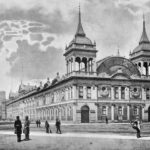
A fourth unusual funeral from our great-great-great parents’ time was that of the legendary William Price [obit 1893], a self proclaimed druid who had himself cremated (pictured): the first legal cremation ever to take place in the British Isles. Price was placed upon two tons of coal – that frankly would burn a tank never mind a human being – and twenty thousand came to see him go up in smoke. Beach has to ask – he asked himself the same thing reading some of the entries above – did they have nothing better to do?

Beachcombing has been able to find relatively little about these individuals – with the exception of the messianic William Price – any obits or details about their graves would be gratefully received. drbeachcombing AT yahoo DOT com


Mystery Discovery on the Isle of Dogs August 28, 2011

Posted by Beachcombing in : Ancient, Modern

Something that always gives Beachcombing a kick is to run across an archaeological discovery from three or, preferably, four centuries ago and try and understand what on earth our ancestors thought they had discovered and what they had really come across. Past examples in this place have included a ‘Buddha’ from medieval London and the ‘evidence’ of one of Claudius’ elephants from the same city. Archaeology seems to have been so much more fun back then.

For today what about this third bizarre archaeological discovery from the same city that apparently appears in no modern text book? This letter was written c. 1820 and appears in a publication that was about as reputable as the whore of Babylon on a bender. But the letter writer is literate and doesn’t seem to be particularly outrageous: he makes no claims to have dug up the Ark of the Covenant.

Some time in the month of April 1800, the men at work upon the Canal [on the Isle of Dogs], there found at the depth of six feet, a spur of uncommon dimensions; it measured eleven inches from shank to shank; it was quite black, but, on examination, the man who found it, discovered it to be pure gold. Sir Henry Banks purchased it for 35 guineas. A few days afterwards they came to the skeleton of a horse, about the same depth, standing erect in a perfect state : On being exposed to the air, however, it fell to pieces. (wonderful 261)

Before Beachcombing gets to the ‘spur’ he will deal with ‘Sir Henry Banks’. There was an alderman of this name at the end of the eighteenth century – ‘Sir’ and all – who was also head of Christ’s Hospital. Obit unknown, but honestly Beach has not looked that hard.

Then we have the ‘spur’ that is eleven inches long and of pure gold… Spurs are reported not just from the Mediterranean but from the tribal north in the Iron Age. But would a spur of gold even survive usage? And would a spur ever be eleven inches long? There has to be the suspicion that our Isle of Dogs workmen discovered something else and explained it as a spur when they came across the body of an erect horse. Was this a grave of a cremated chieftain?

It should be noted that ‘impractical’ golden objects do sometimes appear in Celtic royal tombs: e.g. golden shoes.

Any ideas or any later sightings of this spur in or out of Sir Henry’s possession? drbeachcombing AT yahoo DOT com


***

31 Aug 2011:  Invisible has it in for my Sir Henry, sadly with good reason. ‘Um, Sir Henry Banks died 7-21-1774 according to the Morning Chronicle and London Advertiser, p. 3 so the alderman wasn’t the purchaser of the spur in 1820. I think the gold spur was obviously made for Gog or Magog.’ Thanks Invisible!

Strange Speeches July 11, 2011

Posted by Beachcombing in : Contemporary, Modern

Beachcombing got an email last night from inspired speeches, a new website dedicated to gathering, well, inspired speeches. His correspondent asked for suggestions for notable discourses from the past. And Beachcombing made the terrible mistake of opening said email at midnight. The result? Beach did not sleep until dawn, tossing and turning, as lines from absurdly unimportant talks bounced up and down like  Mayan rubber balls  in his head. By dawn he had, however, made a  list of his ten favourite bizarre speeches: what a sad little world Beach inhabits. He’ll quickly write them out and then go and sleep it off.

1) Colonel Gaddafi: Gaddafi’s weird speeches are so many and of such excellence that it is difficult to choose from among them: take, for example, the head of the Libyan state reading from his  Green Book (author Gaddafi) explaining why he is going to kill his own people and informing his subjects that he cannot be removed because he is not a leader (wth!); or his shifty ramblings to the UN about Iraqis being allowed to enjoy their civil war  and the peace-loving Taliban (who are compared to the Vatican). But best of all – Beachcombing would have sacrificed his wisdom teeth to have been there – was Gaddafi’s invitation to two hundred Italian models to an evening soiree in Rome. Here the great man gave these Italian beauties copies of the Koran and suggested, in a brief talk, that they convert to Islam ‘without compulsion’…

2) Abraham Lincoln: Beachcombing has always enjoyed AL’s prose. He was one of those individuals – how Beach wishes he could say the same of himself – who simply could not write a bad sentence. Even his most casual comments and utterances scan perfectly, giving the sense of someone who read the King James Bible too much at an impressionable age. Beachcombing finds the Gettysburg address particularly interesting because it is flawless and yet – and here is the bizarre element – it was a flop and sank almost without trace when it was given. Did the exhausted Lincoln not have the voice to make it work? Without a recording we will never know. Beach should note as an aside that it has been his very great pleasure to teach a class of fifteen bright American university students this summer: when he asked them though where ‘of the people, by the people, for the people’ came from not a single one got it right. Answers included: the Constitution, the Bill of Rights and ‘Oprah’…  Still Beachcombing discovered yesterday that he can no longer multiply fractions so who is he to talk?

3) Ken Livingstone: The sometime socialist mayor of London is a political and a rhetorical contradiction. His monotone, unctuous befuddling voice should be irritating: and yet the man is actually a performer on the podium. This speech in particular lays bare the Livingstone contradiction, not least because talking after the London bombings (7/7) Livingstone could not employ his two greatest resources, his insouciance and his wit. His words are not Churchillian and yet, against all the odds, they are moving.

4) Charles De Gaulle: The greatest politician of the twentieth century? De Gaulle had, from his earliest days, a way with words and like Lincoln never uttered a bum thought even in his most private, terrible moments: for example, ‘maintenant, elle est comme les autres’ ‘now she is like all the rest’ on the death in 1948 of his daughter Anne who had Downs Syndrome. De Gaulle was also an exciting speaker because he did not play by the rules and no one ever knew quite what he was going to do next. There are some lovely reports, for example, of him trying to sabotage British membership talks with the Common Market at Press Conferences where he used to ‘hear’ (i.e. make up) questions. Then there were his lying balcony words in Algiers. Best of all though was his speech in Quebec in 1967. When in Montreal, no less, he advised the province to secede from Canada, saying ‘long live a free Quebec’ in the middle of a state visit!  De Gaulle afterwards pretended it was all a big misunderstanding: something the wild crowds did not seem to have appreciated. But note in the video how he underlines the word ‘libre’ as he is speaking. This was clearly, as everything De Gaulle every did, deliberate. Just imagine De Gaulle’s reaction if Pearson, the Canadian Prime Minister of the day had turned up in Corsica or Brittany demanding the Corsicans’ or the Bretons’ ‘freedom’! (Beach has just discovered that this was precisely the point that Trudeau, then Canadian Minister of Justice made against De Gaulle, apologies Pierre).

5) Margaret Thatcher: MT was sold to the public as a conviction politician and the raw anger and sense of injustice that she carried around in her swag bag gave her speeches a sharp, sharp edge. Most commentators like Thatcher when she is playing with words or trying to be memorable: Beachcombing just finds this sub par. Instead, he loves it when MT ‘loses it’ over, for example, the European Union (where she was right) or his personal favourite the capture of South Georgia in the Falklands Conflict. She says little in this clip: most of the talking is done by her defence secretary John Nott – imagine being war minister to Thatcher when British troops are fighting! But watch her face as the speech progresses and then enjoy yourself as she savages the press at the end. Again politicos would see this as MT being a school ma’am to disobedient children. It is nothing of the sort. Really it is a girl from a lower middle class background irritated almost beyond words by smug, London media types who think they know better. Relishing this clip Beach remembers Mitterand’s sublime description of MT – ‘eyes like Caligula, a body like Marilyn Monroe…’

6) Benito Mussolini: It is very difficult to understand today the charismatic charge that Mussolini brought with him. After all, to see him talk and walk in the Luce films would make any casual twenty-first century observer think of an angry duck. Yet Mussolini clearly had presence, a presence that could pack hundreds of thousands into piazzas to listen to his pronouncements. Here is perhaps his most bizarre outing: a brief speech in English, the only one that survives. Enjoy Mussolini’s walks to the camera – what Putinesque strides! – and then listen to the far from perfect spiel. Beachcombing suspects that Muss’s English teachers were too scared to correct him. Certainly no one seems to have every taught him how to say the word ‘people’ properly. But then Mussolini always had to be top of the class, with diet, with sex, with politics, with opera… His vanity over language ultimately got Italy into trouble because he always insisted in speaking in German – a language he had never mastered – with Hitler. The result was not a dialogue but a monologue as Hitler ranted and Mussolini pretended to understand.

7) A.V. Alexander: AVA was a Labour politician, Britain’s ‘Sea Lord’ in the Second World War and a cipher in Churchill’s machinations. He was also a poor public speaker. Beachcombing particularly treasures this speech because AVA misses an open goal. He is speaking to navy personnel. He know something that they don’t: that the German warship the Bismarck has just been sunk and that one of the Bismarck’s victims, the HMS Hood has been revenged. And yet he can’t, perhaps because of his emotions, get his words out at the right speed. The last sentence would have been full of pregnant pauses if Eden or even Attlee had given it. Instead AVA  just wants to get to the applause. Listen, instead, now to this heartbreaking description of the destruction of Coventry Cathedral given just months before by a Coventry clergyman: artlessness can sometimes be artful, memories of the radio description of the destruction of Cassino.

7) Winston Churchill: Not so much a bizarre speech as a missing bizarre speech. Many years ago one of Beachcombing’s students, Omar, described a talk by Churchill in which Churchill had stood up at a university, for a much advertised discourse on ‘how to succeed’, said the single word ‘persist!’ and then sat down, discourse over. Beachcombing suspects that this was Churchill’s ‘Never Give Up’ Harrow Speech in 1941, which was actually several hundred words long. Omar told Beach that his source was a self-help book! Does anyone know better?

9) ‘Huntley Haverstock’ (aka Hitchcock): Beachcombing has often pushed in this blog the idea of invisible libraries (books that have not existed save in the imagination) and perhaps there is also a place for invisible speeches, speeches that were only ever made in fiction. The following was Hitchcock’s expatriate  contribution to the British war effort in 1940 and comes from the finale of Foreign Correspondent. HH, foreign correspondent extraordinaire, is an American who has learnt the hard way that the Nazis are not to be trusted. The film ends with him making a speech on British radio to an American audience as German bombs fall and the lights start to falter. It is melodrama, it is propaganda and it is manipulative but it is also powerful. And as so often Hitchcock’s timing was immaculate. The final scene anticipated the bombing of London, which was only a hypothesis during filming. The film came out though in the US in August 1940…

10) Einstein and George Bernard Shaw: This speech is a late entry. It can hardly be called bizarre, but it is full of the majesty of history and it is perhaps the speech on this list – with the obvious exception of Gadaffi in Rome – that Beachcombing would most have liked to have attended. Einstein has come to London and George Bernard Shaw has been given the happy task of introducing him. Annoyingly the speech is not to be found on the net in one part (please tell Beach he is wrong). The first part is on film, enjoy GBS kicking Napoleon in the googlies, the second and the most interesting, in audio. Einstein’s reply (in German) is humdrum. There is a lesson there somewhere. Perhaps speech making doesn’t matter that much?

Any other bizarre speeches? drbeachcombing AT yahoo DOT com

Beachcombing has just realized that he forgot to include something by Silvio Berlusconi – a crime given SB’s contributions over the years to the art of bizarre speech making: he will then, ignore public utterances, and put up a token shot of SB (in office) misbehaving on camera in front of the world’s TV cameras. Imagine if Obama tried this…  [Apologies Beach fell for a bit of internet fakery: see AC's note below] What about  SB offending the European Parliament and above all Martin Schulz (who perhaps didn’t deserve this, but had ‘it’ coming) by implying that Schulz would make an excellent head of a Nazi concentration camp! Sadly there are no versions with English but watch the delayed reaction from Schulz as the translator takes a moment to sum up what SB has said. Watch too the surprised face of Gianfranco Fini, Italy’s foreign minister at the time, by Berlusconi’s side.

***

11 July 2011: Beachcombing woke up to a few comments on these videos, including a couple suggesting that he had exaggerated with Alexander and Thatcher: perhaps these enter too much his own private mythology? However, the first substantial contribution is from Ten Gallon: ‘I was wondering about a category of accidental speeches. The obvious one is Reagan ‘outlawing Russia’ on an accidentally recorded outtake in a radio studio. And people say we came close with the Cuban Missile Crisis… Then also a vague memory of a Carter visit to Poland where Carter had a very poor translator. On arrival, my memory is that his translator told his hosts that he had come to seek refuge and that he wanted carnal relations with the Poles! I stress again that this is my memory.’ Ten Gallon’s memory seems to be in order! Thanks Ten Gallon!

12 July 2011: Tokyobling writes ‘I have more speeches in languages other than English at the top of my head right now. I am sure the speech that Yukio Mishima gave at the Ichigaya barracks in central Tokyo right before he committed harakiri after his failed coup-de-etat belongs right up there on the list though, no matter what language he gave it in. Apparently his speech wasn’t even heard as the soldiers who had gathered in the yard below the balcony jeered and mocked him and his followers so loudly. While we are on the subject of Mishima, he gave very long, rambling, funny and cute speeches in English, totally different than his Japanese speeches. As for more inspired stuff, you might try the English translation of Kawabata Yasunari’s nobel prize acceptance speech, ‘Japan, the Beautiful, and Myself’. Good stuff. Or, my favorite Swedish speech would be the unofficial ‘president of the Republic of Jamtland’, Ewert Ljusberg’s 1996 speech mocking the French President for his nuclear testing in the Pacific. Translated from Swedish and my memory, here is the most memorable line: ‘So what do we say to this crazy power hungry French President? We call him for what he is! Quack, Quack, Jacques Chirac! Quack, Quack, Jacques Chirac!’ (whereupon a full city square in one of Sweden’s province capitals starts chanting this line, like a duck! Unforgettable and a long runner on Swedish TV. Funny if you saw it, less so if you hear it retold 15 years after the event, in some rambling email, I admit. But surely, even though he might not be serious about it, the king of bizarre speeches must be your very own Sir Stanley Unwin?’ Pure gold, Tokyobling, thanks!

13 July 2011: AC writes in to point out that the Berlusconi obscenity is not, in fact, Berlusconi but a Berlusconi look alike, Maurizio Antonini who has SB’s moves down. Apologies Silvio. Beach has put up an alternative that is, in its own way, almost as good. Thanks AC!!

Missing Holmes July 4, 2011

Posted by Beachcombing in : Contemporary, Modern

Yesterday it was flogging, tomorrow Renaissance cannibalism, so Beachcombing thought that today he would indulge in something rather more cerebral and what better than a gentle Invisible Library post? Beachcombing has introduced readers to several Invisible Libraries over the months, books that never existed except as titles in their creator’s imagination. And tonight he thought he would explore the invisible library of Sherlock Holmes, cases, in short, that Arthur Conan Doyle described but never wrote. Certainly, on occasion in the  stories and less often in the novels the narrator, Watson, lists offstage cases in enticingly brief terms, cases that he never actually shared with his readers. For example, in the very first published short story, A Scandal in Bohemia:

From time to time I heard some vague account of [Holmes'] doings: of his summons to Odessa in the case of the Trepoff murder, of his clearing up of the singular tragedy of the Atkinson brothers at Trincomless, and finally of the mission which he had accomplished so delicately and successfully for the reigning family of Holland.’

Of course, this is a brilliant narrative device. It immediately gives SH’s England depth and reminds Beachcombing of that sense of being sucked into a world that he associates with the first pages of Kim.  But there is also something exquisite about these skeleton mysteries in their own right. The following is taken from Thor’s Bridge and – forget the dog that didn’t bark and the game being afoot – this is Beach’s favourite paragraph in Doyle’s opus.

Among these unfinished tales is that of Mr James Phillimore, who stepping back into his own house to get his umbrella, was never more seen in this world. No less remarkable is that of the cutter Alicia, which sailed one spring morning into a small patch of mist from where she never again emerged, nor was anything further ever heard of herself and her crew. A third case worthy of note is that of Isadora Persano, the well-known journalist and duellist, who was found stark raving mad with a match box in front of him which contained a remarkable worm said to be unknown to science’.

It is almost as if Holmes with Watson at his side has strayed into an early H.G. Wells novel with a time machine set up to look like an exercise bike. However, there are other skeleton cases that are not to be sniffed at either:

The year ’87 furnished us with a long series of cases of greater or lesser interest, of which I retain the records. Among my headings under this one twelve months, I find an account of the adventure of the Paradol Chamber, of the Amateur Mendicant Society, who held a luxurious club in the lower vault of a furniture warehouse, of the facts connected with the loss of the British barque Sophy Anderson, of the singular adventures of the Grice Patersons in the island of Uffa, and finally of the Camberwell poisoning case.’

‘Of all the problems which have been submitted to my friend Mr Sherlock Holmes for solution during the years of our intimacy, there were only two which I was the means of introducing to his notice, that of Mr Hatherley’s thumb [The Adventure of the Engineer’s Thumb] and that of Colonel Warburton’s Madness.’

‘Here’s the record of the Tarleton murders and the case of Vamberry, the wine merchant, and the adventure of the old Russian woman, and the singular affair of the aluminum crutch, as well as a full account of Ricoletti of the club foot, and his abominable wife.

One Sherlockian, Martin Dakin suggested that Holmes really said something quite different in the last clause of this last paragraph and was misconstrued by that dullard Watson. His true words were, of course, ‘the wrinkled yeti of the club foot and his abominable life’, which would bring cryptozoology and the Himalayas into the canon!

Then, of course, if Holmes-lovers can start rewriting sentences why not actually write up the stories themselves? Holmes lovers are not as geeky as Lord of the Rings or Star Wars and Star Trek fans, but they come wonderfully close.

A notable exercise in this respect was More Exploits of Sherlock Holmes (1954) written by Adrian Conan Doyle and crucially the capable John Dickinson Carr that bring to life several of these half imagined mysteries. However, so many pastiches have been written that there is actually a serious scholarly study, The Alternative Sherlock Holmes* (which Beach is trying to get his grubby hands on), a ‘vulgar’ collection of short stories (The Mammoth Book of New Sherlock Holmes Adventures, ed by Ashley 1997), not to mention, God alive, a Wikipedia page.

Beachcombing is always on the look out for invisible libraries: preferably ones that have not, though, become books – drbeachcombing AT yahoo DOT com

*’Between 1887 and 1927, Sir Arthur Conan Doyle wrote sixty Sherlock Holmes stories, and his great Canon has become the most praised, most studied, and best-known chapter in the history of detective fiction. Over twenty thousand publications pertaining to the Sherlock Holmes phenomenon are known to have been published, most of them historical and critical studies. In addition, however, almost since the first stories appeared, such was their uniqueness and extraordinary attraction that other authors began writing stories based on or derived from them. A new genre had appeared: pastiches; parodies; burlesques; and stories that attempted to copy or rival the great detective himself. As the field widened, there was hardly a year in the twentieth century in which new short stories or novels did not appear. Many hundreds are now known to have been published, some of them written by authors well-known for their work in other literary fields: John Kendrick Bangs, Jon L. Breen, Agatha Christie, August Derleth, Philip Jose Farmer, Maurice Leblanc, Ellery Queen, Vincent Starrett, and many, many more. Presented as an entertaining narrative, of interest to both the aficionado and the scholar, it provides full bibliographic data on virtually all the known stories in the field.’

***

5 July 2011: CCBC writes in to say, ‘I am probably not the first to remind you of the Case of the Giant Rat of Sumatra, which the world is not yet ready to hear. Adrian Doyle and others have attempted to temper that tale to modern ears but… What I may be the first to mention is the astonishing playlet created around that story (wherein humour is employed to blunt horror). Also, have you discovered Ellery Queen’s The Misadventures of Sherlock Holmes? Or the Solar Pons tales by August Derleth?’ Beach is ignorant on all counts. KMH, meanwhile, has a more general consideration: ‘The  Sherlock Holmes literature marks the beginning of a fantasy-oriented  counter-reaction to the general decline in manners and morals in the 19th century, and continuing on to the present day. One affect of this decline is the increase in crime and difficulty in convicting criminals by traditional methods, perhaps abetted by some  corruption in government and police officials.  So, in contrast to reality, we initially have a spawn of purely fictional detectives, beginning with Holmes, brilliantly solving crimes and vicariously  satisfying  the public’s appetite for justice (and good prevailing over evil). Fast forward to the 20th century and justice is being given a helping hand  by even more extreme fantasy figures such as Batman, Superman, Xmen, etc. all of which possess extraordinary advantages beyond the brilliant detective talent. Of course, this is at a time when real respect for government, law and order, and justice appears to be at an historical low. The recent popularity of a number of television dramas involving forensic experts (CSI, NCIS, etc) follows this development by employing advanced scientific techniques which few, if any,  agencies have the training for, or can even remotely afford. Where does the ‘justice hero syndrome’ originate from? It seems to derive from the expectation of Christ’s Second Coming to right all wrongs, punish all criminals, and institute a true government free of corruption, as the greatest of heroic acts.  Today this expectation is stronger than ever as evidence that we are in the ‘last days’ continues to accumulate. What next? Perhaps the next justice heroes could  be  aliens  or extraterrestrials landing in flying saucers to eliminate the criminal psychology and set humanity back on the right course.’ Thanks KMH and CCBS!

10 July 2011: Phil P writes in: Regarding ‘The Giant Rat of Sumatra’, the science fiction/ fantasy author Fred Saberhagen dealt with this one and concocted an engaging tale in which Holmes and Dracula encountered one another in ‘The Holmes Dracula Files’. Alternating chapters are narrated by Dr. Watson. I believe you would enjoy it.’ Thanks Phil, I can’t wait!


Page 1 of 212