jump to navigation

Seventeenth-century English Dragons May 28, 2012

Posted by Beachcombing in : Modern

Beachcombing recently highlighted the case of a giant serpent in nineteenth-century Devon, a snake that was as thick as a thigh. Beach had assumed that this was a one off, but now he is wondering as he found a second reference to go with it. This one comes from a pamphlet with a straight-to-the-point title: The Flying Serpent or Strange News out of Essex. This was published in 1669 and tells how a beast that was spotted at Lodge Farm, Henham-on-the-Mount was

‘8 or 9 foot long, the smallest part of him about the bigness of a Man’s leg, on the middle as big as a Mans Thigh, his eyes were very large and piercing, about the bigness of a Sheep’s eye, in his mouth he had two rows of Teeth which appeared to their sight very white and sharp, and on his back h e had two wings indifferent large but not proportionable to the rest of his body, they judging them not to be above two hand fulls long, and w hen spreaded, not to extend from the top of one wing to the utmost end of the other above two foot at the most, and therefore altogether too weak to carry such an unwieldly body.

A flightless dragon then?! All this makes Beach wonder if (in imaginary terms) the Devonian snake was actually the last traces of belief in wyrms in those parts in the early eighteenth century.

Back to the Henham beast though. One writer, Alison Barnes, has gone on record with (she believes) the true identity of this beast. Crocodile? Salamander? Mutant adder? Well, actually none of the above. AB has argued that it was a practical joke. She claims that the author of the pamphlet, was also the author of the hoax: see further her ‘Ingenious William Winstanley: Poet, Journalist, Bookseller, Historian and Novelist of Saffron Walden and Quendon 1628-1698’. AB argues, in fact, that all the ‘solid witnesses’ were Winstanley’s friends and implies that lots of paper mache was employed.

So dragons were truly extinct by the seventeenth century in Britain? Well, yes and no. In 1614 another text was published whose title will speak for itself.  True and Wonderfull: A Discourse relating a strange and monstrous Serpent (or Dragon) lately discovered, and yet living, to the great annoyance and divers slaughters both of men and cattell, by his strong and violent Poyson: in Sussex, two miles from Horsam, in a woode called St. Leonards Forrest, and thirtie miles from London, this present month of August, 1614. With the true generation of Serpents.

Who needs annotated bibliographies when you have a hundred word titles? A description of the ‘dragon’ follows.

He is of countenance very proud, and at the sight or hearing of men or cattel, will raise his necke upright, and seem to listen and look about, with great arrogancy. There are likewise on either side of him discovered, two great bunches so big as a large footeball, and (as some thinke) will in time grow to wings

He was eight or nine feet in length and his middle part (the thickest) was, reportedly, like the axle tree of a cart.

What on earth is happening here? drbeachcombing AT yahoo DOT com

Cellini and the Salamander May 26, 2012

Posted by Beachcombing in : Medieval, Modern

***Dedicated to Michael F who sent this in***

We last saw Benvenuto Cellini (obit 1571) imprinted on a French/Spanish/Scottish canon. Fourteen months on, here is a little doodle from Cellini’s infancy, judging by his autobiography the happiest years of his chaotic life.

When I was about five years old [c. 1505] my father happened to be in a basement-chamber of our house [in Florence], where they had been working, and where a good fire of oak-logs was still burning; he had an instrument in his hand and was playing and singing alone before the fire. The weather was very cold. Happening to look into the fire he spied in the middle of those most burning flames a little creature like a lizard, that was sporting in the core of intensest coals. Becoming instantly aware of what the thing was, he had my sister and me called, and pointing it out to us children, gave me a great box on the ears which caused me to howl and weep with all my might. Then he pacified me good-humouredly and spoke as follows. ‘My dear little boy, I am not striking you for any wrong that you have done, but only to make you remember that that lizard which you see in the fire is a salamander, a creature which has never been seen by anyone of whom we have credible information.’ So saying he kissed me and gave me some pieces of money.

Innella età di cinque anni in circa, essendo mio padre in una nostra celletta, innella quale si era fatto bucato ed era rimasto un buon fuoco di querciuoli, Giovanni con una viola in braccio sonava e cantava soletto intorno a quel fuoco. Era molto freddo: guardando innel fuoco, accaso vidde in mezzo a quelle piú ardente fiamme uno animaletto come una lucertola, il quale si gioiva in quelle piú vigorose fiamme. Subito avedutosi di quel che gli era, fece chiamare la mia sorella e me, e mostratolo a noi bambini, a me diede una gran ceffata, per la quali io molto dirottamente mi missi a piagnere. Lui piacevolmente rachetatomi, mi disse cosí: – Figliolin mio caro, io non ti do per male che tu abbia fatto, ma solo perché tu ti ricordi che quella lucertola che tu vedi innel fuoco, si è una salamandra, quali non s’è veduta mai piú per altri, di chi ci sia notizia vera – e cosí mi baciò e mi dette certi quattrini.

It is a cute story and one with perhaps special significance for our author. Cellini, after all, would become famous through fire, he was first and foremost a goldsmith: was this creature even his totem? As to the identity of the salamander, the renaissance saw growing belief in elementals and salamandre were the spirits of flame. Almost as curious is the strange parental technique of causing pain to induce pleasant memories.

Any other historical pre-theosophy reports of salamanders: drbeachcombing AT yahoo DOT com

The Problem with Sea Apes May 24, 2012

Posted by Beachcombing in : Actualite, Contemporary, Modern

***Dedicated to Andy the Mad Monk and Invisible***

Beach has, since the early days of this site, shown a persistent interest in mermaids. It would be outrageous then to pass by the important new documentary coming out (or has it already aired?) on Animal Planet. The following is borrowed from Wikipedia (courtesy of the inestimable Invisible).

Mermaids: The Body Found is a two hour Animal Planet… The fictional film tells the story of a scientific team’s investigative efforts to uncover the source behind mysterious underwater recordings and an unidentified marine body. Two former National Oceanic Atmospheric Administration (NOAA) scientists tell their story on camera for the first time. After investigating mass strandings of whales, the team claimed to have recorded mysterious underwater noises coming from an unknown source. This sound resembled a sound previously recorded in 1997, called the ‘bloop’. They also claimed to have recovered 30% of the remains of an unknown creature from inside a great white shark which was said to possess attributes of the human body. They alleged that the marine creature had hands, not fins, and the hip structure of an upright animal. These findings, along with many others led the team to determine that this unknown animal was very closely related to humans, possibly a mermaid.

So a mockumentary has been created to  entertain and to offer the latest theory on mermaids. And what is this theory? This time Beach borrows from part of a Fox News report (courtesy of Andy). Note how there is absolutely no mention here of the fictional content unless the word ‘compelling’ (as in ‘the punters don’t do simple facts’) is supposed to cover that!

In the two-hour CGI Special Mermaids: The Body Found, Animal Planet dives deep into the idea that mermaids may have been real, and, even better – related to humans! ‘It’s a very radical theory on human evolution, but we have approached an age-old myth and really chased its origins,’ Animal Planet honcho Charlie Foley told FOX411’s Pop Tarts column. ‘It has been compiled in a way that is very compelling, making us think that mermaids might not just be mythical creatures.’ The show unravels mysterious underwater sound recordings and presents a bone-chilling argument for the Aquatic Ape Theory, which suggests that during the transition from apes to hominid, some humans went through an aquatic stage. This stage is argued to have resulted in ‘aquatic ape-like’ creatures. ‘There are striking differences between us and other primates, yet [there are] many features we share with marine mammals, like the webbing between our fingers, which other primates don’t have, a layer of subcutaneous fat, and a loss of body hair,’ Foley explained. ‘We also have an instinctive ability to swim, and control over breath. Humans can hold breath up to 20 minutes, longer than any other terrestrial animal.’ Mermaids: The Body Found ponders the concept that coastal flooding millions of years ago turned some of our ancestors inland, while another group branched off into the deep water out of necessity and for food.

Beach has already highlighted sea apes. In fact, he dug up, to the best of his knowledge, the earliest reference to the concept that dates back to the eighteenth century. And this is where the problems begin… Readers might want to flag up problem concerning biology, which Beachcombing is, sadly, not qualified to do: drbeachcombing AT yahoo DOT com However, Beachcombing would like to stick his oar into the epistemology of sea-bourne monkeys.

If you want to explain the unicorn then it makes sense to look for a now extinct creature. After all, people no longer see unicorns (with very few exceptions) and those sightings there are usually involve travelers far from home confronted by unusual but known animals. If there was a unicorn-like animal ten thousand years ago then it is possible that this animal got trapped in an early phase of human myth and that it was passed down to us from there.

However, the problem with explaining mermaids in this way is that sightings continue  into the present. There are dozens of sightings, for example, from the Hebrides (Scotland) in the nineteenth and twentieth centuries. Beach can only see three ways forward in relation to the sea-ape theory.

(i) There is a small population of sea apes that survived (or survives) on and off the British coast and yet no body or photograph has ever turned up.

(ii) The mermaids that are seen cannot be explained as physical entities. Here you can give a psychological, a theosophist or a ‘pagan’ explanation, but sea apes are out.

(iii) By some bizarre mechanism presently beyond our understanding the sea ape, which has not lived on the Scottish coast for a thousand or ten thousand years, entered ‘collective memory’ and has reappeared in the imagination of locals: go to (ii) above but with sea apes ‘in’.

Beach just might be able to conceive, against all his better judgement, that in the wild backwoods of New Zealand or in the expanses of the Rocky Mountains there are giant flightless birds or unknown hominids. But if anyone finds a sea ape community on the coast of Scotland, he’ll eat a tonne of boiled sweets. He has never seen (pace Jungians) any proof for ancestral memory. And so he would plump for number (ii), as he would for fairies.

In fact, forget sea apes, mermaids seem to be sea fairies. And in many ways the sea ape theory is to mermaids what the late nineteenth century pygmy theory was to the fey.

People sometimes see things that are not physically present: whether they are truly external or not Beach will happily leave to the philosophers.  What is absolutely terrifying about this is that if our perception can play these kinds of tricks on us (or ‘pull back the veils of creation’ if you prefer) can our senses be trusted under any circumstances? On just that subject, looking forward to the documentary…

***

25 May 2012: Wade writes in ‘Your sea ape post instantly reminded me of the aquatic ape theory, first proposed by a German pathologist, Max Westenhofer, in 1942, then proposed again British marine biologist, Alister Hardy, in 1960. It has since been championed by Elaine Morgan, a Welsh writer (per Wikipedia). I saw a special on this years ago. It is a fascinating idea. My impression is that most anthropologists have either actively hated or completely ignored the theory as pseudo-science. Here are two links: Elaine Morgan’s  and an anthropologist’s view that examines the controversial theory and yields the sceptical response. Thanks Wade!


The Great Snake Scare of 1828 May 16, 2012

Posted by Beachcombing in : Modern

A cute little WtH story from deepest Devon (Tavistock) about a cryptid snake. Beach knows that nineteenth-century newspapers had a great time making up serpents and other monsters, cue ‘the 200-foot-long Hideous Ice Worm‘ with hat tip to Invisible. But in this case local tradition seems to have done the job for them.

I think it was in the summer of 1828 that an application was made to a magistrate to issue an order, for the security of the neighbourhood, that a certain monstrous snake, first seen in Pixy Lane, and afterwards in our orchard, should be well looked after. If the magistrate had to issue this order to apprehend the snake, or to secure the attention of the constables, the applicants themselves did not very clearly define. I never heard such a story as speedily found its way amongst the lovers of the marvellous.

No doubt, however, the snake that had been seen was an extraordinary one; and, as a matter of curiosity, I set to work to learn the most credible account of it that could be met with. One boy offered to take his ‘bible oath’ that he was leading up (i.e. walking up) Pisgey Lane with another lad, and on going to the hedge to pick something, a great snake leapt out, over the little boy’s shoulder, as he was standing beneath; crossed the road with great rapidity, and an old man who was near the spot, declared that the body of the long cripple (for so they here call a snake [long creeper?]) was as thick as his thigh [!!]; and so long, that he would not say how long it could be. I also heard an old woman, considered here a wise one, declare ‘the reptile was for all the world just such another snake as tempted Eve to eat the apple’.

Beach had a couple of years ago the experience of coming (literally) face to face with a snake when one reared up and started hissing at this blogger. The effect, even with a stick in your hand, is primal: humans are evidently hardwired to fear serpents. Beachcombing can understand then how a very long adder could have been exaggerated into this semi-monster. But ‘as thick as his thigh’?!? Perhaps the old man was a consumptive with  nil protein intake? Perhaps his thigh was as thick as our arms? Parallels maybe? drbeachcombing AT yahoo DOT com In any case, our author continues.

In our orchard, however, [the presence of the snake] produced a very different effect; for the formidable monster, luckily for us, having been there last seen, proved as good a guard as any dragon to the fruits there found, so that we had fewer apples stolen that year than we ever had before. What became of the snake no one could tell; but not in the days of monkish superstition could more extravagant tales respecting a reptile have been circulated or believed. On hearing these, I no longer wondered at the credulity of the old chronicler, who recorded that marvellous story about the monstrous snake at Rouen in Normandy, which swallowed knights whole, armour, horse and all, and at last required a saint himself to kill it.

Beach doesn’t want to bore his non-fairy loving readers but Pixy/Pisgey Lane, of course, refers to the fairies of the south-west. Make of that what you will…

The Leprechauns of Liverpool and the Bowling Green from Hell May 14, 2012

Posted by Beachcombing in : Contemporary, Modern

Beachcombing has been spending some time in the last few days looking at the fairy lore of Irish immigrants: spurred on by his continuing failure to find the New York changeling case. Not surprisingly the city of Liverpool stuck out: Liverpool was flooded by Irish workers in the nineteenth century, particularly after the horrors of the famine, and Liverpudlian is, to this day, the one English ‘accent’ that shows signs of Irish influence.  Beach has managed to track down a thin gruel of nineteenth-century fairy references from Liverpool, in a period where one fifth to one third of the city was of Irish decent. He would be extremely grateful for any help here: drbeachcombing AT yahoo DOT com However, he also stumbled upon the curious story of the Liverpool Leprechauns.

Beach should start by saying that this story is somewhat outside his normal remit. It is very modern, it involves lots of screaming children, and, worst of all, UFOs (hats off to Magonia) make an unwelcome sweep over the Mersey… But it is also entertaining and, hey, rather the Summer of the Leprechauns than the Summer of Sam.

30 June 1964 children (number unspecified) saw ‘little men’ (numbers variable) in Jubilee Park near that vortex of northern necroticism, ‘the bowling green’. (If Beach ever writes a horror short story it will be called simply, ‘the Bowling Green’ and it will be illustrated by a man with bushy eyebrows drinking piss-weak ale.) Quite what the children saw has been much debated. ‘White hats’ on the little men were noted, as were their antics in throwing sods at each other. What is documented is that very rapidly the little men were interpreted (by the press?) as being leprechauns.

Leprechauns are, of course, an Irish solitary fairy known for shoe-making and vast wealth: Beach’s daughter recently shared with him the insight that the leprechaun might be rich because he sells lots of shoes. Legend claims that if you grab and hold a leprechaun you will be able to claim the fey’s treasure. So was ‘leprechaun’ just a reflex word picked up by a local journalist: leprechaun are always male, the connection might have been as simple as that? Or do we have here third of fourth generation Irish children living the stories told them by their grandparents? And in either case was this all hysteria? Beach’s belief system requires him to nod sagely here. But some modern Liverpudlians have memories. Make what you will of the following two.

I was one of the school children that saw those leprichauns I attended Brae Street School and we all saw them popping in and out of a window overlooking the school yard , there were about 4 of them all tiny dressed like a school book idea of a typical gnome and they sat swinging their legs on the window ledge getting in and out. What they were I don’t know I only know what they looked like. I’d love to know the truth!!!

I certainly [remember leprechauns], and I actually saw a few of them on Kensington Fields, close to the library, but my parents and other adults tried to convince me that I”d been seeing things. This would be one afternoon in early July 1964, around 4.30pm, and I remember it as if it were yesterday. I was 10 at the time and on my way to play football with my mates and saw these little (I”d say just a few inches tall) men dressed in red and black, standing in the grass, looking at me. I’m sure one of them had some type of hat on. I panicked and ran all the way home. My mum said there had been reports of leprechauns and little men on Jubilee Drive and Edge Lane the day before. That same evening crowds turned up on Jubilee Drive, and I remember a girl with a jam jar that she was going to put the leprechauns in! 

Luckily, a history blog can leave the existential questions to one side and go like a hungry ferret after the hysteria. By the 1st word was spreading among the little folk (the children not the fairies) and swarms descended on Jubilee Park to see for themselves.

It was all too much for Irish parks constable James Nolan. ‘I don’t believe in leprechauns myself’, he said. He called in the city police. Police in cars and on motorcycles arrived. They cleared the hundreds of youngsters from the bowling greens — the reported playground of the wee folk — closed the gate, and stood guard.  But beyond the bowling green gates the youngsters milled, tiny tots to 14-year-olds. They crammed the top of the covered reservoir for a better view of the bowling green. Tolerant bobbies wandered about trying to get the youngsters on the move. But the kids would not believe that there were no little green men. It was not until after 10pm that the park was cleared. How the story started was not known, but last night was the second night running of the leprechaun hunt. And how did those little brownies who help the Irish housewife with her chores come to arrive in Liverpool? Maybe they flew from old Ireland. A woman resident in Crosby last night reported seeing ‘strange objects glistening in the sky, whizzing over the river to the city from the Irish Sea’. 1 July 1964

The Crosby UFO and perhaps the ‘green’ men can be dismissed. They both sound like a journalist’s fugue. But by 10 July rumour had come to nearby Kirkby where children believed that there were fairies in the churchyard of St Chad’s there. It took ten days and the intervention of clergy and policemen to get the children out from among the graves. Beach wonders very vaguely if the ‘hunting’ element, children with jam jars and (by some accounts) air rifles (!) were responding to the idea of capturing the leprechaun and his treasure.

Beach should end by noting that rational explanations have been offered up, as they always are in these cases. There is the circus school that claims that the leprechaun scare began with a household of travelling midgets. There is the James Nolan school that claims that Nolan (the park constable) set up the rumour mill as a prank: evidence includes the testimony of a colleague. Then there is the diminutive gardener, Brian Jones, who may have set off the leprechaun fever and who claimed as much in a Liverpool newspaper in 1982. In any case, the Liverpool-Kirkby kerfuffle would make a great final chapter for a book of modern fairy.

***

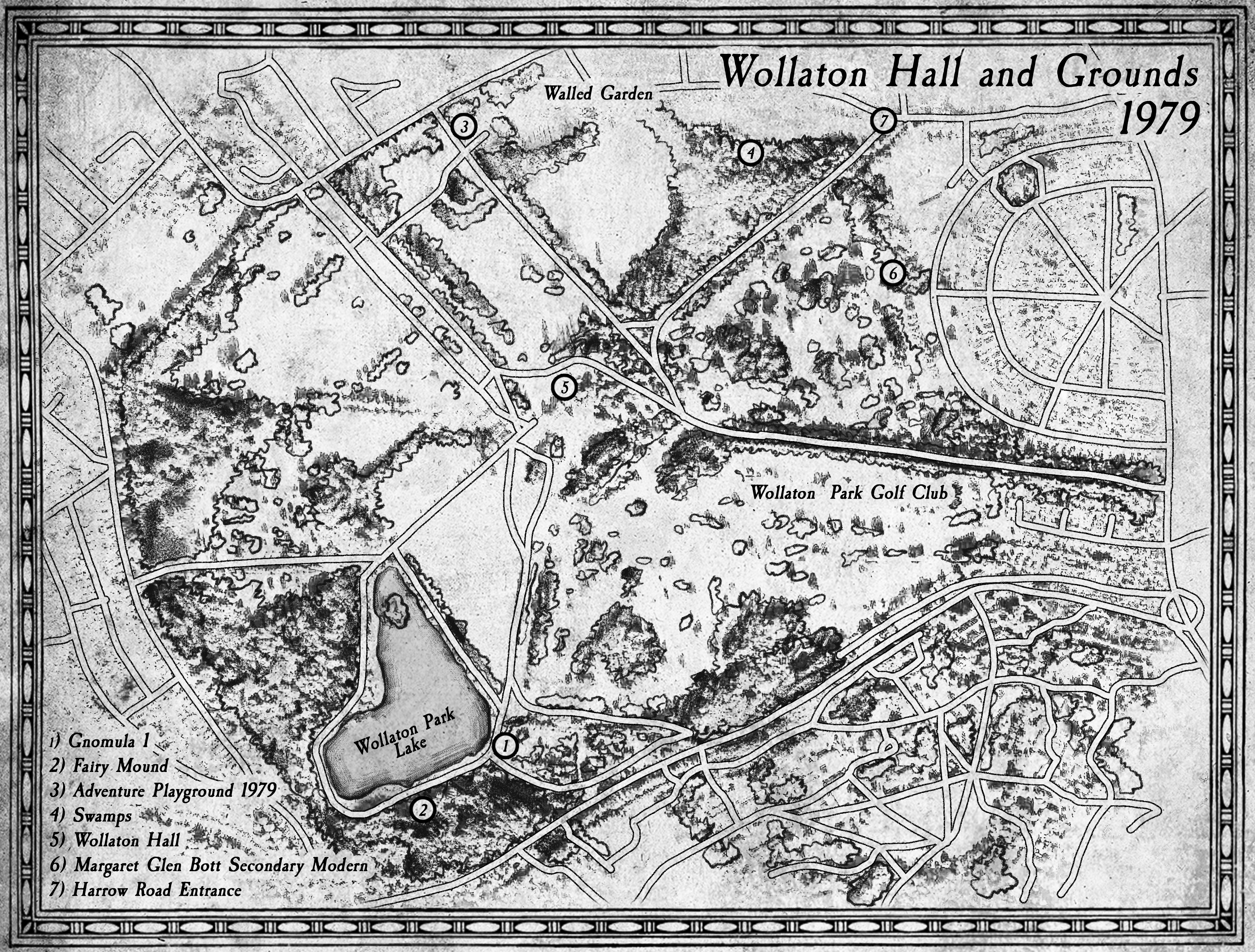
14 May 2012: Southern Man quotes direct from the great Janet Bord, The Traveller’s Guide to Fairy Sites on the Liverpool episode.  ‘The city was an unlikely setting for a series of reported fairy sightings in the summer of 1964. Little green people, varying from 3 inches tall to garden gnome-sized, were being seen at night in the city’s parks and golf courses, as well as at people’s houses and flats. The excitement grew so intense when the reports were widely publicised, that on one occasion a crowd of people gathered near the bowling green in Edge Hill in August 1964 hoping to see fairies (or whatever they were) and had to be restrained by the police. Later the same year, a woman living in Wavertree claimed that three little men in green clothes had been sitting on her backyard wall, throwing stones at her dog, and other women saw them climbing a tree in Wavetree Park. These events demonstrate the difficulty the researches sometimes has of easily distinguishing between reports of fairies, aliens and other non-human beings…‘ Invisible coincidentally points to the report ‘Janet Bord’s Fairies, Real Encounters with Little People for the Wollaton little people sighting–also in a park-like setting, also by children. This was in 1979 and reminded me very much of the Liverpool case you cited, except it was kept much quieter so there was no crowd hysteria and there are no mention of jam jars.’ Thanks SM and Invisible!


23 May 2012: Larry writes ‘In 1989 when the USSR started being more open about themselves, some Moscow children reported seeing robot aliens in a nearby park.  At the time the Western press ate this up because the Soviets usually never reported such things. If these little green men are aliens, I hope their taxpayers never find out that they came countless light years to Earth just to throw rocks at dogs and goof off in various parks. For what this is worth, there was an experiment done circa 1982 in a local radio station where someone pretended to report seeing a UFO.  Nothing fancy, just a disk shaped light zipping across the night sky.  In a matter of hours the station got over 300 calls from people who also swore they saw it.  And the stories ramped up to where some were reporting seeing the ship land and aliens coming out to abduct them.  Yes, separating the wheat from the chaff when it comes to UFO reports has always been very difficult.’ Thanks Larry!

Hauntings and Technology: the Teflon Effect January 19, 2012

Posted by Beachcombing in : Actualite, Contemporary, Modern

***Dedicated to Penne with thanks***

Not a month ago Beachcombing reflected on the strange way that Roman ghosts are a modern invention and the way too that there are apparently fashions in which historical periods haunt and which do not. Beach thought that today he would reflect, instead, on a different but surely related phenomenon, the apparent allergy that new technologies have for the spirit world.

Take this 1880 article about ghosts:

It used to be a common thing for sailors to refuse to go to sea on a Friday. We hear nothing of this in these steamboat days. Steam has made every day alike. Steam has been a great changer, and in the matter of popular superstitions it has proved the great reformer. Wherever steamboats and steam-engines appear superstitions disappear, ghosts, fairies, witches are speedily forgotten. Who ever heard of a ghost in a railway station, or of a bewitched cattle truck, or of a haunted saloon carriage. The thing is impossible. The most expert seer could not find a ghost in a first-class waiting-room – could not even imagine such a thing

This was probably not true even in its day. After all, Dickens had written The Signal Man, the most famous railway ghost story of all, in 1866, fourteen years before this. And today railway ghosts are two to a penny: Beachcombing finds 170 at the paranormal database. But it is probably true that new technology has, at least at first, a sort of Teflon effect with such legends: tales of haunting just don’t stick for the first generation.

Now it seems it’s the turn of airfields. Penne sends in this extraordinary collection of airfields haunting (from which the photograph above is stolen). Lots of good stuff including non-existent native American cemeteries under Denver airport:

The rumor may have started, says the site, when the airport’s public art program began playing Native American chants on a continuous audio loop near the pedestrian bridge linking Concourse A and the Jeppesen Terminal building.’

And there is at least one Battle of Britain fighter-pilot ghost.

So what’s next up for a visit from the spirit world? drbeachcombing AT yahoo DOT com Beachcombing’s money is on internet cafés and call centres…

 ***

21 Jan 2011: First up is Invisible who has reflection upon reflection on this. ‘It is a little odd that while there are accounts of phantom trains, planes, and automobiles, there does not seem to be an increase in ‘tech hauntings’: haunted computers, Blackberries, video games, or I-phones although there do seem to be a fair number of reports of haunted radios. See, for example, news.stv.tv and paranormaldatabase.  (And if you want phantom fighter pilots and planes, see Bruce Halpenny’s “Ghost Stations” series.) There are few reports of haunted computers (The Vertical Plane case where Ken Webster supposedly had a 16th-century gentleman communicating through his word-processor is one case that springs to mind.) Despite the scene in the movie Poltergeist, TVs rarely figure in ghost stories. I have heard a number of anecdotes about TVs turning on and off by themselves and mysteriously switching channels—often interpreted as ghostly activity, but more likely to be the result of a neighbor’s garage door opener being on the same frequency as the remote. But for the most part ghosts seem to favor more low-tech gadgets: the tape recorder for collecting Electronic Voice Phenomenon, the digital cameras to snap photos of orbs, and the ubiquitous EMF detectors of the ghost hunters with which the country seems overrun. I’m not sure why these items are so popular since there is no manual with which to calibrate said ‘ghost detectors’—no table that says, ‘if you get a reading of .7501, it means there is a ghost.” instead of, say, old furnace ductwork in the walls. If you look at the items in the average ghost hunter’s kit, they would not differ much from the stopwatches, thermometers, and cameras of the 1950s Ghost Club. One wonders if this means that ghosts are inherently conservative late adopters… What’s the latest trend in the spirit world? One thing I’ve noticed recently is a ghost hunting ‘protocol’ where one sets up a flashlight and commands any spirits present to turn it on and off. (The electrical version of ‘rap once for yes; twice for no’ of the séance room?) While headless ghosts and phantom cavaliers are completely passé, unfortunately ‘demons’ and ‘dark entities’ seem to be the newest fad with the title ‘Demonologist’ replacing the term ‘ghost hunter’ or ‘parapsychologist’. One can’t just have a harmless ghost; it has to be an Evil Spirit in a House of Horror where a Portal to the World Beyond has attracted a Vortex of Malevolent Entities. I blame the Evangelicals. That and all the loose apocalyptic talk that has been going around.’ Stella writes: Telemarketers calling from beyond the grave to try to sell people obsolete products or ask them whether they plan to vote for Roosevelt or Hoover certainly have excellent urban legend potential.  I predict that the psychically inclined will soon be able to contact the dead on their iPhones.  Who knows, there might even be a ouija board app.’ Mccp writes, meanwhile: This isn’t about ghosts, per se, but the Denver (Colorado) International Airport is the strangest in the world. It features a mural by Leo Tanguma that depicts an apocalypse, a sculpture of a demonic horse with red eyes that light up, and gargoyles. It is a frightening place, more like one of those Asian theme parks that depict Buddhist Hell than an airport. No one has ever explained the odd decoration scheme. The DIA is cited in many places on the Net. Then Tony has this to say: the Tiger tank  captured in Tunisia 1943 , and now restored to running condition at the Bovington Tank Museum (Wool, Dorset) is supposedly associated with the ghost of Herman the German,  who is sometimes seen in the buildings . I heard tell of him as a schoolboy in about 1964.’ Thanks Tony, Invisible, MCCP and Stella!


The Earliest Roman Ghost in Britain January 4, 2012

Posted by Beachcombing in : Ancient

Owen Davies in his fascinating The Haunted: A Social History of Ghosts notes the way that strangely (or obviously if you are a sceptic like Beachcombing) ghosts follow the fashions and interests of their times. Take OD’s thoughts, for example, on Roman ghosts in the UK.

The most recent addition to the corpus of heritage hauntings is also the most venerable of all – the roman [sic and below] legionnaire. A search on the internet reveals numerous sightings in diverse places such as London, Derby, the Isle of Wight, and an old Roman road near Weymouth. Some readers will be familiar with a well-known case of a troop of soldiers seen by a plumber working in a York cellar in 1953. However, such sightings are a modern phenomenon with nearly all of them dating to the last 50 years. The earliest reports I have found concern a Roman centurion seen patrolling the Strood, Mersea Island, which was first recorded in 1904, and a ghostly Roman army that marched on certain nights along Bindon Hill, Dorset, to their camp on Ring’s Hill during the 1930s. Distinguishing between the ghost of a Bronze Age  warrior and an Iron Age one would be a task for an archaeologist, but thanks to ‘swords and sandals’ film epics, and the inclusion of the Roman invasion in the curricula, the dress of the roman soldier has become as recognisable as that of a monk or a cavalier. Clothes truly make the ghost.(42)

It would be fun to chase this 1904 ghost back down the ladder of time and see if it really was spotted in Edwardian times. OD references The Lore of the Land, p. 269 if anyone has a copy to hand: Westwood and Simpson. A quick look on the internet turns up a lot about ‘Romano-British barrows’ in the area, which is a rather bizarre phrase for all but perhaps the  very early period of Roman occupation. There is also the difficulty that the Stroud was built by a Saxon king a couple of hundred of years after the Romans had left the area.  Then even more suspiciously it seems the ghost has been appropriated by a local pub: the Peldon Rose!

Beach spent a few aimless minutes looking for evidence for Roman ghost sightings in Britain prior to 1904 and came across two unsatisfactory comments – can anyone do better, drbeachcombing AT yahoo DOT com? The first is from a novel (sorry) dating to 1863 that might be an imaginative recreation of York? At one point in a crypt ‘Alice’ states:

‘I am glad I thought of bringing you here and the old Roman ghosts that they say haunt this place have not meddled with you whilst we have been away?’

Note that the context leaves no doubt that these are antique ghosts rather than Roman Catholic ones!

Another fragment comes in a newspaper article from the 1880s but is probably more a rhetorical point than a factual statement.

Those old Roman ghosts who still haunt the scenes of their victories over their Saxon foes have laid aside the toga and have forgotten their native tongue; after having patiently endured many changes which were meaningless to them, they now wear the commonplace black coast and top hat, and talk Cockney English.

This reminded Beach in turn of a paragraph in a Grant Allen short story – alluded to in the Wells’ Time Traveller – that he hopes to include in a packet he is preparing for his readers for epiphany.

All the spirits of all that is, or was, or ever will be, people the universe everywhere, unseen, around us, and each of us sees of them those only he himself is adapted to seeing. The rustic or the clown meets no ghosts of any sort save the ghosts of the persons he knows about otherwise; if a man like yourself [an intellectual] saw a ghost at all – which isn’t likely – for you starve your spiritual side by blindly shutting your eyes to one whole aspect of nature – you’d be just as likely to see the ghost of a Stone Age chief as the ghost of a Georgian or Elizabethan exquisite.

Which brings us back to Owen David’s initial point.

***

5 Jan 2012: First of all an apology, I put up the wrong passage from Grant Allen! ‘It’s a very odd fact,’ Dr. Porter, the materialist interposed musingly, ‘that the only ghosts people ever see are the ghosts of a generation very, very close to them. One hears of lots of ghosts in eighteenth-century costumes, because everybody has a clear idea of wigs and small-clothes from pictures and fancy dresses. One hears of far fewer in Elizabethan dress, because the class most given to beholding ghosts are seldom acquainted with ruff’s and farthingales; and one meets with none at all in Anglo-Saxon or Ancient British or Roman costumes, because those are only known to a comparatively small class of learned people, and ghosts, as a rule, avoid the learned – except you, Mrs. Bruce – as they would avoid prussic acid. Millions of ghosts of remote antiquity must swarm about the world, though, after a hundred years or thereabouts, they retire into obscurity and sense to annoy people with their nasty cold shivers. But the queer thing about these long-barrow ghosts is that they must be the spirits of men and women who died thousands and thousands of years ago, which is exceptional longevity for a spiritual being don’t you think so, Cameron?’ Then KMH on the metaphysics of ghosts.  ‘There is much confusion over ghosts. They are left behind after death, rather than being escorted to another realm, because they are not ready to go due to some tragic event or psychological condition. Ghosts are more likely in the primitive religions than the modern ones and more likely in degenerative times than  positive ones. Contrary to popular opinion they do not exist forever as ghosts since they gradually lose their energy as the years pass. Eventually they are picked up (what is left of them) by a higher being and sent to their appropriate realm.  Any ghost over five hundred years is infrequent and any over one thousand years (the adamic limit) should not be thought of as simply a ghost. They may have been given ‘demonic’ ability to function as a spirit much in the same way a poltergeist – a human spirit given demonic powers – would. So, the apparitions of ‘roman soldiers’ are not really ghosts.’ Thank KMH and apologies again!


6 Jan 2011: Leif A writes in making a connection that Beach should have thought of ‘Another (fictional, sorry) reference to Roman ghosts in Britain can be found in Arthur Machen’s novella ‘The hill of dreams’ [written 1895-1897, published 1907].  Since you mentioned him on your ‘HP Lovecraft’s invisible library’ page, you may be interested. This novella is freely available on the web. Search ‘ghosts’, but in fact the theme runs throughout the entire work. Late 19th century archeology brought a series of discoveries about ancient Rome, and there was a popular fascination with the subject. Years ago, I toured a reconstruction of a Roman fortress in the Taunes (near Frankfurt am Rhein), and I remember hearing that it was constructed by Wilhelm II, who had a strong interest in the period.’ Thanks Leif!

28 March 2012: Invisible writes in From More Ghosts & Legends of the Wiltshire Countryside, Kathleen E.E. Wiltshire, p. 48 Many people believe a Roman Centurian is sometimes seen riding along the Roman road at Bulkington, near Poulshot. He is said to be wearing a full red or crimson cloak, which streams from his shoulders as he gallops alone. (Collected at Hilmarton Women’s Institute, November, 1975) p. 156-7 A very strange story is told of a gentleman who lived in the Salisbury disrict, but at the time was engaged in excavations of a late Bronze Age field near Bournemouth. he was returning home one evening, and had reached a spot near the Roman road, between Sixpenny Handley and Cranbourne Chase, just before the Wiltshire border. He saw in the distance a horse-man, going in the same direction as himself, and as they came nearer he was surprised to see that, though a beautiful animal, with flowing mane and tail, the horse had neither bridle nor saddle. Its rider seemed chiefly clad in a long cloak, his arms seemed to be bare, and he was waving some armament over his head in a threatening manner. He kept up with the car for about a hundred yards, then suddenly vanished. The next day the archeologist drove along the road again and found the spot where the rider had disappeared was a low round barrow which he had not noticed before. He looked for some object, such a bush, which he might have mistaken for this man, and found nothing. A friend of his who lived near Sixpenny Handley asked a number of people int eh district if anyone had seen such a ghost, and an old shepherd had said, “Do you mean the man on the horse that comes out of the opening in the pine-wood?” The gentleman said he had no doubt that the pre-historic rider, with his horse, lies buried in the “low, round barrow.”  Kings Barrow, two hundred yards north of Boreham, near West Wood and East Kennet, is one of the largest in Wiltshire. It is 206 feet in length, 56 feet in width, and 15 feet in height. It was opened in 1800, when two human skeletons, the horns of a stag, the tusks of a boar, and fragments of pottery were found. p. 158’Thanks Invisible!!!


Socrates, Sneezing and Daemons December 31, 2011

Posted by Beachcombing in : Ancient

Socrates is the bedrock on which the western philosophical tradition has been built. You can polish him like Plotinus. You can take your geological hammer and tap gently at his sides in the style of Aristotle (poor dolt). Or you can start smashing bottles of nitric acid on his stone-work as Nietzsche did. The fact is that Socrates and his tiresome amanuensis Plato remain the foundation of every philosophical argument.

It is then rather unnerving to learn what extraordinarily silly things Socrates believed in. Apart from all the self-indulgent claptrap about not escaping from Athens when he was sentenced to death, there is also his faith in sneezes.

I have it from one of the Megarian school, who has it from Terpsion, that Socrates’ sign was a sneeze, his own and others’: thus, when another sneezed at his right, whether behind or in front, he proceeded to act, but if at his left, he desisted; while of his own sneezes the one that occurred when he was on the point of acting confirmed him in what he had set out to do, whereas the one occurring after he had already begun checked and prevented his movement.

If you were an adversary of Socrates then all you had to do was have a friend with a cold go and sit to the philosopher’s left before a debate began.

More interesting and no less unusual was Socrates’ internal voice, a voice he claimed that he had heard since his youngest childhood ‘a sort of voice that comes to me’.

Beachcombing discussed in this place recently the power of auditory hallucination and perhaps even the most stolidly materialist of us can hear a voice within, be that voice the echo of long-ago parental admonitions, conscience or, why not, consciousness.

So what, this materialist might then argue, Socrates sometimes listened to himself: nothing to see, move on… He was, after all, a philosopher! But this voice was allegedly a daemon (a spirit) and it was not just a question of random thoughts become Word. Take this remarkable fragment also from Plutarch.

But once when I was present, as I went to Euthyphron the soothsayer’s, it happened, Simmias, for you remember it, that Socrates walked up to Symbolum and the house of Andocides, all the way asking questions and jocosely perplexing Euthyphron. When standing still upon a sudden and persuading us to do the like, he mused a pretty while, and then turning about walked through Trunk-makers’ Street, calling back his friends that walked before him, affirming that it was his Daemon’s will and admonition. Many turned back, amongst whom I, holding Euthyphron, was one; but some of the youths keeping on the straight way, on purpose (as it were) to confute Socrates’s Daemon, took along with them Charillus the piper, who came in my company to Athens to see Cebes. Now as they were walking through Gravers’ Row near the court-houses, a herd of dirty swine met them; and being too many for the street and running against one another, they overthrew some that could not get out of the way, and dirtied others; and Charillus came home with his legs and clothes very dirty; so that now and then in merriment they would think on Socrates’s Daemon, wondering that it never forsook the man, and that Heaven took such particular care of him.

The key-stone of western philosophy then avoided being dirtied on the street because an interior voice told him to take another route: this is bizarre indeed! It certainly has nothing to do with ‘parental echoes’ or Quakers trying, in silence, to distinguish good from evil by looking within.

Interestingly Socrates’ voice was supposed only to ever speak when it wanted Socrates not to do something.  Not sure what to make of that.

Near contemporary sources (Plato) demonstrate that Socrates really had such a voice (or believed he did); unfortunately the passages above come from Plutarch and are of uncertain value as they are late.

Any other ‘voices’ in history: drbeachcombing AT yahoo DOT com Beachcombing remembers Joan of Arc.

Jung, Active Imagination and the Bicameral Mind December 18, 2011

Posted by Beachcombing in : Actualite, Contemporary

The demography of this blog is unusual: it is about 30% history buffs, 30% anomalists/Forteans and 40% hybrid types. Beachcombing belongs very much to the first of these three and he certainly did not plan, when he started, a year and a half ago, to write for anyone but his dry-as-dust friends. He is glad, though, that things turned out as they did and he enjoys his email post bag and the wide swathe of views found there.

Slowly, however, some of these emails have begun to have an impact on the questions that Beach asks himself. In the good old days Beachcombing was interested in the cultural impact of fairy belief in fringe societies: and, of course, for fairies here we could write, instead, mermaids, exotic felines in the English countryside, UFOs, ghosts, armies in the sky and pretty much any other ‘curiosity’. Now, sometimes, late at night, he finds himself, instead, wondering what these men and women actually see.

Given his plodding rationalist ways Beachcombing’s ‘instinct’ (a dangerous word in this context) would be that it is all in the head. And he came across some justification for this in an interesting essay by Colin Wilson, Jung and the Active Imagination. The active imagination is hardly a key Jungian concept – Beach is not clear of the extent to which CW has created it himself from the mosaic of Jung’s work – but he found this passage strangely haunting.

‘In his Tavistock Lectures of 1935 (Collected Works, Vol. 18) Jung gives an example of how one of his patients finally achieved active imagination ‘from cold’, so to speak. He was a young artist who seemed to find it practically impossible to understand what Jung meant by active imagination [Beach has similar problems]. ‘This man’s brain was always working for itself’.; that is to say, his artistic ego would not get out of the driving seat. But each time the artist came to see Jung, he waited at a small station, and looked at a poster advertising Mürren, in the Bernese Alps; it had a waterfall, a green meadow and a hill with cows. He decided to try ‘fantasising’ about the poster. He stared at it and imagined he was in the meadow, then that he was walking up the hill. Perhaps he was in a particularly relaxed mood that day, or perhaps his artistic imagination now came to his aid instead of obstructing him. (We can imagine his right brain saying ‘So that’s what you wanted!’ Why didn’t you say so?’) A waking dream took over. He found himself walking along a footpath on the other side of the hill, round a ravine and a large rock, and onto a little chapel. As he looked at the face of the Virgin on the altar, something with pointed ears vanished behind the altar. He thought ‘That’s all nonsense’ and the fantasy was gone. He was struck by the important thought: perhaps that was not fantasy – perhaps it was really there. Now presumably on the train, he closed his eyes and conjured up the scene again. Again he entered the chapel, and again the thing with pointed ears jumped behind the altar. This was enough to convince him that what he had scene was not mere fantasy, but a genuine glimpse of an objective reality inside his own head, ‘access to inner worlds. This, says Jung, was the beginning of a successful development of active imagination.

Here is a very fine description of a little examined capacity that is perhaps in most of us. Is it possible that people who see curiosities allow their imagination to take over and that their imagination (objective or not) superimposes itself on the world?

Beach has in his life had two ‘curious’ experiences involving aural hallucinations (or at least that is what he like to think they were!): where the active imagination broke through. Both came in a period of relaxation or collapse after great stress.

Certainly, in the many accounts he has read over the years, he has also been struck by the frequency with which ‘curiosities’ are seen while individuals relax part of their mind in repetitive tasks: picking blackberries (for fairies) or driving (for abcs). There is also a tendency for the young rather than adults to see these things.

While reflecting on this Beach thought of Jayne’s The Origin of Consciousness in the Breakdown of the Bicameral Mind.  And, suitably enough – let’s call it synchronicity as we are talking Jung, Wilson mentions Jayne on the next page: before we know it we’ll be finding dead kingfishers in the garden!

Jayne, for those who haven’t come across him, argued that our society has been taken over by the left side of the brain that trains out an ability open to our ancestors: that of externalising stresses within into visions without. For example, according to Jayne, when an ancient Greek saw a god, say Hermes, what he or she were actually doing was projecting a articulation of their own problems.  Are ‘curiosities’ just then a residual ability that has been bred or trained out of most of us, the psychological equivalent of the tail bone say?

Does this mean then too that curiosities have no reality external to us? Beach recently asked one of Jayne’s old friends – Jayne himself is sadly now dead – and got an unexpected response. The historian in question quoted a Christian mystic saying that as we are in God’s image we are not just the created but also creators. What comes out of us, in other words, comes out of the fabric of God/universe. Presumably this could be restated in Islamic or pantheistic or, for that matter, atheist terms: in some ways it comes close to CW’s ‘objective reality’.

Apologies for a long and wandering post about an area where Beach is very far from being expert, but where he would like to learn more.

Are there any other worthwhile theories out there? (rhetorical question!) : drbeachcombing AT yahoo DOT com

***

18 Dec 2011: First, Southern Man writes to defend Colin Wilson: ‘Beach, active imagination is so well established as a Jungian idea that it has its own Wikipedia page!’ Then Phil P: ‘A couple of years ago Jung’s legendary, but seen by only a very few, Liber Novus was finally published. You might be interested in it. It is a folio and a bit pricy, but I thought it worth buying and have one’. The LN it transpires is Jung’s artwork from his ‘mad’ years and his own personal acts of active imagination. Still on Jung Harold Arrow in the Eye: ‘That Jungian Joseph Campbell wrote about schizophrenics going on their own personal hero quests created by their visions and madness. This would be another example of active imagination breaking through into the real world. James writes in with this comment: ‘Some sympathy with what you write but let me present two big and obvious problems: first, how do you explain multiple sightings (five children see a fairy) and, second, how do you explain different people seeing the same thing at the same place (a ghost in that room).’ Thanks Southern Man, James, Phil P and Harold!

21 Dec 2011: Judith M writes in with some interesting considerations and experiences, Beachcombing, and this is the highest compliment, is as confused as ever: ‘I am compelled to post some musings about active imagination: a) What is the demarkation line in terms of a person’s schizophrenic status or “normalcy”, regarding visions, “hallucinations”, or in fact, “active imagination”? b) Are not artists — particularly “visionary” artists (say, Redon) slightly schizoid, however “normal” folk define it? c) And about children’s capacity to see the “unreal” — is it not that children’s minds have yet to be encapsulated and channeled by School, into little left-brain thinkers and thus still have an intact, undamaged, innate and unfortunately (I suppose) vestigial human capacity to fully experience active imagination?  A capacity that has been relegated to the useless functions file and hence is now quite dormant. and, on a personal note or two: I’m an artist and see my visions/images very clearly before I begin getting them onto canvas/paper, etc., (you guessed it — I do not do still lives or lone pines by the seaside en plein air), and bring them into as “real” a form as I’m able to.  They are somewhat beyond the Pale, “reality”-wise! But I’m wondering, in a completely non-confrontational way and in uncritical self-examination, whether I am in the “schizophrenic” camp?  Admittedly there are other non-worldly ways in which I don’t conform (baaaad with numbers, money, keeping up w/the stock market — also, I lack the gene for housekeeping) but no one other than my mother has accused me of being completely non-functional.  No doubt I’m quite average but with an odd extra spyglass attached to my inner eye, or a broken sieve in the Great Corpus Callosum Divide. Finally, as a child, two friends and my brother and I played in an meadow in Vermont which we called “Invisible Meadow”; we truly believed that we saw many phenomena out of the scope of adults — we had a section called the “Dryad’s Dancing Plain” and “Darkest Brook” and so forth.  That was appallingly long ago but still, I wonder……and as a adult myself I have experienced unusual occurrences that others might call “active imagination”. While not wishing to take your time up with long-winded recountings, there have been times when these peculiarities, for lack of a better term, have come to my aid in times of danger.  Perhaps they were urgent projections from my personal unconscious, brought up as warnings to my gormless conscious.’ Thanks Judith!


Dubious Archaeology September 4, 2011

Posted by Beachcombing in : Actualite, Ancient, Contemporary, Medieval, Modern

Reading Kenneth Feder’s Encylopedia of Dubious Archaeology Beach was reminded of an adage by Benjamin Franklin. Franklin once said that before you start arguing with someone you need to make a fundamental decision: do you want to change that person’s opinion or do you want to draw blood?

It is a frightening question because 90% of the time 90% of us instinctively want to do the second.

Certainly, most academic books written about anomalies (real or imagined) and unorthodox theories in archaeology or history belong  to the blood-drawing category. Take Stephen William’s brilliantly put together Fantastic Archaeology: The Wild Side of North American Archaeology to which KF’s book is, in some respects, a successor.

But for an outsider there can be something rather smug and limiting about  the righteous arrogance with which academic archaeologists argue their cases.

The very great virtue of KF - who is a 'convincer' - is that he sparkles and has fun like Williams, but also manages, in three hundred pages, to argue things out without too much gratuitous violence: mild and  enjoyable sarcasm is the worst it gets.

Of course, a lot of this material is too good not to have fun with: voces include the Westford Knight, the Bosnian Pyramids, Barry Fell, Lemuria, the Star Child and '2012' and KF indulges himself if within polite  limits.

KF is also refreshingly open minded. While clearly having contempt for Erich von Daniken - it happens to the best of us - he  revisits Carl Sagan’s theory that aliens could have come to the earth earlier in history. Sagan’s argument demanded evidence that has not been forthcoming and Feder underlines this: Sagan would surely have been the first to agree. But there is a dialogue here, not the chain of exclamation marks and innuendos that, say, Stephen Williams would have artfully employed.

Personally, for Beach the most interesting parts of the book concerned not specific artifacts or digs or fakes but KF’s discussions around the nature of  knowledge, archaeological or otherwise: e.g. 'Occam’s Razor', ‘Cult Archaeology’ and ‘Lost Civilisations’.

Fields like archaeology need strong filters and it is right that new ideas, particularly surprising ones are put to the test: ‘extraordinary theories require extraordinary proofs’ .

Yet are the filters sometimes too strong?

It is enough to look at medical science, to see how in the last forty years, good ideas often take too long to be adopted. Scientists  screw up and can be too conservative. But then a certain rigidity is also necessary if a discipline is not to fall victim to every novel vapidity and lose its coordinates. If doctors had gone overboard on water cures in the 1890s, x-ray would have arrived a generation later.

An example of archaeologists being too open to change is Shinichi Fujimura, who wrecked prehistoric Japanese archaeology for twenty years with his falsified digs. An example of archaeologists being too closed, on the other hand, is the debate over the date of human settlement in North America. It is only now that some light pre-Clovis settlement in America is being accepted by the mainstream.

Why was Fujimura immediately adopted as a standard bearer? Why did American archaeologists throw bricks at each other over a very modest question: Clovis or  pre-Clovis? And how do you get the balance between keeping rubbish out and welcoming truth in? The effort behind KF's work and the thinking that motivates it is probably the best we humans, with our flaws and absurdities, can hope for.

Two complaints, both symptoms of affection for this title: (i) Dubious Archaeology costs too much – roll on the paperback. (ii) It should be twice as long. Ken Federer is good at what he does. The world needs more of him!

Beachcombing is always on the look out for unusual books: drbeachcombing AT yahoo DOT com

***

10 Sep 2011: Half a dozen readers have written in with this bad archaeology address: the question is are they convincers or blood drawers?


Page 1 of 3123