jump to navigation

Two Thousand Infants Sold to Russia for Human Sacrifice May 30, 2012

Posted by Beachcombing in : Ancient, Medieval, Modern, Prehistoric

***Dedicated to Wade who sent the relevant passage in***

The custom of burying infant children in the foundations of new buildings was well established in prehistoric, ancient and even (gulp) medieval times. The bigger and more important a building the more likely it was to a have a tot dropped in the cement. It is pretty ghastly but there you are… Humans are pretty ghastly: no news there.

The custom while not universal seems to have been used through much of Euro-Asia-Africa and large parts of the Americas. Presumably the dried cats in walls that Beach has publicised with a certain abandon in the past are an updated version of this? A sacrifice to ‘ground’ the building and assuage the gods of earthquakes, floods and other misfortunes.

Beach has come across infant burial reports from all over the world and from many different time periods. However, yesterday he ran across this extraordinary piece about the nineteenth-century China to Russia railway.

As the Siberian Railway approached the northern boundaries of the Chinese Empire and surveys were made for its extension through Manchuria to the sea, great excitement was produced in Pekin (sic) by the rumor that the Russian minister had applied to the Empress of China for two thousand children to be buried in the roadbed under the rails in order to strengthen it. Some years ago, in rebuilding a large bridge, which had been swept away several times by inundations in the Yarkand, eight children, purchased from poor people at a high price, were immured alive in the foundations. As the new bridge was firmly reconstructed out of excellent materials, it has hitherto withstood the force of the strongest floods, a result which the Chinese attribute, not to the solid masonry, but to the propitiation of the river god by an offering of infants.

The ‘rumor’ can probably be brushed gently to one side, though it says a lot about  nineteenth-century China that such a rumour could grow to maturity: or is this just Russians barbarizing the Chinese with tall tales?

More difficult to deal with is the whole question of the bridge in Yarkand. Beach would bet a substantial amount of money that eight children were not bought from their parents and that they were not built into the bridge. But tradition, depravity and superstition – a particularly hellish threesome -  are such that he would not bet his house (which has he hopes not skeletal remains in the foundations).

Can anyone add anything to the tradition of the children in the Yarkand bridge? drbeachcombing AT yahoo DOT com

(Apologies for all those unanswered emails but Little Miss B been very ill the last four days and this has coincided with a period of manic work chez Mrs B.)

Dare-Nots May 29, 2012

Posted by Beachcombing in : Contemporary

***A Pietro***

Beach fluttered around the edges of an Italian project a few years ago that affected him profoundly. A series of interviews were collected from families who had suffered violence at the hands of the partisans at the end of the Second World War. The vast majority of these partisans, particularly in Emiglia-Romagna and Tuscany, had been Communist and in 1944 they were acting under the (thankfully mistaken) belief that the revolution was a sure thing. As the Germans retreated, some Communist groups, particularly in the Apennines and immediately to the north in the ‘Triangle of Death’ took to liquidating any enemies of the proletariat that they could lay their hands on. Priests, shopkeepers, those who attended mass… There was a long list and many had had either nothing to do with Fascism or had had only (like most Italian adults) nominal membership.

The great curiosity was that the interviews were, again and again, with children. This being the 2000s not actual children, of course, but men and women who had been children or at best teens at the time. Those others in the family who had lived through those events – typically a knock on the door in the early evening and ten men outside with firearms – had tried to speak but had been ignored in the 1950s, 1960s and beyond and had died before their memories became interesting. Post-war Italy had been just too delicate a place to air anti-communist, let alone anti-partisan sentiments. It is only in the last fifteen years that the media and popular books have begun to cover partisan atrocities; atrocities that by some (controversial) estimates claimed the lives of more Italians in Italy than the Germans. (If you include Italian deaths outside Italy – Cephalonia, Auschwitz etc - then Germany rushes into first place.)

All this got Beach thinking about ‘history-that-dare-not-speak-its-name’. Two readers (thanks to Invisible and James W) sent in this extraordinary article on another twentieth-century dare-not (to coin a phrase), the Great Famine in China (1958-1962) when perhaps forty million (the population of Spain or Poland) died of hunger due to the failures of collective agriculture. The USSR had Khrushchev who spoke out against Stalin and criticisms of Uncle Joe became possible already in the 1950s; in fact, they became, this being the Soviet Union, practically de rigeur. But in China there was never a convincing break with the Maoist past and hunger and death stayed out of textbooks and out of bar talk. The problem is that if evidence is not collected now – the link details one attempt - it will very soon be too late. Those adults who survived are elderly and their memory is already tottering. As in Italy, we’ll be relying on ‘children’…

There, of course, must be dozens of dare-nots in our modern history books: horrific events that cannot be discussed until years later (if at all). Any notable examples? drbeachcombing AT yahoo DOT com  

The three characteristics: (i) trauma, (ii) a political climate that does not allow discussion of said trauma and (iii) a lack of easy methods to publicise that trauma. On this subject will dare-nots even be possible in the internet age? As to the pre-modern period there is a case to be made that pretty much every unpleasant event was a dare not. It is depressing to think of the suffering and of what has been lost.

Marco Polo and Pasta May 21, 2012

Posted by Beachcombing in : Medieval, Modern

***Dedicated to Zach Nowak and Beach’s good friends over at FoodinItaly***

The lunatic idea that Marco Polo brought back spaghetti from China to grateful Italians is a modern food myth. There is no proof for this in MP’s writing: though there is an interpolated passage that might have started the confusion. In fact, the idea of MP hauling kilos of Barilla can be disproved by external sources that show pasta was already around in Italy before MP’s birth. When did this myth begin? We don’t know, but it was certainly running up steam in 1926 when it became the subject of an American advertising campaign. Enjoy this.

Accordingly [Marco Polo] steered his ship as close to the shore as safety would permit, and sent several of his men off in a small boat in quest of fresh water. One of the sailors in the party was a Venetian named Spaghetti, and it is around this man that the legend centers. When the small boat reached the beach the 3 or 4 sailors comprising the party separated, each striking out in a different direction. They knew there would be fresh water close by, but of course did not know its exact location. Spaghetti in his search, soon came to a little patch of huts. He realised that water must be close but before advancing into the village his attention was drawn to a native man and woman working over a crude mixing bowl. The woman appeared to be mixing a dough of some kind, particles of which had overflowed the mixing bowl and extended to the ground. The warm, dry air characteristic of the country, had in a short time hardened these slender strings of dough, and had made them extremely brittle. Spaghetti observed the ingredients used, the simple method of mixing, and it immediately occurred to him that a dry food of this kind would be a welcome addition to their ship’s menu. His curiosity prompted him to approach the couple and make known his wants as best he could. Through signs and gestures he managed to obtain a quantity of the grains used in making this strange dough, also a batch of the ready mixed dough and several strings which had dried. After relating his experience, upon returning to the ship, Spaghetti ‘worked’ the entire quantity of dough into long slender ribbons. As they dried he broke them into shorter and more convenient lengths. The problem of preparing the food had not been given much thought and it was one which would have to be experimented upon. The sticks were not palatable if eaten dry, and when cooked in fresh water were not much better. Thereupon Spaghetti conceived the idea of boiling strips in sea water, which, as every one knows, is intensely salt [sic]. This method seemed to produce the best result, and to bring out the flavour of the food. Before returning to Venice Spaghetti learned much of this new and appetising food. He discovered its energy providing qualities, its ability to remain fresh [? copy not clear] and wholesome for long periods to time and noted the acclaim with which it was received by his shipmates and other Europeans to whom he introduced it. Upon Spaghetti’s arrival home the popularity of this new delicacy spread among the villagers and before long a similar food made of home grown wheat was to be found on every table.

John Dickie in his history of Italian food claims that this campaign marks the origin of Marco Polo pasta-myth: note, incidentally, the way that the advertisers don’t entirely give the credit to the Chinese. It was from there, then, that we surmise that the myth was picked up by the 1938 film The Adventures of Marco Polo, in which there is a memorable scene showing some Chinese Christians eating spaghetti with MP and his imbecile sidekick. Beach can’t find the videoclip on line, sorry… It is well worth seeing.

However, as an extract that we, long ago, passed on to FoodinItaly has shown the legend dates back to at least 1900 when this appeared in an English language cookbook.

And why, so far, no word of pasta, that ever present, ubiquitous Italian dish? For the reason that Pasta, whatever it may be to-day, is said not originally to have been a native of the country, but is alleged to be one of the many wonders brought home by the 13th century explorer, Marco Polo, from his travels in China. Nevertheless, although Pasta, in its many shapes and forms, may not have started off as a true native of Italy, to-day it seems as much a part of the country as an operatic tenor, and anyone wanting to present a truly Italian meal must perforce learn a few of the ways of preparing and cooking Pasta…

The myth seems to have already been around when this was written. So where does the myth come from and when does it begin? Can anyone help Beach and FoodinItaly track the myth down? Drbeachcombing AT yahoo DOT com

***

23 May 2012 John G writes in with this link that contains the Marco Polo link at about twelve minutes. Beach does not have a media player on this computer so he has not been able to check the exact seconds. Thanks John!

Cat Clocks – No Really! February 28, 2012

Posted by Beachcombing in : Modern

Cats, it has been a while… Then Beach recently stumbled on this very strange passage in Abbe Huc’s Chinese Empire (1854). Can there be any truth to it? Beach is doubtful but he certainly likes the idea.

One day when we went to pay a visit to some families of Chinese Christian peasants, we met, near a farm, a young lad who was talking a buffalo to graze along our path. We asked him carelessly, as we passed, whether it was yet noon. The child raised his head to look at the sun, but it was hidden behind thick clouds, and he could read no answer there. ‘The sky is so cloudy’, said he, ‘but wait a moment’; and with these words he ran towards the farm, and came back a few minutes afterwards with a cat in his arms. ‘Look here,’ said he, ‘it is not noon yet’; and he showed us the cat’s eyes, but pushing up the lids with his hands. We looked at the child with surprise, but he was evidently in earnest. ‘Very well’, said we, ‘thank you’, and we continued on our way.

Beach can well imagine the party of Europeans, Huc at their head, fleeing from this serial killer in training: ‘from an early age he liked inflicting pain on cats, then he moved on to squirrels and his baby brother.’

But…

As soon as we reached the farm.. we made haste to ask our Christian friends whether they could tell the clock by looking into a cat’s eyes. They seemed surprised at the question; but as there was no danger in confessing to them our ignorance of the properties of a cat’s eyes, we related what had just taken place. That was all that was necessary; our complaisant neophytes immediately gave chase to all the cats in the neighbourhood.

And here the fun really began.

They brought us three or four, and explained in what manner they might be made use of for watches. They pointed out that the pupils of their eyes went on constantly growing narrower until twelve o’clock, when they became like a fine line, as thin as a hair, drawn perpendicularly across the eye, and that after twelve the dilation recommenced.

Beach has visited in this place before Cat Organs (see now Andy the Mad Monk’s recent addition of Pig Organs) but cat clocks? Presumably the eye narrows with the growing sunlight? Are cats used as clocks elsewhere or had our narrator stumbled on a very unusual part of China!? drbeachcombing AT yahoo DOT com. Special honours for anyone finding this custom in modern or contemporary East Anglia (another very unusual part of the world).

 ***

29/2/12: Invisible writes in: I was wondering if the cat clock had something to do with the same polarisation mechanism as the Viking sun-stones, but I find to my astonishment that the pupil dilation is a well-known phenomenon.  The folk of East Anglia were, apparently, far too busy putting cats up the chimney and concealing them behind walls to tell time by gazing into their eyes. ‘ Then Dennis M: ‘In Japanese ninja lore the cat eye clock is rather well known.  I first saw it in some ninja book years a ago‘.   Thanks Invisible and Dennis!


Anne Frank, Ghost Weddings and Post-Mortem Baptisms February 27, 2012

Posted by Beachcombing in : Contemporary

***Dedicated to Andy the Monk and the Boy in the Hospital Bed***

A bit of a ragtag post this: the possibilities of post-mortem marriage and baptism (or ‘naming ceremonies’ to remain as broad as possible). Beach got thinking about this after a recent discussion with a priest who had married a teenager to her dead boyfriend. The boyfriend had just passed away in intensive care after a nasty moped accident and, at the ministrations of the understandably hysterical girl, the priest performed the rites of marriage there and then. The ceremony clearly made a lasting impression on the priest, who was troubled that he had done the wrong thing: the girl was neither legally nor ‘theologically’ married (there was no response…) but perhaps it brought some comfort to her.

In any case, all this got Beach thinking about other attempts to bully the dead into contracts that generally require consciousness. Andy the Mad Monk, a long-standing friend of this blog had just sent in an article about Chinese ghost marriages. Families who have lost an adult daughter can, in China, sell her corpse – which seems to actually involve lending the body – to a family who have lost a bachelor son and so make sure that the dead man has solace in the afterlife.

It all sounds very civilised until you see the potential for abuse. Grave-robbers have been selling young dead girls over and over to various parents. As Andy put it: ‘The thought of becoming a bigamist after death, when you were unmarried in life is a strange one!’  There are even some Burke and Hare sorts who kill girls to sell them.Beachcombing hopes that his old friends the Chinese hackers aren’t involved. Tech geeks are so prone to marriage abuse of all kinds. Easy boys!

European examples of the dead getting up to such japes are harder to come by – the best Beach could do is a probably mythical coronation of a dead woman from medieval Portugal.But if we pass over to the United States there is Mormon post-mortem baptism.

This custom is based – thanks to Invisible here for clarification – on I Corinthians 15:29 and includes the very reasonable idea that you can splash a bit of water on the heads of your dead ancestors.

The Church would have had a field day with this in the early Middle Ages, if only some adventurous bishop had tried it out on his congregation of beer-burping Visigoths. Remember the chieftain who announced to one missionary that he would rather party in hell with his own great grandparents than listen to harp music in heaven with monks?

Still, better late than never, Joseph Smith saw a gap in the soul market and sent the troops in. Mormons have been looking for dead ancestors ever since – we have Mormon genealogical centres around the world to thank for this – and some have also, naughtily strayed into other categories, including Holocaust victims.

Anne Frank, for example, has been baptised as a Mormon on oodles of occasion. How strange life is! If we could have told Anne that she would have been killed by the Germans, that she would become world famous for her diary, that some nutters would say that she had never existed, she, bright girl that she was, would certainly have been able to grasp it all. But would that girl in the attic, scribbling in her exercise book, have understood that in Salt Lake City, men in jeans with long black ties and good intentions…

Beachcombing should finish this little interrogatory of the Mormon faith by saying that he finds Mormon beliefs even stranger than some of his own: spectacles on a prophet of God! But he has always been most impressed with Mormons themselves: the most extraordinarily kind people (as long as you steer clear of Mountain Meadows).

All this to say that if the brethren want to baptise Beach after his death, he gives them full position to do their worst whatever Mrs B says to the contrary. They (or at least some of them) know where to find him…

More post-mortem shenanigans? Drbeachcombing AT yahoo DOT com

***

29/Feb/2012: First up is documentary-maker and author Chris Hale: ‘I once made a series of films with Prof. Steve Jones, ‘In the Blood’ – including an episode called LOST TRIBES which was about the way we all want and need high quality ancestors – and sometimes use genetics to find them. There are many peoples scattered from Utah to Burma who claim to be descended from one of the Biblical lost tribes: a myth of a myth if you like, almost certainly fostered by Christian missionaries. Mormon mythology – set down by Joseph Smith in ‘The Book of Mormon’ – refers to some native Americans as a lost tribe, I believe. I am not sure: we would need to ask the angel Moroni, who appeared to Smith and pointed him towards the location of some golden tablets, and now resides on top of the Temple in Salt Lake City. I remember being told by a Mormon gentleman that Smith used a pair of ‘granite spectacles’ to translate the Book of Mormon which he had unearthed from an old Indian mound. When Steve and I visited the genealogical centre in Salt Lake City, we discovered that a Welsh ancestor of Steve’s had been baptised more than a century after his decease. Just outside SLC, we drove up to the main gates of the ‘Mountain of Names’ – an immense subterranean archive which stores the results of all that global genealogical research by Mormon missionaries. I believe Mormons also wear weird underwear when they attend Temple, but can’t be sure. Some believe the Welsh to be a lost tribe, of course – and once upon a time there was a flourishing society that promoted the idea that the British were in fact Israelites. Having disparaged this religious lunacy, it’s worth mentioning that scientists at the University of Utah (not the same as Brigham Young Uni, the Mormon college) used some of the Mormon family records to track down one of the breast cancer genes. Is Mormonism – the fastest growing religion in the world – any odder than others?‘ Then here is Invisible: Where to start in terns of post-mortem rituals to correspond to Mormon baptisms? Of course saints are forever raising the unconfessed dead so that they may be absolved and then die again. There is also a Japanese tradition in some sects of Zen of post-mortem ordination. The dead person is symbolically shaven and ordained as a Buddhist priest and transformed into a Buddha: look for motsugo sasõ  In Thailand , Buddhist monks celebrate the post-mortem birthday of their Abbot.  As for post-mortem “marriages,” there was the exceedingly distasteful case of Carl Von Cosel/Tanzler and Elena Hoyos:  The Portuguese post-mortem coronation made me think of the story of Elizabeth of Hungary. When her relics were transferred in 1236, Holy Roman Emperor Frederick II, who once asked Elizabeth to marry him, came and laid his crown on her tomb (some stories say, on her head), saying: “Since I could not crown her as Empress in the world, I will at least crown her today, immortal queen in the Kingdom of God.” Then I thought of the uses of the dead in the legal system and remembered cruentation—the idea that the blood of a victim will flow in the presence of the murderer [and at sacred texts].  But my favorite (admittedly legendary) story of post-mortem hi-jinks comes from Legends of the City of Mexico, collected by Thomas A. Janvier, 1910. “The Legend of the Obedient Nun”:  where a Mother Superior charges a very tall dead nun-– under her vow of obedience – to shrink enough to fit into her mis-measured coffin. Saints’ lives are full of tales of religious obeying nonsensical orders from their spiritual advisors (plant a staff and water it or eat worms) but this story, as far as I can see, is unique‘. Southern Man writes: Your comparison with the Middle Ages is particularly well placed. Do you remember the passage in the tripartite life of St Patrick where Patrick brings a good giant back from the dead to baptise him?’ thanks Southern Man, Invisible and thanks Chris!!


The Soul Zoo January 27, 2012

Posted by Beachcombing in : Medieval

So many interesting replies to recent posts to put up but little Miss B has a nasty flu so she is home from school and Beachcombing will be spending the morning with her – she is a state of such anxiety that the poor kid needs to be held at all times. Saturday seems a more promising day in this respect. Anyway on to the strange…

Odoric of Pordenone was a fourteenth-century European traveller in deepest Asia visited before in these pages. Though his memoirs make for bizarre reading, they generally seem to be borne out and Odoric is judged a reliable witness. What then about the following passage that Beachcombing finds simply inexplicable.

In the foresaide citie [Kanasia = Hangzhou in eastern China] foure of our friers had conuerted a mighty and riche man vnto the faith of Christ, at whose house I continually abode, for so long time as I remained in the citie. Who vpon a certaine time saide vnto me: Ara, that is to say, Father, will you goe and beholde the citie? And I said, yea. Then embarqued we our selues, and directed our course vnto a certaine great Monastery: where being arrived, he called a religious person with whom he was acquainted, saying vnto him concerning me: this Raban Francus, that is to say, this religious Frenchman commeth from the Westerne parts of the world, and is now going to the city of Cambaleth to pray for the life of the great Can, and therefore you must shew him some rare thing, that when hee returnes into his owne countrey, he may say, this strange sight or nouelty haue I seene in the city of Kanasia. Then the said religious man tooke two great baskets full of broken reliques which remained of the table, and led me vnto a little walled parke, the doore whereof he vnlocked with his key, and there appeared vnto vs a pleasant faire green plot, into the which we entred. In the said greene stands a litle mount in forme of a steeple, replenished with fragrant herbes and fine shady trees. And while we stood there, he tooke a cymball or bell, and rang therewith, as they vse to ring to dinner or beuoir in cloisters, at the sound whereof many creatures of diuers kinds came downe from the mount, some like apes, some like cats, some like monkeys and some hauing faces like men. And while I stood beholding of them, they gathered themselues together about him, to the number of 4200. of those creatures, putting themselues in good order, before whom he set a platter, and gaue them the said fragments to eate. And when they had eaten he rang vpon his cymbal the second time, and they al returned vnto their former places. Then, wondring greatly at the matter, I demanded what kind of creatures those might be? They are (quoth he) the soules of noble men which we do here feed, for the loue of God who gouerneth the world: and as a man was honorable or noble in this life, so his soule after death, entreth into the body of some excellent beast or other, but the soules of simple and rusticall people do possesse the bodies of more vile and brutish creatures. Then I began to refute that foule error: howbeit my speach did nothing at all preuaile with him: for he could not be perswaded that any soule might remaine without a body. Then I began to refute that foule error: howbeit my speach did nothing at all preuaile with him: for he could not be perswaded that any soule might remaine without a body.

In illa ciuitate 4. fratres nostri conuerterant vnum potentem ad fidem Christi, in cuius hospitio continué habitabam, dum fui ibi, qui semèl dixit mihi, Ara, i. pater, vis tu venire et videre ciuitatem istam: et dixi quòd sic, et ascendimus vnam barcham, et iuimus ad vnum monasterium maximum, de quo vocauit vnum religiosum sibi notum, et dixit sibi de me. Iste Raban Francus, i. religiosus venit de indé vbi sol occidit, et nunc vadit Cambaleth, vt deprecetur vitam pro magno Cane, et ideò ostendas sibi aliquid, quòd si reuertatur ad contratas suas possit referre quod tale quid nouum vidi in Canasia ciuitate: tunc sumpsit ille religiosus duos mastellos magnos repletos reliquijs quæ supererant de mensa, et duxit me ad vnam perclusam paruam, quam aperuit cum claue, et aparuit, viridarium gratiosum et magnum in quod intrauimus, et in illo viridario stat vnas monticulus sicut vnum campanile, repletus amoenis herbis et arboribus, et dum staremus ibi, ipse sumpsit cymbalum, et incoepit percutere ipsum sicut percutitur quando monachi intrant refectorium, ad cuius sonitum multa animalia diuersa descenderunt de monte illo, aliqua vt simiæ, aliqua vt Cati, Maymones, et aliqua faciem hominis habentia, et dum sic starem congregauerunt se circa ipsum, 4000. de illis animalibus, et se in ordinibus collocauerunt, coram quibus posuit paropsidem et dabat eis comedere, et cum comedissent iterum cymbalum percussit, et omnia ad loca propria redierunt. Tunc admiratus inquisiui quæ essent animalia ista? Et respondit mihi quod sunt animæ nobilium virorum, quas nos hic pascimus amore Dei, qui regit orbem, et sicut vnus homo fuit nobilis, ita anima eius post mortem in corpus nobilis animalis intrat. Animæ verò simplicium et rusticorum, corpora vilium animalium intrant. Incoepi istam abusionem improbare, sed nihil valuit sibi, non enim poterat credere, quòd aliqua anima posset sine corpore manere.

There is perhaps nothing impossible about this scene, though the theology clearly stuck in Odoric’s gullet. But still a monastery with a soul zoo out back! Early Asian Christianity contributed several unusual offshoots of Roman and Greek Christianity, but this must be among the most beautiful… Beach can’t help wondering whether it was all a misunderstanding (on the part of Chinese Christians) of some of those fabulous Roman images of Christ as Orpheus or the Byzantine images of all creation worshipping Christ.

Any ideas? drbeachcombing AT yahoo DOT com

***

28/1/12: Virginia seems to have cracked this. ‘Clearly a Buddhist belief that some souls reincarnate as animals in the next life. Buddhists teaching is that there are 4 possibilities for reincarnation until one finally achieves nirvana and stops the wheel of perpetual reincarnation. One can reincarnate into a) the realm of the demi gods until good karma is used up, b) another human life, c) an animal, d) as a hungry ghost. Ringing of bells is quite common in a buddhist monastery. Also Kubla Khan the emperor of China was a protector of Tibetan Buddhism.’ KMH has, instead, a more general reflection: ‘If you think about it, any religion or ideology, especially Christianity, spreads more readily  if a few or more  doctrinal errors are included to make swallowing it easier. Immediate examples might be Jehovah’s Witnesses, Mormons, etc. This also applies in the political arena with Communism,  Nazism, etc.  In fact, it might be said that certain groups, like the German tribes accepting Arianism,  need to experience a less than perfect version so the final step to the perfect one  will not be prohibitively  difficult. This is where “heresy” is temporarily useful. So it is not at all surprising to me that  these Asian Christians retained a belief in reincarnation or transmigration of souls.’ Thanks KMH and Virginia!

3/Feb/2012: SY writes in to say: remember the Taliesin poems that describe constant mutation from animal through animal that ends up as the change scene in Sword in the Stone. Then Adrian sterling of Anomalist fame. ‘Not really anything regarding history but the follow-up to the Soul Zoo by Virginia reminded me of this poem by Rumi. I died as a mineral and became a plant, I died as plant and rose to animal, I died as animal and I was Man. Why should I fear? When was I less by dying? Yet once more I shall die as Man, to soar With angels blest; but even from angelhood I must pass on: all except God doth perish. When I have sacrificed my angel-soul, I shall become what no mind e’er conceived. Oh, let me not exist! for Non-existence Proclaims in organ tones, To Him we shall return.’ Beach loves the last line. Thanks SY and Adrian!

The Future of English December 29, 2011

Posted by Beachcombing in : Actualite

There have been various ‘world’ languages, beginning with Greek, moving on to Latin, and from there changing rapidly from Portuguese, to Spanish, to French and more recently to English. Beachcombing spent a lazy moment yesterday browsing a nineteenth-century essay on the ‘inevitable’ triumph of English, the author arguing that not only would English become the world language, but that it would be permanently enthroned in that role, never mind, any geopolitical changes. How likely is this though and have the writer’s words – made in the balmy days of British imperium – been  borne out in the century and a half since it was written? Will, what began life as the dialect of hicks around Birmingham really become and remain the global tongue?

The triumph of English in 1800-2000 was based on three factors. First, there was the coincidence that two successive world powers, imperial Britain and the ‘imperial’ US, spoke the same language, something without precedence in Western history. Second, English had drifted away from its Indo-European roots shedding (thank God!) declensions, verb stems and cases becoming a remarkably easy language: particularly if you don’t mind non-native speakers going ‘Estuary’ and speaking with seven rather than the requisite fourteen vowels. (The great misfortune of English is its obscene spelling system, that could so easily have been made phonetic in the eighteenth or early nineteenth century: a missed opportunity). Then, third, English has had the fortune to have been the world language at the moment of globalisation. English not Arabic is the language of Google and Twitter.

Will English survive as the top language given the geo-political changes that are likely to shake the world in the next years? Beachcombing, of course, has not the slightest idea and more sensible notions should be sent to drbeachcombing AT yahoo DOT com  However, two almost random thoughts.

English very likely is crystallizing into a world tongue: as a native speaker Beach has noted with some alarm the way that ‘his’ language’s rules are being changed not through the grind of tongues in the Thames valley basin or on Manhattan Island but by the mistakes  in foreign-learners’ classrooms. (What is the plural of deer, for example?) English is crystallizing though at a time when technology is also advancing rapidly. Indeed, Google Translate and Babel Fish are now able to give a tolerably close translation of most major world languages: they still have a way to go with Ancient Greek and Gaelic but, anyway… It may, in fact, be technology that means we don’t really need an international koine. What are the bets that in twenty years entrepreneurs from Kenya will arrive in Paris with a nifty simultaneous translating machine – such as those already used by the American army in Iraq and Afghanistan – and that the business meeting will advance in French and Swahili without any reference to l’anglais?

Second, if quantitative easing really does push the west down into the second league, economically speaking, in the next ten years, it will be ‘interesting’ to see whether the shift in power towards China and India takes place in a bloodless or a bloody way. If the former it is possible to imagine a world where India, and western Europe and the Americas come to an understanding against Chinese hegemony. If so then the succession of Britain, the US and India will provide three English-speaking world powers in succession. It is difficult to imagine humanity ever getting over that. A bloody shift of power though with economic and military might shifting to China after an exchange of nuclear weapons over Taiwan, say, might easily lead to Mandarin graffiti in London and New York by 2100.

Beachcombing wants to take this opportunity to wish a belated happy Christmas to his friends the Chinese hackers.

***

KMH writes in ‘My idea for English is that it will eventually assume the same status Latin had for written material, especially for religion, science, technology and academia. For speaking it will further fragment into more dialects although it may never mutate into the equivalent of the romance languages. Each dialect may incorporate elements of a native language with English, the most widely known second language. The long-term cultural future belongs to the Asiatic peoples and their languages, especially Mandarin. The ideographs would be good to leave behind since they aren’t as precisely interpretable as true words using an alphabet. Ultimately we will need a new language for the new kinds of situations and humans of the far distant future when we have exhausted the current ones. Zephaniah 3.9 actually predicts such a new language. Anyone interested in Esperanto?’ Adrian S meanwhile is taking an even longer view with futurese: From ‘Wé cildra biddaþ þé, éalá láréow, þæt þú tǽce ús sprecan rihte, forþám ungelǽrede wé sindon, and gewæmmodlíce we sprecaþ…’ to ‘We children beg you, teacher, that you should teach us to speak correctly, because we are ignorant and we speak corruptly…’ to ‘Wi txìldran beg yu, titxar, dat yu xùd titx as tu spik karektli, bikaz wi ar ìgnarant and wi spik karàptli…’ and finally ‘*ZA kiad w’-exùn ya tijuh, da ya-gAr’-eduketan zA da wa-tAgan lidla, kaz ‘ban iagnaran an wa-tAg kurrap…’ Or for a more lighthearted view (also via Adrian). Southern Man writes in ‘Your readers (and you) should go and look what Burgess did in the Clockwork Orange.’ Thanks KMH, Adrian and Southern Man


Bartering Chinese Women: Mao and Kissinger September 12, 2011

Posted by Beachcombing in : Contemporary

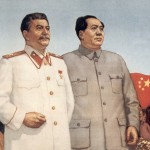
kissinger and mao meet

The honour! Strange History is, as we speak, being hacked by a bunch of Chinese ruffians. If the fairies and mermaids disappear under a swelter of fake Tiffany bags you’ll know why. To celebrate this epoch-making event Beachcombing thought that he would bring China centre stage and also throw Kissinger into the mix.

It is 1973 and Kissinger has passed over to see that great friend of the United States, Mao Zedong, a man who has the dubious honour of having been responsible for more deaths than any other individual in history.

Beach recently re-imagined a famous encounter between Finnish democrats and Molotov before the Winter War and he hopes soon to be a very small fly on the wall at an encounter between Churchill, Roosevelt and Stalin. Why? Because diplomacy rocks. It throws up important people who really don’t know how to act appropriately in each other’s company, and as there are translators and secretaries in the room their idiocies go on record.

Anyway, Mao and Kissinger are sitting face to face: a serial-killing peasant from Hunan province squares off against the svelte, metropolitan Henry, a Bavarian Jew whose family just got out of the Reich in time and who wrote his doctorate on ‘Peace, Legitimacy and the Equilibrium: A Study of Statesmanship of Castlereagh and Metternich’.

Beachcombing is not sure that Castlereagh and Metternich can prepare anyone for the rigours of the psychopathic side of Marxism, but HK certainly tried his best.

By all accounts the two got on surprisingly well and smoked cigars into the small hours. It was sometime in the miasma of burnt Havana that Mao brought up the question of women: ‘You know, China is a very poor country. We don’t have much. What we have in excess is women. So if you want them we can give a few of those to you, some tens of thousands.’

Beach has a small file of men being offered women on their travels: perhaps he should try this with the hackers? But here the normal, give- me-your-sister-and-I’ll-give-you-a-camel is really being institutionalized: memories of an early Soviet’s attempt to nationalize the fairer sex.

Mao, in any case, realized he wasn’t getting anywhere and upped the offer to ten million. Was he joking? With Mao you never know but Kissinger thanked him saying ‘It is such a novel proposition. We will have to study it’! For the record Beach bets HK’s hands were sweating as he said that.

Of course, the irony is that today China has a gender imbalance like few others in history: 119 boys were born two years ago for every 100 girls. All that pent up energy and aggression with nowhere to go: it’s terrifying and will lead to world wars and downed history blogs.

Any other curious diplomatic encounters? drbeachcombing AT yahoo DOT com

The Nanjing Belt July 9, 2011

Posted by Beachcombing in : Ancient, Contemporary

Beachcombing always comes to China with a certain trepidation. After all, he doesn't have much Mandarin (i.e. absolutely zilch), he has an embarrassingly modest knowledge of Chinese historiography and yet he must admit to having nothing but fascination for the exotic flowers that grow in the swamps of the Chinese past – recent oriental posts have included manned kite flight and (alleged) Roman legionaries in ancient China. The danger, of course, is that the sirens pull you into the mud and before you know it the water’s pouring over the top of your Wellington boots. And how much worse that water feels when ‘China’ combines with another unknown like, say, ‘metallurgy’. Welcome, please, oh reader, the Nanjing Belt.

Beachcombing will quickly get the routine details out of the way. The Nanjing Belt was discovered in a tomb in 1952 around a skeleton. The tomb and the body dated to the Jin Dynasty that brings us back to the early centuries A.D (265-420) and luckily the name of the occupant was established through an inscription. He was one Zhou Chou (obit 297) who died fighting, of all people, the Tibetans.

So far so easy: belts and even britches are common in graves around the world from the mysterious dragon buckles of Late Roman mercenaries to the ceremonial belts of the Lords of the Maya. In fact, the problems only really began when the boffins got the belt off Zhou and back into a laboratory.

The belt included ‘about’ (?) twenty pieces of metal – which had presumably been attached to the now rotted leather – and four of these were made of almost pure aluminium. Aluminium it will be remembered does not appear alone in nature. It took Europeans till the early nineteenth century to understand how to isolate this useful substance and even then the aluminium that issued was far from pure.

Chinese historians were, understandably, bemused and something of a civil war broke out, not helped by the fact that the Cultural Revolution was on the horizon. If there was a resolution though before Mao’s guillotine came down it was that four pieces were, indeed, aluminium. The problem then was not metallurgical but rather archaeological: were they Jin Dynasty relics or had they been placed in the tomb in the nineteenth or twentieth centuries? If genuine, it goes without saying that you would need a merchant cash advance and possibly your life savings multiplied by three to get a sniff at these objects in an auction house.

This question was taken up in the west by three scholars – Butler, Glidewell and Pritchard – at St Andrew’s University who looked at the question in  ‘Aluminium Objects from a Jin Dynasty Tomb – Can They Be Authentic?’ Interdisciplinary Science Reviews 11 (1986), 88-94.

The abstract sums up their work nicely:

Pieces of aluminium, supposedly parts of a set of belt ornaments, were found in a Jin dynasty (AD 265–420) tomb during excavations in the 1950s. The authenticity of these finds was questioned at the time in view of the technology required to isolate aluminium from its ore. In this review the archaeological and analytical evidence is reconsidered, but the matter remains unsettled, as it is known, from experimental evidence, that aluminium alloys can be prepared by the carbon reduction of alumina. Examination of the thermodynamic data for this process in terms of Ellingham diagrams demonstrates unequivocally that the temperature required for this process is greatly in excess of that possible with Jin dynasty technology, and so the finds cannot be authentic. However, it is quite possible that metallic objects containing small quantities of aluminium could have been produced in China at that time. The review ends with some speculation on how the pieces of aluminium came to be in the tomb.

Beachcombing need only add that the three end by suggesting that the aluminium had been included with the other belt fragments as a practical joke at the time of excavation, but that the joke got out of hand: memories of Anglo-Saxon Attitudes.

It is a reasonable solution and 'Butler, Glidewell and Pritchard, 1986' is now the conventional answer to the problem of the Nanjing Belt in west and east.

Beachcombing is a natural sceptic where aluminium before its time is on offer. But he is left slightly cold by the methodology in the St Andrews article. After all, the authors seem to go backwards, proving first that something cannot have been done... Still unless there is a way to prove the age of aluminium in the laboratory perhaps they had no other way to approach the problem.

Beach will round off with William R. Corliss on the belt in 2003 for Corliss introduces one later Chinese attempt to explain the belt as a genuine artifact (249):  ‘Assuming no hoax, it would appear that the Chinese had somehow isolated aluminum from its ores 1,500 years before the Europeans. Much has been made of the so-called Nanjing belt. No vague tale from antiquity, the tomb and belt were thoroughly studied by modern archaeologist and chemists. The latter vouched for the existence of aluminum. A hoax was deemed highly improbable. Where, then, did the aluminum come from? Two possibilities seem in play: (1) The Chinese metallurgists of the Jin Dynasty, who had high temperature furnaces, accidentally hit upon one of several ways to chemically win aluminum from one of its several ones. (2) Contradicting the encyclopaedias [i.e. aluminium not found in an isolated form], Chinese geologists reported in 1985 that they had found grains of native aluminum in Guizhou Province. Could the Jin Dynasty metallurgists have collected enough of these grains to make the aluminum sections of the Nanjing belt? Did they hammer the grains together or perhaps melt them. The melting point of pure aluminum is only 1220 f. This temperature might not been out of reach 1,500 years ago.’

Beachcombing is always on the look out for wrong time objects: drbeachcombing AT yahoo DOT com

***

12 July 2011: Marcy writes in to say, 'If temperatures of only 1220 F are required to extract aluminum from soil, then the Chinese should be ruling the world.   Their porcelains have been fired to temperatures well over 2500 F for millenia.  The "standard" among American potters is currently (2011) called 'cone 6'.   Cone six is attained between 2230 and 2250 Fahrenheit.  Even in the USA some dedicated potters fire to cone 10 and cone 13.   That covers 2380 to 2455 Fahrenheit.  There must be a strong interaction between pottery and metallurgy.' Thanks Marcy!

Marco Polo Meets a Dragon? May 30, 2011

Posted by Beachcombing in : Medieval

Beachcombing still mouse hunting so a brief and curious passage in Marco Polo 2, 40. It is an extract that scholars – depending on their proclivities – try and ignore or enjoy overly.

Leaving the city of Yachi, and traveling ten days into a westerly direction, you reach the Province of Carajan [modern Yunnan on the edge of Burma] which is also the name of its chief city…Here are seen huge serpents, ten paces in length, and ten spans in the girt of the body. At the fore-part, near the head, they have two short legs, having three claws like those of a tiger, with eyes larger than a fourpenny loaf (pane da quattro denari) and very glaring. The jaws are wide enough to swallow a man, the teeth are large and sharp, and their whole appearance is so formidable, that neither man, nor any kind of animal, can approach them without terror. Others are met with of a smaller size, being eight, six, or five paces long; and the following method is used for taking them. In the day-time, by reason of the great heat, they lurk in caverns, from whence, at night, they issue to seek their food, and whatever beast they meet with and can lay hold of, whether tiger, wolf, or any other, they devour; after which they drag themselves towards some lake, spring of water, or river, in order to drink. By their motion in this way along the shore, and their vast weight, they make a deep impression, as if a heavy beam had been drawn along the sands.

What is being described here? Three explanations have been offered up over the years. (i) Marco Polo has stumbled on an Asian crocodile. (ii) Marco Polo is repeating and treating over seriously folklore descriptions of a flightless Chinese dragon. MP’s account continues. (iii) We are dealing with another animal unknown to science.

Those whose employment it is to hunt them observe the track by which they are most frequently accustomed to go, and fix into the ground several pieces of wood, armed with sharp iron spikes, which they cover with the sand in such a manner as not to be perceptible. When therefore the animals make their way towards the places they usually haunt, they are wounded by these instruments, and speedily killed. The crows, as soon as they perceive them to be dead, set up their scream; and this serves as a signal to the hunters, who advance to the spot, and proceed to separate the skin from the flesh, taking care immediately to secure the gall, which is most highly esteemed in medicine. In cases of the bite of a mad dog, a pennyweight of it, dissolved in wine, is administered. It is also useful in accelerating parturition, when the labour pains of women have come on. A small quantity of it being applied to carbuncles, pustules, or other eruptions on the body, they are presently dispersed; and it is efficacious in many other complaints. The flesh also of the animal is sold at a dear rate, being thought to have a higher flavour than other kinds of meat, and by all persons it is esteemed a delicacy.

So what is being described here? Beachcombing who can always be trusted to plump for the most tedious explanation would say the crocodile . He was convinced by MP’s great translator and commentator Yule: ‘It cannot be doubted that Marco’s serpents here are crocodiles, in spite of his strange mistakes about their having only two feet and one claw on each, and his imperfect knowledge of their aquatic habits. He may have seen only a mutilated specimen. But there is no mistaking the hideous ferocity of the countenance, and the ‘eyes bigger than a fourpenny loaf’, as Ramusio has it. Though the actual eye of the crocodile does not bear this comparison, the prominent orbits do, especially in the case of the Ghariydl of the Ganges, and form one of the most repulsive features of the reptile’s physiognomy. In fact, its presence on the surface of an Indian river is often recognisable only by three dark knobs rising above the surface, viz. the snout and the two orbits. And there is some foundation for what our author says of the animal’s habits, for the crocodile does sometimes frequent holes at a distance from water, of which a striking instance is within my own recollection (in which the deep furrowed track also was a notable circumstance). The Cochin Chinese are very fond of crocodile’s flesh, and there is or was a regular export of this dainty for their use from Kamboja… Matthioli says the gall of the crocodile surpasses all medicines for the removal of pustules and the like from the eyes. Vincent of Beauvais mentions the same, besides many other medical uses of the reptile’s carcass, including a very unsavoury cosmetic.’

Any other ideas? drbeachcombing AT yahoo DOT com

***

31 May 2011: John states – ‘I was ready to agree that MP had merely seen crocodiles when I started thinking about how long crocs had been known in the Mediterranean when Polo took his trip to China. Because if Polo were at least somewhat aware of the possibility of the existence of an animal like the crocodile, he most likely would have called it that had he seen it, even for the first time. Which means that the beast he describes in his book must be something else. The ancient Egyptians of course had the crocodile-headed god Sobek. The Greeks, who were aware of Sobek, whom they called ‘Suchos’, would have been quite familiar with the Nile crocodile by the time Alexandria was started up about 331 B.C.E. After all, ‘crocodile’ is derived from the Ancient Greek ‘κροκόδιλος’ (krokodilos). (I am told this, but I must take it on faith, as I am entirely innocent of ancient Greek, or any Greek for that matter.) So it is almost certain that Europe would have known of crocodiles at least  by Alexander’s death; and possibly some 1,500 years earlier, when the Aegean ‘Sea Peoples’ terrorized even the great Ramesses during centuries of regular raiding and conquest of coastal provinces putatively ruled by Egypt. Knowledge of crocodiles crossed to Italy soon after, because ancient Romans had depictions of them all over the place, in addition to slaughtering them at the Colosseum. At least one 3rd-century C.E. Romain legionnaire made a wizard suit of armor from a crocodile’s robust skin, helmet included. Emperor Hadrian apparently loved the vicious reptiles, placing a life-sized marble statue of a crocodile at his villa at Tivoli around 125 C.E. He also included an impression of a Nile crocodile on various denominations of his coins from Roman Egypt about 130 C.E. And then there is the famous mosaic in which a crocodile stalks ducks in a marsh, from the ‘House of the Faun’ in Pompeii, which was inundated with ash and volcanic muck in the huge eruption of Vesuvius in 79 C.E. So I’m guessing that the merchant class of Venice in the 13th- and 14th-centuries C.E. probably knew what a crocodile was. Which leads us to ask, ‘What then did Polo see?’ Well, what about fossils of plesiosaurus-like dinosaurs? At least three-phalanged versions. Or even fossils of land dinosaurs, with some reconfiguration, some missing parts or good imagination. While I think Marco traveled most of the places he says, I suspect he may have gilded the travelogue somewhat. I think as well that he may have passed off as first-hand observations a good many second- and third-hand stories, as well as legends he was told were factual accounts. So I can easily imagine a wide-eyed Polo being shown a fossil from the imperial collection, in excellent condition and wonderfully prepared to reveal the skeleton of a massive and terrifying monster, lying fully extended in the rock as if laid out for respectful burial. And I can imagine a very impressed Polo accepting without question the legends and stories he was told about a monster whose skeleton he was actually beholding at that moment. I myself would find it hard to dismiss what I heard under those conditions. Polo I think would hardly feel he was fibbing to pass on the stories as if had himself observed the living beast, or a recently-killed carcass. Of course his Cathay hosts wouldn’t steer him wrong about what the beast did in life!’ As to KMH he writes: ‘The value of Marco Polo’s account  depends on how reliable he is generally thought to be (not perfect, as I seem to recall). Normally it takes supporting observations to get a handle on single witness accounts.  Is there any evidence that he had ever seen a crocodile or alligator before the alleged dragon?  If not, then what he saw could have been very large crocodiles, especially if the natives had never seen  crocodiles. Assuming the dragon as described could be an extinct kind of reptile, a clue may be the description of the dragon as serpents with two small front legs. As it happens, dragons may come with four, two or no legs, as the two legged dragon article in Wikipedia explains. As dragon varieties tend to be specific to geography and culture, and probably highly territorial, there is little or no hope for pinning down the variety without further data. So, my verdict is the account isn’t sufficient to make a conclusion.’ Finally Jerry Maguire writes in with a more general cultural reference: ‘I’m a fan of the crocodile explanation – though I recognise that there are some difficulties. However, just want to signal the fact that there are lots of creationist sites on the net with pages and pages of comments about surviving dinasours where not one post mentions that creature!’ Thanks John, KMH and Jerry!!!!

Page 1 of 212