jump to navigation

Cellini and the Salamander May 26, 2012

Posted by Beachcombing in : Medieval, Modern

***Dedicated to Michael F who sent this in***

We last saw Benvenuto Cellini (obit 1571) imprinted on a French/Spanish/Scottish canon. Fourteen months on, here is a little doodle from Cellini’s infancy, judging by his autobiography the happiest years of his chaotic life.

When I was about five years old [c. 1505] my father happened to be in a basement-chamber of our house [in Florence], where they had been working, and where a good fire of oak-logs was still burning; he had an instrument in his hand and was playing and singing alone before the fire. The weather was very cold. Happening to look into the fire he spied in the middle of those most burning flames a little creature like a lizard, that was sporting in the core of intensest coals. Becoming instantly aware of what the thing was, he had my sister and me called, and pointing it out to us children, gave me a great box on the ears which caused me to howl and weep with all my might. Then he pacified me good-humouredly and spoke as follows. ‘My dear little boy, I am not striking you for any wrong that you have done, but only to make you remember that that lizard which you see in the fire is a salamander, a creature which has never been seen by anyone of whom we have credible information.’ So saying he kissed me and gave me some pieces of money.

Innella età di cinque anni in circa, essendo mio padre in una nostra celletta, innella quale si era fatto bucato ed era rimasto un buon fuoco di querciuoli, Giovanni con una viola in braccio sonava e cantava soletto intorno a quel fuoco. Era molto freddo: guardando innel fuoco, accaso vidde in mezzo a quelle piú ardente fiamme uno animaletto come una lucertola, il quale si gioiva in quelle piú vigorose fiamme. Subito avedutosi di quel che gli era, fece chiamare la mia sorella e me, e mostratolo a noi bambini, a me diede una gran ceffata, per la quali io molto dirottamente mi missi a piagnere. Lui piacevolmente rachetatomi, mi disse cosí: – Figliolin mio caro, io non ti do per male che tu abbia fatto, ma solo perché tu ti ricordi che quella lucertola che tu vedi innel fuoco, si è una salamandra, quali non s’è veduta mai piú per altri, di chi ci sia notizia vera – e cosí mi baciò e mi dette certi quattrini.

It is a cute story and one with perhaps special significance for our author. Cellini, after all, would become famous through fire, he was first and foremost a goldsmith: was this creature even his totem? As to the identity of the salamander, the renaissance saw growing belief in elementals and salamandre were the spirits of flame. Almost as curious is the strange parental technique of causing pain to induce pleasant memories.

Any other historical pre-theosophy reports of salamanders: drbeachcombing AT yahoo DOT com

Pyramids in Italy April 29, 2012

Posted by Beachcombing in : Ancient

The pyramids of the Etruscan king Porsenna (fl c. 500 BC) are one of the great mysteries of antiquity. What does this passage ‘mean’? What did they really look like (try and visualise them)? Where were they? Hell, did they ever really exist?

[Porsenna] was buried below the city of Clusium in the place where he had built a square monument of dressed stones. Each side was three hundred feet in length and fifty in height, and beneath the base there was an inextricable labyrinth, into which, if any-body entered without a clue of thread, he could never discover his way out. Above this square building there stand five pyramids, one at each corner and one in the centre, seventy-five feet broad at the base and one hundred and fifty feet high. These pyramids so taper in shape that upon the top of all of them together there is supported a brazen globe, and upon that again a petasus from which bells are suspended by chains. These make a tinkling sound when blown about by the wind, as was done in bygone times at Dodona. Upon this globe there are four more pyramids, each a hundred feet in height, and above them is a platform on which are five more pyramids.

Sepultus sub urbe Clusio, in quo loco monimentum reliquit lapide quadrato quadratum, singula latera pedum tricenum, alta quinquagenum. in qua basi quadrata intus labyrinthum inextricabile, quo si quis introierit sine glomere lini, exitum invenire nequeat. Supra id quadratum pyramides stant quinque, quattuor in angulis et in medio una, imae latae pedum quinum septuagenum, altae centenum quinquagenum, ita fastigatae, ut in summo orbis aeneus et petasus unus omnibus sit inpositus, ex quo pendeant exapta catenis tintinabula, quae vento agitata longe sonitus referant, ut Dodonae olim factum.Supra quem orbem quattuor pyramides insuper singulae stant altae pedum centenum. supra quas uno solo quinque pyramides.

This text appears in Pliny (obit 79: NH 36) who claims that he is quoting here Marcus Varro (obit 27 BC) perhaps his Antiquitates rerum humanarum et divinarum, a lost work. Where Varro got it from is anyone’s guess. Talk of ‘Etruscan sources’ among Classicists seems optimistic, but this is the first century B.C.: so it is perhaps just possible.

Chiusi (Clusium of the ancients) has been excavated and there is absolutely no sign of what must have been – again granting that it once existed – an architectural monstrosity. The closest is what is sometimes called Porsenna’s Labyrinth, a series of tunnels under the city whose purpose is still not understood: several other Etruscan cities including Perugia have similar subterranean passages.

Twentieth-century digs at Chiusi have made Varro into a liar or more probably a naïf. But budding Indiana Jones are unwilling to give up such fabulous material and have decided that perhaps there was more than one Clusium. There has even been a mini Atlantis style hunt with archaeologists and desperados identifying other possible locations up and down the peninsula. A present favourite is the hill of or around Florence. Any other locations: drbeachcombing AT yahoo DOT com

Oh and Beach cannot leave this without quoting von Humboldt on Porsenna

‘The story formerly current in Germany, and reported on the testimony of Father Angelo Cortenovis, that the tomb described by Varro of the hero of Clusium, Lars Porsena, ornamented with a bronze bat and bronze pendant chains, was an apparatus for collecting atmospherical electricity, or for conducting lightning (as were also, according to Miehaelis, the metal points on Solomon’s temple), was related at a time when men were inclined to attribute to the ancients the remains of a supernaturally-revealed primitive knowledge of physics, which was; however, soon again obscured.’

The Gospel of the Witches: Missing or Faked? April 6, 2012

Posted by Beachcombing in : Modern

Beach is not waving but drowning in the flood of work, but the summer is coming closer and – oh wonderful – closer. Soon he’ll be able to settle down to four months of light teaching and heavy research. Most of the cherry-blossom time will be given over to fairies. However, Beach has also been sniffing around the books of one Charles Leland (obit 1903). Leland, for those who have not heard of him, was an American who spent several years in Florence towards the end of his life. His writings ranged from ‘mere’ journalism, to work on the gypsies, to humorous pastiches, to discussions of the legend of Virgil. However, in his last decade he rounded off his scholarship with three works on witchcraft and popular belief in central Italy: these books have given him what immortality he now enjoys.

Leland had as his main source here a Tuscan witch called Maddalena (not her real name). Now the whole question of whether there were any Tuscan witches at this date is a controversial one: there are extremists who argue that there never were Tuscan witches and that even in the ‘burning years’ the trials and the deaths were all the result of hysterical inquisitors. This is going too far but were there really wise old women in late nineteenth-century Tuscany following a pagan religion: and this a generation before Margaret Murray got so delightfully het up about the whole question? Certainly, there is a case to be made that such witches as existed were confidence tricksters and shysters rather than minions of Diana.

Maddalena backed up, though, her claims with references to a book known as the Gospel of the Witches. She first mentioned this book to Leland in 1886 (he claims). But it was only in 1899 that he finally got his hands on a copy (sent by Maddalena) and went ahead and published it. This is Leland’s background to the gospel.

However, [old beliefs] die slowly, and even yet there are old people in the Romagna of the North who know the Etruscan names of the Twelve Gods, and invocations to Bacchus, Jupiter, and Venus, Mercury, and the Lares or ancestral spirits, and in the cities are women who prepare strange amulets, over which they mutter spells, all known in the old Roman time, and who can astonish even the learned by their legends of Latin gods, mingled with lore which may be found in Cato or Theocritus. With one of these [Maddalena] I became intimately acquainted in 1886, and have ever since employed her specially to collect among her sisters of the hidden spell in many places all the traditions of the olden time known to them. It is true that I have drawn from other sources, but this woman by long practice has perfectly learned what few understand, or just what I want, and how to extract it from those of her kind. Among other strange relics, she succeeded, after many years, in obtaining the following ‘Gospel’, which I have in her handwriting… I do not know definitely whether my informant derived a part of these traditions from written sources or oral narration, but believe it was chiefly the latter. However, there are a few wizards who copy or preserve documents relative to their art. I have not seen my collector since the ‘Gospel’ was sent to me. I hope at some future time to be better informed.

The key question, of course, is: did this book exist or was it just a product of Leland’s imagination? Leland himself admitted in his work to being ‘bitter’ at the lack of interest in his previous works on witchcraft: perhaps the Gospel was an attempt to convince scholars? However, if the manuscript did not exist then Leland made a very good job of pretending that it did. He translated much of it in his Aradia or the Gospel of the Witches. He also included the Italian in some cases. Unfortunately, the manuscript itself does not survive: if it could be found in an archive it would be the Holy Grail of modern Wicca-types who derive many of their ceremonies from Aradia and who get a little irate when scholars dismiss it out of hand.

Of course, even if the manuscript was dug up there would be another question: was it a genuine object handed down from hand to hand, or one created by Maddalena to sell to her American patsy? It is here that Beachcombing would have suspicions. Maddalena was no illiterate. Elsewhere Leland writes ‘Maddalena has written me her self about 200 pages of this folk-lore incantations and stories. It is a good thing that she likes to collect and write.’ In a later letter he writes that he paid her five francs a week for collecting. Not bad money for the 1890s. Then as Leland himself writes above: ‘this woman by long practice has perfectly learned what few understand, or just what I want’. It would be a curiosity if one of the pillars of modern Wicca was built on the creativity of a Tuscan cardsharp: the manuscript remember was in her handwriting.

Any other perspectives on the lost (or never existing) Gospel of the Witches: drbeachcombing AT yahoo DOT com

Escaped Lions March 22, 2012

Posted by Beachcombing in : Contemporary, Medieval, Modern

***Dedicated to Andy the Mad Monk***

Lions are striking animals and it is only natural that, through the ages, zoos and circuses have kept them to impress their clientele. They are also hardy creatures that makes them easier to keep alive than, say, the giraffe or a rhino. But they are dangerous and if they should escape…

Beachcombing has tracked down several, the-lion-that-got-away stories. A recent one, for example, was sent in by Andy the Mad Monk. In 1816 a lion escaped from Ballard’s travelling menagerie in Britain and attacked the night mail service from London to Exeter, Quicksilver, jumping at the horses. Imagine the fear and surprise of the bleary-eyed riders as a lion sprang from out of the nearby oaks.

The beast had been stalking the mail coach for a short while before the attack – and the driver had initially mistaken it for a calf. When the carriage pulled into its scheduled stop at the Winterslow Hut, the lioness pounced and attacked one of the four horses named Pomegranate. The passengers stormed into the inn and locked themselves inside, shutting out the mail coach guard, Joseph Pike. Pike reached for his blunderbuss gun but was persuaded not to shoot the expensive lion by the menagerie owner who came rushing up to the scene.

About six centuries before this, in early Renaissance Florence (thirteenth century), a lion got away from its keeper and ran through the streets of the city. The lion was one of the city’s symbols so Florentine were used to seeing stone versions of the beast at every turn. But to have been confronted with the real thing trotting through Piazza della Signoria must have been terrifying!  

At the time of the people in Florence, a very handsome and strong lion was presented to the commune and was placed in a cage in the Piazza San Giovanni. Because of the keeper’s negligence, the lion escaped and ran through the streets terrifying the city. When it arrived at Orto San Michele [today Orsanmichele], it caught hold of a boy and held him between its paws. The mother, who had no other children and had been pregnant with this one when the father died, ran shrieking and disheveled up to the lion and snatched the boy from its paws. The lion hurt neither mother nor child, but simply sat quietly and watched the whole affair. It was unclear whether this occurred because of the lion’s noble nature or because fortune had preserved the boy’s life so that he could pursue a vendetta regarding his dead father. He eventually did so, and was called Orlanduccio of the lion of Calfette.

Then from the sublime to the simply ridiculous. This is a warning to all intrepid news-anauts who stumble on nineteenth or twentieth century accounts of escaped lions. The story relates to Felixstowe in Suffolk.

There used to be the boating lake down the bottom half of the park with the monkey island in the middle, with real monkeys on it.  Oh yes, real monkeys.  And the bottom end which then became the dodgem track that was a zoo.  And I always liked the tale, whether it’s true or not I don’t know, but before the war if it was quiet they used to have an old lion, harmless old thing, a bit like Clarence the lion,  well he was like a friendly old lion.  And they used to sometimes get him out of his cage and walk him up the front.  Then phone the papers and say, ‘‘The lion’s escaped!’  Get a bit of publicity from that,’ Dangerous Lion Escaped from Zoo is Recaptured by Brave Keepers’.  It wasn’t quite like that but you got a bit of publicity. 

A reminder of the most famous escaped zoo hoax of all from nineteenth-century New York.

Beachcombing would love to have any other escaped lion stories and he has been disappointed by how few he has been able to gather together: drbeachcombing AT yahoo DOT com

He’ll end just for his own satisfaction with a beautiful lion story from Trieste though none of the bearded ones escaped. That old reprobate James Joyce in his long exile in that city used to go and sit on the bench next to the zoo and listen to the mangy Trieste lions roaring as twilight closed in.

As a young man he had dreamt of his hand on Nora’s bra-strap in Dublin. In senility he listened to felines at dusk in the foothills of the Balkans. So ends all human vanity…

On just the subject a terrible period in the Beachcombing household. Sick relatives, daughter with terrible teeth problems, aupair leaving to tend for ill mother. Please be patient with replies then.

***

27 Mar 2012: Leslie writes in: This instance of an escaped lion only happen a year ago, so it’s not as historical as the other fun instances. But it is still fun (if you can call escaped lion stories fun). It happened in Zanesville Ohio, not far from where I live. This guy owned a private zoo, and someone made a very unfortunate mistake . . . well, long story short there were so many animals that escaped that wildlife expert Jack Hanna said it was like “Noah’s Ark wrecked in Zanesville.” They had to shoot to kill, since Jack Hanna informed them tranquilized lions would only get angry and they are very good hunters in the dark. I found the story from the BBC to make it seem more international. Tacitus from Detritus writes on the same topic:  Zaneville is more or less the Battle of Somme regards escaped wild things.  Happened last year and if I recall rightly the low life owner of this mangey menagerie committed suicide after opening the cages.  Final toll more one sided than day one Somme:  18 tigers, 17 lions, 8 bears, three cougars, two wolves and a baboon who might reasonably be considered the brains of the outfit.  The Zanesville SWAT team got a lot of good stories to tell.’ Invisible has four New York Times archive stories: (1), (2), (3) and (4).  Colleen, meanwhile, is thinking of the tragic figure of Harold Davidson. As she points out it is not an escaped lion story as such but a lion features prominently. Davidson had been sacked as a vicar for supposed dalliances with prostitutes. In his attempts to clear his name he went to eccentric ends. ‘For the summer season in 1937 Davidson worked at Thompsons’ Amusement Park in Skegness, where he was billed as “A modern Daniel in a lion’s den”. He would enter a cage with a lion called Freddie and a lioness called Toto, and talk for about ten minutes about the injustice he felt had been meted out to him. On 28 July, he was moving through his act when he accidentally tripped on the tail of the lioness. Presumably perceiving this as an attack, Freddie the lion attacked and mauled him. Renee Somer, the 16-year-old lion attendant, entered the cage and fought the lion back using a 3 ft whip and an iron bar. Davidson was taken to Skegness Cottage Hospital with a neck injury and broken collar-bone and lacerations on his upper body. The lion had mauled him at the neck leaving a gash behind his left ear.’ Thanks Invisible, Colleen, Tacitus and Leslie!!

26/4/2012: Barry H writes in. As always with genealogical story Beach has carefully stored Barry’s email away and will be very happy to pass on any correspondence: This is an old family story, and it revolves around my great-grandfather who lived in the US, he was a wagonmaster at some point in his life; I know little else about him, his name was Mark Lilibridge Homan (b 1860 - d 1937). I’ll tell the story briefly, but remember that this could be a tall-tale that gets passed down through generations, and the facts get distorted along the way – I’ve tried researching the history, using the net, hoped to find some old, scratchy newspaper-accounts; but so far, I’ve had no luck in verifying any part of this tale. So goes the story, told to me by my father: Mark Homan was attending a travelling circus, this would probably have been somewhere in the American southwest, possibly California. At the time, he was presumably still a young man and in his prime, with his wits about him and courage to match. Mark was sitting up in the bleachers, under the circus tent, enjoying the show with many other patrons. When the lion act came on, a disaster happened: a lion escaped right in the middle of the act, was on free-foot and scowling at the fear-stricken crowd, calculating its next move. The crowd panicked, everyone jumped up and scurried up the bleachers, jumping off the backside, trying to escape from the tent. My great-grandfather, however, kept his head. He stood up and moved down the bleachers, jostling his way through the panicked mob, heading towards the lion. The lion hadn’t attacked anyone yet, it was probably a little confused by the sudden change in events. Great-granddad bustled his way towards the lion, the whole time fumbling with the buttons of his overcoat, until he finally managed to reach inside his coat and pull out his piece – have gun will travel, as the tradition was in those days. Mark Homan stepped up until he was quite close to the lion, as close as comfort would allow; with a steady hand, he levelled his gun, took aim, and fired. Dead on, he hit the lion right between the eyes, first shot - I know, it sounds like a line from a Rudyard Kipling book, but that’s how the story goes: disaster averted, beast slain, peace restored and my great-grandfather a hero, presumably. Mark Lilibridge Homan was laid to rest in a small cemetery in Phoenix, Arizona, in an unmarked grave. If I ever find concrete verification and proof of his involvement in this event, and should I be able to spare the funds, I may erect a tombstone at his gravesite - with a pictograph of his fearless deed displayed upon it. Tombstone, how apt, because if the story is true, then it was done in the real Wyatt Earp fashion! Thus endeth the tale. If you happen to come upon anything that might be related to this story, I’d love to hear from you. We’ll let you know Barry!

Hitler’s Italian Fantasy Life November 16, 2011

Posted by Beachcombing in : Contemporary

Beachcombing offers today an other example of a historical dream. However, unlike the nightscapes of Leonardo or Augustine, here, instead, is a fantasy from Adolf Hitler.

Now Hitler’s private life is not particularly well known. There are unsubstantiated rumours about his genealogy and his sexual preferences, and his family relations (including a possibly murdered niece). And this lack of knowledge means that we don’t know what Hitler conjured up in his head when he lay back in bed or on the couch between rabble rousing. Until forty the best bet is that he dreamt about power and German troops marching through Paris with Wagner playing on the radio. But once he had achieved that there are hints that he fantasized, instead, about the dolce fare niente to the south of the Alps.

Certainly, in Hitler’s Table Talk, a record of the Fuehrer’s delirious ‘wisdom’ dispensed to his dinner guests in the years in which he led Germany, we hear time and time again about Italy and its beauty.

Part of this stems from Hitler almost homo-erotic love for Mussolini: ‘[a]s I walked with [the Duce] in the gardens of the Villa Borghese, I could easily compare his profile with that of the Roman busts, and I realised he was one of the Caesars’.

But the more important reason for this enthusiasm is the memory of the road not taken: Hitler’s failed life as an artist. Hitler recalls the beauty and wonders of the peninsula, connecting it with his dissipated aesthetic side.  

‘I lived marvelously in Italy. I don’t know any country that enlivens one more. Roman food, how delicious it is!’

Or ‘The Italians have a splendid foundation of peasantry. Once when I was travelling to Florence, I thought, as I passed through it, what a paradise this land of southern France is ! But when I reached Italy – then I realised what a paradise on earth can really be!

And the highest praise for a wannabe Bocklin: ‘From the cultural point of view, we are more closely linked with the Italians than with any other people. The art of Northern Italy is something we have in common with them: nothing but pure Germans’.

Of course, all these mix in with effortless and rather condescending put downs from cold Germany. But the point is that Hitler had a Tonio Kruger thing going and it is apparently here that AH’s heart roamed in his moments of rest. ‘My dearest wish would be to be able to wander about in Italy as an unknown painter.’

The most interesting word in this sentence is ‘unknown’. For Hitler going back to being an artist was not just an escape from politics but an escape from success.

When he had finished shouting at his generals he managed to lie back then and saw himself painting a Gothic church just outside Perugia or Piacenza, while, doubtless the local peasants threaded flowers for his hair or offered him polenta dotted with peppercorns.

Heavy the head that wears the crown…

What is sometimes not appreciated is the extent to which Hitler’s fantasies may have changed the course of the war in Italy. On several occasions, but most notably with the German army’s illogical retreat from Florence, Hitler seemed to have preferred strategic discomfort to the ruin of Italy’s architectural marvels. A shame he and Kesselring didn’t extend the same courtesy to the Italian people…

Beachcombing is now taking not only historical dreams but historical fantasies as well: drbeachcombing AT yahoo DOT com

Buying Up Clarice October 30, 2011

Posted by Beachcombing in : Medieval


Beach hasn’t been able to stop thinking about the Italian Renaissance this past week: blame the genitals of the mad, bad but always interesting Caterina Sforza. And in this difficult time of renaissance obsession one source that has run around and around his head is (Lauro Martinez’ translation of) an extraordinary letter sent by Lucrezia de Medici in the mid-late fifteenth century. Lucrezia is in Rome wife- hunting for her eldest son Lorenzo – he of Savonarola, the ‘Great’, and the Pazzi Conspiracy. If this was a man writing there would be the pulse of sensuality in the description of her prime candidate: Clarice Orsini. As it is Lucrezia’s prose is part Jones (as in ‘keeping up with’) and part meat market. Breakfast in bed and candlelit dinners for two simply don’t figure.

Thursday morning on the way to St Peters, I met my lady, the sister of the cardinal, Maddalena Orsini, with her daughter, who is almost fifteen or sixteen years old. The girl was dressed in the Roman fashion, in a broad wrap of linen, and she seemed to me very beautiful in that outfit, fair and tall. But because she was rather covered up, I couldn’t see her as I would have liked. It happens that yesterday I went to visit the said Monsignor Orsini… and after I had made the requisite avowals in your name, his sister entered with the girl, who this time was wearing a close-fitting skirt without the wrap. We spent quite a while conversing and I really studied the girl, who is, as I’ve said, of an attractive height and fairness and she has a sweet manner – though not as fine as our daughters. But she is all modesty and could soon be made to adopt our ways.

Now honestly is this the mother-in-law that you would like?

She’s not a blonde because you don’t find those in Rome. Her hair tends towards the reddish and there’s a lot of it. The face itself is a bit round but I don’t disapprove; her throat is nice and slender though it strikes me as a bit thin or rather on the delicate side. Her bosom we couldn’t see because the custom here is to go round all bundled up, but the promise is good. She does not walk with her head up proudly, like ours, but somewhat down, and I believe this comes from shyness. She really is very bashful. Her hands are long and slender. So all told we consider that the girl is definitely above average but not as good as our girls. Lorenzo has seen her and if he’s satisfied you’ll be able to tell. I feel that whatever you and he decide will be well done and I will agree to it. It’s in God’s hands.

God’s hands… Lucrezia now gets on down to the grimy business of what really matters: not vital statistics or bearing but dowries made of brick and stone.

The girl is the daughter of the lord Jacopo Orsini of Monte Ritondo and her mother is the cardinal’s sister. She has two brothers. One is bred to arms serving the well esteemed lord Orso, the other a priest and subdeacon to the Pope. They have half of Monte Ritondo; the other half belongs to the uncle, who has two sons and three daughters. In addition to half of Monte Ritondo they have three other castles belonging to her brothers and I gather that they are well settled there and are better off every day because apart from being maternal nephews of the Cardinal, of the archbishop and of the knight, they are also cousins through their father to the aforesaid lords, who love them greatly.

Then in a second letter Lucrezia rounds off the attack on her prey.

As I said to you by letter before we’ve had a close look at the girl. There was no fuss and if the thing [i.e. marriage] doesn’t work out you’ll have lost nothing because nothing was said. The girl has two features. She is tall and fair-skinned and though she doesn’t have a beautiful face, it is not a peasant’s, and she does have a handsome presence.

‘A peasant’s face’… This from the Medici family that only three generations before had been burning charcoal in the Mugello with the rest of the contadini!

Then comes the final insult: the girl’s name is given last, like the dim afterthought that it really is. The ‘misspelling’ is an acceptable variant, but after what has come before it seems to be adding insult to injury.

Find out if Lorenzo likes what he saw, as there are so many other things in her favour, that if he is satisfied we also could be. Her name is Crarice.

And they say arranged marriages were/are often happy.

Perhaps.

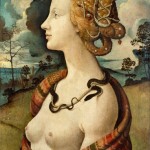
‘Crarice’ spent most of her marriage, Beachcombing always imagines, listening to Lorenzo’s (truly) beautiful lyrics written to women whose name did not begin with ‘c’. Then if this needs any more driving home we are not sure if the Botticelli picture above is really of Clarice or not.

Any other sources for the medieval meat market? Drbeachcombing AT yahoo DOT com

Pietro Montini: A Tribute September 10, 2011

Posted by Beachcombing in : Contemporary, Modern

***This post is dedicated to Pietro and Sami***

First, sincere apologies for not yet getting the comments up this month. Beach has written about 30,000 words on fairies and is still getting over it. Sunday night is his self-imposed deadline and then he’s going to forget the red-capped ones ever existed and think about making our young into better citizens (ahem). Today though by way of interlude he wanted to share the work of an obscure talent, Pietro Montini, obit 1919.

PM was born in 1846 in the little village of Santa Brigida in the Tuscan hills. He was a nano, a ‘dwarf’ and also hunchbacked and coming from a poor background he never learnt to read or write. Apparently he never left Santa Brigida, but lived there as the sacristan, which may not have been much fun.

PM had, however, a pulsating mind and, in his spare time, played at art and had too (so his gravestone claims) a fascination with lenses. Imagine what William Blake would have done if he had been born in Italy in the mid nineteenth-century without an education but with serious health issues and you start to get the picture.

Beachcombing has regrettably not been able to find any of his painting or bronze work – sigh – but his stone sculptures are piled up all over the village, which lies about an hour from Florence. They are, for the most part, over a century old and many have been damaged by the elements, so Beach thought that as a contribution to PM’s memory he would document them before it is too late. In a few cases it already is…

Beach has posted here five that confuse him or that might confuse others. For example, what is the gentlemen at the head of this post: he has a sword, sheaved on his side? ‘A Turk’? A Pacific Islander? Pietro himself in pantomime outfit?

PM borrowed his style from medieval art that he found in his community and the churches round about: though look out for the odd telescope that jarringly creeps in. Indeed, in a couple of instances Beach was not sure if he was looking at the work of a medieval sculptor or PM’s work. In some instances he’s still not sure.

PM’s creations are fabulous things and this is likely the only immortality they will ever know… so enjoy and spread the word, crediting Pietro where possible. They are high resolution: you can click, save and photoshop to your heart’s content.

I salute thee, Brigidino,
I that loved thee since my day began,
Wielder of the stateliest measure
Ever moulded by the hands of man.

Thanks to Sami L-H for the outstanding photos. All explanations or guesses: drbeachcombing AT yahoo DOT com

Is this a monk? A hood and a chalice? At first Beach hoped for a fairy… (it’s been an obsession this past month: he is not to blame).

What animal is this?

Is this a journey to St Peter’s? Notice the ‘medieval’ trains and the vision of Christ (?).

What inspired this? Almonds?

Note the telescope in what appears, at first glance, a twelfth-century sculpture? Is the astronomer sitting on a child’s head? Why?


 ***

10 Sept 2011: Many of you wrote in about the last picture pointing out the obvious flaw in Beach’s description. Here is Mark L: ‘I had an idea looking at the Pietro Montini sculpture of a man with telescope in which you seem to see the subject sitting on a child’s head (despite there being no evidence of a head anywhere in sight.) This though initiates a number of rather ugly and bizarre pictures in one’s imagination as to where that head might be. This appears to me more likely to be a crude ‘lambda’-legged bench topped with a pillow a bit larger than the bench-top’s width.  It lops over the bench-top edge in back and in front and may give the viewer the impression of a child’s shoulders and arms (then again, where are the hands?) If this is some insomniac proto-astronomer examining the heavens at night in a cold tower (and if so, why is the telescope aimed lower than the horizon?) he might well bring along a soft cushion for the bench on which he intends to seat himself, there to spend the long marches of the night.‘ Thanks Mark and apologies Pietro!


Fury and Cannibalism July 5, 2011

Posted by Beachcombing in : Contemporary, Medieval, Modern

Cannibalism for most of us took place on ‘less happy (is)lands’ in less happy times, when neurologically-challenged Pacific folk loped from side to side suffering from Creutzfeldt–Jakob disease. Others might also recall occasional starving humans on boats, in plane wrecks or beseiged cities obliged to eat each other. But cannabilism does not, surely, figure in mainstream western history? Well, in fact, unlikely as this may seem, cannibalism was an occasional guest in renaissance and modern Europe particularly in cases where men-at-arms or rioting crowds lacked anger management training.

Take the death of Princess de Lamballe in 1792 at the hands of the sansculottes in the streets of Paris: the beautiful confidante of Marie Antoinette was butchered on the spot and allegedly her heart was taken and eaten by one rioter.

One of the brigands carried on the end of a pike that head from which hung a mass of blonde hair soaked with blood. He was followed by another, who carried in his hand the bloody heart of the princess while her entrails were twisted around his arm. In this way they passed under the windows of the Duc de Penago, whom they forced to gaze on the mutilated members of his daughter-in-law. From there they proceeded to the Temple, to the royal family. The queen fainted at the horrible sight. All the carriages in the streets were stopped and their occupants compelled to kiss the head of the princess. One monster boasted of having made his dinner on the heart of Madame de Lamballe.

In the wreckage and degradation of the Terror it is difficult to know whether to believe the cannibal details or not. However, a richer seam of cannibal claims appears in the fifteenth-century Italy and here there is no reason to doubt the  excellent sources in which they appear.

In the Pazzi Conspiracy (1478 Florence), for example,  the enemies of the Medici were hurled down from the high windows of Palazzo Vecchio and butchered in the Piazza della Signoria. Machiavelli describes the city square and the nearby streets littered with body parts. But this was not all. Florentine guards were said to have grabbed the dead or dying bodies hurled from the high windows and to have eaten their enemies’ livers raw! Similar stories can be found concerning the plot against Count Riario and concerning the assassination of the Duke of Milan (1476).

If we avoid a couple of German serial killers, twentieth-century examples are more difficult to come by. Beachcombing does though have some records from the Balkans where the special intensity of inter-ethnic conflict led to nibbling at human remains. There is one Yugoslav story that Beachcombing has come across on a number of occasions where a father is tricked by members of the enemy community into eating his own children. Folklore or, God forbid, folk practice?

Then, of course, there are the allegations of cannibalism practised by the Japanese army in the Second World War. A number of these can be explained by desperation and lack of supplies. But there were instances where Allied airmen, particularly, of course, bomber crews, were killed and partially eaten as an act of ‘total war’. The most notorious example of this took place in  the ‘Ogasawara Incident’ in 1944/1945 (in reality a number of incidents) where US flight crews were executed and eaten. The following account from Time is not perhaps entirely neutral: no one though, including the condemnded, denied that parts of American airmen were devoured.

All these examples have in common cases of extreme hatred where killing is not enough. It is necessary also to obliterate and absorb your enemy. Beachcombing is looking for other Western or modern examples of anger cannibalism: drbeachcombing AT yahoo DOT com

***

5 July 2011: Java Man writes in with the story that George Bush senior was almost eaten by senior Japanese officers – ‘a hinge moment?’, writes Java Man: ‘The former President George Bush narrowly escaped being beheaded and eaten by Japanese soldiers when he was shot down over the Pacific in the Second World War, a shocking new history published in America has revealed. The book, Flyboys, is the result of historical detective work by James Bradley, whose father was among the marines later photographed raising the flag over the island of Iwo Jima. Lt George Bush, then a 20-year-old pilot, was among nine airmen who escaped from their planes after being shot down during bombing raids on Chichi Jima, a tiny island 700 miles south of Tokyo, in September 1944 – and was the only one to evade capture by the Japanese. The horrific fate of the other eight ‘flyboys’ was established in subsequent war crimes trials on the island of Guam, but details were sealed in top secret files in Washington to spare their families distress. Mr Bradley has established that they were tortured, beaten and then executed, either by beheading with swords or by multiple stab-wounds from bayonets and sharpened bamboo stakes. Four were then butchered by the island garrison’s surgeons and their livers and meat from their thighs eaten by senior Japanese officers.’ Thanks JM!!

12 July: Tokyobling also has cannibal memories: When thinking about the disgustig topic of cannibalism in modern times, one remembers the photos and reports of the Finno-Soviet war 1940-1945 that were declassified a couple of years ago to much disgust. Reports of field kitchens where Soviet soldiers cooked their fallen comrades, etc, half eaten limbs among starving encircled Soviet bivouacs. This should be readily googleable (spelling?). One also remembers the tales of cannibalism during the Cultural Revolution in China, where bullying and collective cannibalism merged in a disgusting soup. There should be plenty of stuff out there to google, especially the story of the girl who ate parts of her stepfather in order to show her defiance to his capitalist ways. Thanks Tokyobling!

Barbecuing Friars in Late Medieval Florence April 7, 2011

Posted by Beachcombing in : Medieval

Beachcombing promised just the other day that he would leave blood alone for at least a month. He wants then to be very clear that this post will not involve bloodshed. It will describe though one of the last ordeals by fire of the Middle Ages, an attempt to use flames to judge a human argument. What is even more interesting is that it takes place, 7 April 1498, in, of all, places, ‘rational’ Renaissance Florence.

The combatants are two friars. First, there is Domenico da Pescia, representing the Dominicans of San Marco. Second, there is Giuliano Rondinelli a Franciscan from Santa Croce. The Franciscans have offended the honour of that extraordinary late Florentine figure, Savonarola and have asked for the ordeal by fire to see whether God favours Savonarola or not. Domenico has taken up the challenge on behalf of his master.

The city government seeks legal advice and establishes that it need have nothing to do with these priestly shenanigans. But the Florentines are always ready for a spectacle of any sort and so the Signory lend out Piazza della Signoria for the occasion.

Our best source for the preparations, done with typical Florentine thoroughness, is the Florentine diarist Landucci (a Savonarolan): Lauro Martines while not giving a direct translation offers a useful summary.

Made of wooden beams and planks, [the place of the ordeal] was nearly thirty metres long, just over six metres wide, and reached a height of more than two metres. The four sides were enclosed by a low lying wall of green or unbaked brick, not more than a foot high. Logs were stacked along each side, rising to just under a metre in height and running to a length of about twenty-five metres; and the planks between the two stacks of logs were thickly covered with earthy, bricks and rubble to keep the fire away from the beams underneath. Having then put masses of brushwood, cut branches, and bundles of twigs all around the logs, the workers soaked all the wood with oil, pitch and resin, adding gunpowder as well, for a fire that would burn all the more fiercely.

Down the middle of this construction was a passage two feet wide (!) through which the friars would have to pass. Beachcombing has only a GCSE in integrated science and has never been caught in a real fire, bar one very uncomfortable occasion in the Tanzanian bush, but he is guessing that no one would come out of this death trap alive.

What follows is not, however, so much a human barbecue as a comedy of errors – there is not just a lack of blood but also, thankfully, a lack of pain.

For one, the Franciscan, Giuliano, sensibly doesn’t turn up.

Second the Dominican, Domenico is accused of various stratagems for trying to avoid the heat. So he is made to remove a wonderful red cape he is wearing as the Francescans suggest that it is bewitched. They also insist on inspecting his underpants and even his genitals (!!) presumably for further witchery.

Then if this is not enough the Friars indulge in a fabulous argument over whether Domenico should be allowed to carry the sacrament into the fiery passage. The Francescans claim that the Dominicans want to burn Christ. The Dominicans on the other hand believe that though the bread might burn Christ’s essence would remain.

Then it starts to rain… And even the Dominicans with their bewitched cloaks and fire-proof sacraments retreat from the place of battle to jeers from the public and lightning bolts from the heavens.

One of the last ordeals by fire in history never, in fact, takes place.

Beachcombing is tempted to say that the participants were just too sensible to go through with it. But given the genital inspection and the arguments over Christ in the bread he is not sure that this would stand up. 

Beachcombing is building up his very thin folder of European ordeals by fire at or after the end of the Middle Ages. Any contributions would be gratefully received. drbeachcombing AT yahoo DOT com

Cobblers: a UFO in Palazzo Vecchio? March 4, 2011

Posted by Beachcombing in : Medieval

The Madonna col bambino e san Giovannino was painted in a hazy month sometime at the end of the fifteenth century. It hangs today in a corner room on the highest story of Palazzo Vecchio. Its artist – the work is ascribed to Sebastiano Mainardi, Jacopo del Sellaio or one of half a dozen other of that golden generation… – would be happy to know that the picture is still much visited today. Beachcombing never walks into this room without seeing at least a couple of gawping tourists, who often spend ten minutes or more examining details. However, the original artist would be horrified to know why they are pointing. For the viewers are not, for the most part, there to enjoy the brushwork or the baby’s alarmingly impressive torso. Rather they are taking in the UFOs flying around the background of the picture. Beachcombing now, with a wave of his wand, offers some close-ups.

Note, first, the UFO above the right shoulder of the Madonna.

And, if this is not enough to get the Erik von Daniken in you purring, then what about the floating octopi off to the left? Are they – as has been suggested – probes leaving the mother ship?

This picture, in fact, fits neatly into the ultra Christian symbolism of Savonarola’s Florentine republic with which the picture is contemporary. First, the ‘UFO’ in the upper right is a common convention in pictures of the time: a shepherd (seen clearly here on the hill and horizon of the sea) observing cloud-floating angels in the sky, announcing the nativity. True, in this case there is no angel – something that is unusual. But the motif is so common that it cannot be mistaken. Beachcombing would forward any interested reader to the following (excellent) Italian-language site for ‘UFO’ pictures, but includes one here for good measure.

As to the star on top left with three octopus squiggles beneath. These are not Venetians, but a classical medieval symbol for the Madonna with her triple virginity. If this had been painted elsewhere in Italy, it would be antiquarian at this date. But once more the artist was working in the heady theocratic atmosphere of Savonarola’s Florence where reaction and invention, for a while, rubbed along together and where even Botticelli returned to God for a time.

Beachcombing has, in the eight months of writing this blog stayed away from UFOs because they bring out the worst in him. But flicking through various art history books this last weekend he was impressed by just how paltry all the ‘UFO’ references in art are: can anyone come up with a really good, genuine UFO in a Renaissance painting – drbeachcombing AT yahoo DOT com? Or is all we have the detritus of medieval Christian symbolism and some blurs and blots on the canvas?

As he’s now in the mood Beachcombing will leave you with his personal favourite ‘conspiracy’ piece, this remarkable work by Masolino da Panicale. Do we have here an angelic Martian invasion or, well, clouds?

Clue: the picture refers to a ‘miracle of the snow’.

Page 1 of 212