jump to navigation

Image: Princip’s Conscience February 2, 2012

Posted by Beachcombing in : Contemporary

Beach has several things on his conscience. Aged eight he clumsily trod on a frog breaking its back bone; last summer he accidentally killed a baby adder while trying to get it out of the garden; and then there was a very painful split with a girl who deserved better a decade ago, sorry E.

But what would it be like to have the death of people on your conscience? It is a burden that many  carry with them hour by hour, day by day. Beachcombing once had a capable, serious student who  ‘confessed’ that he had been responsible for the death of three passengers in a car and that he had left another passenger, a woman, in life-long paralysis in a hospital bed. Beach cried a little when he killed his juvenile adder: God knows what he would do with something like this haunting him.

But this is, of course, all little league baseball. Let’s get on to a real star who went to bed at night knowing that he was responsible for millions of deaths, millions of amputations and who stood behind the nightmare that men and women were still having as late as the 1990s. Beach refers, of course, to a mass murderer, who makes Hitler look like an ugly sister in a London pantomime: Gavrilo Princip.

The extraordinary thing is that many people don’t even know who GP was: though anyone who has read a book, knows his victim. Well, here is a clarification of sorts. GP was the Serbian patriot who 28 June 1914 shot, in Sarajevo, the Archduke Ferdinand and his delectable wife: Beach always grieves more for Sophie – perhaps because her last act was to throw herself on her husband, or perhaps just for fond memories of Sophie’s Stuttgart.

The events of that day are well worth the bizarrist’s study in their own right. After all, six assassins (!) failed to kill Ferdinand. It was only when the Archduke’s chauffeur took a wrong turn and blundered into the street where GP was despondently walking (with a pistol in his pocket) that the foundations of Europe started shaking.

Princip was nineteen when he set off the most disastrous conflagration in history. If he had been a month older, he would have been eligible for the death penalty and would have been spared the God awful mess he had made. But as it was he was sentenced to twenty years in prison and given a spectator’s seat as the world collectively checked into a mental asylum next door with sharp razors and loaded revolvers hidden away in their strait jackets.

We should say GP’s seat was in the stalls rather than on a balcony. For GP had a pretty miserable time in his cell in what is today the Czech Republic. He contracted TB and had an arm amputated and died in early 1918, just six months before the formerly great powers signed their armistice. One vivid detail not found in Beach’s written source, but there on several web sites (‘so it must be true’) is that he weighed 40 kilos at death. It sounds as if the Austro-Hungarians had decided to execute Princip slowly…

Of course, to call Princip a mass-murderer like Hitler is, in one sense, profoundly unfair. GP should bear moral responsibility for the deaths of two of Europe’s best royals and, on the plus side, he has part responsibility for the subsequent freedom of Serbia.

But GP is  unquestionably at the apex of amoral cause and effect that led to the deaths of tens of millions of combat and civilian deaths in the First World War. That cannot be said of any one individual in the Second World War: not even the moustached Bavarian wolf in his killing lair.

In some way Beach feels towards GP as he feels towards Judas in the gospel accounts: he can’t help thinking that both were ultimately victims.

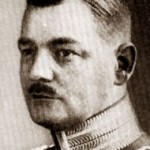
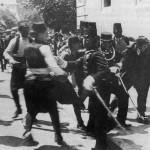
The photograph at the head of this post and the one above of GP being led away then is well worth a minute of meditation. Here we see the seconds immediately after Europe began its plunge into lunacy. In the first photograph Princip, second from right, is being arrested in a scuffle – memory of an earlier arrest post on this blog – and the blood of Sophie and Ferdinand are running through the streets of Sarajevo.

Sometimes in history – if we took on the guise of a time-lord – we could step back and prevent disaster: jog a shooting arm, stuff five dollars into the hand of a starving man or woman, push a pram carrying a particularly obnoxious future ruler into a nearby river. But no such luck here. By the time these photographs were taken it was already (moments) too late.

Beach is always fascinated by hinge moments: drbeachcombing AT yahoo DOT com

***

3 Feb 2012: First up is Ricardo R. who has an objection shared by many readers, his email will hopefully serve for all: I can’t help think that WWI was just something awaiting to happen and to ascertain any kind of blame to the man who puts the last drop in the glass a bit unfair. In a loose link I’m reminded of the infamous “football war” between El Salvador and Honduras (which sprung to my mind yesterday while getting news on the deaths in Egipt, after a football match). Some occasions just work like photographic chemicals, bringing whatever is hidden to the surface and making it visible.’ Beach would agree with all of this. WW1 was going to happen given France and Germany’s attitude to Strasbourg and their recent shared history. But what interested Beach here was the poor dolt who put himself at the apex of ‘cause and effect’. Just because it was going to happen anyway doesn’t make photographs taken moments after any less chilling. Or does it? Then comes RR: ‘These ‘hinge moments’ you mention can only be seen in history’s rear-view mirror, imo.  If only the nexus of crucial human events could be foreseen.  On the other hand, that might not be such a blessing.  Que sera, sera. Your essay’s last paragraph made me think immediately of the short story, The Adjustment Bureau, by Phillip K. Dick.  It is absolutely on point with your wish.  The film of that work with Matt Damon is very much worth viewing.  If you have not seen it, the entire film is about hinge moments for an individual, Damon, and how/why those moments occur.   My distaste for most of Hollywood’s offerings is immense, but this movie overcame it.  For a short while.  90 minutes, perhaps.’ Then Adrian Sterling of Anomalist fame writes in: ‘If you’re interested in hingepoints of history, check out a little card game by Looney Labs called Chrononautshttp://store.looneylabs.com/Chrononauts. You have a timeline (it’s a touch provincial, sad to say) going from the Lincoln Assassination up to the David Koresh/Waco disaster. Among these is the assassination of Archduke Ferdinand. There are three ways to win. Collect 3 artifacts on your mission, make the timeline fit your home timeline or have 10 cards in your hand at the end of your turn. You get your timeline by flipping over history cards, creating paradoxes then patching them up. For example Archduke Ferdinand was just wounded instead of killed which changes other points of the timeline. Not to mention the superparadox where nuclear war happens in 1963 meaning the timeline beyond that is completely unchangeable. If you’re playing a cockroach or space alien chrononaut you usually want that to happen. It’s a cool history game and a nice way to get kids interested in history.’  Thanks Ricardo, RR and Adrian!

5 Feb 2012: Mikulpepper is shouting cobblers and he may be justified. ‘That picture got me going on a sort of stream-of-consciousness googlefest (stream-of-search?). Anyway, some folks doubt that the photo actually shows Princip’s arrest. One site goes so far as to identify the arrestee as one Ferdinand Ber, a friend of Princip’s. But that site loses because it cites Princip’s Sandwich, an apparent urban legend that is dissected here. That mythic sandwich is now the subject of art and a sign that, perhaps coincident with the passing of anyone who can remember this event, it has become Legend. Princip’s Remorse? Probably non-existent in fact, but a worthy subject for Myth.’ Thanks Mikulpepper!

12 Feb 2012: Invisible writes in with this link to the unlucky car. Thanks Invisible!

30/April/2012: Adrian Sterling of Anomalist fame writes: Back in February you mused upon the fate of Gavrilo Princip. Today I saw this article. “Curveball” was asked if his lies started a war that killed many, he simply answered “yes”. Anyway I saw a weird correspondence there. It’s unfortunate that “Curveball” avoided a similar fate as Gavrilo.’ Thanks Adrian!


Napoleon in a Pot January 16, 2012

Posted by Beachcombing in : Modern

***Dedicated to Mike G***

Anyone who love history has a little black list of people they would have gladly have seen choked at birth: Hitler, Ida Amin, Verdi…

Fairly close to the top of Beachcombing’s is that jumped-up world destroyer Napoleon Bonaparte, a man who ‘could by industrious valour climb/ To ruin the work of time/ And cast the Kingdoms old/ Into another mould’.

How nice it would have been if the zeitgeist on horseback had fallen down a hole in the Corsican badlands or trod on a rusty nail and got blood poisoning in his late teens…

Beachcombing has fantasized about these thing for years and imagines the survival of Moscow, the endurance of the Venetian Republic, not to mention an unmutilated Spain. But, in fact, you do not have to thrash desperately about for unlikely childhood accidents.  There was one moment early on in Old Boney’s life when everything could have changed and, indeed, almost did.

In 1784 and 1785 the great French explorer Jean-François de Galaup La Pérouse prepared an expedition that would make him famous (and dead). The expedition began in August 1785 and took La Pérouse’s two boats across the Pacific zig zagging till they reached Samoa, where eleven of the crew were eaten by the locals in 1787. By January 1788 La Pérouse was in Australia, then in March he sailed off and neither he nor any of his crew were ever seen again.It was not until 1828 that the wreck of La Pérouse’s expedition was found at Vanikoro in the New Hebrides. The depredations of the sea and the islanders unquenchable appetite for European flesh (by all accounts a wonderful thing) had done for them all.

Now what has this to do with Napoleon?

Well, apparently Napoleon applied to go on this voyage, was shortlisted as assistant astronomer (!) and then, finally turned down.

Beachcombing imagines: Napoleon in a pot. Better than 6000 British dead at Waterloo and toothache on St Helena.

Which all leads to a question. Today is the last day of relative freedom and Beachcombing has before term begins and he not been able to spend all the time he would have liked on this. But is Napoleon’s application a sure-fire thing? Or is this a bit of French cobblers? Drbeachcombing AT yahoo DOT com The few obvious sources that Beach looked at seem to neglect this marvelous story and that, in itself, is suspicious.

And the news links: it has been a while. Thank to all contributors.

Israel Saved by the Soviets in 1973? January 13, 2012

Posted by Beachcombing in : Contemporary

In 1948, 1967 and 1973 Israel fought wars that could conceivably have seen the destruction not only of the Israeli state but also of the Jewish community in Palestine. None of these wars came closer to Arab success than the last, the Yom Kippur war. Egypt and Syria (with Iraqi backing) managed to achieve almost complete surprise and broke through the Israeli lines on Suez and almost broke the Israeli lines in the north on the Golan Heights.

What is remarkable looking back is what a close run thing Yom Kippur war was not only in military but also in intelligence terms. The Egyptians and Syrians had taken for granted that news of their attack would get through to Israel’s extraordinary intelligence agencies: either Mossad or AMAN. In fact, they believed that Israel’s cabinet would know of the attack at least five days before it began.

This seems to have been a reasonable assumption. The higher echelons of the Syrian and Egyptian government knew of the decision in September: a month before October 6th. The Commanders of the Egyptian army on Suez knew from 1st October, Egyptian divisional commanders were told on the 3rd and battalion commanders on the 5th. The Soviet Union was warned on October 3rd and there are reasons for thinking that Soviet advisors on the ground must have known (or been able to guess) at least a day or two before that. (Beachcombing remembers earlier discussions of how many people can keep a secret…)

And yet it was only at 6.00 AM on the day of Yom Kippur itself that the Israelis finally decided that war was inevitable and the cabinet was hurriedly convened. Even then the Israelis guessed wrongly in assuming that the attack would come twelve hours later at 6.00 p.m. They had time to mobilise (kind of): but they lost the chance to make pre-emptive strikes on Egyptian and Syrian airfields. Indeed, the Israeli cabinet were still arguing the pros and cons of a pre-emptive air attack at 2.00 pm when their enemies started firing.

Part of the credit for this must go to the Syrians and Egyptians who worked several bluffs. But perhaps more important were the various miscalculations of Israeli intelligence, more dramatic in their way than America’s corresponding failures prior to Pearl Harbour. From late September clues had dripped in but the Israelis had simply failed to put two and two together: the forward deployment of Arab planes, the taking of SAMs from Damascus to the Golan Heights, the issuing of live ammunition to the Egyptian army…

However, it was not until 5 October that Israel’s high command began to get antsy. News that Soviet advisors and their families were being flown out of Syria and Egypt came as a nasty surprise and one that could not be explained away as easily as the use of proper bullets on Sinai. Simultaneously, photographic evidence from Suez – after technical failures and bad weather – showed a massive build up of Egyptian troops.

At this point something strange happened. The Israeli security head held back from pronouncing war until he had confirmation from an important source within Egypt (Ashraf Marwan?) that came (confirming war) on the early morning of Yom Kippur itself. The details given in that report demonstrate that the Israelis had someone high up in Egypt’s government or with high up contacts there, perhaps someone who could only be contacted in an emergency; otherwise the prior silence of this source is strange.

What is extraordinary looking back is how lucky the Israelis were. If we accept that AMAN approached their special Egyptian source, then the news that really seems to have caused that approach was the flying out of the Soviet advisors from Syria and Egypt in the days previous. The Soviet Union clearly wanted to show its distance from an independent act of war on the part of two of its satellites in the Middle East.

But what if the Soviet Union had not given out this important signal to every CIA and Mossad agent in Cairo and Damascus? Israel would have known nothing till it was attacked at 2.00 pm. True the borders had been reinforced and leave had been cancelled – the Israelis recognised that the temperature was rising – but mobilisation would have started several hours too late. As it was the Israelis only just held the attack on the Golan Heights and the Egyptians broke the Israeli lines on Suez and were still on the Israeli side of the canal when the ceasefire was called. Curiously then it looks as if the Soviet Union reduced a potential Israeli catastrophe to a military and intelligence disaster.

Beachcombing is always looking for hinge moments; moments when history could have turned out differently. drbeachcombing AT yahoo DOT com

Review: Five Days in London December 19, 2011

Posted by Beachcombing in : Contemporary

***Dedicated to Sword&Beast***

John Lukacs, Five Days in London, May 1940 (1999) has a simple thesis. The United Kingdom could not have defeated Hitler alone, but she could have lost the war before the Soviet Union and the USSR entered as Allies. And she never came nearer to this, according to Lukacs, than 24-28 May 1940 – the five days of the title – when Britain’s war cabinet broke into two factions: one determined to fight (if need be) to the death; the other prepared to negotiate peace with Nazi Germany should the opportunity arise.

So far so good. You have a thesis. You have May 1940, perhaps the most interesting month in world history, only ten days before Italy plunges into the fray. You have characters that novelists would struggle to invent: Churchill and Hitler, Chamberlain and Mussolini. You have unforgettable moments: Lord Halifax in the rose garden or Churchill telling his colleagues that ‘nations that fight to the death rise again!’, momentarily reducing Britain’s chief executive to a high school debating society.

But how do you actually write all this down? There are two obvious solutions. One is to put together a micro-history, using the war cabinet meetings as a skeleton key for understanding Britain in 1940. Alternatively, you could write a reconstruction in flawless prose in the style, say, of Rick Atkinson’s Day of Battle, going to the Met Office to find whether it rained on the morning of the 28 or looking through butler’s diaries to see how Churchill liked his boiled eggs.

Lukacs though does neither of these things. Instead, the book reads like a series of notes rather than a ‘proper’ work of history. Our author bounds from British public opinion, to the breakdown of the BEF in France, to Britain’s ruling classes and then over, dizzily, to Germany: and as if to underline the lack of order in the text he has the most eccentric footnotes Beachcombing has ever come across (and that's saying something).

Yet, not withstanding all this, here is the best history book of the thirty to forty that Beachcombing has read in the last twelve months. How is it that a rule breaker can be so good?

Beachcombing himself is confused on this point. But it is probably the quality and peculiar transparency of Lukacs’ thought. All historians have a backroom on the upper left hand side of their brains where they work through their views on historical truth, and other ‘theological’ issues relating to their discipline. Lukacs though, at least in this volume, does it on the page. Not only do we get lectured on the difference between public opinion and public sentiment and the British unwillingness to deal in abstracts, we also get hectored on the very nature of history itself. Coming from some jumped up history lecturer at a British polytechnic (tipo Beachcombing) this would be excruciating, but coming from a man of Lukacs’ stature it makes for a transforming experience and the gravity of those five days magnifies these issues rather than causing distraction.

Many books claim to touch on hinge moments: The Rock Concert that Changed History, How Tomato Ketchup Saved Western Civilization and the like. But this one really does. Though perhaps the war cabinet did not come as close as JL suggests to bending, Halifax (representing the ‘appeasers’) was fairly isolated, Churchill’s determination to fight on was not rewarded with consensus until the 28.

Beachcombing can’t help but quote as a taster of this remarkable book the final paragraph. It gives some sense of just how odd and yet how powerful Lukacs’ prose is: reaction's answer to Eric Hobsbawm. Remember as you read this that for most of the war the author - a 'Jew' - worked in a Hungarian Labour battalion… Remember too that his country would be condemned to almost fifty years of Soviet occupation afterwards.

In 1989 I wrote a book about the duel between Churchill and Hitler. Now ten years later, we can see that in 1989 not only was an entire century closing (the short twentieth century from 1914 to 1989) but an entire age was closing as well, an age that had begun about five hundred years ago and that was among other things, characterised by the struggle and increasing coexistence of Aristocracy and Democracy, with the latter gradually rising the former gradually weakening. Now we have begun living in a global democracy – unquestioned democracy, with its unforeseeable circumstances and conditions and perils – is beginning. This is neither the place nor the time to speculate about that. But what we must understand is that the history of the fifty years from 1940 to 1990 was inseparable from what happened in 1940, just as the Cold War too was but the result of the Second World War. At best, civilisation may survive, at least in some small part due to Churchill in 1940. At worst, he helped to give us – especially those of us who are no longer young but who were young then – fifty years. Fifty years before the rise of a new kinds of barbarism not incarnated by the armed might of Germans or Russians, before the clouds of a new Dark Age may darken the lives of our children and grandchildren. Fifty years! Perhaps that was enough.

Beachcombing, who shares most of Lukacs’ deplorable and nostalgic tendencies, finds the author’s conclusion here both credible and terrifying.

Strange history is always looking for strange books: drbeachcombing AT yahoo DOT com

Gunfire in Notre Dame November 9, 2011

Posted by Beachcombing in : Contemporary

A wibt (wish I’d been there) moment in a snatch of about five minutes as Mrs B is still far away from home and Beachcombing has to undertake full babysitting duties for his two terrifying daughters.

26 August 1944, after four long years of Nazi occupation, Paris is liberated by Allied troops and marching into the capital comes General De Gaulle, the leader and hero of the Free French. De Gaulle being De Gaulle he ordered his column, after laying flowers at the tomb of the Unknown Soldier, to go straight to the church of Notre Dame, for if Paris is the centre of France then Notre Dame is the heart of the capital, a church that had also been a childhood haunt of the General. What should have been though the most sacred moment of that most sacred day risked becoming a bloodbath for as the general arrived gunfire broke out all around. This is a description from Helen Kirkpatrick who happened to be on the scene.

The general’s car arrived on the dot of 4.15. As they stepped from the car, we stood at salute and at that very moment a revolver shot rang out. It seemed to come from behind one of Notre Dame’s Gargoyles. Within a split second a machine gun opened up from behind the Hotel de Ville. It sprayed the pavement at my feet. The generals entered the church with people pressing from behind to find shelter. Follow the link for archive film of this moment.

De Gaulle and his attendants within the cathedral began to march down the central aisle, but now gun fire opened up in the church itself.

Suddenly an automatic opened up from behind us – it came from behind the pipes of Notre Dame’s organ. Other shots rang out and I saw a man ducking behind a pillar above. Beside me FFI [Forces Françaises de l'Intérieur] men and the police were shooting. For one flashing instant it seemed that a great massacre was about to take place as the cathedral reverberated with the sound of guns. There was a sudden blaze and a machine gun sprayed the center aisle, flecking the tiles and chipping the pillars to my left. Time seemed to have no meaning. Spontaneously, a crowd of widows and bereaved burst forth into the Te Deum as the generals stood bareheaded before the altar. (260)

HK didn’t focus on De Gaulle, but BBC correspondent Bob Reid, who gives us the most vivid record of the attack, couldn’t keep his eyes off the self pronounced man of destiny. What follows comes from Reid’s live broadcast, all given with his gentle, unflappable 'Yorkshire'.

Immediately in front of me are lined up the men and women of the French Resistance Movement; they’re a variegated set of boys and girls – some of the men are dressed in dungarees, overalls, some look rather smart, the bank-clerk type, some are in very shabby suits but they’ve all got their red, white, and blue armlets with the blue Cross of Lorraine, and they’re all armed, they’ve got their rifles slung over their shoulders and their bandoliers strapped round their waist. And now here comes General de Gaulle. The general’s now turned to face the square, and this huge crowd of Parisians [machine gun fire]. He’s being presented to people [more machine gun fire]. He’s being received [shouts and shots]. He’s being received even while the general is marching [more fire]—even while the general is marching into the cathedral . [break in recording] Well, that was one of the most dramatic scenes I’ve ever seen. Just as General de Gaulle was about to enter the Cathedral of Notre Dame, firing started all over the place. I’m afraid we couldn’t get you the noise of that firing because I was overwhelmed by a rush of people who were trying to seek shelter, and my cable parted from my microphone. But I fell just near General de Gaulle and I managed to pick myself up. General de Gaulle was trying to control the crowds rushing into the cathedral. He walked straight ahead in what appeared to me to be a hail of fire from somewhere inside the cathedral – somewhere from the galleries up near the vaulted roof. But he went straight ahead without hesitation, his shoulders flung back, and walked right down the central aisle, even while the bullets were pouring around him. It was the most extraordinary example of courage that I’ve ever seen. But what was to follow was horrible, because it happened inside Notre Dame Cathedral. While the congregation were trying to take shelter lying flat on the ground under the chairs and behind the pillars, the firing continued at intervals; the police, the military and the Resistance Movement – all these people, they came in and were trying to pick off the snipers. Some of the snipers had actually got on to the roof of the cathedral. There was an awful din going on the whole time. Just by me one man was hit in the neck, but I will say this for this Parisian crowd, there was no real panic inside the cathedral at all; they simply took reasonable precautions. Round every pillar you’d see people sheltering, women with little children cuddled in their arms. I saw one child being carried to safety in the arms of a young priest who sheltered the youngster to his breast and carried it to the shelter of one of the pillars. It was – as I say – it was a most extraordinary scene, as the snipers were spotted around the gallery by the police and by the soldiers, and there was a smell of cordite right throughout the cathedral. But Paris had come to celebrate the solemn Te Deum and it did; even while the firing was going on the people rose to their feet and stood there and sang the Te Deum with General de Gaulle at the head of them. And then, when it was all over, the general marched right down the aisle; heaven knows how they missed him, for they were firing the whole time; there were blinding flashes inside the cathedral, there were pieces of stone ricocheting around the place.

Napoleon has a nice phrase about ‘two o’clock in the morning courage’ or ‘instantaneous courage’. There are few better examples than De Gaulle continuing his slow walk towards the altar of Notre Dame in the midst of what Reid elsewhere called ‘a queer, crazy scene of modern war amid the medieval setting of a 13th-century church’, cordite and incense mixing in the air.

Yet De Gaulle, who never suffered from false modesty, is strangely reticent in his autobiography about what happened in the cathedral focusing, instead, on the music: ‘Le Magnificat s'élève. En fut il jamais chanté de plus ardent?’ [‘The Magnificat rose up, was it ever sung with such passion?’]!

As to the attack no one was apprehended and though the gunshots were routinely written off as snipers trying to kill De Gaulle there is room for doubt. The General himself wondered if it hadn’t been an attempt to sow panic and justify a continuing state of emergency in Paris. De Gaulle, however, was a sucker for conspiracy theories.

Beachcombing can’t help but wonder what would have happened if a bullet had found its way into the head of the leader of the Free French: the Cuban Missile Crisis, Britain’s late entrance to the EEC, Algeria, 1968… All had crucial input from De Gaulle.

Any other explanations for the attack or any alternative witness accounts gratefully received: drbeachcombing AT yahoo DOT com

***

30 Nov 2011: KMH writes in, 'The perception of great leaders being immune to the effects of gunfire in war (and possibly fully aware of it) isn't limited to de Gaulle. I remember the same was evident  with Douglas MacArthur and George Patton in WWI who went on to participate in WWII. And perhaps the same applied to Montgomery, but I am hazy here. Throughout history the same notion has applied whether with bullets or bows and arrows. So you see there is a distinct difference between us, the commoners, and great military leaders.' Thanks KMH!


Julian in the Desert May 6, 2011

Posted by Beachcombing in : Ancient

Beachcombing finished his last exam yesterday and, with the exceptions of the long and frankly tedious work of correction, term is now all but over. Hurrah! Hurrah!

By way of celebration Beachcombing thought that he would visit this morning one of his favourite hinge moments. The death of Julian the Apostate and with him the death of pagan antiquity and the triumph of ‘the Galilean’.

Julian, for those who might not have heard his happy name, is one of those quixotic characters who mess up the carefully laid schemes of historians: and who are typically written off as exceptions that prove the rule.

A Roman of extraordinary energy, in a period when the Empire was showing a sorry deficit of the same, he led armies against the German tribes and against the Persians, reconquering the respect that Rome had earned from its neighbours in previous generations.

Most interestingly though fifty years after the Edict of Tolerance he was a pagan. In an age when Christians had turned from lambs to lions and had begun to persecute their erstwhile persecutors, Julian tried to turn back the clock. He alone of the late Emperors rejected the Gospels, and with his extraordinary will-power attempted to reintroduce Greco-Roman paganism to a churchgoing Empire.

Nor was this paganism just the ‘village’ heathenism of the fourth and fifth centuries: here was a philosophical brand, born of the copulation of Plato and Venus, involving high-flown discourse and, strangely, vast numbers of animal sacrifices.

Julian was a man of such extraordinary energy that with a forty year reign he might have been able to defeat Christianity, creating a Platonic Hinduism to take its place: a religion that could bridge the gap between monotheism and polytheism.

But the ancients believed that the most beautiful and the best of the young are taken by the jealous gods who demand their company: Julian ruled only from 360-363, from twenty nine to thirty two, before dying from a chance and unnecessary injury in battle.

His undoing was a daring campaign in which he led his troops on against Rome’s oldest enemy, Persia.

In the spring of 363 Julian passed into Persian territory with almost a hundred thousand men, having decided on crossing the Syrian desert, planning on the capture of the Persian capital, Ctesiphon.

Julian, in fact, reached Ctesiphon but though he defeated a Persian army before its gates he was then forced to retreat as the city’s defences were just too impressive for a Roman force far from home.

It was on this retreat while being harassed out in the sands by Persian irregulars that he and his dream of a new paganism met their death.

Rushing out to defend his column – Julian always led from the front – the Roman Emperor grabbed his sword but did not take the time to strap his mail on. It proved, a fatal mistake.

As he rode out a javelin, probably thrown by a Persian Saracen, pierced his side and clipped his liver.

For more than two days Julian’s doctors struggled to save him but all was in vain and eventually Julian gathered his officers around him and admitted his passing – three centuries late the historical reflex of ‘the Great god Pan is dead’.

‘Meanwhile all those who were present wept, whereupon even then maintaining his authority, Julian chided them, saying that it was unworthy to mourn for a prince who was called to union with heaven and the stars. As this made them all silent, he himself engaged with the philosophers Maximus and Priscus in an intricate discussion about the nobility of the soul. Suddenly the wound in his pierced side opened wide, the pressure of the blood checked his breath, and after a draught of cold water for which he had asked, in the gloom of midnight, he passed quietly away in the thirty-second year of his age.’

et flentes inter haec omnes qui aderant auctoritate integra etiam tum increpabat, humile esse caelo sideribusque conciliatum lugeri principem dicens. quibus ideo iam silentibus ipse cum Maximo et Prisco philosophis super animorum sublimitate perplexius disputans, hiante latius suffossi lateris vulnere et spiritum tumore cohibente venarum, epota gelida aqua, quam petiit medio noctis horrore, vita facilius est absolutus anno aetatis altero et tricensimo.

Gulp.

Beachcombing particularly likes the detail of the dying Emperor discoursing on the soul with his teachers in the tradition of Socrates and is reminded of Callimachus: ‘Farewell O sun’, Cleombrotus cried, Then from a lofty wall to Hades hied: Him to his death no desperate grief had led, But Plato on the Soul this man had read.’

A partisan of Julian, Ammianus Marcellinus writes that: ‘Vir profecto heroicis connumerandus ingeniis, claritudine rerum et coalita maiestate conspicuus’. (He was a man truly to be counted with the spirits of the heroes, distinguished for his illustrious deeds and his innate majesty.)

Rome would not see his like again: Adrianople, a frozen Rhine, the loss of the Britains and the sack of the urbs awaited.

Beachcombing is always looking for moments where ‘everything changed’: drbeachcombing AT yahoo DOT com

Martin Luther and the Fire from Heaven December 29, 2010

Posted by Beachcombing in : Modern


Beachcombing has looked before at hinge moments – moments where a simple incident changes history; moments which, had they not happened, would have resulted in a quite different world. Beachcombing thought that, in this spirit, he would today visit Mansfeld, Germany 2 July, 1502 where a young student, Martin Luther, is out walking.

Luther’s great fortune or misfortune – depending on your point of view – was that he found himself strolling in a lightning storm and was hurled to the floor by a blast from the sky. The just conscious Luther managed to mumble an oath as he fell: ‘Help, St Anne, I will become a monk!’; that is, if St Anne’s intercession saw him survive then Luther would enter a monastery.

The rest, as they say, is history and fifteen days later our Martin was knocking on the door of the Augustinian Hermits in Erfurt.

Luther became a monk by chance. Without this meteorological stroke it is difficult to imagine a student of law taking a professional interest in faith – beyond that needed for his own salvation. Indeed, if the lightning strike had not come Luther would be today remembered, if he were remembered at all, as a moderately successful sixteenth-century German lawyer.

Instead, he became a bad monk and, as a result, an enemy of the Catholic Church.

Two factors made Luther a bad monk.

First, Luther’s introspection led him to visions and depression as the lightning survivor was constantly brought up against the limits of his own personality and the human condition more generally.

Second, the monastic structure, recognising Luther’s dangerous introspection made the mistake of directing his energy into theology. Papists must still be kicking themselves that Luther was not put to work in the garden. It was as a theologian that Luther would create a world view that would threaten all monasteries.

By 1517 his revolution was unleashed on a world hungry for change and the Reformation had begun – though it was not originally recognised as such. The religious wars in France, the abbot of Glastonbury hung on his own Tor, the sack of Rome and, worst of all, baroque architecture… All would follow from Luther’s close brush with lightning.

Of course, if it had not been Luther it might have been someone else: a Savonarola or a Zwingli or a Huss. But Luther combined in his person several factors that allowed him a success not granted to others. Luther, after all, kept his mercantile respectability and avoided any hint of millenarianism or socialism in his doctrine, making it easier for the aristocracy and rising middle classes to support him. Luther also had the good fortune to be living far from Rome and yet in a part of the world, the Holy Roman Empire, where fissile and divided authority allowed his ‘heresy’ to spread by degrees. Yet, he did not find himself – Zwingli and Calvin’s misfortune – trapped in the Alpine ghetto. Swiss reformation anyone?

Beachcombing has been wondering a lot about lightning in the last few days. Any other cases of lightning intervening in history? drbeachcombing AT yahoo DOT com


Saint Patrick’s sinning past December 17, 2010

Posted by Beachcombing in : Ancient

Most saints begin life as, well, saints. They help their parents with chores; they annoy more normal brothers and sisters; and they make discreet enquiries into career prospects for monks and nuns. However, there are some – Beachcombing likes to think of them as ‘the rogues’ – who have more colourful pasts. Typically these men or women sow wild seeds in their youth before a dramatic conversion in middle age. They add colour and spirit to the monotony of sanctity. And it is Ireland’s special privilege to count their own patron, St Patrick, among these dilettantes.

Usually it is left to later biographers to cover up the indiscreet youth of ‘the rogues’. But this was never possible with Patrick because he wrote, back in the fifth century, an autobiography, the Confessio, where he himself decried his past sins. The Confessio is short and is more of an apology than a conventional narrative of his life – there is, for example, no straightforward chronology. However, from his words we do gather some important facts about his misspent early years that are perhaps surprising for those, like Beachcombing, who associate Patrick with dying snakes and clover patches.

One of the big shocks is Patrick’s nationality. Ask anyone where Patrick was from and nine out of ten will answer ‘Ireland, of course’. In fact, Patrick grew up in a wealthy family in Roman or post Roman Britain. Patrick’s family was Christian – his grandfather had been a priest. But Patrick insists that their faith was superficial and as a teenager, in the saint’s words: ‘[I] did not know the true God’.

Typically rogue saints have a kind of mid-life crisis after which they begin to live holy lives. However, Patrick is unusual in this respect, because he set out on his road to Damascus at a very young age.

Beachcombing says ‘set out’. In fact, Patrick was given a push…

In his mid teens (‘almost sixteen’), Patrick was visiting ‘a little villa’ that his family owned – frustratingly no one knows where in Britain Patrick lived – when it was suddenly attacked by Scotti. The Scotti were Irish pirates who, in the late fourth and early fifth century, regularly attacked Britain in search of slaves and Patrick ‘with so many thousands of others’ was dragged away into captivity in Ireland. Once there he was sold to an Irish warlord – unreliable tradition tells us in Donegal – and Patrick was sent out to look after his master’s sheep in the wilds. It was a dramatic change for a teenager from a rich Romano-British family. And, perhaps unsurprisingly, hardship worked changes, the now penitent Patrick turning towards God.

‘…after I reached Ireland I pastured the flocks every day and I used to pray many times a day; more and more did my love of God and my fear of Him increase, and my faith grew and my spirit was stirred, and as a result I would say up to a hundred prayers in one day, and almost as many at night; I would even stay in the forests and on the mountains and would wake to pray before dawn in all weathers, snow, frost and rain; and I felt no harm and there was no listlessness in me – as I now realise, it was because the Spirit was fervent within me.’

Of his boyhood we know little else. But Patrick does tell us that, in his late teens or early twenties, he managed to escape from his master and found his way, after various adventures, back to his family in Britain. However, Patrick’s experience in the Irish hills had changed him. And, like many Britons who came after and lived for a time there, he could not forget Ireland. Following a vision – Patrick would probably have been diagnosed with schizophrenia in the twenty-first century – he announced to his horrified family that he wanted to return to convert the very people who had enslaved him. It was a decision that defined Patrick and that changed history.

Patrick also alludes in his writing to a great sin that the saint committed in his youth before going to Ireland, that he revealed to a confessor and that later, embarrassingly, became public knowledge. What this sin was no one today knows, though Beachcombing has spent most of the afternoon with flu in bed trying to guess.

‘They [Patrick’s elders or congregation] brought up against me after thirty years an occurrence I had confessed before becoming a deacon. On account of the anxiety in my sorrowful mind, I laid before my close friend what I had perpetrated on a day – nay, rather in one hour – in my boyhood because I was not yet proof against sin. God knows – I do not – whether I was fifteen years old at the time, and I did not then believe in the living God, nor had I believed, since my infancy; but I remained in death and unbelief until I was severely rebuked, and in truth I was humbled every day by hunger and nakedness.

So the sin has to be (i) committable by a fifteen year old, (ii) doable ‘in an hour’ and (iii) serious enough that Patrick’s fellow Christians were scandalised thirty odd years later. Patrick, in fact, almost lost his job as bishop over this buried mistake.

Any suggestions: drbeachcombing AT yahoo DOT com.

Beachcombing would put his money on some form of sexual activity, deviant by late antique standards (that covers pretty much the whole gamut).

He finds it interesting that Patrick does not mention said sin. Beachcombing bets a macho undercurrent in Patrick would have recalled a murder or wounding and, in any case, the chances are that Patrick would not have referred to these in terms of ‘an hour’.

Irish tradition interestingly has obliterated all memory of the peccatum.

31 Jan 2010: Richard R. writes into suggest a homosexual act as Patrick’s forgotten sin. This is surely the obvious choice. The Roman Empire was wide open to a whole range of sexual activities that began to be frozen out in the late Empire with the coming of Christianity and other ‘mystery’ religions, enemies all of the body. Perhaps Patrick found himself in a peripheral province where the memo from central office had not got through? Or perhaps his physical urges simply overpowered him? Lying in bed last night Beachcombing was also remembering that there is more to sin than sex and violence. One of the crimes listed by early Western penitentials, for example, was to guide barbarian raiders. Did Patrick show a party of Scotti to a nearby settlement?! Thanks Richard!

The table leg that changed history (kind of) September 29, 2010

Posted by Beachcombing in : Contemporary

Beachcombing knows that estimates of the number of serious assassination attempts against Hitler vary from ten to twenty. However, the only one of these attacks that actually drew Adolf’s blood was the last, Claus von Stauffenberg’s gutsy solo effort towards the end of the war. In fact, on three different occasions – 11, 15 and 18 July 1944 – Stauffenberg carried his bombed up briefcase into Hitler’s Conference Room in the Wolf’s Lair, but only on the third did he actually decide the conditions were favourable for detonation. Stauffenberg primed the bomb with a pencil detonator in the bathroom, placed the briefcase next to a table leg and then left the room summoned by a prearranged telephone call.

It is always nice to kill obnoxious dictators and get away with it. From outside Stauffenberg heard the explosion and watched with satisfaction as plumes of smoke rose from the Conference Room. He then sensibly headed for a plane, mission accomplished.

But things had not gone according to plan. Though Hitler subsequently needed two hundred splinters removed from his body – he also sent his singed uniform to Eva Braun as a keepsake – he came out essentially intact. Only four of the twenty in the room died and one of these was the stenographer that strikes Beachcombing as being grossly unfair considering the calibre of evil there.   

So what saved the Fuhrer from the anger of the German resistance? Well, all the indications are that the abovementioned table leg put paid to von Stauffenberg’s bomb.

Stauffenberg had left the briefcase against this solid table leg with nothing but trousered legs between said briefcase and the leader of the Reich. However, Colonel Heinz Brandt, a one time Olympic gold medal winner – equstrian in case you were wondering – found that the briefcase was getting in his way and, once von Stauffenberg had vanished, he moved it around to the other side of the table leg so that he could get a better look at a map. Doubtless some sets of contours relating to the Russian front.

Seven minutes later the bomb went off. But the heavy table leg effectively shielded Hitler – and peppered him with splinters.

Curiously Brandt was something of a good luck talisman for Hitler as 13 March 1943 he had been tricked into carrying some cognac – actually a bomb – onto Hitler’s personal plane. That bomb didn’t even go off… Hitler brought no luck, however, to Brandt who lost a leg July 18 and died the next day.

If Beachcombing were playing to his normal script he would now get all lyrical about the table leg that changed history. His finger would reach for the shift key and the exclamation mark and he would hover wondering whether or not he should really lay it on.  

But by the summer of 1944 it is difficult to see just how Hitler’s death would have changed a damned thing. The Americans and British had, by then, established a convincing if worrying pact with the Soviet Union that would not have fallen apart with the death of Hitler. (Would it? Drbeachcombing AT yahoo DOT com.) They were also ashore in Normandy.

Hitler’s successor would have either come from within the closed circle of his personal nasties – Goebbels, Himmler etc. Or, failing that, from Prussia’s starchy military caste whose record in the First World War against Belgian and French civilians and on the Eastern Front in the Second does not say much in favour of the Wehrmacht’s humanity.

In either case Germany would have been fighting an implacable war against the Soviet Union, a war that they were almost certainly bound to lose. Perhaps it was even a blessing that Brandt moved that bomb for Germany’s defeat arguably came more quickly under half delusional Hitler than it would have come, say, under a smiling Albert Kesselring, one of the most capable men to command in the Second World War.

For Beachcombing the great bonus of the attack are the wonderful photos of a clownish Mussolini being personally shown around the destroyed bunker by Hitler, who interestingly spent the trip muttering about that old whore ‘Providence’.

***

27 Feb 2011: Ann from Sweden writes in about the attempt on Hitler’s life detailed here with this fabulous picture. Ann reminds Beachcombing that Mussolini did not know of the attack when he arrived – he was coming to talk to Hitler about the war going wrong. What Beachcombing did not know was that Hitler sat Mussolini down to talk in the bombed out room making the claim that destiny was on his side: a brilliant stroke given how depressed Mussolini was. Enjoy this shot of Hitler’s trousers and thanks to Ann!

24 August 1940: the night that Hitler lost the war August 24, 2010

Posted by Beachcombing in : Contemporary

The answer to the question of when the Third Reich doomed itself to extinction depends naturally on whom you ask. Some will tell you Germany’s failure to secure the Mediterranean in 1942 was crucial. Others will point to the invasion of the Soviet Union in 1941. Hitler’s possibly unnecessary declaration of war on the United States did not help. Then there were the faulty strategic decisions at the end of the war including Germany’s infatuation with rockets at the expense of fighter aircraft.

Beachcombing, however, wants to offer today a minority opinion: 24 August 1940, about eleven at night, when a handful of German bombers dropped a handful of bombs on the east end of London.

Today the casual reader might ask why bombing London should be comment worthy. After all, that is what the Germans did with panache through much of the war. But Hitler had always, prior to this attack, claimed that he would not bomb London without provocation. In fact, Hitler had a superficially civilised attitude to the bombing of civilian targets (with the important rider that they belonged to the short list of countries that he believed were ‘civilised’). He, later, in the war was to rave about the ‘barbaric’ allied bombing of German cities: in his political testament, written on the day before his death, he even talked (with a straight face) of the ‘hundreds of thousands of women and children… burned and bombed to death in their cities’.

Hitler admired Britain, he even had something of an inferiority complex in relation to that country, and did not want to escalate the war with the British Empire in 1940.

So why did Hitler order the Luftwaffe to bomb London on the night of April 24/25 1941?

Well, the easiest answer to that question is that he did not. Instead, a trail of German bombers dropped their bombs on London getting the wrong target in the dark. (For another opinion follow this link and scroll down towards the bottom of the page).

Churchill was, in any case, quick to react. London had been bombed and now Berlin would pay. On the evening of 25 April British bombers were sent to attack the German capital and, though the bombing was not particularly successful, Berliners had the novel experience of running for the shelters.

Hitler was furious and ordered reprisals against London that were eventually to come in early September. Goebbels wrote in his diary that ‘[Hitler] said he would repeat these raids night after night until the British were sick and tired of terror attacks. He shares my opinion absolutely that cultural centres, health resorts and civilian resorts must be attacked now. There is no other way of bringing the British to their senses. They belong to a class of human beings with whom you can only talk after you have first knocked out their teeth.’

Hitler’s rage was in part a result of having lost face with his own people. Having promised that no enemy aircraft would reach Berlin he now found that the British had made a fool of him. But his decision also came at a crucial point in the Battle of Britain and had unintended consequences.

In late August the Luftwaffe was intensifying its most devastating tactic, the bombing of British airfields.

Having been unable to knock the British out in the air Goering, the Luftwaffe’s commander, had decided that he would knock them out on the ground.

The tactic gave the Royal Air Force its worst moment of the war. As airfields went out of commission it looked increasingly likely that Fighter Command would have to pull out of the east and the south-east of England and regroup in the north and west.

The revenge attacks on London and other British cities gave British airfields desperately needed breathing space and allowed his Majesty’s Hurricanes and Spitfires time to reform as the holes in their runways were filled in.

There are even references to British fighter pilots guiltily expressing relief as they saw German bombers sweeping over London. The city and the country were paying a terrible price, but it was one that allowed the survival of Fighter Command.

On 24 August Germany still had a chance of winning the Battle of Britain and it would very probably have done so if it had kept on at the airfields instead of wasting bombs on London. The defeat of the RAF’s Fighter Command would have led to the possibility of a German invasion in September 1940.

Of course, it would not have been easy to invade the island even with German air superiority. The Germans would have had to slip around the Home Fleet (or bomb it to pieces) and then defeat Britain’s army on the beaches and ‘in the hills’. But victory over Britain would have become a long- or mid-shot possibility and with it the end of the Second World War. Hitler could have then turned with leisure to Stalin in the east, not having to worry about that greatest of German nightmares, the two front war. Stalin would have lost without British Imperial aid and by the time of Pearl Harbour Germany would have had most of Euro-Asia under its control.

Some faulty German navigation seventy years ago tonight perhaps saved European civilisation from its moustached enfant terrible.

Page 1 of 212