
Mass Misunderstandings and Worse March 12, 2013
Author: Beach Combing | in : Ancient, Medieval, Modern , trackback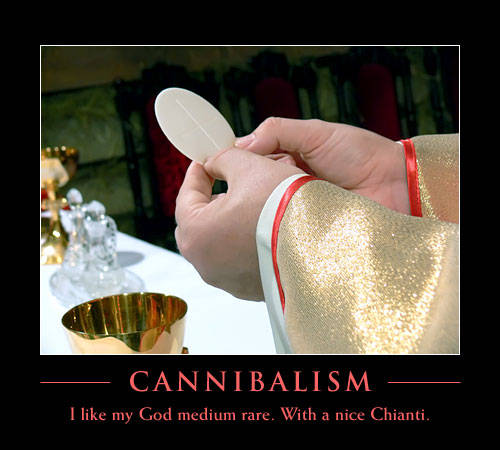
What is a Catholic or an Orthodox Mass? Well, it is essentially an act of magic, a miracle, the bread and the wine that are brought together become the flesh and the blood of Christ, which Christians then devour. Put in these brief, crude terms Christianity is a cannibalistic and highly unpleasant: though, of course, not one Christian in ten thousand conceives of the bread and wine as a cannibal act. Yes, there are a few medieval saints’ lives where the bread becomes steaming flesh, but they proved rather unpopular…
It is perhaps because of its very strangeness that the mass has created such curious incidents and misunderstandings through its long history. In the early Christian centuries, the belief in transubstantiation led to all too predictable accusations about cannibalism: for some sexual equivalents read a previous Strange History Host. Here is a strange passage from Church Father Tertullian. The mad-dog of Northern Africa is here daring his foes to do what they claim Christians do: namely kill children for their blood and commit incest with their female relatives. What is interesting is the association with bread and blood: did pagans at this date believe that Christians dipped their bread in infant blood then?
Come, plunge your knife into an infant, harmless, innocent, and helpless; or if this be the duty of another, do you at least stand by while this human being dies before it has really lived; wait for the flight of the newly-entered soul; catch the immature blood; soak your bread in it; feed freely upon it. Meantime reclining at the feast, note the positions of your mother and sister; observe them diligently, so that when the darkness has been ushered in by the dogs, you may make no mistake. For you will contract pollution unless you commit incest.
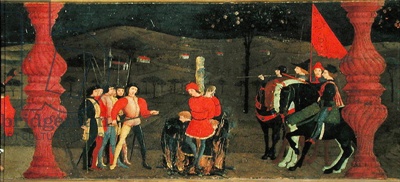
In the late thirteenth and the early fourteenth century anti-Jewish craze swept around Europe claiming that the Jews were taking and torturing Christ’s body. As Christ was long in the ground (or depending on your view elsewhere) this was curious. But European Christians explained how Jews would secrete some bread from mass, take it to their homes and there torture the piece of bread! It is difficult to take this very seriously, but people did, in fact, die as a result. The horrid image below is from the brush of Paolo Uccello (from the magnificent palace at Urbino) and shows a Jewish family being burnt (husband, wife and child) for deliberately roasting the flesh of Christ, a piece of communion bread.
The next incident brings us back to Christian cannibalism – the day of Christ’s body, Corpus Christi – contrasting the same with actual cannibalism. The narrator here is Anchieta, a sixteenth-century Spanish priest working in the mission fields of Brazil.
The other day which was [the day of] Corpus Christi, we went very early in the morning to their village where some days ago he [Father Nóbrega] sent us to make a small house in the middle of the village in order to say mass. And when he [an Indian of the village] saw us, he and all the other women of the village received great joy, as if we were brought back from the dead at that hour, speaking words of much love to us; and he went to another village to invite the others to come and drink at their village, where he had great wines. And they carried on drinking and dancing with the great party, and he said to them that he did not want anyone to do harm to us, nor speak any bitter words against us, and to not disturb the peace that that he [Nóbrega] made with us, which he was determined to defend, even though he knew that it could be broken with them. And one of the worst said, ‘Don’t make me mad, because I already killed one of yours and ate him!’ which was said about a slave of the Portuguese that was from Rio de Janeiro, that a few days ago he was there and he had killed him. And therefore he sent one of his woman to take off a shinbone of the leg that he had saved, of which was left over to make flutes. The others seeing this said, ‘You killed and ate him, let us eat him also.’ And asking for flour [their substitute for bread], one took one strip [of meat], another took another, they began to gnaw on the leg like dogs
Beach’s absolute favourite mass anecdote though comes from Dorset in southern England in the late nineteenth century. There when the village vicar gave the cup to one of his communicants the man touched his forelock and said ‘Here’s your good health sir!’ and another taking the cup said ‘Here’s the good health of our Lord Jesus Christ’. Both were essentially turning the mass into a toast, one to the priest, one to God. A hospitable people the Dorseters.
Other mass misunderstandings: drbeachcombing AT yahoo DOT com
***
31 March 2012: KMH writes ‘Christianity is possibly the leading religion for mandatory ignorance [Beach loves this]. There are the mysteries of the incarnation, the trinity, iniquity, crucifixion, transubstantiation, and so on, which no one is permitted to understand. Then no one knows the true name of the Father or the names of the Holy Spirit. Regarding transubstantiation, we need to realise that “the body of Christ” is a term also applied to the faithful, especially the saints, or the Church generally. So, the true body of Christ not only refers to his unique, sin-free body, but also to the bodies of the saints sanctified by the Holy Spirit. Likewise for the “blood of Christ.” This doesn’t mean the saints are equal to Christ, only that they participate in a limited, finite degree in the sacrament, as they do in the other aspects of Christ’s operation within Christianity. There are mysteries within mysteries,Thanks KMH!!!
20 Dec 2013: Southern Man who has been helping Beach with a post on the Sami sent this in relating to the collision of Christian mass and pagan culture: Each side [Sami and Norwegian] had its own interpreter, because the Sami who live in the outermost part of Finnmark, all the way north by Gandvik (= the White Sea), are utterly heathen and speak a language different from the one we Norwegians speak. Among the Sami there was a certain man who was so wise and skilled in witchcraft that all the other Sami revered him and called him the leader and prophet of them all, not only because of his sorcery but also for the fact that he could foretell the future. It so happened one day that the above-mentioned priest was saying Mass in his tent, as there was no church anywhere near. All the Christians attended the Holy Mass ceremony, just as is right and proper to respect such a significant rite. The Samiwere also present and their wizard stood by the door of the tent. When the Mass had proceeded so far that the priest raised aloft God’s sacred Body, the Sami wizard ran suddenly away from the tent. The Christian interpreter noticed this and found it intriguing. A little later he set out to look for the wizard, as he wanted to observe and investigate his actions. Looking for the Sami he found him lying on the ground, apparently unconscious, not far from the tent. The Christian interpreter asked if something evil had happened to him. The Sami replied, ‘I saw a terrifying sight. The person who is singing in the tent and you call your priest raised his hands aloft holding between them a baby covered in blood, and yet shining so brightly that I could hardly look at it. Because of ‘ this manifestation I was seized by such great fear and fright that after I got out of the tent I fainted.’ After Mass, the priest came to the scene together with the other Christians and had this event verified with sworn statements. It is not mentioned in connection with this incident whether or not the Sami wizard was converted to the true Faith. Thanks SM!

