jump to navigation

Big Bones in Churches November 19, 2011

Posted by Beachcombing in : Medieval, Modern

At the end of the nineteenth century the Reverend Wilkins Rees put together a short collection of examples of enormous bones that had found their way into English and Welsh churches. He mentioned five impressive instances, four of which he seems to have seen himself.

1) Foljambe Chapel, Chesterfield Church: ‘This bone, supposed to be the jawbone of a small whale, is seven feet four inches in length, and about thirteen inches, on an average, in circumference.’ ‘It is suspended over an alter tomb.  A generally-accepted explanation about this bone – not even disbelieved entirely at the present day – was that it formed a rib of the celebrated Dun Cow [monstrous bovine] of Dunsmore Heath, killed by the doughty Guy of Warwick, with whom local tradition identified the warrior whose marble effigy lies beneath the bone, sent to Chesterfield to celebrate the much-appreciated victory’. Note though that there is a contradictory account in Cox: ‘Another legend respecting the jaw bone of a small whale in the Foljambe chapel, instead of ascribing it to the Warwickshire Dun Cow, assigns it to a local cow of gigantic size, that supplied milk to all the good folk of Chesterfield, no matter how often they went  or however large the pails. But an old witch, living by the Common side where the animal grazed, jealous of its fame, went one night with a sieve and milked away till daylight. The excellent animal was so vexed by its inability to fill the vessel, that it went mad, and had to be put to death by a company of archers. In grateful remembrance of its virtues, the inhabitants of Chesterfield placed one of its rib bones within the church.’

2) Chapel of Guy of Warwick (at Guy’s Cliff?): A sixteenth-century account records how ‘in the chapel of the great Guy, Earl of Warwick, which is situated rather more than a mile from the town of Warwick (Guy’s Cliff), there is hung up a rib of the same animal [the fearful Dun Cow], as I suppose, the girth of which in the smallest part is nine inches, the length six feet and a half’.

3) St. Mary Redcliff, Bristol: This church has a ‘ bone said to have belonged to a monster cow which once supplied the whole city with milk. Bristolians, proud of their connection with the great discoverer, Cabot, assert that it is a whalebone brought to the city by the illustrious voyager on his return from Newfoundland. But here the story of Guy of Warwick and the cow has also been introduced.’ It seems that there was also a picture which contains ‘a big figure of a man on the right hand side, while in the foreground lies a prostrate man, behind whom stands a cow. To the left of the picture are certain human figures in attitudes expressive of surprise. This ancient painting was said to refer to Guy’s exploit, and the rib was pointed out as a positive proof that the daring deed was done’.

4) Pennant Melangell: includes a large bone, more than four feet long, which has been described as the bone of the patron saint, Melangell (Asen Melangell). Scholars in the nineteenth century had identified it either as a whale bone and or something belonging to a mammoth: the modern consensus seems to be for the former. It was said to be found on a nearby mountain – the date is unclear – and it was known in the middle of the nineteenth century as the Giant’s Bone (Asen y Gawres).

5) Mallwyd: ‘Over the porch of this church [pictured] some bones are suspended, but no palaeontologist has yet decided as to their origin. It has been said that they are the rib and part of the spine of a whale caught in the Dovey in bygone days!’ There is a modern tradition (with nineteenth-century backing?) that these bones were dug up locally.

We can add to this list:

6) Canewdon (Rochford): what is probably a whale vertebra has been interpreted as the knee of King Canute! (Johnson 199)

Any other giant bones in churches in Britain or elsewhere? Beachcombing is particularly struck by the secular nature of most of these legends: drbeachcombing AT yahoo DOT com

***

21 Nov 2011: Beach is grateful to Lisa who has written in on this: ‘Your post on giant bones at English churches was surprising to me! I thought this was just something at the cathedral in Krakow. Here’s some of the story behind the bones. This site has a great photo. I was too lazy to search through my computer to find the one that I took when I visited.  The bones aren’t the only interesting thing about Wawel Hill, where the cathedral is located. This hill has been continuously occupied since the seventh century, and artifacts clear back to the paleolithic have been found there. It is ruin, upon ruin, upon ruin. It is supposed to be one of the Earth’s chakras. Quite a mysterious place.’ Thanks Lisa!

25 Nov 2011: Amanda writes in with some fossils in a church, though not where you would expect… thanks Amanda!


35 cms from Oxfordshire November 10, 2011

Posted by Beachcombing in : Medieval

Beachcombing’s ordeal of single parenthood is coming quickly to a close. Mrs B.’s conference is all but over and by tomorrow morning the house will be a happier place. In the meantime 35 centimetres of soil from just off Goldbury Hill, near West Hendred in Oxfordshire; 35 centimetres that often pass through Beachcombing’s mind when his elder daughter is dropping off to sleep.

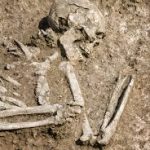
At this spot there was a small, Anglo-Saxon cemetery dug by Helena Hamerow in the early 90s. And the 35 centimetres of soil? Archaeologists at first believed that it was the grave of a baby, given the size of the diminutive skeleton within. But careful examination of the teeth revealed that surprisingly this was a two to three year old child. The only explanation was that the child in question had stopped growing in his (or her) first year. An illness or congenital condition, the kind that in another age would have sparked talk about changelings, had frozen the bairn’s development and bone analyst Sally Crawford (also an outstanding historian) speculated in her writing about a hole in the heart (96).

Anglo-Saxon graves have been used to tell stories from rapes, to witchcraft, and from murders to shamanism, but this particularly struggle against and within life has gone almost unnoticed. However, make no mistake, a story here there is. A child who stops growing in the first year is often difficult to keep alive in a modern hospital. But at West Hendred an Anglo-Saxon family – with Welsh raids, snow storms, Mercian taxmen and famine conditions to contend with – managed to keep their ill heir going through two or perhaps three years. The screaming, the sleepless nights, the growing despair…

Too often records from the past – a famous letter from Roman Egypt comes to mind – lead us to think that ancient and particularly that tribal societies washed their hands of ‘broken’ or unwanted children. And there is no question that infanticide did take place and that countless children were left on the village dung heap: Beachcombing has previously looked at hints of another form of infanticide on the barbarian Rhine. Nor do sociologists help with their chatter that childhood (along with romantic love) is a modern invention and that our ‘contemptible’ sentimentality would have gone unrecognized in the medieval or classical world.

Of course, for the most part the medieval and classical world cannot answer back. But every so often there are these small one line postcards from the past that, in their way, are superior to a Tolstoy short story.

Beachcombing is always interested in tales from the grave: drbeachcombing AT yahoo DOT com

From the Mahogany Ship to Mons Badonicus: An Archaeological Fantasia October 17, 2011

Posted by Beachcombing in : Ancient, Contemporary, Medieval, Modern

Inspired by thoughts of Nag Hammadi, Howard Carter and Leslie Alcock at Cadbury Beachcombing spent an  evening wondering about archaeological fantasias, discoveries that he hopes will be made before he  himself becomes an archaeological subject and is put into the ground.

Boudica’s grave. Boudica was, of course, the queen of the Iceni who gave Nero and Roman settlers in Britain nightmares. After being defeated in the field by the Romans in 61 AD, we are told by Tacitus that she poisoned herself and by Cassius Dio (62, 12) that she fell sick and died, the Britons giving her a ‘costly burial’. Imagine the treasures that were thrown into the secret place, the burning torches, the sacrificial victims with hazel wrapped around their necks and mistletoe berries smeared on their lips. Perhaps some day a bulldozer working on a bypass in Norfolk will send a stream of gold from out of the roots of a dying oak. (Note that there is a very curious legend that Boudica was buried under King’s Cross Station. Beachcombing has been unable to trace the origins of this. It seems about the least likely place any self respecting rebel would have left their warrior queen, especially given what she had done to  Londinium.)

The Mahogany Ship. Beach doubts very much that the early Portuguese ever made it to Australia. He has always been intrigued though by legends of a possibly Portuguese mahogany ship, which stood off the coast in the province of Victoria. It is the holy grail of those who search for proof of early European contacts with the deep Pacific, but regrettably it was never seen after the mid nineteenth-century, when of course interest in such things was starting to pick up. That there was a large shipwreck is beyond question: there were many reliable witnesses. Beach – and he is not alone – would love to see this hulk dug out of the dunes or lifted from its watery grave so that its origins can finally and definitively be established. For what it is worth, we are betting on an eighteenth-century whaler…

The Fortifications of Badon. Sometimes in the fifth or more probably the sixth century the British-Celts defeated the Saxons at the Siege of Mount Badon, a battle often associated, though probably wrongly, with ‘King Arthur’. Historians have argued over which of a half million British hill-tops was Mount Badon since the times of Milton. There have even been rather bizarre attempts to sketch out British cavalry strategy and put units on maps, all this on the basis of a dozen words in Latin in Gildas about the ‘last victory of the fatherland’. Beach isn’t asking for much here. He doesn’t want precious stones or King Arthur’s crown. He just wants some war graves, a couple of late Roman belt buckles and a Roman road marker with the words Mons Badonicus scratched upon it for the literate passerby.

The Vanished Legion. The three legions lost in the Varus Revolt have now been found. The Ninth Legion never vanished at all, pace the great Rosemary Sutcliff. But there is still some mystery in the world. Herodotus describes how  Cambyses, the son of Cyrus the Great, sent 50,000 soldiers in 525 BC to do some wrecking at Thebes. After more than a week in the desert they simply disappeared, presumably in the mother of all sandstorms. There have been claims that the army has been found, but Beachcombing doesn’t believe a word of it. Again, let him be clear. He doesn’t want 50, 000 men lain out end to end, but he is asking for some striking friezes carved out by the archaeologist’s trowel.

The Honour Rings Cave. A frisson of evil to finish off. As Hitler took down the Reich stone by stone he took care to hide his own ill-gotten gains from posterity and not a few Nazi treasures too. It would certainly be more noble on Beachcombing’s part to ask for the recovery of the Amber Room (which was almost certainly burnt) or some of the world’s masterpieces that disappeared at that date, for example, Van Gogh’s Painter on the Road (also probably burnt). However, he has to confess to being more fascinated by the search for the Honour Rings. The Honour Rings, made of silver, were a crucial piece of SS paraphernalia. When as SS soldier fell or died they were removed from hacked off hands and shrapnelled bodies and then taken back to Wewelsburg, the Nazi Grail Castle. Those that returned though, and the number 9000 is often given, never appeared at the end of the war. Legend has it that a member of the SS high command was entrusted with putting these objects in a cave and blowing up the entrance as the Allies were getting close. One day someone is going to stumble on this particular nest of vipers… and Beachcombing wouldn’t mind being there when they do. Imagine the glint of torchlight off several thousand silver skulls.

Any other archaeological fantasias gratefully received: drbeachcombing AT yahoo DOT com

PS And then there’s the one that we couldn’t track down. This Beach read about in his tender years and he just spent the last hour tracking through little Miss B’s bookshelves, where most of his infancy books are kept. An African chieftain brings away various sub-chieftains to hide a great treasure from a colonial power (presumably the British). He kills all but one of the chieftains to keep the treasure secret and by the time a treasure hunter has arrived at the house of the last surviving witness, half a century later, that man has lost his mind.

***

24 October 2011: Irish Archaeologist wants an Irish codex or something recognisably Irish from either Iceland or Greenland ‘but don’t hold your breath’. Jimmy wants to find the brass plate that Drake left in his Californian New England, possibly in the bay of San Franciso and no, he writes, the present brass plate is NOT genuine. Invisible writes: Your post on archaeological fantasias made me want to dig out Richard Halliburton’s Book of Marvels, with its tales of treasure lost and found. Although it can’t be classed as a discovery, since the site is known, I would like to live to see the actual tomb mound of the First Emperor excavated at last. According to Ssu-ma Chi’en/ Sima Qian, the tomb included a clay model of the “world” including lakes and flowing rivers of mercury. Above, the ceiling was moulded with a map of the heavens with stars represented by jewels and oil lamps fed by a reservoir of oil so they would burn eternally. Apparently archaeologists have found high levels of mercury in the soil around the tomb so I am hoping the maps are real. The historian also says that the tomb was guarded from robbers by booby traps including poisoned arrows from automatic crossbows. If the emperor’s body was surrounded by layers of coffins or sealed with clay (supposedly ground-penetrating radar shows a large, sealed section within the mound), perhaps he would be as well-preserved as the Marquise of Tai and we could look upon the actual face of the First Emperor, not just a skeleton. Failing that, I would settle for the lost treasure of the Inca, including a garden of gold and silver flowers, hidden from the Spaniards in some remote cave in the Andes. Or the grave of Sir John Franklin. Or the Chinese junk rumoured to have been found in the sands of Sacramento , California . I don’t really care if the Chinese discovered America or not, but it would be delightful to have such an unlikely story be true. Open Sesame does not believe in trans-Atlantic crossings in ancient times but he would like to get to the bottom of the mystery of the Bay of Jars in Brazil, where allegedly a Roman ship ran ashore in ancient times. Thanks to Irish Archaeologist, Jimmy, Invisible and Open Sesame.

27 Oct 2011: The great Ancient Digger writes in with one of her own. ‘One of the most elusive of mysteries is the location of Alexander the Great’s tomb.  Alexander was a champion of Near Eastern and Middle Eastern culture, art, and literature, so if his body was ever discovered in a geographical area associated with the cultures he touched, would it not make sense that a temple or sculpture be erected in his honor?  In 330, when Alexander marched into Pakistan and into the northwestern area of India where the Battle of Hydaspes River was brutally fought and won, he turned back to Babylon. We know what happened next…or do we? Did he ever turn back? Or did he stay right where he was? The history books tell us that he returned to Babylon and died shortly thereafter. Where is the tomb? A great conquest for a great man should render a monument of great proportions. It doesn’t exist.’ Beachcombing is tempted to add YET! Thanks Ancient!!

Dubious Archaeology September 4, 2011

Posted by Beachcombing in : Actualite, Ancient, Contemporary, Medieval, Modern

Reading Kenneth Feder’s Encylopedia of Dubious Archaeology Beach was reminded of an adage by Benjamin Franklin. Franklin once said that before you start arguing with someone you need to make a fundamental decision: do you want to change that person’s opinion or do you want to draw blood?

It is a frightening question because 90% of the time 90% of us instinctively want to do the second.

Certainly, most academic books written about anomalies (real or imagined) and unorthodox theories in archaeology or history belong  to the blood-drawing category. Take Stephen William’s brilliantly put together Fantastic Archaeology: The Wild Side of North American Archaeology to which KF’s book is, in some respects, a successor.

But for an outsider there can be something rather smug and limiting about  the righteous arrogance with which academic archaeologists argue their cases.

The very great virtue of KF - who is a 'convincer' - is that he sparkles and has fun like Williams, but also manages, in three hundred pages, to argue things out without too much gratuitous violence: mild and  enjoyable sarcasm is the worst it gets.

Of course, a lot of this material is too good not to have fun with: voces include the Westford Knight, the Bosnian Pyramids, Barry Fell, Lemuria, the Star Child and '2012' and KF indulges himself if within polite  limits.

KF is also refreshingly open minded. While clearly having contempt for Erich von Daniken - it happens to the best of us - he  revisits Carl Sagan’s theory that aliens could have come to the earth earlier in history. Sagan’s argument demanded evidence that has not been forthcoming and Feder underlines this: Sagan would surely have been the first to agree. But there is a dialogue here, not the chain of exclamation marks and innuendos that, say, Stephen Williams would have artfully employed.

Personally, for Beach the most interesting parts of the book concerned not specific artifacts or digs or fakes but KF’s discussions around the nature of  knowledge, archaeological or otherwise: e.g. 'Occam’s Razor', ‘Cult Archaeology’ and ‘Lost Civilisations’.

Fields like archaeology need strong filters and it is right that new ideas, particularly surprising ones are put to the test: ‘extraordinary theories require extraordinary proofs’ .

Yet are the filters sometimes too strong?

It is enough to look at medical science, to see how in the last forty years, good ideas often take too long to be adopted. Scientists  screw up and can be too conservative. But then a certain rigidity is also necessary if a discipline is not to fall victim to every novel vapidity and lose its coordinates. If doctors had gone overboard on water cures in the 1890s, x-ray would have arrived a generation later.

An example of archaeologists being too open to change is Shinichi Fujimura, who wrecked prehistoric Japanese archaeology for twenty years with his falsified digs. An example of archaeologists being too closed, on the other hand, is the debate over the date of human settlement in North America. It is only now that some light pre-Clovis settlement in America is being accepted by the mainstream.

Why was Fujimura immediately adopted as a standard bearer? Why did American archaeologists throw bricks at each other over a very modest question: Clovis or  pre-Clovis? And how do you get the balance between keeping rubbish out and welcoming truth in? The effort behind KF's work and the thinking that motivates it is probably the best we humans, with our flaws and absurdities, can hope for.

Two complaints, both symptoms of affection for this title: (i) Dubious Archaeology costs too much – roll on the paperback. (ii) It should be twice as long. Ken Federer is good at what he does. The world needs more of him!

Beachcombing is always on the look out for unusual books: drbeachcombing AT yahoo DOT com

***

10 Sep 2011: Half a dozen readers have written in with this bad archaeology address: the question is are they convincers or blood drawers?


Mystery Discovery on the Isle of Dogs August 28, 2011

Posted by Beachcombing in : Ancient, Modern

Something that always gives Beachcombing a kick is to run across an archaeological discovery from three or, preferably, four centuries ago and try and understand what on earth our ancestors thought they had discovered and what they had really come across. Past examples in this place have included a ‘Buddha’ from medieval London and the ‘evidence’ of one of Claudius’ elephants from the same city. Archaeology seems to have been so much more fun back then.

For today what about this third bizarre archaeological discovery from the same city that apparently appears in no modern text book? This letter was written c. 1820 and appears in a publication that was about as reputable as the whore of Babylon on a bender. But the letter writer is literate and doesn’t seem to be particularly outrageous: he makes no claims to have dug up the Ark of the Covenant.

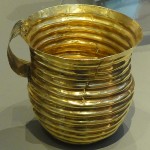
Some time in the month of April 1800, the men at work upon the Canal [on the Isle of Dogs], there found at the depth of six feet, a spur of uncommon dimensions; it measured eleven inches from shank to shank; it was quite black, but, on examination, the man who found it, discovered it to be pure gold. Sir Henry Banks purchased it for 35 guineas. A few days afterwards they came to the skeleton of a horse, about the same depth, standing erect in a perfect state : On being exposed to the air, however, it fell to pieces. (wonderful 261)

Before Beachcombing gets to the ‘spur’ he will deal with ‘Sir Henry Banks’. There was an alderman of this name at the end of the eighteenth century – ‘Sir’ and all – who was also head of Christ’s Hospital. Obit unknown, but honestly Beach has not looked that hard.

Then we have the ‘spur’ that is eleven inches long and of pure gold… Spurs are reported not just from the Mediterranean but from the tribal north in the Iron Age. But would a spur of gold even survive usage? And would a spur ever be eleven inches long? There has to be the suspicion that our Isle of Dogs workmen discovered something else and explained it as a spur when they came across the body of an erect horse. Was this a grave of a cremated chieftain?

It should be noted that ‘impractical’ golden objects do sometimes appear in Celtic royal tombs: e.g. golden shoes.

Any ideas or any later sightings of this spur in or out of Sir Henry’s possession? drbeachcombing AT yahoo DOT com


***

31 Aug 2011:  Invisible has it in for my Sir Henry, sadly with good reason. ‘Um, Sir Henry Banks died 7-21-1774 according to the Morning Chronicle and London Advertiser, p. 3 so the alderman wasn’t the purchaser of the spur in 1820. I think the gold spur was obviously made for Gog or Magog.’ Thanks Invisible!

Cat Burial in Iceland July 31, 2011

Posted by Beachcombing in : Medieval

This site has long tried to further the place of cats in history: something that typically involves describing the horrible things that humanity has done to felines. However, to date it has all been theoretical: a letter about Shelley’s refined animal cruelty; a Belgian tourist brochure about throwing cats off towers; or spurious but strangely fascinating nonsense about what Brahms was said by Wagner to have done to Viennese cats. However, with archaeology we can finally get our hands dirty. Enter from left stage the Icelandic dig site of Ingiríðarstaðir, a pagan era cemetery from the north east of that island.

In the summer of 2010 at Ingiríðarstaðir what Beach, who becomes squeamish about these things, will call a ‘death pit’ was found. And in this pit were discovered fragments of skulls from two different adults and a cat skeleton (partially pictured above) with several other animal bones. Like the dogs of Roman Reading, Calleva to friends, or the horses of numerous Anglo-Saxon graves this cat has to mean something.

Beach read about this recent find from Ingiríðarstaðir in a fascinating 2011 MA thesis Freyja’s Cats: by Brenda Prehal that is happily available online. This thesis is admirable in several respects, and is particularly fascinating read for anyone who finds cats or/and Vikings curious.

BP has worried herself silly over the significance of the find at Ingiríðarstaðir – cats were not particularly common in Viking era Scandinavia and seem to have been still rarer in Iceland. All her research, in fact, is based on the idea that cats ‘were not only the exotic pets of the elite, but were associated with the home, fertility, and the female magic of Freyja’, Freyja being of course the Viking goddess of fertility. This is a reasonable enough conclusion given that Freyja’s chariot was pulled by cats and given also that in one of the sagas, Erik the Red, a sorceress is shown with a cat fur gloves and a cat fur hat. There is then also a broader female association with domesticated cats in all cultures.

But how do we get from this simple fact to explaining an act of cat/human sacrifice in pagan age Iceland? The pit – presumably dating prior to 1100 and conversion – does not have the characteristics of an Icelandic pagan burial. In fact, it was associated with a turf wall where there was also a pit of newborns – such pleasant folks the Vikings. It was then likely a work of ritual magic. But from there on in it is all guesswork. BP suggests that the two unfortunate victims and the cat were an act of sacrifice to appease the dead or other powers in the valley.

The cat might represent the involvement of female magic. It might involve the ‘participation’ of a woman either as mistress of ceremonies or as owner of one of the skulls that was lodged for a thousand years under a turf wall. Alternatively, if cats were truly rare, then the cat in question may just have been a valuable blood gift to place in the pit. What ever interpretation is the right one, time-travelling moggies now have yet another corner of the globe that they should avoid.

Beachcombing is always on the look out for cat stories: drbeachcombing AT yahoo DOT com

***

31 July 2011: KMH writes in with a modern atrocity: ‘It is a dark truth that any object, even cats, that is loved,  revered or considered an element of religion or spirituality will almost automatically receive an unjust amount  of negative, brutal treatment by  enemies. This is human psychology. However, in our post-modern times a new phenomenon has appeared, the strange mutilation of cats by cutting them in half – the lack of blood and precision of the cut resembles those associated with unexplained cattle mutilations. Is it quite possible that aliens are responsible for this atrocity?’ Thanks as always KMH! RQR77UBMNWQX

Roman Mosaics and Bras in 1930s Leicester June 6, 2011

Posted by Beachcombing in : Ancient, Contemporary

A busy day for Beach today – the hunt for mice, newspaper columns and the ongoing search for an aupair – and so he thought that he would just quote from this 1930s guide to Roman Britain for a strange archaeological visit.

Leicester, for those who don’t know it, is a rather frightening English Midland town.

‘Two hours later I made a halt in Leicester, whose name was Ratae Coritanorum, or more simply Ratae [in Roman times], and was what we call today a prosperous provincial city. Before the church of St Nicholas, exactly at no. 50 of St Nicholas Street, is a shop which sells corsets and brassieres. When you have made sure that nobody is watching you going in (in the provinces, alas, people are such gossips!) you cross the threshold of the shop, and when you have explained to the proprietoress of Amazonian stature, who bears most effective testimony to the efficiency of her corsets, what you want, she will emit a yodelling call. From the back parlour comes out the Herculanean consort of the prepossessing ‘corsetière’; and, having exacted the fee of threepence, he will guide you through the parlour and kitchen and courtyard, down several steps, until you land in a large and spotless subterranean chamber, the walls of which are lined with shining white tiles, like a public convenience [i.e. a toilet]. But down on the floor your eyes open wide at two stupendous mosaics designed in brilliant colours, and you think of the cheerfulness of that rich flooring in the comfortable living-room of a prosperous merchant of Ratae. The white tiles and the electric light – so explains the custodian – have been added by the Town Council, which authorises him to pocket the threepence as a token of the thoroughness with which the good fellow polishes the Roman floor.’

Inevitably some remarkable archaeological discoveries are made on private property and, when they are inquisitive tourists find themselves depending on the good will of farmers or, in this case, shop-keepers.

Beachcombing has had several experiences like this himself – typically over Roman or pre-Roman remains.

One Italian city – Mrs B’s home town as it happens – has some notable Roman gatehouse foundations (Beachcombing’s inner geek preens himself) that can only be seen from the cellars of a private residence: unfortunately the doorman is never there when Beachcombing calls.

Then there was a Celtic settlement in a Spanish cornfield and an insanely angry dog.

And best of all, Beachcombing has a vague memory of a sozzled trip to a Midland British town – Sheffield, Nottingham, Lincoln…? – where there was a nightclub called the Wall in which revellers danced around some Roman remains that protruded from the dance floor.

Beachcombing had a misspent youth, but he’s paying for it now.

Any other archaeological finds in peculiar places? drbeachcombing AT yahoo DOT com

***

23 June 2011: Ailsa writes in with Chester memories: ‘Regarding archaeological finds on display in unusual places, have you visited the ones in the back of Spud-U-Like in Chester? There are a lot of Roman remains in the shops within the city walls (also with visable Roman remains) as well as a lot of medieval building still in use. Well worth a trip.’ Thanks Ailsa!

22 July 2011:  This post has been going around and around in Beach’s head. Is there still a bra shop? Can you still descend into the cellar and pay a shilling to see the painted floor? He got in touch with Leicestershire Information shop where DG sent in this reply. ‘The corset shop is long gone, buried under the Holiday Inn, but the Roman mosaic, together with several other locally-discovered mosaics and other Roman etc artefacts is on view in the nearby Jewry Wall Museum.  The museum is open daily between February and October (entry is free) but closed between November and January, except for special events.’ Thanks DG!

Vikings Vikinged in Dorset UK March 29, 2011

Posted by Beachcombing in : Medieval, Prehistoric

Beachcombing has sometimes confessed in this place that he is not a great fan of the Vikings. Indeed, say ‘Viking’ to your average medievalist and they will get lyrical about sturdy boats and trips to Greenland. Beachcombing, on the other hand, sees burnt monastic libraries, lines of children being brought to slavery in the fiords and a couple of kings whose chests have been opened to the elements, just for the hell of it. It gives Beachcombing some satisfaction then to know that every so often the locals got one up on the Norse pirates.

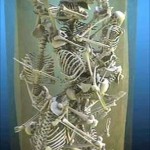
Beachcombing is referring to the pile of skulls that was found in the summer of 2009 at Ridgeway Hill near Weymouth (Dorset) in the UK.  The find – as most important early medieval discoveries – was a chance one. A ‘relief road’ that friend of archaeologically-minded historians everywhere uncovered a pile of forty eight skulls and fifty one headless bodies in a Roman-age quarry.

Here was what, in a later age, would be known as a ‘war crime’.

However, before our tear ducts open in sympathy these were unquestionably invaders. All but a handful of elder ring leaders were young males, from late teens to early twenties. They had no possessions buried with them. But testing on the teeth of a handful – the magic they can now do… – suggested that the victims had come from Scandinavia.  Indeed, one had grown up in the Arctic Circle!

Given that the atrocity dates to the tenth century when the English Kingdom of Wessex was almost overrun by Viking warriors, it is reasonable to assume that these were some of the rare Vikings who found themselves on the losing side in that dismal century. Payback for Maldon and other disgraces of those years.

The place of killing was probably some way from the place of capture: it was on the parish line and close to some prehistoric barrows, a place beloved of executioners as Beachcombing established only last week.  This hints that they had been marched after capture to be killed or that they had been captured conveniently close to an execution site.

Nor will their last moments have been happy ones. Their lack of clothes suggest that they had been stripped naked. And there are ‘grim’ marks on their body suggesting abuse and pain. The head shots were rarely clean: blunt swords and axes taking several blows to end the lives of the prisoners. In one case a victim’s hands had been cut, suggesting that he reached up to stop the blade descending. Given that some were only sixteen Beachcombing can muster up a modicum of sympathy.

Then when it was all over the bodies and heads – minus three presumably taken for display purposes – were dumped in the old Roman quarry Beachcombing referred to above: there was no question of burial with respect.

Beachcombing is fascinated at the way that early medieval historians generally avoid the implications of violence in their period. Faced by such appalling details as this though there can be no question that life for a Dark Ager, perhaps particularly the warriors was, often, bittersweet (ahem).

For a description of a Viking execution Beachcombing has put up a post that may be worth reading.

Beachcombing is always interested in slaughter in the archaeological record: drbeachcombing AT yahoo DOT com  He has a file full of British examples but would love some from further afield.

***

6 July 2011: Round Judith writes in with a link to the Guardian and further work on this mass burial in Dorset. Before the article disappears behind the pay wall, Beach will excerpt some of it: ‘The fashion for dental bling goes back 1,000 years, according to a new discovery by archaeologists. Long before contemporary trends for gold dental caps or teeth inlaid with diamonds became popular, young Viking warriors were having patterns filed into their teeth… The front teeth [in the grave] have horizontal lines that were so neatly filed, archaeologists believe it must have been done by a skilled craftsman rather than by their owners, and the process undoubtedly would have been excruciating. David Score, of Oxford Archaeology, the unit which has been studying the bones since they were discovered in a pit near Weymouth in 2009, said: ‘It’s difficult to say how painful the process of filing teeth may have been, but it wouldn’t have been a pleasant experience. The purpose behind filed teeth remains unclear but as we know these men were warriors, it may have been to frighten opponents in battle or to show their status as a great fighter.’’

22 Feb 2012: Invisible write in with an update from a BBC piece: ‘Dr Britt Baillie, from the University of Cambridge, said she believed the killings could have taken place during the reign of Aethelred the Unready. Following a series of Viking attacks he had ordered all Danish men living in England to be killed on 13 November, St Brice’s Day in 1002. The killings which ensued became known as the St Brice’s Day massacre. Remains have been found in Oxford and it is thought that massacres also took place in London, Bristol and Gloucester. However, Dr Baille said in some respects the killings at Ridgeway Hill were unique. Unlike the frenzied mob attack that took place at Oxford, all the men were murdered methodically and beheaded in an unusual fashion from the front. The Cambridge academic said she believed the skeletons belonged to a group of Viking killers who modelled themselves on a legendary group of mercenaries. They were the Jomsvikings, founded by Harald Bluetooth and based at Jomsborg on the Baltic coast.’ Thanks Invisible and notional thanks to the BBC!

Capital Punishment and Prehistoric Burials March 19, 2011

Posted by Beachcombing in : Medieval, Prehistoric

**Beachcombing dedicates the following post to JKM who brought up this fascinating subject in an email**

You are a member of the minor nobility in some part of northern Europe found guilty of murder in the fifteenth century. After the capital sentence is passed you are thrown in the back of a cart and driven out to the local place of reckoning.  However, as you are also interested in history you can’t help but wonder at the spot that has been chosen: for curiously, you are pulled to the top of a local tumulus where a nice-looking gentleman in a black mask is nursing something metallic and shining. You are just thinking about the possibility of a paper on ‘Prehistoric Barrows as Execution Sites’ (naturally in Latin) and imagining loud hurrahs from antiquarian circles, perhaps a knighthood and a place in the royal academy, when the priest,  begins to mutter the offices of the dead and you remember why you are there…

Incredible as it may seem, there is a serious point behind this fantasy, which has been haunting Beachcombing all morning (the fantasy that is not the ‘point’). Many Europeans dispatched by the axe or the gallows in the Middle Ages and, indeed, in more recent times were executed on prehistoric barrows out beyond the village or the town where they had been sentenced or, in more baroque justice systems, near where the crime had been committed.

Research into this peculiar phenomenon has been fragmented geographically: because establishing where executions took place depends on a lot of spade work involving maps, placenames, archaeology (real spades) and textual references. But it would be, by now, uncontroversial to say that the custom was followed throughout Northern Europe from Scandinavia, to Germany, in the Lowlands and in England (think of the Walkington Wold Burials). Indeed, the whole ‘Germanic’ portion of Europe seems to have subscribed: though not apparently the Celtic fringes?

So why did our ancestors choose Prehistoric barrows to kill and display felons?

It is a nice question and a number of solutions have been dreamt up: Beachcombing enumerates them here from the least dramatic (1) to the most extraordinary (3).

(1) Prehistoric barrows typically stand in visible locations, often near routes or even crossroads, and, of course, are elevated. Executioners also demanded visibility, especially for the display of the body, and so the barrows were pragmatically reused.

(2) The prehistoric barrows that survived often lay on boundaries between settlements. The boundary place was a natural location for killing partly for reasons of visibility – two communities could enjoy the ‘lesson’, but also because these were liminal areas away from community life: the criminal had not only been killed by his neighbours but cast out of human society into the twilight where the fairies and demons dwelt.

(3) Prehistoric barrows sometimes included sacrifices and therefore the custom of medieval execution was an updated Christian form of sacrifice.

Beachcombing is reminded of similar debates about medieval meeting places outside settlements, meeting places that were often close to boundaries and likewise on elevated ground. Here too there have been arguments about whether the reasoning was purely pragmatic or whether there were ancestral memories of earlier customs, though  all that jazz about liminal zones is a bit less convincing in the context of Dark Age talk shops.

Much as Beachcombing loves examples of bizarre continuity through the centuries – and the idea of  bodies being displayed in the nineteenth century mimicking Neolithic killings is splendid, he personally would go no further than (2) and then only with reservations; the landscape and the barrows being  reinterpreted by those who dwelt around them.

Any striking records of sacrifice or killing being associated with barrows? Drbeachcombing AT yahoo DOT com

***

19 March 2011: KMH makes an important point about the hollow nature of barrows. And, of course, many medieval executed bodies have been found in these hollows, often overlaying the original Neolithic body. ‘I favor the notion that barrows were a place where death was meted out, either for sacrifice or as a penalty for breaking the law. It is efficient to centralize the bloodletting around a publicly visible location such as a barrow.  If the barrows had some hollow space in the interior and  were used in ancient times as tombs then there might be an additional reason for ancient killing activities at the top – the bod(ies) might be entombed directly below, thus eliminating any need for further transportation. Continuing the custom would present no problem for Christianity other than the grounds for taking a life.’ Thanks KMH!

29 March 2011: Two more thought provoking emails. First from Cory P who brings an unexpected New World perspective to all this. ‘Having at one time lived about a mile away from the crossroads of Gallows Hill in the northeastern part of Bucks County, PA, I was struck by your entry on the association between executions and ancient barrows in northern Europe. The US Geological survey lists 11 towns, hills, and cemeteries in the eastern US with the Gallows Hill name, most of them in New England. They include a Gallows Hill Burying Ground in Litchfield, CT — an interesting redundancy, since the name Litchfield itself means a burying ground. This might suggest that the original intention was merely to carry out executions on elevated locations which would thus serve as a constant warning to potential malefactors.  Or you might be right that the barrow association was deliberate, in which case the American colonists would have simply been doing their best to carry on the tradition in the absence of any actual barrows. Certainly a number of the hills in and around that part of Bucks County have a somewhat ‘spooky’ reputation, ranging from one popularly known as Ghost Mountain to one which the Pennsylvania Germans called Hexenkopf and where witches were said to gather on Walpurgisnacht.’ Then if this wasn’t fascinating enough Jonathan Jarrett over at A Corner of Tenth Century Europe offers the following: ‘Executions at barrows rang immediate bells as last term I set myself the mission of reading the final Sutton Hoo site report, and as you may or may not be aware the mounds were, post-conversion we can be pretty sure since they themselves span the conversion period, used as an execution site. My personal feeling is that by executing criminals (or whatever category one who was so dispatched fell into then) at such places they were condemning them to the demons as which Christianity had recast the pagan gods, and that there was no inherent conflict in believing that such supernatural powers continued to associate with the burials of pagans, though now ‘correctly’ identified by the learning of the Church. If you transgressed the Christian community’s limits enough, and churchyard burial was forbidden to you, this was the alternative… Interestingly, they found some empty pits in the execution cemeteries (though it’s hard to be sure because of what the soil there does to meat) and that suggests to me that some people were somehow saved from the final ignominy of damnation-by-burial and dragged off to be put somewhere nicer. I may be thinking too binarily however: the most recent work on such matters emphasises that conversion did not just switch off older practices, and that burial at older cemeteries alongside presumed pagans continued with apparently-Christian burials. Sutton Hoo, however, is a fairly special case. I wrote a long and rather morbid post, including some pictures of the bodies (which are one of the bizarrer things even you may have seen). All a bit earlier than you’re talking about, but probably more plausible as an explanation than continuing human sacrifice… Thanks Jonathan and Cory P!!

Review: Myth or Legend? February 9, 2011

Posted by Beachcombing in : Ancient, Medieval

C.E. Daniel et alii, Myth or Legend? (New York/London 1956)

What is the difference between myth and a legend? Well, according to this little BBC miscellany from the 1950s a myth is ‘invention and fancy’, while legend is ‘some kind of history’. This distinction gets right at our main concerns with so many of those now-you-see-them-now-you-don’t figures and places that hide in the shadows of the past. And so Beachcombing has taken it upon himself to accentuate here the positives in this all-but-forgotten collection: eleven short essays, seven to ten sides, each with a tiny bibliography.

First, all the pieces gathered together here, were penned for the airwaves and you can hear, as you read, the rather bluff avuncular tones of yesteryear – think C.S. Lewis in his Mere Christianity radio talks. The reader never feels talked down to, but is rather overwhelmed by bonhomie and suspect jokes. One contributor reflects, for example, on modern druids attempting human sacrifice: ‘If any bold spirit among [the revivalists] were to try and make a return to primitive doctrine and ritual as recorded in our only authorities, the classical writers, the results would certainly be front-page news, but their performance would be as rapidly and forcibly curbed as in the days of the Roman Empire’. You get the idea…

Second, the BBC, in putting together this series of talks, made absolutely no concessions to the public’s tastes. Beachcombing has spent some time at the edge of broadcasting decision-making. And the first thing that you do when you are about to plan a program proposal is ask what Joe Public wants: which of course means what controllers believe that Joe Public wants – a new elitism far more odious than the old. Back in the 1950s though this was the last thing in the broadcaster’s mind. So King Arthur and Robin Hood? Demagoguery! Lyonesse and the Nemi? Never heard of them. Commission a piece!

Third, in part because of its elitist ways, the BBC had extraordinary pull in the 1950s. It was able to get a series of luminaries whom Beachcombing can best describe, in composite, as pipe-smoking, tweed-wearing, classically-trained archaeologists, many of whom had more letters after their name than you would find in a can of alphabet soup: e.g. ‘Kt, Hon.D.Litt. Dublin Hon. LL.D. St.Andrews, Hon. A.R.I.B.A, F.S.A.’. So there is the great Tom Lethbridge, Stuart Piggott, Glyn Daniel and Sir Leonard Woolley, not to mention Sean Ó Ríordáin fresh from his digs at Tara. ‘All the Olympians, a thing never seen again…’ (Though Zeus – aka Mortimer Wheeler – is inexplicably absent).

Then, lastly, this is the 1950s and we find ourselves back in that rather unusual thought world that could have been 1956 but that could equally have been 1860 on the cusp of Darwin’s temper tantrum. One author, for example, goes out of his way to stress that he is not threatening any Biblical narrative n his essay. Leonard Woolley reports a fascinating conversation with his wife about the Flood. R.F. Treharne suggests that the Holy Grail might be found buried at Glastonbury. Then, John Bradford notes how more ‘have read Conan Doyle’s tale, The Maracott Deep, about an imaginary search for Atlantis under the sea, than have read the first written description of the place by the Greek philosopher Plato’. Beachcombing wonders if this was even true in the 1950s…

Now, for the benefit of the internet spiders and bizarrists of the world, the contents:

G.E.Daniel ‘Lyonesse and the Lost Lands of England’; D.L.Page ‘The City of Troy’, R.F. Treharne, ‘Glastonbury and the Holy Grail’; Sir Leonard Wooley, ‘The Flood’; C.T.Selman ‘Theseus and the Minotaur’; Sean Ó Ríordáin ‘Tara’; J.M.White ‘Tristan and Isolt’; E.R.Leach ‘St George and the Dragon’; T.C.Lethbridge ‘The Isles of the Blessed’; S. Piggott, ‘The Druids and Stonehenge’; J.S.P. Bradford ‘The ‘Lost Continent’ of Atlantis’; H.J.Rose ‘Nemi and the Golden Bough’.

This is a rare book and if anyone is desperate Beachcombing could probably scan a chapter or two…

Thanks to Jonathan over at A Corner of Tenth Century Europe who flagged up Myth and Legend. Beachcombing is always on the look out for unusual reads: drbeachcombing AT yahoo DOT com

***

9 Feb 2010: Invisible has been busy proving Beachcombing wrong on his silly claim that this work is rare. ‘I checked this out on Bookfinder.com and there are many copies available, HB & PB, most priced between US$7.00 – $20.00. Full disclosure, no commercial connection with Bookfinder.com except that I shop there and find it a useful place for consolidating all sorts of used book sites/dealers. Whenever I hear about a book reputed to be rare, I like to verify that it is. Just a quirk. The internet, whatever its flaws, has made many rare books a lot more common.’ For some reason Beachcombing ordered in his book from Alaska for a very small King’s ransom – sigh…

Page 1 of 212