jump to navigation

Newspaper Archives as Controls or Filters April 18, 2012

Posted by Beachcombing in : Contemporary, Modern

Beachcombing spent more time than was strictly necessary last summer looking at nineteenth- and twentieth-century newspaper archives. It is an extraordinary world. You constantly find yourself caught up on headlines (‘Sea-monster seen in the Channel’, ‘Germans eat the French’) that cannot easily be ignored and then you take one last look over the page and are struck by yet another title and so it goes on. In the end, after thirty minutes, you are still on p. 2, 4 May 1901, the Torrington Herald with nothing but curiosities to show for your troubles. So much virgin territory, so many jigsaw pieces that fit nowhere…

Beachcombing was so struck by the experience that he still uses the newspaper archives to try and verify material found elsewhere. Take, for example, the rolling head story from yesterday, or the Benbecula mermaid story from c. 1830 or, for that matter, the Robert Stephen Hawker’s mermaid fake from 1825. All three stories describe events that were explosive in their communities. All these stories rely on non-newspaper accounts. And, most confusingly, all these stories are absent from contemporary newspapers.

Beachcombing feels that this should be significant. One of the most fascinating questions about newspapers, particularly for ‘bizarre’ stories is how receptive these publications are to tales from their heartlands. Given some of the junk that they publish it seems almost impossible that mermaid sightings or the decapitated head of the devil could escape their notice especially given that it involved (allegedly) an important part of the community.

So what are we seeing in these three instances? There seem to be two possibilities. First, the anecdote is false and the newspaper can act as a control: Beachcombing certainly has his suspicions about the two mermaid stories and Invisible this morning has sent an email (just put up) that calls the Owens’ account into question.

The second possibility is that newspapers just were not interested. In the case of the Benbecula mermaid perhaps the newspapers in question were too far away. In the case of the Cornish mermaid perhaps, say, the editor had illusions of grandeur and wanted to avoid Fortean tat.

Beach can’t help thinking that it would be useful to gather together twenty nineteenth-century anecdotes that involve community reactions  and to search for them through the newsprint. Whether we are dealing with false stories or just the ability of peculiar happenings to escape the notice of the print barons would be something of great interest. History, after all, is what happens when no one is looking. The problem, of course, would be to divide the false anecdotes from the overlooked ones. That would be – Beach suspects – impossible and so an interesting exercise would become an ambiguous one.

Any thoughts on this search for anecdotes through newsprint? drbeachcombing AT yahoo DOT com

***

22 April 2012: Invisibile writes in: Invisibile writes in: ‘You mention using the newspaper archives to try and verify stories such as the mermaid tales. I should think that the reverse would obtain: that anything found in a 19th century newspaper should be regarded with the utmost suspicion. It was the golden age of hoax stories, the best of which are difficult to distinguish from true forteana even today. I’ve been wrestling for some time with the veracity question and still haven’t got the hang of it. I’ve enjoyed obvious hoaxes, but have also verified stories that seemed patently impossible. It’s the more reasonable, plausible hoaxes that drive me mad. To state the obvious, some caveats in using 19th century newspapers: Distrust and verify. Damnably, hoax stories often contain names of real people and places.  Context can be everything. One doesn’t cite an apparently serious account of an early flying machine if the author was known to have previously written only tall tales.  Local knowledge can be invaluable. When a newspaper article mentions secret treasure caves in a place called “Mt. Nebo” in the northeastern corner of Ohio, it’s useful to know that a) Mt Nebo is in the southeastern part of the state and b) the caves, as situated by the article, do not exist and cannot exist due to the local geology. Recurring lurid stories about neighboring communities may reflect rivalry, rather than reality.  Genealogy sites are useful, if tedious, for verifying the reality of persons mentioned in a story. However, they are not infallible.  It is astonishing how far tales traveled–even the smallest of small town newspapers have articles about killer meteor showers in Persia or the habits of ostriches in South Africa. The degree of exaggeration is a natural tip-off.  I think it is safe to say that the 200-foot-long Hideous Ice Worm was a journalistic invention. But what about the Two-Headed Baby of Morrow County? Or the Girl Buried Alive For Three Weeks? (Both actual events, although the burial was a publicity stunt for a “fakir.”) Sometimes, maddingly, stories will have no endings. I’ve been collecting stories about panics and local sensations (“Ghostly Woman in White Seen Again!” “Women Fear the Gum-Shoe Man!”) Some run over a series of weeks or even months. Others run for a few days and then stop. Nothing is ever heard on the subject again. Are these just hoaxes that had run their course? Newspapers weren’t shy about exposing supernatural hoaxers, as you might have gathered from the file of “joke” ghost stories I sent you a while back—they were very severe on sheeted young men jumping out of the bushes, scaring the womenfolk. So why did these stories have no official end? Or did they merely trail off in real life with no satisfactory ending? That said, I’m very grateful I can search and retrieve 18th- and 19th-century newspapers without going through microfilm motion-sickness. And sometimes you just want to enjoy a good yarn.    To use a much later example, in response to your suggestion about studying historical anecdotes in the light of newspaper reports, I was struck by the irregular media coverage of a tragic local story. The story went that a number of teenagers had been hit by lightning at a mysterious stone structure known as Frankenstein’s Castle or Witches’ Tower. Naturally the marks of the burns were still visible on the stones and the ghosts of the victims were to be seen at the tower on stormy nights. It was an excellent ghost story, but I assumed it was the sort of folkloric tale that is told about any strange castle-like structure—except that I kept hearing it from librarians and public officials who had remembered it for 30 years and who swore that it was true.    So I went in search of documentation. There was absolutely no news coverage in the Dayton/Kettering papers, even though the tower stands on the edge of downtown. I spoke with some older local firefighters and police officers who said they remembered the case, knew it had happened in the 1960s, but nobody had any specifics. Eventually I wrote about it as a local legend. It wasn’t until several years ago that Curt Dalton, a local historical researcher, found a small article about the tragedy in a Van Wert paper—a community over 90 miles north of Dayton. Armed with the names in that article, Curt located this article http://www.daytonhistorybooks.com/frankenstein.html in a Xenia paper—a community about 30 miles from the death site and about 10 miles from the dead girl’s Bellbrook home. It is a mystery to me why this sensational story never made it into the local papers. Thanks Invisibile!

Misfortunes with Severed Heads: Richard Owen and Lancaster Jail April 17, 2012

Posted by Beachcombing in : Modern

Beachcombing regrets that he cannot provide the primary source for the following anecdote from Richard Owen’s early life. Anyone lucky enough to have instant access to mid nineteenth-century periodicals will find it in Hood’s Magazine and Comic Miscellany vol 3 (1845), 294-303. Beach is taking this paraphrase from the excellent Dinosaur Hunters by Deborah Cadbury, a book to slaver over.

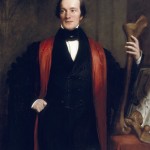
Richard Owen was, for those who don’t know, the rather insufferable scientist who, by his own estimation, ‘brightened’ mid and late nineteenth century England. As a young man he had become apprenticed to a surgeon in the north and after some traumatic weeks of autopsies and operations Owen was bitten by the anatomy bug: something which led to an extraordinary incident involving an African’s head.

By chance, a black patient had died in the gaol hospital [in Lancaster] and Owen assisted at the post mortem. Inspired by and article had he had read on ‘The Varieties of the Human Race’, he slipped some silver to the old turnkey. ‘I told him I should have to call again that evening to look a little further into the matter before the coffin was finally screwed down.’ It was snowing that night, when he returned to the gaol. He made his way up the same spiral stairway that had so terrified him just a few weeks previously, entered the corpse room and took the head of the dead man. Carefully concealing the head in a brown paper bag under his cloak, he went back down, past the turnkey. His thoughts, he said later, were only on craniological speculations of ‘facial angles’, ‘prognathic jaws’ and the ‘peculiar whiteness of osseous tissue’. But his thoughts were not on such lofty matters for long. As he hurried down the hill, he slipped on the ice and lost his balance. The black head was catapulted out of the bag and went bounding off down the slippery hill, pursued by Owen in his great, flapping, dark cloak and leaving splashes of red on the white pavement slabs. It bounced against the door of a cottage, which flew open, and he heard unearthly shrieks from inside. Owen rushed inside, ‘saw the whisk of a garment of a female’ vanishing through the door, ‘and the ghastly head at my feet with its white protruding eyeballs.’ He grabbed it and ran home. The next day the whole town was talking of the phantom, which was widely rumoured to be the ghost of a Captain Tasker and his Negro slave, perhaps even the Devil himself. For any doubters, a drop of blood now dry and dark by the door to the cottage, provided proof of their nocturnal visit.

Beachcombing would be grateful for any other good severed head stories and he would be very grateful for the scans from Hood’s Miscellany which he promises to type up for the world: drbeachcombing AT yahoo DOT com

***

18 April 2012: Invisible writes with this calling into question the anecdote and its identification with Owen: I’m sorry to say that Ms. Cadbury seems to have been misled. I pulled up the reference from >shudder< Google Books and it says nothing whatever about Richard Owen, but is part of a series of comic vignettes written as fiction, apparently to mock popular superstitions about ghosts, goblins, haunted houses, etc. I’ve been unable to find out anything about the author as yet.  I tried to attach a PDF of the relevant passage which is “Recollections and Reflections of Gideon Shaddoe Esq IX pp. 294-303. Signed by “Silas Seer” but it was taking hours to load. Perhaps you can pull the plain text from the link above so you don’t have to transcribe.  It’s a lovely tale to attribute to Richard Owen, but I don’t think it will hold up. And given Owen’s propensity to appropriate other scientists’ research, it’s ironic that his name somehow should have become attached to this fiction. Then later the same day. Here’s a bit more about Hood’s Magazine and Comic Miscellany which makes it’ pretty clear that the Gideon Shaddoe series was written by Hood himself. He apparently wrote many satires on events of the day so it IS possible that Richard Owen was supposed to be recognized as the anatomist mentioned in the piece. I just haven’t found the clef to this comic roman if that’s what it is.  Owen was such a prominent figure; he would have been ideal topical material Hood’s Magazine and Comic Miscellany was a monthly journal originally published by Thomas Hood. A total of 61 issues were published from January 1844 to June 1849. Hood made most of the original material for it. After his death in 1845, Charles Rowcroft became the editor. The magazine was not particularly successful, partly due to the refusal to take on a publisher. Hood wrote humorously on many contemporary issues. One of the most important issues in his time was grave robbing and selling of corpses to anatomists–another reason Owen might have been a target.  Thackeray and Dickens mention Owen by name in The Newcomes and Our Mutual Friend respectively, briefly and in a mildly satirical vein. Richard Altick, in The Presence of the Present: Topics of the Day in the Victorian Novel has this to say about Thomas Hood. ‘With the exception of numerous treatments of public issues of the day in the form of ‘addresses’ to their respective proponents, Hood’s kind of topicalities did not relate primarily to news events. Instead, they took the form of witty improvisations on the trivia of everyday life, ‘manners’ as we would call them. From the perspective of a century and a half, they are closer to the weekly contents of Punch than to Byronic comedy. Buried in them are uncountable ‘in-jokes’ from which posterity is excluded. Only Hood’s contemporaries would have recognized them and welcomed their humor for whatever it was worth.’ Again, I suppose it is possible that Owen was the person alluded to in the severed head incident. But if he was, I’d just like to know how Ms. Cadbury deduced his identity. I spent the morning photographing the 20 B-25 bombers here for the Doolittle Raider 70th (and final) reunion and my computer is locked up loading them to my FB page. Otherwise I might have more answers for you!  I still think, given the context of the Gideon Shaddoe series, which positions itself as a satire on the superstitions of the ignorant lower classes, that it’s reaching (without further proof) to assume that Owen was the target of that satire.’ Thanks Invisible!


Self Decapitation in South East Asia November 13, 2011

Posted by Beachcombing in : Medieval

A short post today as the Beachcombing family celebrates its reunion. The following text comes from the mid fourteenth century and relates to the experiences of a visitor to the court of the Sultan of Mul Jawah (Java or more likely East Sumatra).

In this Sultan’s assembly I saw a man with a knife like a billhook. He laid it on his neck and spoke at length although I did not understand. Then he took the knife in both hands and cut his own throat. His head fell to the ground because the knife was so sharp and his grip of it so strong. I was astonished at what he had done. The sultan said, ‘Does anyone do this among you?’ [!!] I said, ‘I have never seen this anywhere’. He laughed and said, ‘These are our slaves and they kill themselves for love of us.’ He ordered the body to be carried away and burnt. The sultan’s deputies, the state officials, the troops and the common people went out to the cremation. He granted ample to the pensions to his children, wife and brothers, and they were highly honoured because of what he had done. Someone who had been present at that assembly told me that what they man had said had been an affirmation of his love for the sultan, and a declaration that he was killing himself for love of him, as his father had killed himself for love of the sultan’s father, and as his grandfather had done for love of the sultan’s grandfather.’

Of course, lots of cultures offers special prizes in life and, indeed, posthumously to slaves who die with or for their masters. Beachcombing has a particularly unpleasant memory of the description of a Viking funeral on the Volga and an ‘angel of death’ there.

But what is unusual in this instance is the act of self decapitation. After all, is self decapitation really even possible? Beachcombing is bound to say that the author is usually reliable and that this text has probably to be read as a straightforward witness report. But Beachcombing also then has another question. This young man was presumably brought up with the expectation of removing his head in public. How did he practice?

Any other examples of self decapitation – homemade guillotines don’t count: drbeachcombing AT yahoo DOT com

Last European Headhunters July 27, 2011

Posted by Beachcombing in : Contemporary, Modern

Beachcombing has been trying to keep up with decapitation this summer by looking at late examples of head-hunting. Go back to the Celts, the Germanic tribes and even the Romans and there are several striking examples of head-hunting in Europe well into historic times. Then, of course, if you cross the Atlantic there is scalping: a sport Beach examined on a previous occasion with reference to the unpleasant end of a young German soldier. But when, to get down to business, were the last instances  of European warriors cutting off neighbours’ heads just for the hell of it?

If someone were to put a gun to Beach’s head and ask the question: ‘in which European region did the last head-hunting take place?’, he would answer instinctively ‘the Balkans’. And, on the basis of some reading Beach indulged in today it looks as if he would be right. The following description dates to the early 1920s and the author’s Christian name was Edith. Edith was one of those extraordinary English matrons of another era, who once stopped a Montenegrin biting another Montenegrin’s nose off ‘on the road between Cattaro and Njegus’ as ‘the blood dripped freely from the ends of his enemy’s long moustache’. But we digress. For present purposes Edith confides that:

Head-hunting, studied usually in distant lands, flourished in Europe well into the middle of the nineteenth century and is not yet quite extinct. When I travelled in Montenegro at the beginning of the present century all the elderly men could, and did, tell tales of the heads that they or their friends had taken. My guide confessed, with shame and humiliation, that he had not taken a single one in the war of 1877, pleading that he was only seventeen, and was severely told that others, even younger, had done better.

Every man in earlier days went to war or to a border fray intending to take as many heads as he could. The short heavy hanzhar was used for the purpose. Never for stabbing. An expert severed the head at one blow. If two Montenegrins both wounded the same man, the head ‘legally’ belonged to the man who took first blood. I was told of cases in which a dispute followed about the head and that the rival claimants have been known to fight each other for it to the death.

The reasons for head-taking were given as ‘show’ how brave you are’ and ‘to shame the enemy’. I gathered that it was also supposed to affect the future life of the enemy [i.e. in the other world?]. But whether it would prevent it altogether I could not learn. That it was formerly believed to do so seems probable, as I heard grisly tales of heroic women who crawled over the border at night and, with danger and difficulty, brought back their husbands’ heads in order to bury them with the bodies.

Edith correctly understands that the Montenegrins were great trophy takers and here the nose biting recurs.

The desire to take a trophy was so great that a wounded Montenegrin whose hands were disabled would sometimes seize his enemy’s nose with his teeth and try to bite it off. A Montenegrin gendarme told me how, in the war of 1877, he had thus made a supreme effort, had been cut down, and on recovering consciousness in a Russian field hospital found, to his intense joy, the nose in his breeches pocket, a friend having generously cut it off for him!

And when were the last Balkan heads collected?

The last heads that I heard of as being cut off were those of three Montenegrins killed in a border fight just preparatory to the first Balkan war in August, 1912. I spoke with a nephew of one of the decapitated. He took it very calmly and seemed to think it might happen to anybody’s uncle. During the war which followed nose-taking was substituted by the Montenegrins for head-taking and a great deal went on. I saw nine of the victims. The nasal bone was hacked right through and the whole upper lip removed as well as the nose. The trophy was carried by the moustache. It is only fair to the Turks to say that I did not see or hear of a single case of a mutilated Montenegrin. The practice was to go round the battle-field and cut the nose, and in some cases also castrate, the wounded, who usually died of the additional shock and haemorrhage.

This blog has taught Beach humility and he fully expects to learn that the last European headhunting actually took place in the Alps or somewhere outside Slough: serial killers and the schizophrenic need not apply,  drbeachcombing AT yahoo DOT com Or alternatively it is difficult to believe that there was no headhunting in the First World War and perhaps even in the Second in Montenegrin territory, long after Edith had put down her pen.

***

27 July 2011: Invisible has some modern cases of head-hunting: ‘Do honor-killings count in the head-hunting category? As an impressionable student I saw a book in the library called (I think) Faces of Death (I believe it was made by the same people who later did a series of notorious videos of the same name). In it was a photo of the head of a young Indian woman wrapped in plastic. It had been found on a British railway line. She had been decapitated by her father either for refusing the marriage arranged for her or for having a boyfriend. This would have been in the very early 1970s. I have never forgotten it.’ And, of course, earlier than Edith’s account of the Balkans, the heads of traitors exposed on London Bridge COULD be considered a kind of headhunting, if you want to stretch a point…. I have read (and I have no wish to go in search of visual sources) that shrunken heads of prisoners were found in German concentration camps. Lawrence Douglas, ‘The Shrunken Head of Buchenwald: Icons of Atrocity at Nuremberg,’ Visual Culture and the Holocaust, (New Brunswick, New Jersey: Rutgers University Press, 2001) p. 275.’ Thanks Invisible!

28 July 2011: Comfortably Numb writes in with some personal memories though from outside Europe: ‘I lived in East Timor for two years, while working in a UN Mission there (2000/1). Head chopping is a common struggle tactic in East Asia, and many corpses in East Timor were found without their heads (some heads were never found). In Indonesia, it is common to read news about head chopping in the Mollucas islands, for instance. In Papua, I was told that head shrinking is still practiced in some areas, and so on. I bet my money that those heads are involved in ritual practices. I think in Africa it won’t be that different. Just think of the bad luck that albinos experience in some African countries.’ And Mad Monk Andy remembers head-hunting among US troops in Vietnam. Thanks CN and Andy!


Women Warriors of Benin July 23, 2011

Posted by Beachcombing in : Modern

Having tested the limits of masculinity yesterday Beach feels obliged to pay tribute, today, to the fairer sex. He will pass through time to the late nineteenth century and through space to Dahomey (today part of Benin) in Africa where several thousand women formed an important part of the royal army there.

Now, of course, women often prove violent in myth – think of the Amazons cutting off their breasts to better draw their bows. There are also lots of examples in traditional and not so traditional societies where women take up weapons in times of desperation: the role of women in the various European resistance movements 1939-1945 is a fascinating one. But it is rare – apologies to any matriarchs – to find an example of a society (not under stress) where women routinely serve as warriors. Rare but not unknown…

Welcome to the armed ahosi (or wives) of the king of Dahomey. Beach should say here at the outset that he has not perused (yet) Alpern’s Amazons of Black Sparta: The Women Warriors of Dahomey (1999). He has – in large part through the fault of readers with their  irresistible recommendations – spent a fortune on books this summer and has to call a halt. But he has, in his wider browsing, stumbled on some accounts that make these razor-wielding dames sound like a force of nature.

The amazons [invariable European term for the warrior ahosi] are not supposed to marry, and, by their own statement, they have changed their sex. ‘We are men’, say they, ‘not women’. All dress alike, diet alike, and male and female emulate each other: what the males do, the amazons will endeavour to surpass. They all take great care of their arms, polish the barrels, and, except when on duty, keep them in covers… The amazons are in barracks within the palace enclosure, and under the care of the eunuchs and the camboodee or treasurer. In every action (with males and females), there is some reference to cutting off heads. In their dances – and it is the duty of the soldier and the amazon to be a proficient dancer – with eyes dilated, the right hand is working in a sawlike manner for some time, as if in the act of cutting round the neck, when both hands are used, and a twist is supposed to finish the bloody deed.

As a further scene setter take this list of ahosi warriors from a nineteenth-century account. All these were present within the king’s retinue and marched by a European visitor. Beach particularly enjoyed the union jacks sandwiched between the muskets and human skulls. Note that this list is greatly curtailed to avoid a surfeit of ahosi. Oh to have been there!

60 amazons of the elephant destroyers

20 carrying war stools, ornamented with human skulls

20 amazons armed with muskets

20 amazons carrying drums ornamented with twenty-four skulls

12 amazons, band of drums, &c. 20 amazons armed with muskets

12 carrying drum ornamented with twelve skulls

20 amazons armed with blunderbusses

12 amazons, band of elephant’s tusk horns

20 amazons, armed with muskets

1 amazon leading a horse

20 amazons, armed with muskets

12 forming a band, drums

60 amazons, armed with muskets

12 forming a band, drums

20 amazons

1 amazon leading a horse

12 forming a band, elephant’s tusk horns

60 amazons guarding a carriage drawn by four, and attended by four of the king’s wives under parasols

20 amazons

40 amazons, armed with muskets, guarding eight skull-surmounted banners

60 amazons, banners, skulls, &c., surrounding the lady holding the title of royal mother

20 amazons, armed with muskets

60 amazons, banners, skulls, &c., surrounding the royal grandmother

60 amazons, banners, and attendants, round two ancient ladies of the harem, bearing the title of dowager queens

10 women carrying human skulls

40 amazons, banners, &c., round one dowager queen

70 amazons, banners, &c., round one dowager queen

30 women dance before the queen

60 amazon band, and dancing women

30 band and singing women round one royal wife, in a cuirass

20 amazons, armed with muskets

2 amazons carrying British union-jacks

30 royal wives, handsomely dressed

2 amazons carrying each a large knife mounted on a human skull.

And just in case anyone refuses to believe the evidence of these last paragraphs and suspects that the ‘broads’ dress up for curious European tourists and then go back to being royal wives when the visitors have left town:

All the successful amazons in the late war then passed the throne ; and one of their generals, assisted by two other officers, proclaimed the name of each amazon and of her prisoner. Four hundred and twenty five are said to have brought prisoners, and thirty-two the heads of enemies. Several that had been wounded were introduced to us by name.

And if this is too abstract consider this modern account of the attack in 1850 on the city of Abeokuta, one of their rare failures. (239 based on an eye-witness British account)

The women fighters advanced ahead of the men and… simply passed right over the thorn bushes and fearlessly attacked the wall, some women making it over and into the city before being cut down. A fierce battle then raged, but, with the help of their massed firepower, the Egba were able to force the women to retreat. The Dagomean army lost three thousand soldiers, of which two thousand soldiers were amazons  - an indication of the ferocity with which the amazons carried forward the attack.

For all that the ‘amazons’ prided themselves on being men, (see above) they also prided themselves on being better than their male equivalents. There are several references to arguments between amazon generals and male soldiers in the royal court: and the above numbers suggest that the ahosi may have been right to boast of their superiority.

At the end of the nineteenth-century the ahosi warriors met, though, their nemesis: French machine guns. They are armed with double-bladed knives and Winchester rifles. These amazons perform wonders of bravery; they come to within 50 feet of our positions to be killed.

Any other ‘amazons’ from medieval or modern times: drbeachcombing AT yahoo DOT com

24 July 2011: New Moon writes in with a useful site. Women Warriors in History.  Naturally missed on Beach’s extensive web research. ‘Your article about the Woman warriors of Benin also reminded me of something I read many years ago about a Welsh princess called Gwenllian who fought against the Normans. There’s some historical information here plus a ghost story.’ Invisible also has a host of examples: ‘Not quite Amazons, but like the Dahomean women warriors, the burrnesha, ‘sworn virgins’ of Albania, changed their sex to live like men. Highlighted here is a relatively recent article about the lives of these women.  I thought also of ‘The Grenadier Squaw’ a Shawnee ‘Peace’ (rather than War) Chief, but I cannot find that she actually did much fighting. This from an Ohio Historical Society plaque, is a quick summary of her story. Grenadier Squaw was chief of the largest Shawnee Indian village, located on the south bank of Scippo Creek, upon the Pickaway Plains in 1774. Born about 1720, Non-hel-e-ma, sister of Chief Cornstalk, was named ‘Grenadier Squaw’ by white traders because of her imposing stature, regal bearing and unflinching courage. She spoke three languages, serving as peacemaker and interpreter between Indians and whites. Because of her friendship, she accepted Christianity. After the peace treaty in 1774, she was disowned by her people and became a homeless exile.   (if you scroll down there is a short article about the Grenadier Squaw.)  And just for fun, Helga the Terrible and a film.’ Thanks New Moon and Invisible!!

25 July 2011: More Vikings… It was only a matter of time. Invisible is the donor. ‘Freydís Eiríksdóttir, Erik the Red’s natural daughter.  (Not the best translation I’ve seen, but you can read the original on the website.) ‘Now it came to pass that a bull, which belonged to Karlsefni’s people, rushed out of the wood and bellowed loudly at the same time. The Skrælingar, frightened thereat, rushed away to their canoes, and rowed south along the coast. There was then nothing seen of them for three weeks together. When that time was gone by, there was seen approaching from the south a great crowd of Skrælingar boats, coming down upon them like a stream, the staves this time being all brandished in the direction opposite to the sun’s motion, and the Skrælingar were all howling loudly. Then took they and bare red shields to meet them. They encountered one another and fought, and there was a great shower of missiles. The Skrælingar had also war-slings, or catapults.Then Karlsefni and Snorri see that the Skrælingar are bringing up poles, with a very large ball attached to each, to be compared in size to a sheep’s stomach, dark in colour; and these flew over Karlsefni’s company towards the land, and when they came down they struck the ground with a hideous noise. This produced great terror in Karlsefni and his company, so that their only impulse was to retreat up the country along the river, because it seemed as if crowds of Skrælingar were driving at them from all sides. And they stopped not until they came to certain crags. There they offered them stern resistance.Freydis came out and saw how they were retreating. She called out, ‘Why run you away from such worthless creatures, stout men that ye are, when, as seems to me likely, you might slaughter them like so many cattle? Let me but have a weapon, I think I could fight better than any of you.’ They gave no heed to what she said. Freydis endeavoured to accompany them, still she soon lagged behind, because she was not well; she went after them into the wood, and the Skrælingar directed their pursuit after her. She came upon a dead man; Thorbrand, Snorri’s son, with a flat stone fixed in his head; his sword lay beside him, so she took it up and prepared to defend herself therewith.Then came the Skrælingar upon her. She let down her sark and struck her breast with the naked sword. At this they were frightened, rushed off to their boats, and fled away. Karlsefni and the rest came up to her and praised her zeal. Two of Karlsefni’s men fell, and four of the Skrælingar, notwithstanding they had overpowered them by superior numbers. After that, they proceeded to their booths, and began to reflect about the crowd of men which attacked them upon the land; it appeared to them now that the one troop will have been that which came in the boats, and the other troop will have been a delusion of sight. The Skrælingar also found a dead man, and his axe lay beside him. One of them struck a stone with it, and broke the axe. It seemed to them good for nothing, as it did not withstand the stone, and they threw it down.’ I love the image of this heavily pregnant woman, baring her breast and slapping it with a probably bloodied sword. In her later adventures, she leads expeditions, cons her husband into killing a rival by claiming he assaulted her, and murders a number of innocent women with an axe when her men refuse to do so. Not at all a nice woman, but she certainly had the gift of leading by intimidation.’ Thanks yet again, Invisible!

12 nov 2011: SY writes in: ‘for the study of warrior women. The following appears in The Travels of Ibn Battutah: ‘On the second day after our arrival at the port of Kailukari [Cambodia?] the princess summoned the captain, officers and merchants to a banquet she had prepared for them, according to her custom…. When I greeted the princess she said to me in Turkish, ‘How are you? Are you well?’ She seated me near her…She asked me from which country I came. I said ‘From India’. She said: ‘The pepper country?’ I said yes. She asked about that country and events there and I answered her. She said ‘I must invade it and take possession of it. Its wealth and its soldiers please me.’ I said to her ‘do so…. The ship owner told me that this princess had in her army women, serving women and slaves, who fought like men, and that she goes out among her troops of men and women, invades the territory of her enemies, is present at the fighting, and engages the champions. He told me there was a fierce battle between her and one of her enemies in which many of her soldiers were killed and her army was on the point of fleeing; but she forced her way forwards and broke through the armies till she reached the king against whom she was fighting, pierced him with a lance thrust and killed him. At this point his troops fled, and she brought his head on a spear, which his family recovered from her for much treasure.’ Thanks SY! She spoke Turkish!!!!

30 Nov 2011:Invisible writes ‘At a local booksale today, I saw a book called The Encyclopedia of Amazons: Women Warriors from Antiquity to the Modern Era by Jessica Amanda Salmonson. (She writes fantasy and sci-fi). I just glanced at it – it wasn’t in very good shape – mostly entries of a paragraph or two, but seemed to have a wide variety.’ Thanks Invisible!


Vikings Vikinged in Dorset UK March 29, 2011

Posted by Beachcombing in : Medieval, Prehistoric

Beachcombing has sometimes confessed in this place that he is not a great fan of the Vikings. Indeed, say ‘Viking’ to your average medievalist and they will get lyrical about sturdy boats and trips to Greenland. Beachcombing, on the other hand, sees burnt monastic libraries, lines of children being brought to slavery in the fiords and a couple of kings whose chests have been opened to the elements, just for the hell of it. It gives Beachcombing some satisfaction then to know that every so often the locals got one up on the Norse pirates.

Beachcombing is referring to the pile of skulls that was found in the summer of 2009 at Ridgeway Hill near Weymouth (Dorset) in the UK.  The find – as most important early medieval discoveries – was a chance one. A ‘relief road’ that friend of archaeologically-minded historians everywhere uncovered a pile of forty eight skulls and fifty one headless bodies in a Roman-age quarry.

Here was what, in a later age, would be known as a ‘war crime’.

However, before our tear ducts open in sympathy these were unquestionably invaders. All but a handful of elder ring leaders were young males, from late teens to early twenties. They had no possessions buried with them. But testing on the teeth of a handful – the magic they can now do… – suggested that the victims had come from Scandinavia.  Indeed, one had grown up in the Arctic Circle!

Given that the atrocity dates to the tenth century when the English Kingdom of Wessex was almost overrun by Viking warriors, it is reasonable to assume that these were some of the rare Vikings who found themselves on the losing side in that dismal century. Payback for Maldon and other disgraces of those years.

The place of killing was probably some way from the place of capture: it was on the parish line and close to some prehistoric barrows, a place beloved of executioners as Beachcombing established only last week.  This hints that they had been marched after capture to be killed or that they had been captured conveniently close to an execution site.

Nor will their last moments have been happy ones. Their lack of clothes suggest that they had been stripped naked. And there are ‘grim’ marks on their body suggesting abuse and pain. The head shots were rarely clean: blunt swords and axes taking several blows to end the lives of the prisoners. In one case a victim’s hands had been cut, suggesting that he reached up to stop the blade descending. Given that some were only sixteen Beachcombing can muster up a modicum of sympathy.

Then when it was all over the bodies and heads – minus three presumably taken for display purposes – were dumped in the old Roman quarry Beachcombing referred to above: there was no question of burial with respect.

Beachcombing is fascinated at the way that early medieval historians generally avoid the implications of violence in their period. Faced by such appalling details as this though there can be no question that life for a Dark Ager, perhaps particularly the warriors was, often, bittersweet (ahem).

For a description of a Viking execution Beachcombing has put up a post that may be worth reading.

Beachcombing is always interested in slaughter in the archaeological record: drbeachcombing AT yahoo DOT com  He has a file full of British examples but would love some from further afield.

***

6 July 2011: Round Judith writes in with a link to the Guardian and further work on this mass burial in Dorset. Before the article disappears behind the pay wall, Beach will excerpt some of it: ‘The fashion for dental bling goes back 1,000 years, according to a new discovery by archaeologists. Long before contemporary trends for gold dental caps or teeth inlaid with diamonds became popular, young Viking warriors were having patterns filed into their teeth… The front teeth [in the grave] have horizontal lines that were so neatly filed, archaeologists believe it must have been done by a skilled craftsman rather than by their owners, and the process undoubtedly would have been excruciating. David Score, of Oxford Archaeology, the unit which has been studying the bones since they were discovered in a pit near Weymouth in 2009, said: ‘It’s difficult to say how painful the process of filing teeth may have been, but it wouldn’t have been a pleasant experience. The purpose behind filed teeth remains unclear but as we know these men were warriors, it may have been to frighten opponents in battle or to show their status as a great fighter.’’

22 Feb 2012: Invisible write in with an update from a BBC piece: ‘Dr Britt Baillie, from the University of Cambridge, said she believed the killings could have taken place during the reign of Aethelred the Unready. Following a series of Viking attacks he had ordered all Danish men living in England to be killed on 13 November, St Brice’s Day in 1002. The killings which ensued became known as the St Brice’s Day massacre. Remains have been found in Oxford and it is thought that massacres also took place in London, Bristol and Gloucester. However, Dr Baille said in some respects the killings at Ridgeway Hill were unique. Unlike the frenzied mob attack that took place at Oxford, all the men were murdered methodically and beheaded in an unusual fashion from the front. The Cambridge academic said she believed the skeletons belonged to a group of Viking killers who modelled themselves on a legendary group of mercenaries. They were the Jomsvikings, founded by Harald Bluetooth and based at Jomsborg on the Baltic coast.’ Thanks Invisible and notional thanks to the BBC!

Headless Races March 27, 2011

Posted by Beachcombing in : Medieval

After all those head lice (see previous posts) Beachcombing gets back to some decapitation stories, not least because it would be the most efficient way to solve his family’s present problems. In any case, before anyone makes contact with the social workers…

In response to an earlier beheading post RR wrote in with the following appealing story. ‘I recall reading about a man in Britain or France who was beheaded, but made a request of the executioner to pardon his half-dozen comrades if he could run past them as they stood in a row.  After losing his head.  I recall he did this.’ With the help of fellow bizarrists – Jason from Executed Today and Mathias B. – Beachcombing has now tracked the tale down to a certain Klaus Stortebeker (obit c. 1400).

Klaus was the leader of a bunch of thugs known as the Victual Brothers. The Victual Brothers were essentially a group of mercenary seamen who turned – as mercenaries invariably do – against their own masters and began causing havoc in the Baltic and North Sea in the late fourteenth century.

However, by that strange perversion of human nature that makes heroes out of villains, folk songs and legends gathered around KS and his men: think of modern t-shirts of the Manson ‘family’…

Did the Victual Brothers deserve their Robin Hood reputation? Beachcombing doubts it. But their celebrity might explain how such an unlikely and biologically impossible legend attached itself to Klaus’ head.  He was the focus of popular story.

There are different versions of the story and it would, naturally, be interesting to track down the earliest: drbeachcombing AT yahoo DOT com However, the gist is precisely as RR had it. Klaus makes a deal with the mayor that as many men as he can run past once beheaded will be pardoned. He manages some eleven of the seventy plus with whom he was captured c. 1400. But – and RR didn’t include this - the eleven are killed anyway.

The moral?

You can’t trust the ruling classes, whereas homicidal mariners are just dandy.   

Beachcombing doesn’t believe this story for a second, but it is attractive enough that he has been wondering if it didn’t predate Klaus. Well, this week another correspondent, Luis – to whom many thanks! – wrote in with this tale:

‘I contact you because last weekend I saw a documentary about Reichenstein’s castle whose warden was telling the story of Dietrich von Hohenfels [obit 1282], a knight who was beheaded in gruesome conditions. He was the owner of the castle and part of group called the robber knights. They taxed all the boats passing along the Rhine river and eventually turned rogue… and got captured after a long siege by Rudolf von Habsburg. Dietrich begged the king Rudolf to spare his sons. The king agreed but said ‘Look you murderer, here are all your sons. In a moment your head will roll into the sand, but should you manage to walk past your brood I will keep everyone of them alive whom you manage to pass’. Which Dietrich managed to do, once he had his head off he passed along his 9 sons who were standing in a row before falling to the ground.’

Luis kindly sent links to Dietrich’s headless billy-goating.

The story again is pleasing. Perhaps more pleasing still is the way that it attaches in both cases to Germanic outlaw figures connected with boats. Was there simply a mix up in an eighteenth-century tourist guide, which was then passed down to us? Or are we dealing with an ancient metropolitan legend that was told in previous ages about, say, Loki? Attentive readers will have noticed that RR got the country wrong in his original email ‘Britain or France’: or are there other cross channel or Latin versions? Beachcombing is going to put a small wager that this tale will have been told across Europe about a half dozen dodgy heroes ‘of the people’. He’ll offer an almost valueless first edition of Somerset Maugham if anyone feels like calling him on it.  

For any poor innocent being sucked in by Google, Beachcombing feels it his duty to point them in the way of a previous post on Viking speculations about headless trunks: Mathias was ‘responsible’ for that too.

To his more regular readers Beachcombing must signal the fact that Klaus’ skull has recently been stolen from its home in Hamburg History Museum for which thanks, yet again, to Mathias.

It wasn’t Beachcombing, though if anyone is selling…

Capital Punishment and Prehistoric Burials March 19, 2011

Posted by Beachcombing in : Medieval, Prehistoric

**Beachcombing dedicates the following post to JKM who brought up this fascinating subject in an email**

You are a member of the minor nobility in some part of northern Europe found guilty of murder in the fifteenth century. After the capital sentence is passed you are thrown in the back of a cart and driven out to the local place of reckoning.  However, as you are also interested in history you can’t help but wonder at the spot that has been chosen: for curiously, you are pulled to the top of a local tumulus where a nice-looking gentleman in a black mask is nursing something metallic and shining. You are just thinking about the possibility of a paper on ‘Prehistoric Barrows as Execution Sites’ (naturally in Latin) and imagining loud hurrahs from antiquarian circles, perhaps a knighthood and a place in the royal academy, when the priest,  begins to mutter the offices of the dead and you remember why you are there…

Incredible as it may seem, there is a serious point behind this fantasy, which has been haunting Beachcombing all morning (the fantasy that is not the ‘point’). Many Europeans dispatched by the axe or the gallows in the Middle Ages and, indeed, in more recent times were executed on prehistoric barrows out beyond the village or the town where they had been sentenced or, in more baroque justice systems, near where the crime had been committed.

Research into this peculiar phenomenon has been fragmented geographically: because establishing where executions took place depends on a lot of spade work involving maps, placenames, archaeology (real spades) and textual references. But it would be, by now, uncontroversial to say that the custom was followed throughout Northern Europe from Scandinavia, to Germany, in the Lowlands and in England (think of the Walkington Wold Burials). Indeed, the whole ‘Germanic’ portion of Europe seems to have subscribed: though not apparently the Celtic fringes?

So why did our ancestors choose Prehistoric barrows to kill and display felons?

It is a nice question and a number of solutions have been dreamt up: Beachcombing enumerates them here from the least dramatic (1) to the most extraordinary (3).

(1) Prehistoric barrows typically stand in visible locations, often near routes or even crossroads, and, of course, are elevated. Executioners also demanded visibility, especially for the display of the body, and so the barrows were pragmatically reused.

(2) The prehistoric barrows that survived often lay on boundaries between settlements. The boundary place was a natural location for killing partly for reasons of visibility – two communities could enjoy the ‘lesson’, but also because these were liminal areas away from community life: the criminal had not only been killed by his neighbours but cast out of human society into the twilight where the fairies and demons dwelt.

(3) Prehistoric barrows sometimes included sacrifices and therefore the custom of medieval execution was an updated Christian form of sacrifice.

Beachcombing is reminded of similar debates about medieval meeting places outside settlements, meeting places that were often close to boundaries and likewise on elevated ground. Here too there have been arguments about whether the reasoning was purely pragmatic or whether there were ancestral memories of earlier customs, though  all that jazz about liminal zones is a bit less convincing in the context of Dark Age talk shops.

Much as Beachcombing loves examples of bizarre continuity through the centuries – and the idea of  bodies being displayed in the nineteenth century mimicking Neolithic killings is splendid, he personally would go no further than (2) and then only with reservations; the landscape and the barrows being  reinterpreted by those who dwelt around them.

Any striking records of sacrifice or killing being associated with barrows? Drbeachcombing AT yahoo DOT com

***

19 March 2011: KMH makes an important point about the hollow nature of barrows. And, of course, many medieval executed bodies have been found in these hollows, often overlaying the original Neolithic body. ‘I favor the notion that barrows were a place where death was meted out, either for sacrifice or as a penalty for breaking the law. It is efficient to centralize the bloodletting around a publicly visible location such as a barrow.  If the barrows had some hollow space in the interior and  were used in ancient times as tombs then there might be an additional reason for ancient killing activities at the top – the bod(ies) might be entombed directly below, thus eliminating any need for further transportation. Continuing the custom would present no problem for Christianity other than the grounds for taking a life.’ Thanks KMH!

29 March 2011: Two more thought provoking emails. First from Cory P who brings an unexpected New World perspective to all this. ‘Having at one time lived about a mile away from the crossroads of Gallows Hill in the northeastern part of Bucks County, PA, I was struck by your entry on the association between executions and ancient barrows in northern Europe. The US Geological survey lists 11 towns, hills, and cemeteries in the eastern US with the Gallows Hill name, most of them in New England. They include a Gallows Hill Burying Ground in Litchfield, CT — an interesting redundancy, since the name Litchfield itself means a burying ground. This might suggest that the original intention was merely to carry out executions on elevated locations which would thus serve as a constant warning to potential malefactors.  Or you might be right that the barrow association was deliberate, in which case the American colonists would have simply been doing their best to carry on the tradition in the absence of any actual barrows. Certainly a number of the hills in and around that part of Bucks County have a somewhat ‘spooky’ reputation, ranging from one popularly known as Ghost Mountain to one which the Pennsylvania Germans called Hexenkopf and where witches were said to gather on Walpurgisnacht.’ Then if this wasn’t fascinating enough Jonathan Jarrett over at A Corner of Tenth Century Europe offers the following: ‘Executions at barrows rang immediate bells as last term I set myself the mission of reading the final Sutton Hoo site report, and as you may or may not be aware the mounds were, post-conversion we can be pretty sure since they themselves span the conversion period, used as an execution site. My personal feeling is that by executing criminals (or whatever category one who was so dispatched fell into then) at such places they were condemning them to the demons as which Christianity had recast the pagan gods, and that there was no inherent conflict in believing that such supernatural powers continued to associate with the burials of pagans, though now ‘correctly’ identified by the learning of the Church. If you transgressed the Christian community’s limits enough, and churchyard burial was forbidden to you, this was the alternative… Interestingly, they found some empty pits in the execution cemeteries (though it’s hard to be sure because of what the soil there does to meat) and that suggests to me that some people were somehow saved from the final ignominy of damnation-by-burial and dragged off to be put somewhere nicer. I may be thinking too binarily however: the most recent work on such matters emphasises that conversion did not just switch off older practices, and that burial at older cemeteries alongside presumed pagans continued with apparently-Christian burials. Sutton Hoo, however, is a fairly special case. I wrote a long and rather morbid post, including some pictures of the bodies (which are one of the bizarrer things even you may have seen). All a bit earlier than you’re talking about, but probably more plausible as an explanation than continuing human sacrifice… Thanks Jonathan and Cory P!!

Viking Decapitations and the Knife Experiment February 21, 2011

Posted by Beachcombing in : Medieval

*Post dedicated to Mathias B who inspired it with his readings in Jómsvikinga saga*

Beachcombing is down in the flu doldrums and so apologies for any emails to which he’s not yet replied. Several of you though (Ostrich, Swedish Anna, SY) pointed out that yesterday’s request about the letter from a Frederick to Ethiopia was a letter from Frederick Barbarossa to Saladin (where Ethiopia is mentioned, the tricks of memory): more on this anon (another post, another day). For now though back to the question of decapitation customs and the possibility that criminals/victims survive the grim blade – at least for a few seconds… Beachcombing is not surprised that others have asked themselves the same question through the centuries, certainly based on his inbox interest is immense. He was surprised though to see that an early experiment was carried out by a group of Norse pirates, the Jómsvikings. The following extracts appears in Jómsvikinga Saga a twelfth or thirteenth century text purporting to retell tenth century events: make of that what you will.

Seventy Jómsvikings – a bunch of psychopathic pirates – have been captured by the Norwegian army and will now be executed one by one… Memories of a recent archaeological dig in Dorset (yet another post another day). 

As the first ten are led out they are each asked whether they are happy to die and each of the ten answer in such a way that shows their contempt of death and, when possible, their executioner, Thorkell. One stands out as evidence of early interest in the consciousness debate.  

‘Then the seventh one was led forward and Thorkell asked him as usual [are you happy to die]. ‘I’m quite content to die. But deal me out a speedy blow. I have a dagger here. We Jomsvikings have often discussed whether a man knows anything after he has lost his head if it is cut off speedily. Let us make the following arrangement, that I will hold the dagger up if I know anything, otherwise it will fall down.’ Thorkell struck him and his head flew off, and the dagger fell down.’

Viking neo-realism? If this had been the Arabs or the Gaels, even the Anglo-Saxons Beachcombing bets that the hand would have tossed the knife in the air, caught it and then thrown it at the executioner.

A couple more of sea-dogs die bravely:

‘Then the ninth man was released and Thorkell asked him as usual [whether he was happy to die]. He said: ‘I am well content to die as are all our comrades. But I will not let myself be slaughtered like a sheep: I would rather face the blow. Strike straight at my face and watch carefully if I pale at all, as we have often spoken about that.’ He was allowed to face the blow and Thorkell approached him from the front and hewed into his face. He did not pale but his eyes did close as death overtook him.

True, this is consciousness before dying, not after the event, but it shows a similar morbid, if fully understandable, interest in the experience of decapitation.

Beachcombing can’t resist also adding a truly bizarre comment of Thorkel the executioner (who incidentally does not survive the executions):  ‘Thorkell Leira was appointed to act as the Jomsvikings’ executioner. Three gravely wounded men were freed from the rope, and slaves were appointed to guard them and twist sticks in their hair. Thorkell Leira then proceeded to cut off their heads. Afterwards he asked, ‘Do you think I have changed colour because of this deed, for many say that this happens if a man beheads three men?’ Earl Eirikr replied, ‘We didn’t see you change colour, but yet you don’t look the same at all.’

What was that about? Is the point that Thorkell is frightened? Is this an omen that he will soon die? There is probably a study in Fiord Bulletin of Norse Studies from the mid 1960s, next to an article on the erotics of Viking backgammon. But if truth be known – whisper it – Beachcombing is not a great Viking fan and does not know.

While Beachcombing was writing this he found himself wondering about mythical decapitations where the head survives death. It is strange that he didn’t think of this before: certainly from Gawain and the Green Knight, to Bran, to several Christian saints including Saint Minias, to Anne Boleyn ‘with her head tucked underneath her arm’, there is a long catalogue, presumably evidence of the same morbid fascination and perhaps too of ‘the cult of the head’? Now Beachcombing is remembering the pig’s head scene in Lord of the Flies where Simon faces his nemesis and fails. Any other mythic reflexes or better still explanations: drbeachcombing AT yahoo DOT com

Lavoisier Blinks February 6, 2011

Posted by Beachcombing in : Modern

Today a continuation of the decapitation series with the life and unusual death of Antoine-Laurent de Lavoisier (1794). Lavoisier was a dreamy French chemist responsible, in part, for the metric system and a few other crimes against humanity (‘hydrogen’, the elementary table…). The facts of Lavoisier’s death are, meanwhile, suitably enough, a mix of brutal fact and legend sympathique.

Let’s start with the facts. Lavoisier was condemned to death by a people’s court in 1794 – a typical example of the revolution’s Saturn-like eating of its own children. When mercy was asked for so that he could continue his experiments the judge responded with the words ‘La révolution n’à pas besoin de savants’, ‘the revolution doesn’t need scholars’, forgetting for a moment that the revolution was a direct result of scholars: echoes of Pol Pot shooting people with glasses.

As it happened Lavoisier would be pardoned a little more than a year after his death – this is fact too. But facts are hard to come by at the guillotining…

It is said by numerous authorities that Lavoisier, in his last service to science, agreed to blink for as long as he could after the blade came down and that blink he did, for as many as thirty seconds, depending on the source.

Beachcombing loves the image of a couple of earnest French savants (the kind that mother liberté had for elevenses) lifting the head and counting the blinks as the grinning executioner stepped over them to get at the next prisoner.

But is this story true? The most serious biographers are uncertain about the judge’s comment, quoted above. And they are downright hostile to the idea of Lavoisier’s blinking his way into eternity: though Beachcombing hopes that some reader might be able to make a case – drbeachcombing AT yahoo DOT com.

So where does the story come from? Quite simply human curiosity about the fate of the head when the blade has separated it from the body and a desperate attempt to add some romance to the industrialisation of killing with the guillotine. Certainly, there are a lot of good stories about. Beachcombing got some fascinating responses to his recent question about proof for continued consciousness after decapitation. Most were unsourced and if anyone can fill in the gaps he would most grateful.

Invisible offered: Charlotte Corday, whose head blushed and looked indignant when slapped (Beachcombing has chased down several non-contemporary references); Mary Queen of Scots, lips moving for 15 minutes; and Sir Everard Digby, whose head supposedly spoke to refute that he was a traitor!

RR offered the following story (Beachcombing’s favourite because it turns from the head to the body): ‘I recall reading about a man in Britain or France who was beheaded, but made a request of the executioner to pardon his half-dozen comrades if he could run past them as they stood in a row.  After losing his head.  I recall he did this.’ RR also mentions ‘the celebrated chicken who was beheaded for dinner, but lived for years after losing his head.  Went on tour and was exhibited.  Fed thru the top of his neck with an eyedropper.’ Beachcombing is lost for words…

Ostrich, meanwhile, gave a link to Mike Dash’s examination of Antoine Joseph Wiertz’s hypnotic experiments with a decapitated head that has several other references and considerations. There have also, Beachcombing learns, been literary reflexes: including C.S. Lewis in That Hideous Strength (RR), an unnamed Aleister Crowley short story (AG, probably The Testament of Magdalen Blair) and an attractive Japanese story from CF.

Beachcombing will, if he can get his nerve up, be visiting the decapitated head experiments of Dr Beaurieux in the not so distant future.

Page 1 of 212