jump to navigation

Big Bones in Churches November 19, 2011

Posted by Beachcombing in : Medieval, Modern

At the end of the nineteenth century the Reverend Wilkins Rees put together a short collection of examples of enormous bones that had found their way into English and Welsh churches. He mentioned five impressive instances, four of which he seems to have seen himself.

1) Foljambe Chapel, Chesterfield Church: ‘This bone, supposed to be the jawbone of a small whale, is seven feet four inches in length, and about thirteen inches, on an average, in circumference.’ ‘It is suspended over an alter tomb.  A generally-accepted explanation about this bone – not even disbelieved entirely at the present day – was that it formed a rib of the celebrated Dun Cow [monstrous bovine] of Dunsmore Heath, killed by the doughty Guy of Warwick, with whom local tradition identified the warrior whose marble effigy lies beneath the bone, sent to Chesterfield to celebrate the much-appreciated victory’. Note though that there is a contradictory account in Cox: ‘Another legend respecting the jaw bone of a small whale in the Foljambe chapel, instead of ascribing it to the Warwickshire Dun Cow, assigns it to a local cow of gigantic size, that supplied milk to all the good folk of Chesterfield, no matter how often they went  or however large the pails. But an old witch, living by the Common side where the animal grazed, jealous of its fame, went one night with a sieve and milked away till daylight. The excellent animal was so vexed by its inability to fill the vessel, that it went mad, and had to be put to death by a company of archers. In grateful remembrance of its virtues, the inhabitants of Chesterfield placed one of its rib bones within the church.’

2) Chapel of Guy of Warwick (at Guy’s Cliff?): A sixteenth-century account records how ‘in the chapel of the great Guy, Earl of Warwick, which is situated rather more than a mile from the town of Warwick (Guy’s Cliff), there is hung up a rib of the same animal [the fearful Dun Cow], as I suppose, the girth of which in the smallest part is nine inches, the length six feet and a half’.

3) St. Mary Redcliff, Bristol: This church has a ‘ bone said to have belonged to a monster cow which once supplied the whole city with milk. Bristolians, proud of their connection with the great discoverer, Cabot, assert that it is a whalebone brought to the city by the illustrious voyager on his return from Newfoundland. But here the story of Guy of Warwick and the cow has also been introduced.’ It seems that there was also a picture which contains ‘a big figure of a man on the right hand side, while in the foreground lies a prostrate man, behind whom stands a cow. To the left of the picture are certain human figures in attitudes expressive of surprise. This ancient painting was said to refer to Guy’s exploit, and the rib was pointed out as a positive proof that the daring deed was done’.

4) Pennant Melangell: includes a large bone, more than four feet long, which has been described as the bone of the patron saint, Melangell (Asen Melangell). Scholars in the nineteenth century had identified it either as a whale bone and or something belonging to a mammoth: the modern consensus seems to be for the former. It was said to be found on a nearby mountain – the date is unclear – and it was known in the middle of the nineteenth century as the Giant’s Bone (Asen y Gawres).

5) Mallwyd: ‘Over the porch of this church [pictured] some bones are suspended, but no palaeontologist has yet decided as to their origin. It has been said that they are the rib and part of the spine of a whale caught in the Dovey in bygone days!’ There is a modern tradition (with nineteenth-century backing?) that these bones were dug up locally.

We can add to this list:

6) Canewdon (Rochford): what is probably a whale vertebra has been interpreted as the knee of King Canute! (Johnson 199)

Any other giant bones in churches in Britain or elsewhere? Beachcombing is particularly struck by the secular nature of most of these legends: drbeachcombing AT yahoo DOT com

***

21 Nov 2011: Beach is grateful to Lisa who has written in on this: ‘Your post on giant bones at English churches was surprising to me! I thought this was just something at the cathedral in Krakow. Here’s some of the story behind the bones. This site has a great photo. I was too lazy to search through my computer to find the one that I took when I visited.  The bones aren’t the only interesting thing about Wawel Hill, where the cathedral is located. This hill has been continuously occupied since the seventh century, and artifacts clear back to the paleolithic have been found there. It is ruin, upon ruin, upon ruin. It is supposed to be one of the Earth’s chakras. Quite a mysterious place.’ Thanks Lisa!

25 Nov 2011: Amanda writes in with some fossils in a church, though not where you would expect… thanks Amanda!


Cyclops Origins June 7, 2011

Posted by Beachcombing in : Ancient


Beachcombing has always had a bit of a thing about Cyclops. And who can blame him? After all, the encounter between old Round Eye and that smarty-pants pirate king from Ithica is what most children – genuine or grown – remember about the Odysseus: there is something so Roald Dahlish about the disgusting yet liberating battle of wits undertaken in the Cyclops cave.

But a question that has long nagged irritatingly away is where do Cyclops actually come from? If it is taken for granted that there never were twenty foot one-eyed giants running around the Greek islands – something that even the most enthusiastic cryptozoologist would be unwilling to sustain – then what mythic need did they fulfill or what misunderstanding were they inspired by?

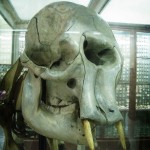
An ingenious solution was offered up a century ago by the Austrian palaeontologist Othenio Abel (obit 1946). Abel suggested that the Cyclops myth was inspired by the discovery of fossilized pygmy elephant skulls. The eyes on such skulls – Beachcombing shamelessly stole the picture of one above – are not particularly prominent, while though the trunk leaves a large ‘nasal cavity’ in the middle of the head – the Cyclop’s ‘eye’. Even better these skulls were typically found with lots of other fossil bones: naturally the Cyclops’ human dinner!

The brilliant WANW Adrienne Mayor (7) has shown that Othenio Abel deserves a serious bout of hand-slapping for confusing scholarship: the Austrian falsely suggested that the Greek writer, Empedocles had seen fossilized remains in Sicilian caves, a factoid that has been endlessly repeated since and one that seemed to affirm his claim.

But this relatively minor misdemeanour must surely not detract from what was a brilliant intuition over Cyclop origins: similar to one that OA had over Pliny’s druid’s egg (another post another day).

Perhaps the only drawback is that OA (and his partisans) suggest that those ‘Greeks’ who discovered the putative elephant skulls did not know elephants. But the legend of the Cyclops in the Mediterranean seems to date back to at least to the seventh-century BC and a Punic inscription from elephant territory, Syria, describing a one-eyed demon who is depicted (curiously with a snake’s head) swallowing a man. Are we perhaps dealing with a particular kind of elephant skull with the Mediterranean pygmy? Are elephant skulls really so very different? drbeachcombing AT yahoo DOT com

Having said that the other explanations are weaker or at least more abstract/esoteric. There are the  Indo-European (?) myths where a deity barters an eye for wisdom: though Cyclops seem to have been the tabloid readers of the ancient world. There are curious notions about ancient smiths wearing eye patches – Cyclops are sometimes though not universally associated with smithies. Then there is the possibility that occasional cases of human cyclopia, though note that most sufferers of this extremely rare condition do not generally survive the womb or early babyhood. Perhaps the elephants have it then?

***

17 June 2011: KMH has also been worrying about one-eyed giants ‘Here is a  defense of Cyclops. If we had no physical evidence of the giraffe, I am sure that most learned people would regard it as a physically preposterous myth, violating known laws of biology. If coelacanths had not been discovered living today, we would be certain that they had all died off some 65 million years ago.  Also, if Troy,  Babylon and other sites mentioned in ancient texts hadn’t been unearthed, they would be regarded at present as only mythical (as they were in the 19th century). So, the only thing lacking is a Cyclops skull for examination. We know giants existed in ancient times from the frequent discoveries of their large bones, and accounts of their activities. But what advantage could one eye possibly possess over two?  One explanation is that the Cyclops race didn’t posses a normal eye, rather an abnormally large  pineal gland that functioned perfectly as a “third eye” enabling the Cyclops to see ‘astrally’ rather than physically. The pineal gland is widely regarded as the location of the third eye when it is activated by drugs, or other methods. Its power is greatly increased if the bone in front of the gland is removed. The third eye requires that the two normal eyes be closed for full effectiveness. It isn’t clear if the Cyclops in question was born with a hole in the skull or not, but there may well have been a race of these beings, perhaps a remnant of ancient genetic experimentation. They would have been the only giants we know of who could see in the dark… Hoping you can clearly see my reasoning. Also Cyclops skulls may be more difficult to find than hen’s teeth, but there seem to be rare reports,  I vaguely remember other finds in the 20th century, but at my age any investigation is better left to the younger generation.’ Thanks as always KMH!!!

8 July 2011: Adam C writes in with a reflection on one-eyed sheep, ‘The following [see picture] is an example of the non-human ‘cyclopia’ that occurs in the wild (alongside the human cases you mentioned) and how some areas may even produce whole batches of one-eyed creatures, and is also a slightly bizarre story in itself from Forbes: Idaho sheep ranchers couldn’t figure out why, in the decade after World War II, a random batch of their lambs were being born with strange birth defects. The creatures had underdeveloped brains and a single eye planted, cyclopslike, in the middle of their foreheads. In 1957 they called in scientists from the U.S. Department of Agriculture to investigate. The scientists worked for 11 years to solve the mystery. One of them, Lynn James, lived with the sheep for three summers before discovering the culprit: corn lilies. When the animals moved to higher ground during droughts, they snacked on the flowers. The lilies, it turned out, contained a poison, later dubbed cyclopamine, that stunted developing lamb embryos. The mothers remained unharmed. […]  But now cancer researchers have improbably seized on the obscure plant chemical as the blueprint for a half-dozen promising tumor-fighters. Cyclopamine, it turns out, blocks the function of a gene called Sonic hedgehog that is essential for embryonic development but also plays a lead role in causing deadly cancers of the pancreas, skin, prostate and esophagus.’  Thanks Adam!
”"

Woolly Mammoths among the Pharoahs? April 14, 2011

Posted by Beachcombing in : Ancient, Medieval

**This post is dedicated to Andy the Mad Monk who put Beachcombing onto it**

Beachcombing has long wondered if the publishing world would not have room for a volume on long-travelled exotic animals in Antiquity and the Middle Ages: giraffes turning up in Renaissance Italy; polar bears being brought down to the medieval Arabs; camels in Merovingian Gaul; some of the living furry bait that the Romans used in their gladiator fights; turkeys sailing across from the Americas etc etc. After all, transferred beasts represent an unusual form of trade: one that requires handlers, feed, special transport facilities: perhaps a good general rule is that if animal z can be moved from country x to country y, then objects, people and ideas will also be able to cover the same distance regularly?

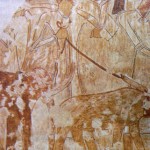
A fine example of animals being brought from afar appears in c. 1400 BC in the wall decorations from the celebrated mortuary chapel – not tomb – of Rekhmire at Thebes. On the wall there are two rows of tribute being brought to the Egyptian master-race. On the top we have ‘Nubians’ and their gifts – including a far travelled giraffe. Then on the second line we have ‘Syrians’ and a bear (or lion?) and a baby elephant.

This ‘baby’ elephant has been the cause of much controversy – (follow the link for an excellent discussion), not least because its tusks seem quite remarkably mature. Then, even more problematically, this ‘baby’ seems to have a coat of fur. It has even been suggested that this may be a dwarf woolly mammoth!

Yikes.

From here it was just a short step to positing a trade network between Egypt and ancient Siberia, shuttling woolly mammoths across the steppes to the court of the pharaohs. Beachcombing should add that there is no definite evidence that woolly mammoths survived this late in Asia.

Given that the creature in question is associated with folk from the Levant then the easiest solution is that this is an immature elephant from there that had been stylised with tusks – an elephant with immature tusks might not seem like an elephant in graphic terms.

However, there has also been the suggestion that this was a Mediterranean pygmy elephant from one of the Mediterranean islands, that might, on the basis of some very doubtful but intriguing evidence, have survived into times of human habitation. Note though they would have needed to survive another three thousand years to get them to the vizier’s Egypt and Beachcombing doubts that the locals would have been able to resist wiping out this breed. Certainly, he’d love to have a head over the fire-place. Then there is the problem of whether they were really hairy…

Beachcombing is always on the look out for far-travelled animals: drbeachcombing AT yahoo DOT com

***

30 April 2011: Judith Weingarten took up the challenge: The baboons from Eritrea: ‘The Egyptians were not good sea sailors. Navigating the dangerous waters of the Red Sea to the very edge of the known world must have seemed to them as daunting as a mission to the Moon to us.’ And to the poor baboons, too… Thanks to Judith!!

Review: War Elephants July 27, 2010

Posted by Beachcombing in : Ancient, Medieval

Beachcombing is bringing Elephant Week, ‘the freakish fringe history of the largest land mammal’, to a close with a review of an outstanding recent publication War Elephants by John M. Kistler (Nebraska 2007). In this work the author covers the history of pachyderms on three continents – Africa, Asia and Europe – from the earliest time to the Vietnam War.

Kistler has four characteristics that make him a worthy guide.

First, the author clearly loves elephants: he even has a mahout certificate! Kistler peppers his text with human adjectives like ‘poor’ and ‘courageous’ to describe the fate of his war elephants and gives constant testimony to sympathy between humanity and elephant-kind: be that the Roman crowd booing the slaughter of elephants, Chinese villagers commemorating an elephant that saved them from bandits or the RAF pilots in Burma asking to be excused from killing pachyderms drafted into the Japanese army.

Second, he has an eye for the fabulous details that, as this week Beachcombing has tried to show, collect around elephants. Whether it is the elephants on a train in Russia being calmed down with vodka or the camels dressed to look like elephants or the elephants dressed to look like yaks (!!) the reader will enjoy the ride.

Third, the author is very good at bringing a sense of the scale of elephants home to the reader with numbers and statistics: quoted or calculated. So an elephant can sprint fifteen miles an hour at an enemy – terrifying when you think about it. Eight elephants are an ile and 16 an elephantarchia. An elephant can swim 50 kilometres in the sea (Beachcombing still has problems believing this). 500 elephants would need 110 tons of fodder a day. And the 200 elephants that Alexander kept near him would have produced about 25 tons of dung in a day.

Then fourth, and finally, the author has an engaging style. There are frequent exclamation marks and striking images including a comparison of male elephants in a rage to Star Trek’s Dr Spock: Beachcombing seemed to see the face of Leonard Nimoy superimposed on every image of elephants that followed! It might even be said that the book has something of a bloggish feel about it. For the harrumphing sorts that complain about split infinitives and the Oxford comma that can only be a bad thing. Beachcombing relaxed and read it in bed between siestas: rather than at the table quivering with a pencil.  He’s consequently grateful.

In going through this book, the reader will skim text-book history from the Fertile Crescent, to Alexander, to the Punic Wars and the rise of Rome: is the history of pachyderms the history of man?

The book is very successful, in fact, in telling that story up until the time of the end of the Roman Principate. But then as it widens outside the classical world order breaks down and the book becomes a collage. In the author’s defence it must be said that this is also true though of the traditional narrative of western history!

A linked problem can be seen in the chronological spread of the book. From pp. 1-166 we go up to the death of Julius Caesar. From p. 167-234 we take the story up to the twentieth century, while also taking in new parts of Asia including the entire sub-continent, China, the Mongols and Vietnam! There is some disproportion here.

Naturally, certain historical details are suspect. Beachcombing would disagree, as he has stated elsewhere, with the idea that Caesar brought an elephant to Britain. Not least because Caesar would never have been able to resist mentioning the elephant in his Gallic Wars: Caesar lived for things that he could boast about at dinner parties and this would have been one of them. However, Beachcombing has to say that perhaps he, not the author, is in a minority on the British elephant question.

The bibliography is immense. Summarising important elephant books (p. xiii) the author refers to the ‘extremely rare’ Histoire Militaire des Elephants by Colonel Armandi (1843): this book is now on google books, though Beachcombing has not checked to see how badly it has been mauled by those digital clowns. The author does not refer to Konstantin Nossov’s War Elephants (2008) for the very understandable reason that it was published a year later than his work: it is a very brief (pp. 47), richly illustrated and well-structured book. It is curious that the author does not refer to Charles Holder’s The ivory king: a popular history of the elephant and its allies (1902) with its chapters on war elephants and Beachcombing found no reference to Halliburton’s Seven League Boots (repr 2001) with Halliburton’s attempt (that ends in tears) to create Hannibal’s trip over the Alps. It might not be particularly serious but it is immense fun.

Beachcombing will finish with his favourite elephant anecdote of all, noted by the author on pp. 159-160. Plutarch tells us that Pompey, one of many unpleasant Romans of which history has left us notice, wanted to be brought through Rome in triumph on a chariot dragged by four elephants. So far, so predictable. However, as the vain glorious procession came up to the city gate it became clear that the elephants were not able to fit through the city gate and pompous Pompey has to abandon his chariot in full view of the city, get down and walk.

It couldn’t have happened to a nicer person…

Beachcombing is always on the look out for good elephant books. drbeachcombingATyahooDOTcom

Elephants and Burning Pigs July 26, 2010

Posted by Beachcombing in : Ancient

A challenge.

Your army is spread across the plain when rumbling into sight come not only two hundred enemy cavalry and a thousand hoplites but, unexpectedly, thirty mounted elephants that seem very, very angry – they have been made drunk before battle according to custom. As your horse begin to neigh and your infantry start to look nervously over their shoulders you have mere seconds to decide – how are you going to stop these behemoths and avoid a complete rout?

Well, Beachcombing has come across several solutions in his reading. These include the straightforward: every archer and slinger aims at the elephants’ riders and eyes. The work-intensive: put down caltrops (sharp spikes buried in the ground) or elephant pits before battle begins. The unbelievable: leave elephant-dung-smeared warriors in overhanging trees and let them drop down the back of the elephants and ham-string them. The fiery: naphtha grenades. And the expensive: train up, over several years, special elephant killing troops with spikes on their armour (so they will not be picked up by trunks) and heavy cutting weapons for ‘the snake like hand’ and the elephants’ delicate feet.

But the naphtha is out, the caltrops are lost, there is not a tree in sight and there is not an archer or elephant killer on the field. What then?

Bring on the burning pigs, of course.

War elephants had a considerable fear of pigs – perhaps because of their squealing. Elephants also didn’t like fire. So you take your ten or twenty swine, cover them in tar and then light them in front of the elephants. The pigs, naturally, resent being burnt alive and charge madly around trying to put the flames out, making an extraordinary racket as they do so. The elephants are faced with their two worst nightmares – squealing pigs and flame. A rout follows. The battle is yours.

The stuff of fantasy?

Perhaps not.

The Romans arguably used this tactic – accounts differ - against the Greek elephants of Pyrrhus in the third century BC (Beneventum) and at Megara, Claudius Aelianus (obit 235 AD) tells us, the citizens of that place used burning swine against the elephants of the general Antipater, again with success, in  266 BC. The best attested example, however, is from Edessa in 544 AD when the city’s inhabitants hung, according to the contemporary writer Procopius, a pig over the city wall and its squeals were enough to terrify the Persian elephants away. They did not, however – ruining forever a good story – burn the pig.    

Can any readers offer any further good pig burning references? drbeachcombingATyahooDOTcom

The last elephant charge in history? July 25, 2010

Posted by Beachcombing in : Ancient, Medieval, Modern


Beachcombing has had several very useful emails from readers on the last cavalry charge in history. So many useful emails, indeed, that he has decided to risk repetition and ask a parallel yet no less beguiling question – ‘when was the last elephant charge in history?’

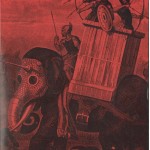
Elephants, after all, were the tanks of the ancient and medieval world. Typically trained to carry men in small towers – as many as 14 – they cast terror into opposing armies, especially among warriors (or horses) that had never seen this beast before.

As only the most aggressive were employed they were consummate warriors, not just carrying soldiers to the enemy but personally wreaking havoc on the foe and on opposing fortifications. They could survive naphtha grenades, arrows – burning or otherwise – and even multiple musket shots.  Then there was their fury: ‘One of the elephants, lifting Ilak Khan’s standard-bearer in his trunk, hurled him into the air and then catching him on his steel-clad tusks, cut the wretch in two, while others [elephants] threw down riders from their horses and trampled them to death.’ (Nossov, 39).

Yikes.

Elephants never entirely caught on in the armies of the old, antique Mediterranean. Hannibal, for example, had only thirty seven with him when he crossed the Alps. The largest eastern elephant army that Beachcombing has found reference to was an extraordinary nine thousand strong (including pack animals?). These creatures did though appear, from time to time, in the armies of Syria, Egypt, Carthage and latterly those of Rome.

The last reference that Beachcombing has come across to elephants being used by a Mediterranean army was in the force of that all too Roman idiot Didius Julianus (obit 193 AD), who brought some almost untrained elephants – possibly drafted from a circus – to protect Rome in the year of his death.

The Romans, however, did face elephants in the field again as Persia had elephants from India and employed 700 – remember Hannibal’s 37? – in the Persian-Roman war of 227. There were then, for several centuries afterwards, Roman-Persian and Byzantine-Persian battles where the Romans had to fight off elephants .

A good rule seems to be that the further to the east you go the longer elephant warriors survived. The Indians continued to use elephants on the battlefield into the eighteenth century against the Brits. Beachcombing actually knows of one reference in the Indian mutiny (1857) when that old reprobate/hero Nana Sahib was spotted riding towards the British on top of an elephant. That is not, of course, the same thing as actually doing battle from an elephant. Beachcombing suspects that Nana had far too much sense to attempt that.

In south-east Asia the last references come from the nineteenth century. The last reference, indeed, from anywhere in the world that Beachcombing has been able to find was a battle between the French and the Vietnamese in 1885, when French infantry fled before the beasts of the Nguyen Emperor. The elephants were only driven back with much effort by imperial rifles.

The Siamese continued to use elephants till the end of the nineteenth century as canon carriers. But here we can no longer talk of ‘charges’ as the elephants stood at a distance while artillery, mounted on their backs, was fired.

Elephants, of course, were then used extensively in the twentieth century as beasts of burden in wars, most tragically perhaps in Vietnam, where US planes and helicopters killed columns of ‘red’ elephants.

After all, an elephant could survive hundreds of arrows and tens of musket balls but mounted machine guns, napalm and vulcans were just too much for even the bravest pachyderm.

May the elephants of battle sleep in peace!

Beachcombing thought that the latest cavalry charge would be in the 1950s or the 1960s, but he was about half a century too early. Does anyone know of any elephant charge in the twentieth century – perhaps improvised: particularly given that so many elephants were at the front helping shift heavy objects? drbeachcombingATyahooDOTcom

***

1st Sep: John Kistler author of the brilliant War Elephants wrote to Beachcombing over Beachcombing’s unwise speculations about a charge c. 1943. ‘All the elephants used in WW2 were logging elephants and not prepared to charge at gunfire, they would run and hide, sensibly, under fire. Actually the Burmese rebels still use elephants but no charges, just for riding and cargo. If you want to count fake elephant charges, I believe Benito Mussolini’s son made a movie about the glorious Roman Italian empire of old called Scipio, where Scipio defeated Hannibal. In the movie he actually has a dozen or more elephants charge, but he also has a few elephants truly speared to death to make the movie realistic. So it is a charge to their deaths actually, for a film.’ Beachcombing is tracking down this film – Scipio Africanus (1937) – and will offer a review for next year’s Elephant Week (if he manages to keep on blogging for that long).  Thanks to John!

An elephant invades Italy in 1936 July 24, 2010

Posted by Beachcombing in : Ancient, Contemporary

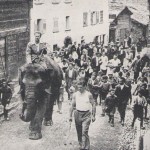
Night four of Beachcombing’s Elephant week extravaganza is taken up by Richard Halliburton’s attempt to cross the Alps in 1936 on the back of an African elephant. Halliburton, a fun kind of fellow, managed to hire (and insure!) an elephant named Elysabethe Dalrymple (aka Dally) from Paris zoo – her greatest love was to play a giant harmonica – and booked a place on a freight train going to Switzerland.

‘The zoo-keeper said that he frequently took six children at a time for a ride on Dally’s back along the quieter paths about the park. The children’s saddle I could use for myself and baggage.’ 75

But the truth is that Halliburton’s greatest challenges were not those that had faced Hannibal in 218 BC.

We left the Bois in perfect order, Dally stepping along gaily at four miles an hour. But outside the zoo we entered the Porte Maillot – a typical Paris square seething with motor traffic, and Dally, brought up in the quietness of the Bois, had never seen such a bewildering sight. She began to tremble and shy like a timid horse. One experimentative taxi-driver, approaching from behind, sounded his electric horn, full blast, within two feet of Dally’s tail. The poor beast leaped panic-stricken into the air, and then with trunk turned skyward, and trumpeting in terror, she bolted wildly and blindly down the Avenue de la Grande Armée at what seemed like forty miles an hour. I was the first of her burdens to be flung off – then the typewriter, then the suitcase and camera. One final toss of her head got rid of the yelling mahout… and some six thousand pounds of elephant went hurtling along the street, scattering pedestrians and cyclists, banging into taxi cabs, oblivious of ever obstacle. Frenchmen shouted and Frenchwomen screamed. Gendarmes and urchins ran after her as she plunged on, leaving consternation and destruction in her wake. A solid mass of motors halted by the traffic light finally blocked her course, but not till she had bolted nearly half a kilometre. Jammed in the middle of this tangle of motor-cars, Dally, still squealing frantically, found herself trapped. The chauffers in the surrounding cars, once they got over their surprise, had the good sense to hold their places and keep Dally imprisoned till the pursuers overtook her. (76)

Dally was led back to the zoo by her trainer and was given months of traffic training: Halliburton reasoned correctly that they would be meeting rather a lot where they were going… When Halliburton came back, after some japes in the USSR, then Dally was ready. Their adventures began in Martigny in French-speaking Switzerland. 

By the time that we got clear from Martigny darkness had set in. However, that was my plan, for there would be less traffic and less heat for our first day’s march. Our little truck, loaded down with hay and meal, went ahead to warn approaching motorists. The warning had to be repeated at least three times before they grasped the fact that there was an elephant coming up the road. A hundred boys on bicycles offered sufficient protection from behind. But there was, at first, no warning for the Swiss peasants along the way. They looked up from their cottage doors to half-see, in the darkness, the shadow of an enormous, unearthly beast hurrying past – the first elephant most of them had ever beheld. Some of the women and children screamed and fled. Some of the men stood in their tracks too astonished to move or to speak. No elephant had come this way since Hannibal’s herd of thirty-seven struggled up this same road more than twenty-one hundred years ago. 296

After several days travel they finally arrived at St Bernard’s monastery and passed down into Italy. It was though the year of Italy’s invasion of Abyssinia and Dally was about to meet her greatest test.

With every step forward into lower altitudes Dally’s spirits rose. Only for the first hour did the rarefied air make our progress slow. After that Dally no longer stopped to get her breath, but scampered along downhill in the Alpine sunshine, ready, apparently to break all records on her march to Rome. With the crest of the mountains behind us, Harel [Dally's handler], who ran beside the elephant, and I, who bounced on her shoulders, were in a gay mood. No more freezing winds, no more mountain sickness, only sunshine and wine and singing days ahead. We let Dally have her beloved harmonica, and the valley rang with happy elephant music

But we gave ourselves over to rejoicing too soon. At about five thousand feet we rounded a curve and ran head-on into the mountain manoeuvres of the Italian Army of Northern Italy. Forty thousand soldiers sprang up all around us. The slopes and woods suddenly swarmed with them; they filled the road, they and their military trucks, and their artillery, and their tanks and cavalry. The Roman legions were as surprised to see us as we were to see them. Most of the soldiers were youngsters, who stood in astonishment, at the sudden appearance, right in the midst of their war-game, of an elephant – especially an elephant playing a harmonica. Discipline went to pieces. Whole companies came running up from all side with shouts of ‘L’elefantessa, l’elefantessa!’ as we lumbered by. Some of them no doubt thought we were the Abyssinians attacking from the rear.

Through this military scene we had ploughed our way on down the road for perhaps half a mile, when disaster fell upon us. The heavy artillery, firing real shells at an imaginary enemy in a Government range across the valley, suddenly let go fully blast with six or eight guns from a hidden battery not two hundred yards away. The concussion coming so unexpectedly was ear-splitting. The whole earth shook, and the very air, caught between two mountain walls, vibrated with the echo.

Poor Dally! The bombardment had found her weak spot. Being a musician she had a horror of blasting noises. An especially raucous motor-horn had been the cause of her runaway down the Paris boulevard. This fear I thought she had outgrown. But I was wrong. It was only automobile noises she had become used to – not artillery fire. When this terrifying, deafening explosion went off just ahead, the startled elephant rose on her hind legs her eyes wild with fear, trumpeted frantically, wheeled about in a flash, and dashed back up the congested road in an even more uncontrollable panic than that which had seized her in Paris. This paroxysm had come so suddenly neither Harel no I was prepared. I was thrown from the elephant’s back as she wheeled, and landed clumsily in the dust. The guide-rope which Harel used to lead her through the masses of troops and baggage trains was jerked from his hand, trod upon and ripped to shreds, as the three-ton animated tanks charged the armies of Rome. (312-13)

Dally was eventually calmed but her invasion of Italy was effectively over. Halliburton, one of life’s nice guys, gave Dally a brand new harmonica as a parting gift and headed back to the States for new adventures.

There is a far more earnest book about Hannibal’s transalpine experience by a British engineering student, John Hoyte, another one of life’s nice guys, in 1960. But Hoyte’s Jumbo (who came from Turin zoo), is not, to Beachcombing’s mind, the equal of Dally.

Beachcombing has been looking for photos of Dally: do any readers have any others? drbeachcombingATyahooDOTcom

***

1 Oct, 2010: Finally Beachcombing has links to photos of Dally and, thanks to Fernando FS, a link to a film as well! Beachcombing’s eyes glistened. Fernando has a fascinating article on Halliburton’s route in Spanish. For some reason this link is dead this evening but Beachcombing presumes/hopes it will be back up in a jiffy: btw don’t mention homeopathy to Fernando, he has strong feelings.

Elephants in eighth-century Honduras? July 23, 2010

Posted by Beachcombing in : Medieval

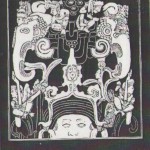
For the third night of Elephant Week, ‘the freakish fringe history of the largest land mammal’, Beachcombing wants to share a remarkable series of images relating to Stela B at the Maya site of Copán in what is today Honduras.

Professor Elliot Smith’s wrote an extraordinary book in 1924 alleging contact between the Maya and Asia in the eighth century.

His proof?

The stela above is supposed to show two elephants being driven by mahout! Beachcombing has crudely put red around the two elephants.

Elliot Smith had the decency, unlike some we can mention, to accept that this elephant was not actually brought to Honduras, but that the ’motif’ arrived with travellers from south-east Asia, about nine centuries before most people think that they got to central America.

The difficulty is that the ‘elephants’ have also been identified as tortoises, macaw (the establishment view), whales, tapir and even woolly mammoths!

Certainly tracing any animal here is a bit of an uphill battle. Beachcombing took ten minutes just to find the trunks, but then he’s a special case.

As one early critic had it: ‘To sum up the superficial for and against the elephant interpretation: Professor Elliot Smith’s theory hangs upon recognising as an eye and an ear of a tuskless elephant what most critics regard as a nostril and an eye respectively of a macaw.’

Much has been made of the fact too that the ‘elephants’ are missing tusks (that is hardly surprising given the nature of the carving), but far more seriously the characteristic elephant ears!

So we leave readers with Elliot Smith’s re-elaboration of Stela B.

Is this a monument to his genius, casting a long, penetrating light across the dark continents, back from Honduras towards the Nile Delta?

Or is it, rather, a monument to the sheer colour and sparkle of human intellectual perversity?

Beachcombing has his opinions but he doesn’t want to offend anyone, least of all Mormons, and so to bed...

If anyone has any other references to North American ‘elephants’, Beachcombing would love to hear. drbeachcombingATyahooDOTcom

He was sent a brilliant example last night. Thanks John from Oregon!

Mongol elephants in America? July 22, 2010

Posted by Beachcombing in : Medieval

For the second article of Elephant Week Beachcombing thought that he would introduce one of his favourite early nineteenth-century books.

Just let the title wash over you…

John Ranking’s Historical researches on the conquest of Peru, Mexico, Bogota, Natchez, and Talomeco in the thirteenth century by the Mongols, accompanied with elephants: and the local agreement of history and tradition with the remains of elephants and mastodontes found in the New World (London 1827).

And you thought that Asians arrived in America only in the sixteenth century and that there were no elephants in the new world in historical times?

But this book is so much better than even the title suggests. Indeed, there are many wonderful moments including the search for carnivorous North American mammoths (not extinct at time of publication) and the suggestion that an animal on an Iron Age British-Celtic coin is a tapir…

Told quickly Ranking’s central theory goes as follows. In 1274 a Mongol invasion of Japan was repulsed by an enormous storm: this is a matter of record. Ranking though argues that some of these ships (with Mongols and elephants) ended up in the New World. His evidence? The following passage from ‘El Inca’ Garcillasso de la Vega’s  writings.

‘I shall relate,’ says Garcillasso de la Vega [obit 1616, pictured above], ‘what Pedro de Cieza de Leon [obit 1554] told me that he had heard in the province where the giants arrived. They affirm, said he, in all Peru, that certain giants came ashore on this coast, at the Cape, now called St. Helen’s, which is near the town of Puerto Viejo. Those who have preserved this tradition from father to son, say, that these giants came by sea, in a kind of rush boats, made like large barks; that they were so enormously tall, that from the knee downward, they were as high as common men; that they had long hair, which hung loose upon their shoulders; that their eyes were as large as plates, and that other parts of their bodies were big in proportion; that they had no beard, that some went naked, others were covered with the skins of wild beasts and that they had no women with them. After having landed at the Cape, they established themselves at a spot pointed out to them by the inhabitants, and dug very deep wells through the rock, which to this day supply excellent water. These giants lived by rapine, and desolated the whole country; they say, that they were such gluttons, that one would eat as much meat as fifty of the native inhabitants; and that for a part of their nourishment they caught a quantity of fish with nets. They massacred the men of the neighbouring parts without mercy, and killed the women by their brutal violations. The wretched Indians often tried to devise some means to rid themselves of these troublesome visitors, but they never had either sufficient force or courage to attack them.*Secure from all apprehension, these new monsters thus tyrannized for a long while, committing the most infamous enormities. Divine justice sent fire from heaven with a great noise, and an angel armed with a flaming sword, by whom they were destroyed at one blow. To serve as an eternal monument of the vengeance of God, their bones and skulls were not consumed by the fire, but are found at the very place, of an enormous size. I have heard Spaniards say, that they have seen bits of their teeth, by which they judged that a tooth weighed more than half a pound. As for the rest it is not known from what place they came, nor by what route they arrived.  I learned this year [1550, aged 11!], when I was at the Ville des Rois [Lima], that during the viceroyalty of Don Antony Mendoza, in New Spain, bones had been found there of a still greater size than the above mentioned. I also heard that, in the city of Mexico, some had been found in an old sepulchre; and also in another place in the same kingdom. We may infer from this, that these giants have existed, and that what authors have written about them is not fabulous. Another wonderful thing is, that at Cape St Helen’s there are springs of liquid pitch, which are fit for the purposes of ship-building.’

Beachcombing is sure that the reader will have noticed the barely hidden references to Mongols disembarking from their ships on elephants. They certainly did not escape Ranking who wrote in a note (relative to the asterisk in the text): ‘The elephants would, no doubt, be defended by their usual armour on such an extraordinary occasion, and the space for the eyes would appear monstrous. The remark about the beards, &c. (many of the Mongols have no beards…) shows, that the man and the elephant were considered as one person.’

Now, of course, storms do bring sea travellers to places that they would not normally dream of going: the Vikings, for example, went beyond Iceland with the help of such tempests. But Beachcombing has been able to find no proof that there were any elephants in the Mongol invasion ships bound for Japan. Not surprising given the appalling problems that Hannibal had in getting his few elephants across the Rhone: never mind poor Pyrrhus bringing elephants over the Adriatic.

Beachcombing feels bound to note too that legends of invaders coming from the sea are common to many maritime cultures: the sea brings seagulls and death and makes those living beside it itchy with worry. (Beachcombing once spent three terrible months in a Breton seaport and the noise and the smell filled his dreams.) In this light, note how the story Vega reports seems to involve initial cooperation between invaders and the locals, ‘a spot pointed out to them by the inhabitants’, a classic legendary invasion motif.

There was perhaps an attempt here on the part of a pre-Columbian population, taken up enthusiastically by the Spanish, to explain large bone remains that they had found. Fossils often excite legends because they demand explanations: indeed, much of Ranking’s book could be seen as a continuation in that tradition. (For fossils and legends Beachcombing would recommend Peter Dodson and Adrienne Mayor, The First Fossil Hunters: Paleontology in Greek and Roman Times). Then the pitch springs may be the origin of the legend of the angel of death?

Ranking though was already on his jolly up the Mountains of Madness and nothing was going to hold him back. There follow another three hundred and fifty pages of pure, magical delirium.

Beachcombing recommends this book in the highest possible terms not least because Google has actually managed to digitalise it getting almost all the pages right and not smearing the print too much. A rare achievement.

He is also very interested, should any reader be able to help him, in other ‘evidence’ for elephants in pre-Columbian America especially in pre-Columbian objets d’art – note that the reader does not have to believe the ‘evidence’!  drbeachcombingATyahooDOTcom

Elephant Week is dedicated to Beachcombing’s dear friend and notable elephant lover Raoul who helped the Beachcombings put up a curtain rail a few days ago.


Execution by elephant July 21, 2010

Posted by Beachcombing in : Ancient, Medieval, Modern

And so begins Elephant Week – for the next seven evenings an article will be given over to the freakish fringe history of the largest land mammal.

First of all, this extraordinary passage from the work of Louis Rousselet, India and its Native Princes (1882). In chapter ten of India – first published as L’Inde des Rajahs: Voyage Dans l’Inde Centrale in 1875 – Rousselet describes his visit to Baroda (Vadodara) in north-western India.

In an attempted revolt by the Waghurs, ‘a half civilised and very warlike race’, a local locksmith was found guilty of helping Waghur prisoners to escape: ‘and the unhappy locksmith was condemned to the punishment of death by the [sic] elephant’.

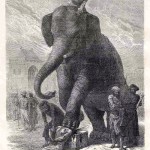
This punishment is one of the most frightful that can possibly be imagined. The culprit, bound hand and foot, is fastened by a long cord, passed round his waist, to the elephant’s hind leg. The latter is urged into a rapid trot in the streets, and every step gives the cord a violent jerk, which makes the body of the condemned  wretch bound on the pavement. The only hope that remains for the unhappy man is to be killed by one of these shocks; if not, after traversing the city, he is released, and, by a refinement of cruelty, a glass of water is given him. Then his head is placed upon a stone, and the elephant executioner crushes it beneath his enormous foot.   (p.119)

The civilised Raj? This is enough to have Amnesty reaching for a thousand telephones.

But death by elephant was once relatively common in areas where elephants had been domesticated.

Typically, there were two forms.

(i) As here a specially-trained elephant executioner was sent in to trample or crush the condemned. Maccabees 3, for example, describes death by elephant in Egypt in the third century B.C. In fact, there is reason for thinking that the lock-smith got off lightly. In some sub-continental states elephant executioners were expected to prolong the suffering of the prisoner by throwing him in the air or by crushing the limbs before going in for the kill.

(ii) In medieval India, under the sultans, elephants, instead, employed blades to kill the condemned.

The elephants which execute men have their tusks covered with sharp irons with edges like those of knives. The drivers mounts the elephant, and, when a person is thrown in front, the animal winds his trunk round him, hurls him into the air, and catching him on one of his tusks, dashes him to the ground, when he places one of his feet on the breast of the victim. After this he does as he is directed by the rider, under the order of the Sultan. If the Sultan desires the culprit to be cut in pieces, the elephant executes the command by means of the irons above described; if the Sultan desires the victim to be left alone, the elephant leaves him on the ground, and (the body) is then stripped of its skin [not presumably by the elephant: B]Dowson in Kistler 200)

Talk about ‘cruel and unusual’.

When did execution by elephant finally die out in Asia? Beachcombing fears the twentieth century, though he has no proof. yet… drbeachcomingATyahooDOTcom

(Note that the illustration that heads the present piece came from the pen of Emile Bayard, was based on Rousselet’s experiences at Baroda and was published in Le Tour du Monde, 1868. Rousselet was an enthusiastic photographer. Is it possible that…)

Elephant Week is dedicated to Beachcombing’s dear friend and notable elephant lover Raoul who helped the Beachcombings put up a curtain rail a few days ago.

Page 1 of 212