The Republic of New Afrika April 2, 2012
Posted by Beachcombing in : ContemporaryThe Forgotten Kingdoms series continues with an interesting and ultimately bloody recent experiment in nationhood: the Republic of New Afrika [sic]. Created 31 March 1968 the RNA was a post Malcolm-X attempt to create a homeland for Afro-Americans who could not be, the founders believed, represented or protected by the US government.
The brain-child of several black radicals it resembled other experiments in extremism. Neo-nazis and, more honourably, libertarians have, after all, similar contemporary schemes for taking over a given corner of the North American continent and seceding. Many Texans and a handful of Alaskans harbour, of course, comparable ambitions.
It has to be said though that the RNA went to greater lengths to create their bit of Africa in the northern hemisphere. For one the RNA mapped an area of the south-eastern US where the new country would be based: Alabama, Georgia, Louisiana, Mississippi, and South Carolina. Beach is tempted to add, ‘good luck with that!’
For seconds, it formed a RNA government in waiting, presumably to negotiate its extraordinary claim for 400 billion dollars as compensation from the US government for slavery: and this in the 1960s when money was still worth something. The plan was that black Americans would be allowed to decide on their citizenship and many could then reverse the Great Migration and return to a new homeland on the Atlantic coast.
The RNA attempted to open negotiations with the Nixon White House: that naturally ignored the ‘peace-feelers’ and so the RNA was forced to make Jackson a provisional centre of their new government. Attempts to go further failed or led to blistering violence. In 1969 at the New Bethel Baptist Church gunfights broke out with the ‘occupying powers’. Then in 1970 the RNA put down their claim to their future territory by taking over a single homestead at Jackson in 1971. A policeman was killed in a raid there and eleven members of the RNA were arrested and charged and tried for murder including the then president Imari Obadele.
The RNA later simmered down to being ‘just’ another pressure group: though the struggle for reparations for slavery was first articulated in the RNA ranks. It is an idea that, while not mainstream, continues to fascinate elements in the Afro-American community to this day. A final echo of the reconstruction promise for ‘fifty dollars, forty acres, and a mule’ for every freed slave?
Beachcombing is always on the look out for forgotten kingdoms, modern or ancient, failures or, however briefly, successes. Drbeachcombing AT yahoo DOT com Even shot up buildings in Jackson.
In Praise of the Hindoestanen February 29, 2012
Posted by Beachcombing in : Contemporary, ModernBeachcombing has run, over the months, a series of forgotten kingdom posts: lands and peoples that time forgot. Sometimes he has stretched this definition to its elastic limit by including forgotten communities: a personal favourite, for example, were the Confederates who fled from Lincoln’s peace and came to settle in Brazil. Another group that he has become increasingly fascinated by are the Hindoestanen of the modern Netherlands, a people that, by some estimates, number almost two hundred thousand. The Hindoestanen are, of course, of Indian descent, but what is interesting is how they arrived in Holland, for they did not come directly from India but by a (very) round-about route.
Essentially from 1873 to the time of the First World War the British allowed/encouraged Indian workers to travel from the Raj to Surinam in Southern America: Surinam being, of course, at this date, a Dutch colony, a younger sister of the more important Dutch possessions in the Pacific, possessions that the Japanese would chew up a generation later.
Surinam survived the Japanese onslaught and the Hindoestanen became an important part of that multi-ethnic state speaking a mix of Dutch, Hindi and other sub-continental languages. They had different religious backgrounds and the slogan of the Hindoestanen political party in Surinam was the pleasing: ‘Hindu, Moslem, Sikh, Christian; they are all brothers; India is the mother of them all!’ Par for the course in Delhi, of course, but a strange phrase to hear in downtown Paramaribo.
The Indians had come as indentured workers – about 30,000 of them of whom 20,000 decided not to return to India. But if they began as a poor community they quickly became one of the elites of the colony. Indeed, so invested were they in Dutch rule that the Hindoestanen often opposed decolonization when it finally became an issue in Surinam. Certainly, tens of thousands of Hindoestanen wisely got out with independence in 1975 and went to their step-mother, the Netherlands.
The Hindoestanen now established themselves in cold Holland, having gone anti-clockwise around the world, from northern India, to dank Surinam to the dykes of the Low Countries. As such they resemble some other communities moved around like checkers pieces by colonial governments, that had to then move again when the imperial draughts board was finally shut up in the mid-late twentieth century.
Another example are the Ugandan Indians who that idiot Idi Amin chased out of his country: honestly, who wouldn’t want an affluent, well-educated Indian middle class to tax?!
Interestingly India’s new found power in the world has not yet been welcomed by the European Hindoestanen, most of whom see themselves as Dutch rather than Indian. But with the shifting and peculiar identities of modern continental Europe, Mother India might yet come and appeal successfully to the great, great grandchildren of those the British loaded onto boats bound for Dutch Guyana.
Any other twice or thrice-moved peoples: drbeachcombing AT yahoo DOT com
***
29 Feb 2011: Southern Man writes in (and the emails below substantiate this in different ways): ‘Two groups that have moved endless times. First, the Jews who have been kicked around like a football from country to country: there was recent news, for example, of the evacuation of the last Yemeni Jews from their country now heading to the New World. Second, African slaves who were moved around through sales and then by daring escapes for freedom. Think of those slaves brought to the US and then their grandchildren brought back to Liberia in Africa.’ Andy the Mad Monk writes in: Jakub has a fascinating side light on this. Following your post on the Hindoestanen, here is another many times moved community that might be of interest: a slave settlement. Speaking of Paramaribo, there’s also a significant and quite ancient community of Jews in Surinam. Louis K, meanwhile, writes in about the Hindoestanen: ‘Being Dutch myself, I could not help notice that there are some trends within the Hindoestaanse Gemeenschap (Hindustan community) that seem to have escaped your attention. As the subject of ‘Identity’ (thanks to mr. Geert Wilders) is now ‘hot’ within Dutch society, for all different immigrant and non-immigrant cultures, a lot of Hindustan teenagers are turning to ‘Mother India’ to pronounce their ‘Indianischness’. Which is in turn roundly condemned by the older generation, who still remember that THEY came from Surinam. However, in The Netherlands, the Surinam Identity was, until recently, seen as a negative thing, and was splintered along ethnic lines (Indonesians, Hindustani, Ex-Slaves and Escaped Slaves, with a smattering of Chinese and Levantines) and the younger generation only knows The Netherlands. But I have read that they suffer from the same problem as US Afro-Americans that “return” to the motherland: Next to no knowledge about what is going on, and culture shock, because all they know about India is from the Bollywood movies that they see.’ Then pulling in the other direction there is Chames: I remember a recent meeting of the Hindustan community in Netherlands organised, in part, by the Indian Embassy there. One Hindustan speaker stood up and said words to the effect that ‘we are Dutch not Indian’ and was cheered ‘to the rafters’. Thanks SM, Andy, Jakub, Chames and Louis!
30 May 2012: Sword&Beast writes in ‘Your post on the hindustani of course got me interested. Living in Suriname itself for 4 months now, I have not much to add to your instructive post and the comments afterwards. Maybe just a picture from Suriname itself: the hindustani community represents, today, around 35% of the Surinamese population. Even though the community had reservations on the pace towards independence, and many indeed left in 1975, they had a major role in it. Its main party, the VHP, has more than 60 years, and its first president, Jagernath Lachmon (http://en.wikipedia.org/wiki/Jagernath_Lachmon), is revered as one of the founders of the nation. Besides being well organized and generally afluent, the community is proud of its heritage, with temples, festivities and excellent food. One recent example was the hosting, last week, of the Miss India Worldwide Pageant (http://miww2012.com/), with contestants with indian ascent from Sri Lanka to Scotland. By the way, the girl from neighbouring Guiana won it. ‘ Thanks S&B!!
P.R.A.W.N.S. October 5, 2011
Posted by Beachcombing in : Contemporary*** Dedicated to Ricardo***
One of teenage Beachcombing’s favourite films was Ealing Studios fabulous Passport to Pimlico that describes a small London borough seceding from the United Kingdom in the years after the Second World War. Classic scenes include a tube train jittering to a halt and a ladder coming down through the roof so Pimlico's policeman can check the passports of outraged men in bowler hats.
There’s a lot to be said for such micronations – and, indeed, Beachcombing has tried to give them some publicity in the past. If according to many pundits they represent an infantile regression into the local and particular, to Beachcombing’s mind they are the proof that sovereignty is vested in individuals and communities: not governments, their baubles or, God forbid, their bloated bureaucracies.
It is with great pleasure then that Beachcombing would like to give some publicity to a recent attempt to redraw the nation-state, one that escaped his notice the first time around, but that Ricardo has pointed out to him. In January 2000 the Sussex village of Ashurst Wood (UK) unilaterally declared independence and founded the People’s Republic of Ashurst Wood Nation State (Prawns). Road blocks were mounted and according to Beach’s source, The Independent, ‘Prawns claim that King Ethelred granted the village of Ashurst, as it was then known, immunity from taxation in 1164 after he was taken ill in the area’.
This is doubtful as Ethelred had been dead two hundred years by then, but given the Independent’s recent record on truth, Beach is betting that this was that paper’s mistake rather than an error on the part of the newly-liberated citizens of Prawns.
And how do you go about setting up a nation state? Scour the archives. The historical justification – in this case a charter – helps. Then, crucially a letter was sent to the Queen and the then Prime Minister, Tony Blair. Beach is betting that the Prawns never got a reply.
And why bother? Back in 2000 Prawns leader Mark Eichner, 43, a company director, said: ‘The motivation lies in the fact our village was losing its direction and identity. It started as a real joke in the pub but is now less so. A lot of people have been involved. Where it will go from here, who knows, but it is growing. We are sure to have an annual independence day.’
Did Prawn live on, in the hearts of at least a couple dozen activists? Or has it now withered on the vine of good ideas? Beachcombing would love to know. He would also love to know of any other recent attempts of lighthouses, parishes, valleys, islands and oil rigs to gain independence, particularly in the UK: drbeachcombing AT yahoo DOT com As one of the characters put it in that magnificent film of sixty years ago: 'We're English and that's why we're Pimlicans!'
***
6 Oct 2011: Talk about the perfidy of memory and the stupidity of Beachcombing in daring to trust his. Ed from secretplacesofitaly (look out for dwarf envy) writes in to say: ‘Thanks to the magic of Wikipedia: I see that Betty Warren’s exact line was, ‘We've always been English and we'll always be English; and it's precisely because we are English that we're sticking up for our right to be Burgundians!’ Pimlico had been gifted to the lord of Burgundy. Amanda has sent in a rich selection of British micronations: Let’s start with Forvik quoting from the Forvik site: 'To test my ideas [about the illegitimacy of Scottish or British rule in the Shetlands], a well-wisher gave me a small island (Forvik). I declared it a Crown Dependency and then spent every penny I had - first to design and build a boat to get access, then to build a house. Forvik is now like Shetland in microcosm. Once the lightbulb went off in my head that Forvik represents the true status of Shetland and that the existing authority is actually an illegal regime, it made it easy to answer questions like 'Is it legal?' - ''Don't you need permission?' and so on. The most significant point is that there has so far been no official challenge to any of my 'unlawful' activities. (I stopped paying Income Tax, VAT and Council Tax, built a house without planning permission, put a car on the road with Forvik number plates and tax disc and various other disobedient actions). The counter at the top of the page tells you how long these have been going on without challenge. The authorities have gone to extraordinary lengths to avoid engaging with me because they know they cannot justify their authority here. Then, as a meso nation, there is Mercia (the English Midlands). ‘We, representatives of the Mercian Constitutional Convention, have assembled here today in the heartland of Mercia to reaffirm and declare the legal independence of the region under The Constitution Of Mercia, which we have now published and which is available to all the people of the region upon request. We have spent over two years in careful deliberation and embrace this Constitution in order to re-create Mercia as an autonomous region, constructed as an organic democracy, based on holistic principles.’ Interestingly the Mercians have attempted to take possession of the recently discovered Staffordshire Hoard: MERCIAN nationalists have claimed ownership of the Staffordshire Hoard for the people of Stoke-on-Trent, Cheshire and the West Midlands. The Acting Witan of Mercia wants to create a separate nation state, made up of the 20 shires, including Staffordshire and Cheshire, which formed the Anglo-Saxon kingdom of Mercia. They claim the Crown and UK Government has no legal authority over the region's citizens, because William the Conqueror and his Norman army took Mercia by force in 1066. Yesterday Jeff Kent, convener of the Acting Witan, or government, of Mercia, visited the Potteries Museum and Art Gallery, in Hanley, to claim ownership of the Staffordshire Hoard, on behalf of the people of Mercia. You get the idea. Then there is Sealand (another post another day). And Amanda also dug up this article (with a fabulous picture) of the beginning of a United Nations of Micronations. James M, meanwhile, who lives in Pimlico (!!) writes in to tell us that ‘one of Pimlico's neighbouring boroughs, Brixton, is trying to get its own currency working’. James also corrects the Independent’s date: According to Wikipedia, PRAWNS said its independence via Aethelred came in 979, when he was alive. It would be interesting to have a gander at this charter. Thanks to Ed, Amanda and James M!
8 Oct 2011: Jonathan from A Corner of Tenth Century Europe write in on the question of Aethelred: 'Apropos of your recent micro-nations post, it would indeed be interesting to have a look at that Ashurst charter; very little if anything like it would be known. You can inspect summaries and texts of all Aethelred's known charters here: Nothing there looks even faintly relevant to me, certainly not from 979. In fact, none of Aethelred's surviving grants appear to concern Sussex at all. More importantly, you'll notice there's nothing there at all to any kind of lay community; noblemen, churchmen, churches, servants, yes, all those, but a village charter is a much later phenomenon. Perhaps the date's right and the king wrong! Perhaps PRAWNS have got something truly revolutionary in one of their attics! But until I see any more information, I'm inclined to call cobblers on the whole thing myself, sorry.’ Thanks Jonathan, let’s hope we haven’t put PRAWNS continued existence into crisis with this.
10 Oct 2011: Ersatz writes in with a fascinating case that it would be fun to better document: 'A micronation you may have missed, was the Republic of Sandtoft, which was unilaterally declared independent in, I think, 1977? Around that time, I was living and working in the Isle of Axholme, which is close to the border between Yorkshire and Lincolnshire. The isle, historically, was an island surrounded by frequently flooded marshy fenland. King Charles I gave over the project of draining this marshe, thus creating valuable farmland, to one Cornelius Vermuyden, and his company. The local people were not at all happy that they were to lose the fishing, wildfowling and hunting lands, and set up in opposition, sabotaging the works, destroying dams and pumps, and generally harassing the dutch. It is claimed that the king gave the tiny island of Sandtoft to Vermuyden, setting it legally apart from England, so that Vermuyden could build there a fort, and dispatch transgressors. In the 1970s the landlord of the inn there, on studying the history, realised that Sandtoft had never been restored to the crown, and that Vermuyden had abandoned it. It was not a Dutch dependency either, therefore, he surmised, it might stand alone as a sovereign state. He had passports printed and car stickers, "RS" (republic of Sandtoft) and on april fools day '77, or maybe '78, he closed the borders. The borders consist of three bridges, not more than a quarter mile apart. He demanded a toll, paid to charity, from all who sought to pass. The national media came. Oh. And he said he'd be no longer paying rates.... At this, the local council bristled, a joke's a joke, but... And they pointed out that they also could close borders. And all that Sandtoft needed came over those borders, including water, electricity, a big sewer.... The pub would be isolated from its supply of ale. I think the republic might have existed for about four days, I'm not sure. Can't find anything about it on the interwebs, so far, but I remember it personally. Some related axholme/ drainage stuff Thanks Ersatz!
28 Oct 2011: Sarah Washington very kindly writes in 'my story is simply that I lived in this village from age 3 to 10 (I left in 1975), so was delighted when my father told me of the Prawns action and we visited the village together to see how it was working out. I am pretty sure I have a little video footage but I am not sure if I interviewed anyone on camera, I will have to check. What I do remember is that we went into the post office which was now acting as the Border Control, and I chatted to the people there and took some flyers. They said that the village pub had become the defacto Prawns HQ. I don't have contact to any of them, but I guess it wouldn't be too hard to track down some of those involved.' Beachcombing is on this. Thanks Sarah!
World Centre September 30, 2011
Posted by Beachcombing in : Contemporary
Autumnal flu continues despite helpful advice from readers, a foot massage from Mrs B and neck-breaking kangaroo jumps from little Miss B. In this reduced, nay pitiful state, Beachcombing thought that he would celebrate a true forgotten kingdom: the World Centre of Communication. Its creators Henrik Christian Andersen and Ernest Hébrard were intent – in 1913/1914 no less! – on creating the perfect city where men and women from all over the world could come together in perfect communion. Here was the socialist utopian impulse, which had given birth to various garden cities, now rising to its magnificently unrealisable climax.
Naturally, the city never escaped the huge book in which its design was mapped out for dreamers to salivate over.
At the entrance of the city were two suspiciously Soviet-looking statues: an unsexed man and woman. Then at the centre of the metropolis, which stretched over miles of flat plain, was the Tower of Progress where reactionaries, conservatives, bishops and generals would presumably be thrown to their deaths. At least, at the beginning… If other human experiments in perfection are anything to go by the descendants of Andersen and Hébrard would soon have moved on to those with dandruff and glasses too.
There was a Temple of Religions, an International Court of Justice (for all the good that has done us), a Temple of Arts and an Olympic Stadium. The houses where the citizens dwelt – the best scientists, artists and thinkers in the world – were monumental and didn’t promise much in the way of ivy, birds’ nests or moss. Interestingly the World Centre was to be built next to the sea with that horrific din of seabirds. Was it forbidden to feed the gulls?

In its magnificent dirigiste sterility the project might stand as a critique of all supranational and international projects – the day this after a significant vote in Germany – which try to create peoples and communities with the stroke of the pen. The following comments by a contemporary reviewer Trystan Edwards is as good as an indictment as any
Messrs. Andersen and Hébrard would appear to have confused the universal with the particular, and to have imagined that their supermetropolis was a shrine which could house the very spirit of internationalism. But that spirit can only find expression in the different capitals of the nations of the world, each of which has its own separate characteristics. Englishmen could not tolerate London if they knew it was the only capital. We can appreciate the peculiar virtues of London, and can become resigned to the thought that there are virtues which it lacks, by dwelling upon the grandeur of Paris, Rome, Florence, Berlin, or other cities. That is the true internationalism. But if we tried to imbue London with all the virtues of all the other cities, many of which virtues are contradictory and incompatible, we should not only deprive our capital of such character as it has, but fail to endow it with any other character. Let it not be our ambition that London should have as many broad streets as has Berlin, for fairly narrow streets have a charm of their own. Let us keep its buildings low so that St. Paul’s may still dominate the city. But let New York be a symphony of skyscrapers. Every capital must jealously guard its own soul.

Any other cities of the imagination: drbeachcombing AT yahoo DOT com?
***
30/9/2011: Ricardo writes in about Urbicande a disconcerting project creating a new world on the internet. At least they can’t construct this with our taxes. The following comes from their English introduction: in all seriousness some intriguing stuff in there. ‘Issued of the collaboration between François Schuiten and Benoît Peeters, the “Les Cités obscures” series is now up to twelve albums published in French by Casterman, and translated into most other European languages. Although references to our world abound, especially in regard to architecture, those various books relate in fact to a parallel universe; one whose coherence is constantly growing with time.’ Beach particularly enjoyed ‘references to our world abound, especially in regard to architecture…’ Thanks, as always, to Ricardo.
28/10/11: Invisible proves herself an expert in urban planning too. ‘With reference to cities of the imagination, we cannot possibly forget Francois Marie Charles Fourier, that daring Utopian Socialist, who wanted to build Phalansteres of 1620 people each – “grand hotels” where the rich had the upper floors and the poor the lower and where all noisy occupations were segregated into one isolated wing. In his new world order, cooperative living would bring order out of chaos, and when perfect harmony was achieved, the seas would turn to lemonade. Here’s the Wikipedia overview because I am lazy and it has photo of a Phalanstere. “Fairies” for the lovelorn! But here are some primary sources, which give the full flavor of the man and his ideas. I particularly like the reference to giving all the dirty work to teenagers, who, Fourier believes, have a natural taste for filth. The Wikipedia reference to the North American Phalanx is interesting to me – in Ohio a number of visionary people were influenced by Fourier. A phalanx for more than a dozen families was built at the aptly named Utopia in Clermont County, on the Ohio River, about 30 miles from Cincinnati. The community worked hard, but went into debt in building a new phalanx building. Newer recruits were unhappy with the financial situation and in 1846, the property was sold to a spiritualist/free love advocate named John O. Wattles and his community of about 100 souls. In 1847 their hopes–and about 40 of their members–were washed away when their building collapsed in the flooded Ohio River. So, communities not completely in the imagination, but I don’t see any bottles of North Sea Lemonade at my grocer’s either. Obviously mankind has not yet achieved unity of action and harmonious collaboration.’ Thanks Invisible!
Favourite Historical Cities September 3, 2011
Posted by Beachcombing in : Ancient, MedievalAnd so it begins… Three hours sleep, arguments about syllabi, a terrifying public-speaking engagement, a walk in the wood (six snakes spotted – an omen?), sleep and stress. In short, the students are back and the cycle of sow/reap/harvest (lesson/field-trip/exam) is starting up once again.
They look (as always) like nice kids. But in an attempt to escape from it all, at least temporarily, Beach has been closing his eyes and enjoying relaxing images: a tip from a therapist several years ago. Two scenes keep replaying and replaying themselves in his head. One is from the Godfather and involves a tall, wiry mobster muttering ‘tell, Michael, it was just business’, before being bundled into the back of a killing limo (why is this restful?); and the other is a walk in Rome, c. 600.
Rome, c. 600…
Just saying those words is like breathing air in a pine forest, lighting incense or writing a sonnet in Old English (it can be done). Don’t get Beachcombing wrong, it is not, God forbid, the close proximity of Gregory the Great and his Angels or any other of the cast of the Romish soap opera: a Leo, a John, a cross-dressing Joan… With max respect to his uber-catholic wife, Beach is indifferent to males in red or white dresses.
Nor is it the odd Scythian or Gael or Copt on pilgrimage, whoring and hell-bending under St Peter’s keys: do they know how silly they look? It’s not even – slightly anachronistic reference – a psychopathic Saxon guard burning another Saxon guard’s house because one’s from the south and the other is from the north of the Humber.
It is the emptiness. The desolate, Ozymandian silence, the record-high brick-to-human ratio…
You don’t believe Beachcombing? Then consider the following. Estimates for the population of Imperial Rome range from about half a million to four or five million. It is never a good thing to take archaeologists or classicists at their word when they talk about population (many other posts, many other days). But at its height and through all the Republican and Imperial period, even when the capital moved north and east, this was an extraordinarily impressive metropolis. Rome was so big, indeed, that its bottle dump became a mountain: Monte Testaccio (pictured in part). This was a cosmopolitan city with a Syrian priestess of Osiris here, an Ethiopian eye doctor there, a tattooed Gaulish gladiator spilling his guts in the people’s sand pit… and that’s before we even get onto the sturdy, built-to-last houses and marvels.
But then came the grinding shut-up-shop of the Empire in the fifth century: the speedy now-you-see-it-now-you-don’t collapse of Roman infrastructure and with it the emptying of towns and cities from Bath to Carthage. No more parrots from India, no more silk from China, no more ostriches from Egypt, no more bears from Scotland… Rome itself experienced ‘shrinkage’ and became, like the other Italian centres that survived, a fort, one that the barbarians and the Byzantines could fight over to their hearts’ content.
If estimates for the population of classical Rome are suspect, estimates for the population of Dark Age Rome are simply laughable: you pick a number at random and look airily around the seminar room just daring someone to add or subtract five percent. But certainly the population was much, much lower than under the Empire: anything from three or four thousand to fifty thousand sounds ‘credible’ (whatever that means).
Let’s take the lowest sensible estimate for classical Rome – half a million – and the highest for Rome c. 600, about 50,000. That means that the population has not only been decimated, but that it had been decimated nine times over. And what is more these heirs of Rome (as fashionable ‘late antique’ historians call them) were resident in an echo box; a city that they no longer had the technology to repair, let alone recreate, where nine out of every ten residences were empty, where three and four story buildings gradually keeled over into the streets and where the Pantheon and the Coliseum looked down mockingly on the little people below, not so much dwarfs on giants’ shoulders, as blue-bottles buzzing around a cow’s backside.
Then, remember, perhaps the actual population of Imperial Rome was more like a million and the population of Rome c. 600 was more like ten thousand, a hundredth of what it had been. The psychopathic Anglo-Saxon guard, the tourist from Scythia and the Pope and his tiny administration could shout as loud as they wanted and no one would have heard them in their ghost town. No one was listening, not even the red baked tiles made in a happier age.
So forget golden age Baghdad, a flutter with flying-carpets. Forget Renaissance Florence under the tyranny of the charcoal burners from the Mugello. Yes, forget even – though it pains Beach to say this – London when Darwin and Huxley strolled to the British museums arm-in-arm and Indian princes visited Parliament. If the afterlife is an urban centre Beach hopes he’s going to seventh-century Rome, walking through his own private classical Gotham for ever and ever.
And I shall have some peace there, for peace comes dropping slow,
Dropping from the veils of the morning to where the cricket sings;
There midnight’s all a-glimmer, and noon a purple glow,
And evening full of the linnet’s wings.
Any other favourite historical cities? drbeachcombing AT yahoo DOT com
19 September 2011: Liverpudlian: ‘I come from a city (Liverpool) that has been depopulated in my lifetime, and where grass grows through the tarmac in some lost boroughs. However, enough of my moaning. What about this city for general desertion: Second Life. The virtual community has collapsed in terms of numbers in the last two years. You pass through empty streets with failed businesses. I’d prefer ancient Rome too, but you can visit second life…’ Thanks Liverpudlian!
The Cha-cha of the Dahomey August 31, 2011
Posted by Beachcombing in : ModernWhile reading up on the Amazons of the Dahomey kingdom (Benin) a long month ago, Beach came across a fascinating if little known figure, Francisco Felix De Souza (obit 1849). De Souza was a Brazilian merchant who came to the West Coast of Africa in the early nineteenth century and set up a huge slave selling concern just as slavery was becoming profoundly unpopular in Western Europe. It seems – accounts differ – that he had left Rio in disgrace as a criminal or an exile: though there is much about his time in his home country that is uncertain.
What is perhaps most interesting about De Souza is that he was one of these immigrants who assimilated perfectly into his new culture. So he combined Catholicism and local African fetish cults: St Francisco of Asisi and taboos about snakes. He was a slaver but was renowned for his kindness to the locals – he tried to reduce human sacrifice – and, above all, to welcome European visitors: who, one senses, came to be disgusted – the dirty frisson of one of the last of the slavers – and went away charmed. A typical sentence: ‘Mr Freeman had an interview also with the great slave-dealer, De Souza, who, notwithstanding his well-known and degrading occupation, received him very courteously.’ Though this kindness need not be exaggerated – this was after all a dealer in human freight; and there is a reference to the son of a German merchant leaving De Souza’s house with a good deal of money and being killed by one of De Souza’s many sons on his way home.
De Souza was also a power in the land. Having been placed in prison by King Adandonzan of the Dahomey, he helped King Ghezo to the throne in a well engineered coup d’etat. He was ‘Cha-cha’ to the new king: a mysterious phrase that became an office and that is still, to this very day, awarded to members of the De Souza family. Beachcombing has been trying to get in touch with the latest Chacha but, regrettably, without success. If anyone has his email… drbeachcombing AT yahoo DOT com
It is unusual for a colonial family on the west coast of Africa to survive for almost two hundred years. But here De Souza had worked up a simple strategy: he reproduced his genes with great enthusiasm. He had adopted a thousand-strong harem – did he say hail marys before going in? – and is said to have had almost a hundred children. Imagine how much happier Conrad’s Mr Kurtz would have been with a seraglio to hand? Nothing like an erotic dream to keep the darkness at bay.
The Dahomey became extremely agitated at the death of their beloved Cha-cha: ‘…when Da Souza died, a boy and a girl were decapitated and buried with him, besides three men who were sacrificed on the beach at Whydah’. And some months later: ‘Although Da Souza died in May, the The customs to his memory are not yet closed and the town is still in a state of ferment. Three hundred of the amazons are daily in the square, firing and dancing; bands of fetish people parade the streets, headed by Guinea-fowls, fowls, ducks, goats, pigeons, and pigs, on poles, alive for sacrifice. Much rum is distributed, and all night there is shouting, firing, and dancing.’
Beach though treasures most from his reading a description of a ‘picnic’ on De Souza’s estate. This a lovely evocation of a colonial family gone native from a British visitor.
A splendid palm-oil plantation was before me, thickly set with palm trees, intermixed with corn, cotton, yams, and cassada, according to the soil; the ground being undulating, sometimes high and dry, at other places oozing and low. The proprietor was a liberated African from Bahia [Brazil], originally a Mahee; and the plantation in the highest order. Arrived on the ground, we smoked a cigar under the shade of a cluster of palm trees, while the lord of the soil brought specimens of the palm nuts for our inspection. In about an hour the Da Souzas were all fast asleep on mats; presently awaking, a canteen was produced, and I was asked to partake of some Brazilian rum (casash), which good breeding even would not allow me to accept. Understanding but slightly Portuguese, I began to think I must have mistaken the invitation, and felt satisfied there was some misunderstanding when the contents of another box were exhibited – some meat cooked in rancid oil, biscuit, and yams. I, with pretended gout, joined in the repast, and, after another cigar, gladly took a walk round the grounds, not in the best of humours, imagining; that I had rather grievously mistaken the meaning of the invitation, or been well paid for accepting one from a slave-dealer. By a circuitous path, we again came to the palm copse, now like the oasis of the desert, a welcome spot. The charm of Aladdin’s lamp could not have wrought a greater change : a milk-white cloth was spread on mats, and was now covered with every delicacy—wines of France, Spain, Portugal, and Germany; whilst every article, even to the coffee cups and saucers, was of solid silver.
De Souza was apparently the inspiration for a Bruce Chatwin novel, The Viceroy of Ouidah and in a film remake of the same ‘De Souza’ was played by Klaus Kinski!
***
16 Sept 2011: Luis is a star: ‘I’ve just finished reading about Cha Cha of Dahomey. So you want their email address? I didn’t find it but I got much better, their facebook page‘ Wow!
The Kingdom of Yetholm July 13, 2011
Posted by Beachcombing in : ModernGypsy history provides a rich field for bizarrists: after all, here is a people from the Indian subcontinent who hiked half way across Eurasia for reasons that are completely mysterious to modern historians causing confusion and marvel wherever they went. Nevertheless, even in such a rich field Beachcombing has an easy favourite: the Gypsy Kingdom of Yetholm on the Scottish borders.
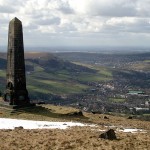
Yetholm, pictured above, is a picturesque Cheviot village that has been a ceremonial centre for Scottish gypsies from ‘time immemorial’.
Now when anyone says ‘time immemorial’ that is, of course, another way of saying: from back before anyone can remember. Some claim the fifteenth or sixteenth centuries when the Gypsies first arrived in Scotland. Other date the establishment of a gypsy base at Yetholm to the seventeenth or even the eighteenth century. Certainly, in the 1800s, between fifty and a hundred and fifty Romani lived in the valley, many of the royal Faa family.
What all the authorities agree upon is that the first properly recorded Gypsy King of Yetholm, William I (Glee’d-Neckit Wull) floruit in the eighteenth century. It was his prerogative to wear the tin crown, to carry the gypsy sword of office (in the picture of queen Esther below) and, if later ritual was respected, he would have been made king with a hare tied around his neck (to represent his poaching ways) and a bottle of whisky broken over his head.
In 1784 King William I died. He was succeeded, however, by his son William II (Wull Faa) who passed away, full of years, in 1847. After a brief face-off with a pretender Charlie Blythe, Wull’s son-in-law became Charles I: Wull Fa had had no male issue. Charles I died in 1861 and there was a further civil war between two of his daughters. After some fish-wivery Queen Esther (Esther Faa Blythe) triumphed over Black-bearded Nell and ruled until 1883 when her son Charles II was crowned with tin. Charles II was the last king of the Gypsies and when he died in 1902 the office fell into abeyance. How could the good folk of Yetholm have let this happen?
Quite where this royal custom came from is a nice, nice question. Historians cannot even be sure when William I was crowned: is it possible that calling him the ‘king’ was just a manner of speech that accidentally hardened into an institution?
However, there are some hints that an institution predated the Faa line at Yetholm. Billy Marshall (obit 1792) was referred to as the King of the Gypsies in Galloway, whereas back in the sixteenth century the Scottish king recognised an Earl of Little Egypt (i.e. Earl over the Gypsies) one of whom was a certain John Faa!
What is known is that the Scottish Lowland gypsies took their royal traditions seriously. Several hundred followed William I’s funeral train when the great man died away from home: a train that reportedly included three hundred asses. And by the time that Charles II was put on the throne his coronation was celebrated by gypsies and gajo alike: ten thousand came to his coronation.
Yet through all this glory the monarchs of Yetholm lived in abject or relative poverty. King William II carted coals, smuggled and finally became a publican. Queen Esther had to rely on poor relief from time to time while Charles II and his wife ran a lodging house.
Any other bizarre Romani stories? drbeachcombing AT yahoo DOT com Beachcombing senses juicy pickings.
14 July 2011: Invisible write in with the following information: Ohio is home to several gypsy tribes, as well as the burial sites of some gypsy kings and queens. This article is unusually laudatory about the clan. Then there is this article from the Dayton Daily News, 6 Jan 2011: ‘Sept. 15, 1878, Woodland Cemetery in Dayton was the site of the burial of Matilda Stanley, queen of the Gypsies. The authors of the ‘History of Wayne Township, 1810-1976’ write, ‘The gypsies’ burial place in Woodland Cemetery … is believed to be the only sacred burying ground of gypsies in the United States.” Matilda was born about 1821 in Reading, Berkshire, England. There she married Levi Stanley, son of Richard ‘Owen’ Stanley, king of a prominent gypsy tribe. The people called gypsies are nomadic tribes and thought to have originated in India, later immigrating to Eastern Europe, and then throughout the world. Rulers are appointed by either inheritance or by the choice of the clan.They have no actual power, but the tribe usually respects and obeys their decisions. In 1856, Owen Stanley decided to move his affiliated families from England to the United States. They settled in the northern part of Dayton, purchasing several farms in Harrison Twp. with others in Mad River, Butler and Wayne townships. When Owen and his wife died, Levi and Matilda became king and queen. The Dayton gypsies lived on their farms during the summer and roamed in the south during the winters. The wealthy families made money in horse trading and fortune telling. If one of their tribe died while gone from Dayton, they shipped the body, in a beautiful casket, back to Woodland Cemetery. Matilda died in Vicksburg, Miss., in January of 1878. She had suffered with cancer for two years. Her body was embalmed and transported to Woodland Cemetery’s receiving vault. All gypsy tribes were notified of the funeral arrangements. National and local newspapers advertised the event. There was a great interest in the occasion. Spectators came from all over the country. Special trains brought throngs of people for the event. The Rev. David Berger of the United Brethren Church of Dayton who ‘for many years ministered to the Gypsies in spiritual things’ read a paper about them to the Dayton Historical Society. The paper was printed in the Dayton Daily Journal on May 23, 1898. Many facts in this column were taken from his paper, He wrote, ‘It can but rarely occur that royalty finds sepulture in Republican American soil, or that an American clergyman is called to officiate at the funeral of a queen.’ The crowd was estimated to be 15,000 to 25,000. The gypsies numbered in the hundreds and were from the United States, Canada, and England. A thousand carriages paraded from downtown to the cemetery. They were stopped at the gates. Police had to open a way for the funeral procession. Berger stood on a plank across the open grave to avoid the crush of the crowd and led the service. A quartet from the First United Brethren Church sang and the casket was placed in the family vault. The plot is marked by a 20-foot granite column topped by a white marble figure.’ There is some further information on the cemetery and a photo. Then there is Queen Marion, a gypsy queen in Pennsylvania, one state over. There is also a gypsy queen one state over, in Pennsylvania. And another member of the Stanley clan buried in Dayton’s Woodland Cemetery: (I suspect the New York Times free archives would yield a lot of gypsy stories.) Allgurrey( Gannie) Stanley wife of Mark Jefferies- funeral as found in New York Times A GYPSY QUEEN’S FUNERAL 1884 HONORS PAID TO THE DEAD QUEEN BY HER SUBJECTS DAYTON OHIO April 15th GANNIE JEFFERS Queen of the Gypsies in the United States died at GREENFIELD TENN on March 10th and was buried here today. Gypsies are encamped about to the number of 1,500 travelling by wagon from all points of the country. The Queen was embalmed and laid out in NASVILLE TENN. Immediately upon her death and was brought to this city fro interment in WOODLAND CEMETERY, where all the King & Queens of the gypsies are buried. The dead Queen reposed in a handsome Casket made of the finest wood, lined with the finest silks and satins and mounted with gold and jewels. The plot belonging to the gypsies is marked by a fine monument of granite shipped here from Greece. The funeral procession which composed entirely of Gypsies formed in the northern section of the city and marched to the southern extremity, where the Cemetery is situated. At the grave ropes were stretched around it , leaving an enclosure large enough for mourners to stand in . The crowds were very large and surged up against the rope. Boys and men sat on tombstones and filled trees and every place that could afford an opportunity of seeing what was going on. The funeral services were conducted by one of the leading PASTORS of the city. The grave was sunk about 10 feet. At the bottom was a box made of stone slabs and in this box the coffin was laid be side the deceased daughter. There were stifled sobs as the mourners marched about the grave and several broke out in loud cries as the coffin was lowered. At the conclusion of the clergyman’s remarks the choir belonging to the officiating clergyman’s church sang the SWEET BYE AND BYE and the services closed. The most affecting scene was when the great stone was about to be lifted by means of a derrick close at hand The sons and daughters of the Queen climbed down to the stone box to take their last farewells Their sobs and cries filled the air and were echoed by the mourners that stood on the brink of the grave. The sons and daughters threw themselves prostrate on the coffins and kissing the hard wood and it was only with great prevailing the stone lid was then put into position and the dirt thrown upon it. A monument will be erected over the grave. Published April 16th 1884 2nd he married his 1st cousin Jentie Harrison Jeffery her parents were Henry younger brother to Thomas & Phillis Stanley also a daughter of Owen & Harriet Stanley QUEEN OF THE GYPSIES THE WOMAN WHO DIED IN MISSISSSIPPI WAS NOT A GYPSY QUEEN DAYTON OHIO JAN 16th 1887 Much has been said in the newspapers during the past week concerning the ‘Gypsy Queen’ who died in Mississippi 1887 and was sent here for burial , JENTIE JEFFREY HARRISON the woman was not en-fact the person who bears the title but was reported as the wife of MARK JEFFRY a member of the Stanley tribe, Mark was a widower when he left here according the best information of his friends and is doubt expressed as to the correctness of the dispatch, it is said that she gave birth to twins during the prevalence of a snow storm and the lack of proper attention and the severe and unusual weather caused the death of herself and the babies, the tents and wagons of the gypsies are comfortable in warm or moderate weather, but not constructed for snowstorms and low temperatures. About May the tribe returned and remain in this neighbourhood until the leaves begin to fall, meantime notice of the funeral of Jeffrey’s wife will be circulated and arrangements made for Christian burial, the Rev D A Berger of the United Brethen Church is usually selected to preach a sermon and conduct religious exercises on such occasions. The mourning is of the most demonstrative and intense character, the women shriek and carry on at a great rate and the men make a wailing noise that is very mournful, at the burial of Mrs Stanley The Queen several years ago great crowds attended. Until a few years ago the Stanley tribe were quite prosperous owning several valuable farms near the city which they rented out through one misfortune after another however they lost about all they owned MISSOURI STANLEY who might be denominated THE PRINCESS being the only one who is at present well to do. Jentie died while delivering twins they did not survive either.’ Invisible continues Dayton was quite the gypsy enclave. One hears little about the Stanley clan these days. I’m still trying to find the story of the gypsy queen buried in Toledo in a glass-topped coffin. A friend of mine used to go and peep in at her. They eventually covered her up.’ Isn’t that always the way… Thanks Invisible!!!
16 July 2011: JEC writes in too on this question: ‘Regarding your reference to the Faa royal line, and the Yetholm Romani, I always had the feeling that there were several competing lines of so-called ‘Gypsy Kings’…or at least there were in the American South from the 1960s into the 1980s. Some extended families of ‘Gypsies’ had lived in my region since the1940s.(They may still, but I lost track after the early 80s.) With non-Romani they used the term ‘Gypsy’, but they referred to themselves as ‘Rumbly Chillun’, derived from ‘Romani Children’. These extended families apparently had ‘territories’, and it was not unusual for their patriarchs to claim to be ‘King of The Gypsies’. Often when an elderly Romani male died in our metropolitan area the obituary (routinely written by the family) referred to the deceased as ‘King of the Gypsies’. Occasionally the local papers or tv news carried stories about the gathering of the clans, come to bury ‘The Gypsy King’. There was from time to time more than one self-styled ‘Gypsy King’ living in the area at the same time, although I don’t believe they ever took the field and fought it out. I don’t know if the contemporaneous claims of Romani royalty in my area were just for entertainment, understandable lily-gilding in published obituaries; or if kingships were truly disputed. Who knows? Perhaps an anti-king reigns from Avignon. And all because the royal line failed in Yetholm in 1902.’ Beach loves the idea of a Gypsy King to rule them all in southern France… Thanks JEC
King of the Tramps June 25, 2011
Posted by Beachcombing in : MedievalBeachcombing has neglected both Forgotten Kingdoms recently and an earlier enthusiasm for the Crusades. He thought that he would correct both these errors with a short post on the King of Tafur and his Tafurs – the einsatzgruppen of the Holy Wars. The source is Guibert of Nogent (obit 1124).
There was another kind of man in this army, who was bare-footed, carried no arms, and was not permitted to have any money. Dirty, naked, and poor, he marched in front of everyone, feeding on the roots of herbs, and on the most wretched things that grow. A Norman, well-born, said to have been formerly a knight, but now a foot-soldier, he saw them wandering without a leader, and laid aside his arms and the clothing he wore, wishing to declare himself their king. He had himself called Tafur, a term taken from the barbarian language. Among the pagans they are called Tafur whom we call, to speak less literally, Trudennes, that is, men who kill time, that is, who pass their time wandering aimlessly here and there. It was the Tafur’s custom, whenever the people he was leading arrived at a bridge to be crossed, or at a narrow pass to be traversed, to rush forward to observe very carefully, and if he saw that anyone of his men possessed two deniers, he would quickly separate him from the general group, order him to purchase arms, and assign him to the section of the army that bore weapons. However, those in whom he saw a love of the simple life, who had no impulse or desire to save money, he made members of his inner circle. Perhaps some might think that these men were not useful for the general good, and that he could have fed others what he was uselessly giving to them. But no one can describe how useful they were in carrying food, in collecting tribute, in hurling stones during the sieges of cities. They were better at carrying heavy burdens than the asses and mules, and they were as good at hurling projectiles as the machines and launchers. Moreover, when pieces of flesh were found among the pagan bodies at Marra, and elsewhere, during a terrible famine, a hideous rumour (based on something that had been done furtively and very rarely) circulated widely among the pagans, that there were some men in the Frankish army who eagerly fed upon the corpses of Saracens. To circulate this rumour among them even more vividly, the men carried the battered corpse of a Turk out in full view of the other Turks, set it afire, and roasted it as if the flesh was going to be eaten. When they learned what had happened, thinking that the charade was real, they grew even more afraid of the fearlessness of the Tafurs than of our other leaders. Like the ancient pagans, the Turks were tormented more by unburied bodies than any Christian seems to be concerned with his soul or fears damnation.
There is some predictable muttering among medieval historians to the effect that the Tafur were a ‘construct’ and that their king – King Tafur – did not exist. But this source, if a little verbose, is early and good.
What can certainly be said is that the Tafur rapidly became the thing of legend with all that implies for memory: cobblers warning!
Their cannibal exploits and also, strangely, their holiness is a topos in several later works. It would be interesting to connect them to other fearsome wanderers of the Christian imagination circumcelliones, gyrovagi and the like.
Beachcombing is working up a post on a forgotten ‘tramp’ kingdom in Scotland – other ‘itinerant realms’ are welcome. drbeachcombing AT yahoo DOT com
Flinders Island May 5, 2011
Posted by Beachcombing in : ModernBeachcombing tries to get a geographical spread going with his posts where – if there is a depressing bias towards Europe and Blighty – he covers pretty much the whole globe in at least a token fashion. However, some parts of the world are underrepresented. Take Australasia. Bar some reports of moas in New Zealand and rumours of Australia on a sixteenth-century map Beach has been disgracefully neglectful of the Antipodes.
By way of amends he thought he would offer today the history of a Forgotten Kingdom, Flinders Island and its last citizens, any ever diminishing group of Tasmanian Aborigines.
In the early nineteenth century British colonisation of Tasmania began apace: convicts salted with the odd farming and pioneer families.
The native population, the Aborigines of Tasmania did not resist in a systematic fashion: by this Beachcombing means that there were no wars and certainly nothing to compare with the Maori resistance in New Zealand.
There was, however, bloodshed and death.
Indeed, in the 1820s and 1830s barely a month went by in which a settler was not murdered – there seems to have been a form of guerrilla warfare on the part of the natives. And the settlers’ treatment of the aborigines was everything that can be imagined and worse… Some have spoken, perhaps reasonably, of genocide: rape and slavery certainly figured.
The British administration tried to deal with the original inhabitants with a variety of methods, from proto multi-culturalism to the most nightmarish forms of apartheid.
What all of these strategies had in common was though that they were ineffective.
The white man’s most decisive weapon was not public policy or rifles but the viruses he and (perhaps more importantly) his animals brought to pristine Tasmania. Indeed, one estimate is that by 1830, only about 300 aborigines of an initial population of several thousand were left, most of the dead had been the victims of disease.
There are reasons for thinking that this number is approximately accurate. What is certain is that the natives were already outnumbered by European settlers at that time and had been for perhaps a decade.
The creation of Flinders Land and the final doom of the Tasmanians was decided in the early 1830s when a curious individual George Augustus Robinson set about rounding up the remaining natives. His modus operandi is worth reporting. GAD – one of those well-meaning bunglers who do more damage to civilization than atom bombs – would go out into the Tasmanian bush and invite the Aborigines to have a cup of tea with him. From there he would try and convince them to come and join an Aboriginal village he was setting up.
He did not go into details but he planned to protect, to civilise and to Christianise the locals: GAD was an evangelical preacher though allegedly he also had sexual relations with his adopted aboriginal ‘daughters’.
By 1835 he had brought together most of the remaining aborigines – perhaps all the pure bloods – promising them a safe place of refuge. And in that year he took them to Flinders Island to the north of Tasmania where none could hope to escape. He was determined to enforce a sedentary lifestyle. Records tell us that this unusual colony numbered about 120 when it began in that year.
Beachcombing’s readers will judge the wisdom of GAD’s mission by their own values. What is clear is that by the most basic variable of all the mission failed for the Tasmanians kept, inconsiderately, dying. Indeed, by 1839 only seventy of the one hundred and twenty were left. By 1851 there were thirty – in 1843 the Aborigines had been moved back to the Tasmanian mainland. By 1855 sixteen… And in 1876 the second to last Tasmanian, Truganini, died and in 1905, the very last, Fanny Cochrane Smith.
As an aside Beachcombing should note that Truganini was treated by the colonists with as little respect in death as she had been treated in life. Her skeleton was not buried but displayed in the Royal Society of Tasmania, though in this she fared better than the third to last Tasmanian to die, William Lanne, whose scrotum was made into a tobacco pouch.
So what went wrong?
A western diet, western way of life and crucially western viruses had not suited the population. Veneral diseases had sterilised and pulmonary illnesses had killed.
Beachcombing is something of an imperialist in historical terms – especially when that means the French and the British thrashing it out in North America or Spanish treasure ships in the Pacific. But here in Tasmania is the sordid reality of what colonisation all too often meant and that reality is underlined by GAD’s killing kindness.
Indeed, GAD’s attempts to create a haven had had the worst possible results. Flinders Island (and subsequent homes of the shrinking population) had gathered the remaining Aborigines together as efficiently as a Third Reich death camp. The last locals would have had a much better chance of survival out in the Tasmanian bush. As it was they were to die in suits and full length dresses with daily visits to church. This photograph of the four of the last Tasmanians (minus Fanny Cochrane Smith) says it all. While an early phonograph recording of Fanny Cochrane Smith speaking and singing Tasmanian – the only example we have of this language family – is enough to make Ayers Rock weep.

Beachcombing is always on the look out for ‘forgotten kingdoms’ particularly modern examples: drbeachcombing AT yahooDOTcom
Crocker Land April 3, 2011
Posted by Beachcombing in : ModernWhere do good bizarrists go when they die: why to Crocker Land, of course. And where is this anomalist’s World of Cockayne? Well, unusually for such a fantastical place we can be exact: it stands at 83 degrees N, longitude 100 degrees. Hell, Heaven, Eden and Purgatory never enjoyed these kinds of specifics.
And how was it discovered? Well, here is the story…
In 1906 the American explorer Robert Peary found himself on Axel Heiberg Island, a part of the Canadian Arctic archipelago named for, of all things, a brewery owner. Axel Heiberg was too cold even for the Inuit in the early twentieth century and so Peary was one of the first explorers to actually make it this far north. And arriving at the end of the island he was treated to a marvelous and quite unexpected view. Far off on the horizon to the north west – he estimated over a hundred miles distant, he spotted a large island that he named Crocker Land after George Crocker, an arctic nut who had sponsored Peary to the tune of 50,000 dollars.
Peary brought news of Crocker Island home and excitement about this extraordinary land grew and grew, so much so that, in 1913, the Crocker Land expedition was launched with ‘provisions for four white men, their helpers, and their dogs: a power boat, a moving picture machine, instruments for all kinds of records, a physician, a cook and cameras for use whenever a moving picture machine would not be available.’
The North West passage had been proved an illusion, the southern continent had been given the coup de grace by Cook, but on Crocker Land the last lovers of mystery could find whatever their imagination had to offer them. Hell, there was even absurd talk about a new race of men on this most mysterious Crocker continent…
Unfortunately, the mission was a disaster from beginning to end. A drunk captain almost sunk the ship with the crew and supplies near Greenland. When the party set off across the frozen sea several members had to be sent back as they became frost bitten. On the return journey one of the party shot another member, allegedly over a quarrel concerning sleigh dogs. Then, finally, suffering from Beachcombian levels of bad luck it took four years to get the party back to the States.
And Crocker Land? Well, it was sighted, kind of..
April 21st [1914] was a beautiful day; all mist was gone and the clear blue of the sky extended down to the very horizon. Green was no sooner out of the igloo than he came running back, calling in through the door, ‘We have it!’ Following Green, we ran to the top of the highest mound. There could be no doubt about it. Great heavens! What a land! Hills, valleys, snow-capped peaks extending through at least one hundred and twenty degrees of the horizon. I turned to Pee-a-wah-to anxiously and asked him toward which point we had better lay our course. After critically examining the supposed landfall for a few minutes, he astounded me by replying that he thought it was poo-jok (mist) [i.e. a fata morgana]. E-took-a-shoo offered no encouragement, saying, ‘Perhaps it is.’ Green was still convinced that it must be land. At any rate, it was worth watching. As we proceeded, the landscape gradually changed its appearance and varied in extent with the swinging around of the Sun; finally at night it disappeared altogether. As we drank our hot tea and gnawed the pemmican, we did a good deal of thinking. Could Peary with all his experience have been mistaken? Was this mirage which had deceived us the very thing which had deceived him eight years before? If he did see Crocker Land, then it was considerably more than 120 miles away, for we were now at least 100 miles from shore, with nothing in sight.’
Peary had, indeed, been mistaken, something the party gradually came to accept.
To increase our latitude we set a more northerly course on the 23d and 24th, with a variation of 178 degrees westerly. Observations on these two days put us ahead of our dead-reckoning in latitude 82 degrees 30 minutes, longitude 108 degrees 22 minutes, 150 miles due north-west from Cape Thomas Hubbard. We had not only reached the brown spot on the map, but we were thirty miles in-land! You can imagine how earnestly we scanned every foot of that horizon – not a thing in sight, not even our almost constant traveling companion, the mirage. We were convinced that we were in pursuit of a will-o’-the-wisp, ever receding, ever changing, ever beckoning.
The party only just made it back across the melting pack ice and Crocker Land remained unconquered and, what is better, unconquerable…
Now a question: what would you rather have named after you: a lump of God forsaken unpopulated rock or a fata morgana that promises new races of men, sherbet creams, sunlit valleys and a ski slope down to the North Pole?
Lucky Crocker.
Any other illusory realms: drbeachcombing AT yahoo DOT com
***
4 April 2011: KMH writes in with a reference that questions Peary’s reliability as a witness, particularly over a sighting of Jesup Land. There is also, of course, the problem of whether Peary really got to the North Pole as he claimed to have done or, perhaps better, whether he deliberately or unknowingly misled the international scientific community. Thanks KMH!