Invisible Library in Skyrim March 28, 2012
Posted by Beachcombing in : Actualite***dedicated to Larry K***
Beach’s nightmare week continues and the search for the aupair proceeds a pace. In an attempt then to relax in these brutish hours as the Beachcombings try and put their lives back together Beach thought that he would offer up another invisible library: libraries that have only ever existed in the imagination of authors. This time though an invisible library with a difference: a library found, against all the odds, in a modern video game.
Beach was inspired in this search by the always stimulating Larry K whose sons had informed him that the new game Skyrim ‘has thousands of actual books that you can open up and read’.
Skyrim in case you are wondering is a province of Tamriel in the world of Nirn. Larry perhaps says it better: ‘Skyrim takes place in one of those Tolkien mythical places that are vaguely Nordic, but they have two moons in the sky so it cannot be Middle Earth.’
Beach was naturally sceptical but he was soon press-ganged into astounded silence by various youtube videos and online lists. It seems – Beach waits to be corrected here – that scattered through the video games world there are books, with concentrations in libraries and in other player’s knapsacks: drbeachcombing AT yahoo DOT com
Now as to the Skyrim books, titles include such epics as
Advance in Lock Pickings
Before the Ages of Man
Bravil: Daughter of the Neben
Disaster at Ionith
Fall of the Snow Prince
Forsworn Note
Frost’s Identity Papers
Have Need of Cynric
Hired Thug’s Missive
Letter from Solitude
On Lycanthropy
Reports of a Disturbance
Sven’s Fake Letter from Faendal
The Cabin in the Woods
The Pig Children
The Lusty Argonian Maiden (parts one and two)
There Be Dragons
Vlad’s Debt
Ysmir Collective
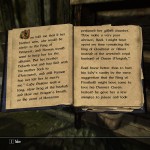
This is a just a sample of close to a thousand books. Note that pedants might say that this is not a true invisible library in that you can read the books. But it would be truer to say that you can read parts of the book. For example, here is the first couple of pages from the Lusty Argonian Maiden: making use of the penis=rising bread joke found in the Anglo-Saxon riddles. But the pages are tasters rarely the whole thing. Though even there, Beach can see exceptions where you would take half an hour to read a book properly.
Thanks Larry and more importantly thanks to Larry’s sons.
***
Wade writes: I’m not sure who started including books within video games, but from its beginning World of Warcraft, like Skyrim, has had books scattered throughout the game, most dealing with WoW lore. Someone should be able to identify the Ur-game that started this. I looked online, but had no luck. Here though some real experts step in. Howard writes: It never occurred to me that your “Invisible Libraries” series might include videogames/computer games. I’m not sure where you draw the line, but I’d draw your attention to The Sims 3 suite of games. Now, The Sims 3 is the largest-selling computer game franchise in history, but most players tend to be adolescent girls, so I wouldn’t be surprised if you’re not familiar with it. The library in The Sims 3 is a true invisible library, in that you can’t actually read the books, but your characters and the non-playing, in-game characters can. Here’s a partial list of books that characters can read in-game. It’s in an ugly table format, and I can’t easily copy it into an email. Many of the book titles contain in-jokes and pop-culture references. For example, Grant Rodiek, Point Farmer, is a reference to the lead software developer for the series. Game of Thorns is a reference to Game of Thrones. For “Jimmy Sprocket” read “Harry Potter.” And so on. I believe there’s a TV Tropes article about this, but I know better than to look that up. Unlike most other invisible libraries I’ve seen, The Sims 3 also includes cookbooks, how-to and self-help books, sheet music, and other books which actually help your in-game character achieve higher skills. Progressing in the game actually requires reading books, either to gain skills or simply to keep your character entertained enough that they don’t become depressed and pee on themselves. Also, your in-game character can learn “writing skill,” and create new books that you can add to the invisible library. If your character sells these to the bookstore, you can subsequently find NPCs reading the books you’ve written. On the subject of literary invisible libraries, I don’t believe you’ve mentioned The Book of Hali, (an ancient disquisition on soul, mind, and body, and the clear inspiration for the Necronomicon) which appears in several tales by Ambrose Bierce, got namechecked by Dunsany, Chambers, Lovecraft, et al, and is consistently ignored by the legions of Lovecraft scholars who seem to have sprung up like eldritch, rugose mushrooms in the last few years. Tony also adds an angle to this: Having readable books in-game is actually a fairly well established mechanism for establishing the ‘lore’ of a gameworld in computer role playing games (cRPGs). It has the advantage of allowing players who are interested in such things to read the neato backstory, and allows the players who want to just hack at goblins to get on with business. Here is a list from Baldur’s Gate (BioWare, 1998) the books labelled ‘History‘ were all readable: Here is the list from Morrowind (Bethesda, 2003)… Morrowind was installment 3 in the Elder Scrolls series, of which Skyrim is V. I’m not sure what the first game to have used in-game literature would have been. If you get too deep into the ’80s, storage limitations made what could be put on disk fairly limited. When a game had a more text than could be packaged in software, a separate manual would be published and when some event happened, the player would be instructed to “Read paragraph 27″. A good example is Wasteland (Interplay, 1988). Apparently at least one book item in that game triggered a direction to read a specific paragraph. I suspect Might and Magic IV (New World Computing, 1993) would have had in-game readable lore (probably packaged as scrolls rather than books though), but I haven’t been able to find a list of non-combat items for that game. And Ultima probably had them by Ultima VII (Origin, 1990), but same problem. (Not that I’ve devoted ton’s of time to looking for item lists for cRPGs that were published two decades ago… they’re probably out there somewhere) There’s probably an interesting phylogenic tree of the cRPGs that could be drawn, but I don’t think I could get funding for it.
‘ SY finally notes: I was thinking how many strategy games – this moves beyond invisible libraries – actually include rule books as ‘trading guides’ etc in the box. The most dramatic example of this was the novella The Dark Wheel, included in that hoary old classic Elite.’ Thanks to Howard, Tony, SY and Wade!!
Beachcombing’s Invisible Library February 4, 2012
Posted by Beachcombing in : Ancient, Contemporary, Medieval, Modern

Beachcombing has had a lot of fun over the last year and a half cataloging invisible libraries, libraries that only exist in the imagination of authors and connoisseurs. Today, Beach thought he would take stock of the achievement to date and also, in a fit of utter self-indulgence, introduce readers to Mrs B’s contribution to the field: a gift.
The following was created by a local artisan – who is responsible for the misspelling of Tolkien’s name! – and was based on a list supplied by readers back in the day and by the invisible librarians listed below. It now hangs proudly in what used to be a doorway, but that is now a cement block between the Beachcombings house and the butcher next-door. Beach wakes up to the happy sound of corpses being dismembered: strangely therapeutic and cheaper than swimming with dolphins in the Indian Ocean.
It’s never going to fool anyone, of course: no one is ever going to reach out their hands and hit canvas. But it is nice to pass a shelf of phantoms every time you are going up to the ‘night’ part of the house: it prepares the mind for sleep and reminds the participant of the ultimate, wonderful futility of our time on this beautiful ball of rock.
Some titles were sent in by readers. Beachcombing ventured a couple. And others still were stolen from existing Invisible Libraries: the invisible public domain is a wonderfully civilized thing.
And, while Beach is in an invisible mood here are all the ILs to date, others gratefully received: drbeachcombingATyahooDOTcom.
The Reading Library [just struck Beach that this was almost certainly Buckland's pun]
H.P. Lovecraft’s Invisible Library December 27, 2011
Posted by Beachcombing in : Contemporary***This post is dedicated to Phil P who suggested and advised***
H.P. Lovecraft is said to be a horror writer. It would be truer to say that, like his near contemporary Arthur Machen, he wrote about evil, evil without consolation of good. A teenage Beachcombing had several uncomfortable nights on HPL’s account and an adult Beachcombing just got rid, last week, of Alan Moore’s impressive but nightmarish contribution to the Mythos, Neonomicon. Beach just didn’t want to sleep under the same roof as that thing.
However, none of this pettiness should take away from HPL’s extraordinary imaginative reach. And given that HPL loved littering his text with references to imaginary books, it seems only fair that HPL is treated to an invisible library post, where imagined but unwritten books are gathered together.
First, though a warning. There are three problems with creating such a list.
(1) HPL sprinkled credible imagined and fantastic real volumes through his works indiscriminately. It is, therefore, not always simple to understand what is real and what is not. Then sometimes, just to complicate things a little further, he borrowed invented books from other authors: e.g. The Marvells of Science from Ambrose Pierce.
(2) Many successful authors have imitators but HPL created, with other authors, a literate community of fantasists [sic] working within the Mythos and feeding off each other. The normal complaint of better Jung than a Jungian doesn’t work here as HPL encouraged such behaviour. Things then became more complicated still as some books were invented by colleagues but then taken up in turn by HPL! The sort of criss-crossing acts literary incest you get in the Carolingian poets…
(3) Just to really put the boot in to any Invisible Librarians out there… At least one of these imaginary books, the Necronomicon has since been written, several times, and in several forms by imitators, and even by opportunists claiming that the Necronomicon truly did exist. Laughing all the way to the bank arm in arm with John Dee…
With these short apologies here is a certainly incomplete shelf from HPL’s invisible library. Now take Beach’s advice. Flick your eyes along the titles, walk to the door (possibly with the Saurian Age under your arm), lock the door and never go back.
Azathoth and Other Horrors by Edward Pickman Derby.
Book of Azathoth, initiates must sign their name in blood in this work.
Liber Damnatus: the Damned Book.
Of Evill Sorceries done in New-England of Daemons in no Humane Shape.
Thaumaturgicall Prodigies in the New-English Canaan, Rev. Wards Philip.
The Book of Eibon with a description of a magician’s journey to the planet Shaggai.
The Dhol Chants.
The Eltdown Pottery Shards, edited by Gordon Whitney in the Eltdown Shards: a partial translation.
The King in Yellow, a play that drives the reader to suicide or madness. Actually invented by Robert W. Chambers, but picked up by HPL.
The Necronomicon (al-Azif), by Abdul Alhazred.
The Pnakotic Manuscripts translated into Greek as the Pnakotica: from the city of, you’ve guessed it, Pnakotus.
The Saurian Age.
The Seven Cryptical Books of Hsan: Divination Text of Chinese Origin.
The Tablets of Nhing: Don’t worry, kept on the planet Yaddith, as such we are unlikely to come across them.
The Zanthu Black Jade Tablets (naturally written in characters from the language of the Sunken Continent of Mu!).
Unaussprechlichen Kulten [Unsayable Cults] probably written by Friedrich Wilhelm Von Junzt.
Beachcombing wrote this with a proper sense of modesty, he is no expert on HPL. Any corrections please: drbeachcombing AT yahoo DOT com
***
27/12/11: Phil P again to the rescue ‘One minor correction though, Unausprechlichen Kulten actually was invented by Robert E. Howard, who gained fame as the father of Conan The Barbarian. He also wrote in the Lovecraft mythos. In fact, he contributed enough short fiction to fill a book.’ Thanks Phil!
30/12/11: Mikulpepper from Shrine of Dreams writes in with this on the Necronomicon: ‘Not only have there been various claimants to the Necronomicon title, one of them actually reprinted a text of Aleister Crowley’s and titled it The Necronomicon. I don’t know what the copyright situation was about this but I argued long and unsuccessfully with a person who thought that this was indeed the writings of the mad Arab Abdul al-Hazred. (Late 1960s, early 1970s?). Al, meanwhile, writes in ‘You should include De Vermis Mysteriis, (Mysteries of the Worm) by Ludwig Prinn. Created by Robert Bloch, “the tome first appeared in his short story “The Shambler from the Stars” (1935), in which a character reads a passage from the book and accidentally summons an extradimensional horror’. Thanks Al and Mikulpepper!
3 Jan 2012: Mark L writes in with these welcome corrections: ‘I don’t usually email bloggers out of the blue, but you DID ask for corrections… The Book of Eibon was a creation of Clark Ashton Smith, not H. P. Lovecraft. Smith wrote a few short stories describing the adventures of Eibon, including one which was supposed to be an excerpt from the book. The Eltdown Shards were first dreamed up by Richard F. Searight, but I believe HPL was the first to actually use them in a story. Searight was a horror writer whose work has, as far as I know, only been reprinted in a series of chapbooks by Necronomicon Press in the 90s and the occasional anthology appearance. Also, you might consider including Cultes des Goules, by the Comte d’Erlette, which was invented by either Robert Bloch or August Derleth. (Wikipedia claims Bloch, but I know Derleth claimed it as his own.) Pretty much all of Lovecraft’s circle had at least one book that they made up, and part of the rite of passage of every Cthulhu Mythos writer is inventing their own. (I have myself.) Wikipedia has a good list on Cthulhu Mythos arcane literature and Cthulhu Mythos miscellaneous books. ‘ Thanks Mark L.
A Faun’s Invisible Library December 21, 2011
Posted by Beachcombing in : Contemporary
Beachcombing used to think that there was nothing more terrible than being ill: fever, soar throat, all that mucus… However, in the last twenty four hours he’s discovered there is a worse condition and that’s being the only well person in a house when everyone else is ill. Yesterday’s dying by laughter is inviting by comparison.
In one of the rare moments when all the ill in the family are sleeping Beach thought that he would offer a short Invisible Library post (it’s been a while): books that have only ever existed in the imagination. He came across this one while watching a 1979 cartoon of the Lion, the Witch and the Wardrobe with his younger daughter yesterday.
Beach has a great affection for the L the W and the W because it was the first book that he ever read: beavers, Pauline Bayne’s illustrations, wartime setting, a grumpy professor who thinks Platonically, ‘a deeper magic still’, the crude but strangely powerful Christian symbolism… However, he had quite forgotten, until watching the cartoon – made interestingly by the man who brought Charlie Brown to the cinema screens – that Lucy sees in the fawn, Mr Tumnus’ house a bookshelf with titles; in short a Lewisian Invisible Library. He now quotes from his British edition.
In one corner there was a door which Lucy thought must lead to Mr Tumnus’s bedroom, and on one wall was a shelf full of books. Lucy looked at these while he was setting out the tea things. They had titles like The Life and Letters of Silenus or Nymphs and Their Ways or Men, Monks and Gamekeepers; a Study in Popular Legend or Is Man a Myth?
Silenus is sometimes billed as the king of the satyrs – his actual role was more complicated – and was presumably an authority figure for Tumnus. Men, Monks and Gamekeepers is sheer genius: a faun equivalent of a human Ghosts, Fairies and Mermaids. Then Is Man a Myth? sounds suspiciously like some of C.S. Lewis’ Christian apologetics. Was CSL actually making fun of himself? Unlikely.
From somewhere upstairs a scream has issued: Beachcombing will get back to trying vainly to put himself in touch with his inner nurse. As he prepares to dash though he should note once more that he is always interested in Invisible Libraries: drbeachcombing AT yahoo DOT com
***
27/12/11: PcCB: ‘Surely, The Life and Letters of Silenus reminded you of The Screwtape Letters? Of course, Lewis was making fun of himself. Tumnus’s fear of the WW is not so very different from Wormwood’s fear of Screwtape and Co., is it?’ Spot on PcCB, Thanks!
Boethius’s Astronomy: Did it Exist? October 4, 2011
Posted by Beachcombing in : Medieval
Beach has always had a thing about Boethius (obit 525). Boethius penned the great Consolation of Philosophy, a strangely affecting study of human priorities, while waiting for his execution. Boethius hovers between Neo-Platonism and Christianity: he is, in some senses, the missing link between the two religions. Then Boethius also wrote books that do not survive: always a strong recommendation, and among these is his Astronomy.
The proof that the Astronomy once existed are four fold.
First, in a letter, Cassiodorus – the most difficult Latin writer ever born? – claims that thanks to Boethius the west can read (i.e. has seen translated from the Greek): inter alia Euclid’s Geomoetry and Ptolemy’s Astronomy.
Second, there are several medieval catalogues that refer to works on astronomy associated with Boethius.
Third, there are some very doubtful references to Boethius’s Astronomy in two letters of the early medieval writer Gerbert.
Fourth, Boethius in his Arithmetic states that he intended to write an Astronomy.
Boethius’ Astronomy is one of these works that might have made a difference. It would, in fact, have given us (and the Middle Ages) a straightforward guide to classical thinking on the heavens without having to surrender the field to Firmicus and other dunces. But, as the careful reader will have noted, the ‘proofs’ above are about as weighty as dead leaves. Indeed, as the great Jim Tester noted (123) the Astronomy‘s existence is ‘an unanswerable question, with the balance in favour of the Noes rather than the Ayes’.
After all, Cassiodorus, in the reference cited before, seems to have been speaking generally of the communication of knowledge from Greek to Latin, something that Boethius did in all his works and that characterised his opus. Medieval catalogues err (constantly) particularly about authors. Gerbert is, as Beachcombing noted, ‘doubtful’. And Boethius promised many things that he did not achieve: he was an ambitious man whose life was cut horribly short. He was likely hacked to death with a sword on his master’s orders after a prolonged imprisonment.
What seems at first a case then of a burning library book might in the end be nothing more than an entry in an invisible library: a ghost summoned up by greedy medievalists and star-mad monks. Still in the last fifty years unexpected plums have been fished out of monastic libraries. Perhaps, in the near future, a scholar will be leafing through a manuscript from Verona when… We can but hope.
Any other now-you-see-it, now-you-don’t books? drbeachcombing AT yahoo DOT com
Updated BH News Stories (with thanks to readers)
-
- A) Money Trees
- B) Irish Spontaneous Combustion
- C) Throw That Television Away…
- D) Italian Witches
- E) US invades UK!!
- F) In Memory of the 50
- G) Earn Money Solving A Historical Mystery!
- H) The Strangest Irish History Professor
- I) Selling Enigma
- J) Swedish Head-Hunting
- K) Icelandic Elves
- L) Axis Invasion of America
- M) Eagles and Babies Again
- N) Creepy Fairy Insect
- O) Neolithic Pub
- P) World’s Greatest Fakes
- Q) Shakespeare Authorship Plus
- R) Oak Island Solved
- S) Global Warming Warns ET!
- T) Round Table in Scotland
- U) British Mummies – no honestly!
- V) Strange Finds from Ghadaffi’s Compound
- W) Phallic Tree Obscured
- X) Beach once voted for this man…
- Y) Hair Styles of the Egyptian Dead
- Z) What the hell is this?
In the Margins September 20, 2011
Posted by Beachcombing in : Contemporary, Medieval, ModernMarginalia: things scribbled in margins. There is a lot to be said for this form of literature that, to date, has been little studied: there are only a handful of books including Robin Alston’s Books with Manuscript: A Short Title Catalogue of Books with Manuscript Notes in the British Library (1994) and Henry Richards Luard’s Catalogue of Adversaria and Printed Books Containing MS. Notes, Preserved in the Library of the University of Cambridge (1864).
Some examples, like Fermat’s Last Theorem, are of the most desperate importance. Others, like an early medieval monk writing ‘My hand is so cold I can hardly hold the quill’, are utterly unimportant but immediate. In some cases, there is art work – Nabokov sketching a beetle in his copy of Metamorphis. In other cases, there is an absence of anything intelligible: Churchill’s poignant red crayon marks on German decrypts detailing their murdering ways on the Eastern Front. There is stupid marginalia: Beachcombing treasures the memory of a student copy of Wilfred Owen’s collected poems where the word ‘futile’ had been written in big block capitals next to that poet’s Futility. There is irrelevant marginalia by important people: Lincoln’s attempts to learn legal Latin in his law books. Then there is important marginalia by irrelevant people. The first evidence of Hamlet being performed in a Chaucer belonging to one Gabriel Harvey: ‘The younger sort takes much delight in Shakespeare’s Venus and Adonis, but his Lucrece, and his Hamlet Prince of Denmark have it in them to please the wiser sort’. There is stolen marginalia – the ‘precious’ early Welsh stanzas from the Juvencus manuscript were cut from their place and hoarded away by a scholar whose names escapes Beach. There is posthumous marginalia – medieval glosses copied out as a text in manuscripts where we’ve lost the original margins: for example, the Greek words taught to Anglo-Saxon students in the seventh-century by Theodore of Canterbury. There is even – in homage to Invisible Libraries – Invisible Marginalia: in Wuthering Heights, for example, there is a reference to Catherine’s pen portrayal of Joseph in a margin of a book.
So viva marginalia! And here are four of Beachcombing’s favourite examples: any additions would be gratefully received – drbeachcombing AT yahoo DOT com
a) An aside in an Icelandic manuscript: ‘You treat me badly, Dóri; you never give me enough fish, my kinsman’.
b) Coleridge in a borrowed book of Charles Lamb: ‘I will not be long here, Charles!—& gone, you will not mind my having spoiled a book in order to leave a Relic.’
c) An ‘illegal’ copy of Julius Caesar in which ANC prisoners signed their name next to their favourite passage: Mandela chose ‘cowards die a thousand deaths…’ Where is this today?
d) And, in late colonial times, a backwoodsman, Robert Odell of Petrolia, Ontario, with his warning in his Third Reader: ‘Steal not this book for fear of life for the owner has a big jackknife’.
***
22 September 2011: Andy the Mad Monk writes in with this: I enjoyed your blog about margins and the last one, about warning people not to steal his book reminded me of a selection of similar warnings from medieval manuscripts. Anathema!: Medieval Scribes and the History of Book Curses by Marc Drogin seems to be the “bible” on this matter – make sure you buy or borrow yours, and not steal it because some of the curses seem to be quite potent! Dennis meanwhile writes in: My blog, in impenetrable Irish, is entitled Nótaí Imill, which means Marginalia. I wander here and there, but keep coming back to the title theme. I often think of marginalia in Medieval Irish MSS as tweets. My blog will remain dark to you, but here’s an article for you in English: ‘On the Colophons and Marginalia of Irish Scribes’ by Charles Plummer in the Proceedings of the British Academy. Lots of lovely examples quoted there. Thanks to Andy and Dennis!
Missing Holmes July 4, 2011
Posted by Beachcombing in : Contemporary, Modern
Yesterday it was flogging, tomorrow Renaissance cannibalism, so Beachcombing thought that today he would indulge in something rather more cerebral and what better than a gentle Invisible Library post? Beachcombing has introduced readers to several Invisible Libraries over the months, books that never existed except as titles in their creator’s imagination. And tonight he thought he would explore the invisible library of Sherlock Holmes, cases, in short, that Arthur Conan Doyle described but never wrote. Certainly, on occasion in the stories and less often in the novels the narrator, Watson, lists offstage cases in enticingly brief terms, cases that he never actually shared with his readers. For example, in the very first published short story, A Scandal in Bohemia:
‘From time to time I heard some vague account of [Holmes'] doings: of his summons to Odessa in the case of the Trepoff murder, of his clearing up of the singular tragedy of the Atkinson brothers at Trincomless, and finally of the mission which he had accomplished so delicately and successfully for the reigning family of Holland.’
Of course, this is a brilliant narrative device. It immediately gives SH’s England depth and reminds Beachcombing of that sense of being sucked into a world that he associates with the first pages of Kim. But there is also something exquisite about these skeleton mysteries in their own right. The following is taken from Thor’s Bridge and – forget the dog that didn’t bark and the game being afoot – this is Beach’s favourite paragraph in Doyle’s opus.
‘Among these unfinished tales is that of Mr James Phillimore, who stepping back into his own house to get his umbrella, was never more seen in this world. No less remarkable is that of the cutter Alicia, which sailed one spring morning into a small patch of mist from where she never again emerged, nor was anything further ever heard of herself and her crew. A third case worthy of note is that of Isadora Persano, the well-known journalist and duellist, who was found stark raving mad with a match box in front of him which contained a remarkable worm said to be unknown to science’.
It is almost as if Holmes with Watson at his side has strayed into an early H.G. Wells novel with a time machine set up to look like an exercise bike. However, there are other skeleton cases that are not to be sniffed at either:
The year ’87 furnished us with a long series of cases of greater or lesser interest, of which I retain the records. Among my headings under this one twelve months, I find an account of the adventure of the Paradol Chamber, of the Amateur Mendicant Society, who held a luxurious club in the lower vault of a furniture warehouse, of the facts connected with the loss of the British barque Sophy Anderson, of the singular adventures of the Grice Patersons in the island of Uffa, and finally of the Camberwell poisoning case.’
‘Of all the problems which have been submitted to my friend Mr Sherlock Holmes for solution during the years of our intimacy, there were only two which I was the means of introducing to his notice, that of Mr Hatherley’s thumb [The Adventure of the Engineer’s Thumb] and that of Colonel Warburton’s Madness.’
‘Here’s the record of the Tarleton murders and the case of Vamberry, the wine merchant, and the adventure of the old Russian woman, and the singular affair of the aluminum crutch, as well as a full account of Ricoletti of the club foot, and his abominable wife.
One Sherlockian, Martin Dakin suggested that Holmes really said something quite different in the last clause of this last paragraph and was misconstrued by that dullard Watson. His true words were, of course, ‘the wrinkled yeti of the club foot and his abominable life’, which would bring cryptozoology and the Himalayas into the canon!
Then, of course, if Holmes-lovers can start rewriting sentences why not actually write up the stories themselves? Holmes lovers are not as geeky as Lord of the Rings or Star Wars and Star Trek fans, but they come wonderfully close.
A notable exercise in this respect was More Exploits of Sherlock Holmes (1954) written by Adrian Conan Doyle and crucially the capable John Dickinson Carr that bring to life several of these half imagined mysteries. However, so many pastiches have been written that there is actually a serious scholarly study, The Alternative Sherlock Holmes* (which Beach is trying to get his grubby hands on), a ‘vulgar’ collection of short stories (The Mammoth Book of New Sherlock Holmes Adventures, ed by Ashley 1997), not to mention, God alive, a Wikipedia page.
Beachcombing is always on the look out for invisible libraries: preferably ones that have not, though, become books – drbeachcombing AT yahoo DOT com
*’Between 1887 and 1927, Sir Arthur Conan Doyle wrote sixty Sherlock Holmes stories, and his great Canon has become the most praised, most studied, and best-known chapter in the history of detective fiction. Over twenty thousand publications pertaining to the Sherlock Holmes phenomenon are known to have been published, most of them historical and critical studies. In addition, however, almost since the first stories appeared, such was their uniqueness and extraordinary attraction that other authors began writing stories based on or derived from them. A new genre had appeared: pastiches; parodies; burlesques; and stories that attempted to copy or rival the great detective himself. As the field widened, there was hardly a year in the twentieth century in which new short stories or novels did not appear. Many hundreds are now known to have been published, some of them written by authors well-known for their work in other literary fields: John Kendrick Bangs, Jon L. Breen, Agatha Christie, August Derleth, Philip Jose Farmer, Maurice Leblanc, Ellery Queen, Vincent Starrett, and many, many more. Presented as an entertaining narrative, of interest to both the aficionado and the scholar, it provides full bibliographic data on virtually all the known stories in the field.’
***
5 July 2011: CCBC writes in to say, ‘I am probably not the first to remind you of the Case of the Giant Rat of Sumatra, which the world is not yet ready to hear. Adrian Doyle and others have attempted to temper that tale to modern ears but… What I may be the first to mention is the astonishing playlet created around that story (wherein humour is employed to blunt horror). Also, have you discovered Ellery Queen’s The Misadventures of Sherlock Holmes? Or the Solar Pons tales by August Derleth?’ Beach is ignorant on all counts. KMH, meanwhile, has a more general consideration: ‘The Sherlock Holmes literature marks the beginning of a fantasy-oriented counter-reaction to the general decline in manners and morals in the 19th century, and continuing on to the present day. One affect of this decline is the increase in crime and difficulty in convicting criminals by traditional methods, perhaps abetted by some corruption in government and police officials. So, in contrast to reality, we initially have a spawn of purely fictional detectives, beginning with Holmes, brilliantly solving crimes and vicariously satisfying the public’s appetite for justice (and good prevailing over evil). Fast forward to the 20th century and justice is being given a helping hand by even more extreme fantasy figures such as Batman, Superman, Xmen, etc. all of which possess extraordinary advantages beyond the brilliant detective talent. Of course, this is at a time when real respect for government, law and order, and justice appears to be at an historical low. The recent popularity of a number of television dramas involving forensic experts (CSI, NCIS, etc) follows this development by employing advanced scientific techniques which few, if any, agencies have the training for, or can even remotely afford. Where does the ‘justice hero syndrome’ originate from? It seems to derive from the expectation of Christ’s Second Coming to right all wrongs, punish all criminals, and institute a true government free of corruption, as the greatest of heroic acts. Today this expectation is stronger than ever as evidence that we are in the ‘last days’ continues to accumulate. What next? Perhaps the next justice heroes could be aliens or extraterrestrials landing in flying saucers to eliminate the criminal psychology and set humanity back on the right course.’ Thanks KMH and CCBS!
10 July 2011: Phil P writes in: Regarding ‘The Giant Rat of Sumatra’, the science fiction/ fantasy author Fred Saberhagen dealt with this one and concocted an engaging tale in which Holmes and Dracula encountered one another in ‘The Holmes Dracula Files’. Alternating chapters are narrated by Dr. Watson. I believe you would enjoy it.’ Thanks Phil, I can’t wait!
Thomas Hood or Tom Hood’s Invisible Library June 30, 2011
Posted by Beachcombing in : Modern
Tomorrow the monthly round up of interesting emails and communications – Beachcombing is slaving to get them ready in time. In the meantime, a further Invisible Library to add to the one that Frank Buckland discovered in late nineteenth-century Reading and that was featured here a couple of days ago. The following list was created by ‘Hood’ – the titles below and the quality of the puns suggest Thomas Hood (obit 1845) rather than his son, the playwright Tom Hood (1874).
The list was, in any case, created, we know, ‘to be painted on a false door in the library of the Duke of Devonshire, at Chatsworth’ – memories of a similar portal in Dickens’ residence.
From this it is not clear whether the door was ever actually put in place: it would be strangely fitting, of course, if it was not.
But whether this was a practical or theoretical exercise there are some outstanding titles here: an endearing mix of erudition and low humour. Beachcombing particularly liked Shelley’s Conchology. It is a joke that few would be idiotic enough to make and only the English would be eccentric enough to enjoy: apologies then to the other ninety-four nationalities who regularly visit this site.
Abernethy, J. On Sore Throats and the Migration of the Swallow
Anon, Dante’s Inferno; or, the Description of Van Diemen’s Land
Ben Lomond, Memoirs of Mrs Mountain
Boyle, On Steam
Earl Grey, Early Rising
Johnson, Samuel Contradictionary
Lamb, The Death of Wolfe
Lord Stair, Recollections of Banister
Malthus, Attack of Infantry
McAdam, Views in Rhodes
Mendoza, D. On the Quadrature of the Circle; or Squaring in the Ring
Pul, On Bell’s System
Shelley, Conchology
Beachcombing is always on the look out for Invisible Libraries – any suggestions would be gratefully received: drbeachcombing AT yahoo DOT com
Invisible Library at Reading June 28, 2011
Posted by Beachcombing in : Modern
Beachcombing pioneered, early in his blogging career, an invisible library tag for books that have never existed save in the imagination of bookophiles: Beachcombing has, in fact, been preparing his own list for the last year for a false door in the family mansion for which readers kindly offered various titles. To keep the tag going he wanted to share a list from, of all places, nineteenth-century Reading.
The great Frank Buckland, recently disassociated with eating Louis XIV’s heart in this place, had visited a Mr Highford Bur of Aldermaston Park, Reading. ‘I got up early to look over the books in the library, always a great treat to me. As I passed down the shelves, I suddenly came to a series of books which, I confess, I had never seen before and the titles of which very much astonished me. The books were admirably placed among the other volumes, so that the deception was complete… While I was still in a state of astonishment, the Squire came into the room, and laughed heartily at the new literary victim he had caught wondering at the backs of the books which formed ‘dummied’ to conceal a door opening out among the book-shelves.’
Anon, Geology of the Moon (2 vols) [This title has driven Beachcombing mad: he has the sense it appears in another invisible library list but has not been able to find it anywhere.]
Anon, History of the Winged Hat of Mercury
Anon, Ministerial Papers during the Reigns of Augustus and Tiberius (6 vols)
Anon, Plans and Elevations of the Tower of Babel (2 vols)
Anon, Secret Memoirs of the Court of Troy
Anon, Sections of the Trojan Horse
Anon, The Lost Books of the Sybil
Archimedes, The Steam Engine
Belshazzar, On Unknown Characters
Calliope, On Poetry
Demosthenes, Orations on the Sea Shore
Empedocles, On Volcanoes
Hobbs, The Rape of the Lock
Horace, The Salt Mines of Africa
Julius Caesar, Tour in the British Islands
Nero, On the Violin
Noah, Logbook of the Ark
Samson, Fox-Hunting
Solon, Geography of America
Virgil, Farmer’s Manual
At this point FB abdicates all responsibility by writing the most terrible words in Victorian prose ‘&c’. Still Beachcombing would forgive anything if only he could have seen the good naturalist’s bleary eyes opening wide as he stumbled upon Solon’s Geography of America in the early morning light.
Any other invisible libraries? drbeachcombing AT yahoo DOT com
The Library of Dream December 15, 2010
Posted by Beachcombing in : ContemporaryBeachcombing has, on previous occasions, enumerated some of his preferred invisible libraries: books or collections of books that never existed save in the imagination of fantasizing authors. And he could hardly overlook a notable recent contribution to the genre, the Library of Dreams by Neil Gaiman.
For those who don’t know NG is an author of graphic novels and novels. Among his many works he has written a series built around the figure of Dream, a being (‘god’ doesn’t really do him justice) who controls the imagination (dreams, fantasies etc) of the universe.
Now in Dream’s realm there is a library and in this library are the books that great authors only dreamt, but never had a chance to actually write.
Beachcombing enjoys the other invisible collections that he has presented to date but, to his mind, Gaiman’s dreamt library beats them all, being just a little below, in wit and breadth, the Musaeum Clausum of Sir Thomas Brown.
In what follows Beachcombing has avoided Dream’s geographical works – Hotels on the Moon and the like – and concentrated on his literary collection glimpsed in the Sandman collection.
Anyone, The Bestselling Romantic Spy Thriller I Used To Think About On The Bus That Would Sell A Billion Copies And Mean I’d Never Have to Work Again
Baum, Frank Road Trips to the Emerald City
Bramah, Ernest The Death of Kai Lung
Burroughs, Edgar Rice Tarzan in Mars
Cabell, James Branch Poictesme Babylon
Carroll, Lewis, Alice’s Journey Behind the Moon
Chandler, Raymond Love Can Be Murder
Chesterton, G. K. The Man Who Was October
Dickens, Charles The Return of Edwin Drood
Doyle, Arthur Conan The Conscience of Sherlock Holmes
Fry, Erasmus The Hand of Glory
Gaiman, Neil Rooms
Ian and Ann’s Book of Days
Jones, Diana Wynne The Last Witch But One
Kelly, Walt Go-Go Pogo
Lewis, C.S. The Emperor Over the Sea
Lofting, Hugh Puddleby Papers
Lord Dunsany The Dark God’s Darlings
Marlowe, Christoper The Merrie Comedy of the Redemption of Dr. Faustus
Mirrlees, Hope Chanticleer’s Dance
Matheson, Richard In Times Like These
Moore, Alan Xenon
Peake, Mervyn, The Fall of Gormenghast
Swift, Jonathan The Last Voyage of Lemuel Gulliver
Tolkein, J. R.R. The Lost Road
Various People, The Real Hitchhikers Guide to the Galaxy
Webster, John A Banquet for the Wormes
White, T.H. Arthur in Avalon
Wodehouse, P.G. Psmith and Jeeves
Zelazny, Roger Beyond Chaos
Some of these books are already a little dated. Gormenghast has crumbled to dust in this world and the world of dream.
Some titles are a little self referential: Neil Gaiman and Erasmus Fry (a Gaiman character).
Some fall flat: Beachcombing would have preferred Jeeves and the Nazis (remembering Wodehouse’s WW2 brushes with notoriety) to the weak Psmith.
And some are – at least to Beachcombing – utterly mysterious: who are Ian and Ann?
However, most are simply fabulous.
So the idea of that fascist teddybear, T.H. White describing an elderly Arthur shuffling around Avalon in ‘a cat knap of old age’ pleases: perhaps the problem, if any, is that it is too credible and would see THW overindulging himself (just for a change).
Chandler’s Love Can be Murder works better because it is the book that Chandler could never have written in his waking hours, though his therapist and the local barman would have dearly wished him to.
The Man who was October is presumably a pagan version of Chesterton’s The Man who was Thursday: Gilbert set loose from the Catholic asylum.
Pace NG, Sherlock Holmes showed that he had a conscience time and time again. But Beachcombing likes the idea of the detective worrying about how he has almost ruined Watson’s marriage, until of course the cocaine takes hold and then oblivion…
Beachcombing’s absolute fave though is Frank Baum’s Road Trips to the Emerald City. Half Kerouac, half Yellow Brick. The Tin Man smoking pot and the Lion living like a glorious Roman Candle, while Dorothy writes bad Beat poems.
God preserve us!
Beachcombing is going Invisible Library mad at the moment as he is considering painting a composite invisible library onto the door of his library in imitation of Dickens. Any other suggestions, do please, then rush them in. Drbeachcombing AT yahoo DOT com
Beachcombing has been playing around with a Shakespeare title He was only a Stratford Lad or a Milton poem, Jehovah in Chains? He can’t quite get them right though.
***
15 Dec 2010: Some wonderful ‘invisible titles’ have already been sent in including Alighieri, Dante Hot Nights with Beatrice (SY); Charlemagne, Life of Einhard (JT) (Beachcombing loves this one); Churchill, Winston Look at me now! (SY); Dux, Arthur Six Months in the Lowland British Forests and the Cavalry Charge at the Hill of Badon (JT); Grimm, Jacob, Lies My Brother Told Me (SY); Hergé Tintin and the Nazis (SY); Plato, The Closed Society and its Friends (anon); and Smith, Joseph Making Religion: A Sociological Study (Fresh Mor).
17 Dec: A second round - Polo, Marco Into Africa (Dreamon); Hanno, Dread at the Chariot of the Gods (Draemon); Christie, Agatha 1926: Harrogate Diaries (Beachcombing); Columbus, Christopher Before the Peacock Throne of the Indian Emperor (Beachcombing); Higgins, Godfrey Anacalypsis: the Missing Chapter on Christianity (Beachcombing inspired by RR); and Casaubon, Dorothea The Key to All Mythologies (Old Timer). Mrs B is giving some serious thought to one from the gospels but could only come up with the fairly weak (Beachcombing thought) Augustine, City of Sin - still she was eight and a bit months pregnant.